
Have you ever typed “therefor” when you meant “therefore”? You are not alone. The two words look almost identical, and the missing e can easily cause confusion.
So, in the therefore vs therefor debate, which word is correct?
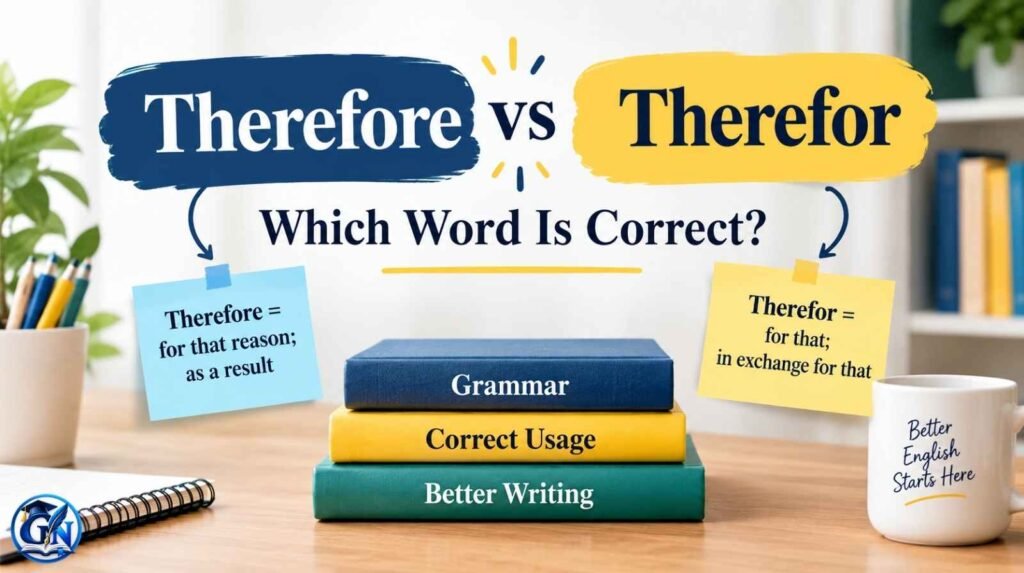
Both are real English words, but they have different meanings and uses. Therefore means “for that reason” or “as a result,” while therefor is a much rarer word meaning “for that” or “in exchange for that.”
For most everyday writing, therefore is the word you want.
Let’s look at the difference, examples, usage rules, and an easy way to remember which one to choose.
Therefore vs Therefor: What Is the Difference?
The simplest way to understand the difference is to look at what each word means.
What does “therefore” mean?
Therefore is an adverb meaning “for that reason,” “as a result,” or “consequently.” It connects an earlier fact or situation with a resulting conclusion or action. Cambridge Dictionary gives the basic meaning as “for that reason.”
Examples:
- It was raining; therefore, we stayed inside.
- Sarah studied hard and therefore passed the exam.
- The store was closed; therefore, we went somewhere else.
- He missed the bus and therefore arrived late.
In each sentence, therefore introduces a result.
What does “therefor” mean?
Therefor is a legitimate but uncommon word. It means “for that,” “for it,” or “in exchange for that.” Merriam-Webster defines it as “for or in return for that.”
For example:
The company provided a replacement and received compensation therefor.
Here, therefor means essentially “for it” or “in exchange for it.”
The word is particularly likely to appear in older, legal, or highly formal writing.
Quick comparison
| Word | Meaning | Common use |
|---|---|---|
| Therefore | For that reason; as a result | Very common |
| Therefor | For that; in exchange for that | Rare/formal |
So, if you are trying to say “as a result,” use therefore.
When Should You Use Therefore?
Therefore is the normal choice when you want to show a logical result, conclusion, or consequence.
Therefore as a transition word
One of the most common uses of therefore is as a transition word connecting two related ideas.
For example:
The road was flooded; therefore, the drivers had to take another route.
The first part gives the reason. The second part gives the result.
Another example:
The product was defective. Therefore, the customer requested a refund.
The defective product caused the customer to request a refund.
Therefore in academic and professional writing
Therefore is especially useful in formal writing because it clearly shows a logical relationship between ideas.
For example:
The sample size was too small; therefore, the results cannot be considered conclusive.
Or:
The evidence supports the original hypothesis. Therefore, the researchers recommended further testing.
However, you do not need to use therefore in every formal sentence. Words such as so, thus, consequently, and as a result can sometimes work better depending on the context.
Where should the comma go?
When therefore connects two independent clauses, punctuation depends on how the sentence is structured.
For example:
The weather was severe; therefore, the flight was canceled.
You can also use therefore within a sentence:
The flight was, therefore, canceled.
And you can place it before a verb in some constructions:
The flight therefore had to be canceled.
The important point is that punctuation should reflect the grammatical structure of the whole sentence rather than treating therefore as if it always requires the same punctuation.
Is “Therefor” Correct English?
Yes. Therefor is a correct English word, but it is not a substitute for therefore.
Therefor has a different meaning
Therefor generally means “for that,” “for it,” or “in exchange for that.” Dictionary.com likewise distinguishes it from therefore, explaining that the two are different words rather than alternate spellings.
Consider:
The buyer received the goods and paid the agreed amount therefor.
Here, therefor refers back to the goods and means approximately “for them.”
Compare that with:
The buyer received the goods; therefore, the payment was processed.
Here, therefore means “as a result.”
The meanings are completely different.
Why does therefor look so unusual?
The word is uncommon in modern everyday English. Dictionary.com notes that therefor is rarely used, while therefore is much more common.
That explains why many readers may recognize therefore immediately but wonder whether therefor is simply a spelling mistake.
It is not necessarily a mistake. The context determines whether it is correct.
Where might you see therefor?
You are more likely to encounter therefor in:
- Legal documents
- Contracts
- Older books
- Formal documents
- Historical writing
For ordinary emails, essays, blog posts, and conversations, therefore will usually be the appropriate word when you mean “as a result.”
Therefore vs Therefor: Easy Examples to Remember
The easiest way to master the difference is to compare the words in complete sentences.
Examples with “therefore”
Use therefore when you mean “as a result.”
- I forgot my alarm; therefore, I was late.
- The shop was closed; therefore, we returned home.
- He worked hard and therefore earned a promotion.
- The evidence was insufficient; therefore, the case was dismissed.
- The weather was dangerous. Therefore, the event was postponed.
A simple replacement test works well:
Can I replace the word with “as a result” or “for that reason”?
If yes, therefore is probably correct.
Examples with “therefor”
Use therefor when it means “for that” or “in exchange for that.”
- The company issued a refund therefor.
- The contract specified the payment therefor.
- The buyer accepted the goods and paid the agreed price therefor.
- The law provides compensation therefor under certain circumstances.
These examples have a noticeably formal tone.
A simple side-by-side test
The road was blocked; therefore, we turned around.
Meaning: As a result, we turned around.
The buyer received the property and paid therefor.
Meaning: The buyer paid for it.
That one-word difference changes the meaning completely.
A Real-Life Writing Example: How the Confusion Happens
Imagine a university student writing an assignment about climate change.
The student writes:
“Global temperatures have increased significantly in recent decades, therefor scientists are studying the effects more closely.”
At first glance, the sentence may look fine. The intended meaning is clearly “as a result.” However, therefor is the wrong word in this context.
The corrected version is:
“Global temperatures have increased significantly in recent decades; therefore, scientists are studying the effects more closely.”
Why?
The first clause presents a situation, while the second clause presents a consequence. The student needs a transition word meaning “for that reason” or “as a result.” That is exactly what therefore does.
Now imagine the same student encounters a legal document containing the phrase:
“Payment shall be made therefor.”
This time, changing therefor to therefore would alter the meaning. The legal phrase uses therefor in its older/formal sense of “for that” or “for it.”
This example demonstrates why simply assuming that therefor is a misspelling is not always correct. The two words have separate grammatical functions and meanings. In everyday academic or professional writing, however, the student will overwhelmingly encounter therefore when expressing cause and effect. The safest approach is to ask what the sentence is trying to say: “as a result” means therefore; “for that/for it” means therefor.
Therefore vs Therefor: 2025–2026 Usage and Dictionary Data
There is an important distinction between dictionary evidence and exact word-frequency statistics.
As of 2026, major dictionaries continue to recognize both words as legitimate English vocabulary. Merriam-Webster lists therefore as an adverb meaning “for that reason” or “consequently,” while its therefor entry gives the meaning “for or in return for that.
What current dictionary data tells us
- Therefore is a standard modern English adverb meaning “for that reason” or “as a result.”
- Therefor remains a dictionary-recognized word, but its meaning is substantially different.
- Dictionary.com explicitly describes therefore as far more common than therefor.
- Merriam-Webster’s current entries document the first known use of both words in the 12th century, showing that neither spelling is a modern invention
There is no reliable universal 2025–2026 statistic showing the exact percentage of all English writing that uses “therefore” versus “therefor.” Search-volume estimates can also vary by country, search engine, and database. Therefore, it would be misleading to invent a precise percentage.
The strongest current evidence is consistent, however: therefore is the normal modern choice for expressing a result or conclusion, while therefor survives mainly in specialized or formal contexts.
How to Remember Therefore vs Therefor
A simple memory trick can eliminate most mistakes.
Remember the “E” in therefore
Think:
Therefore = for that reason
The extra e can remind you that therefore is the word you normally use when connecting a reason to a result.
For example:
It was raining; therefore, we stayed home.
Use therefor only when you mean “for that”
Think:
Therefor = for that / for it
For example:
The customer received compensation therefor.
If you can replace the word with “as a result,” choose therefore.
If you can replace it with “for that” or “for it,” therefor may be correct.
The fastest test
Ask yourself:
Does the sentence mean “as a result”?
- Yes → therefore
- No, it means “for that/for it” → therefor
This simple test handles most situations.
Common Mistakes With Therefore and Therefor
Mistake 1: Treating therefor as a spelling error every time
It is true that many people type therefor when they mean therefore. However, therefor is a real word.
The problem is not that the word is always wrong. The problem is using it with the wrong meaning.
Mistake 2: Using therefor to mean “therefore”
Incorrect:
The weather was terrible; therefor, we stayed home.
Correct:
The weather was terrible; therefore, we stayed home.
Mistake 3: Assuming therefore and therefor are interchangeable
They are not.
Therefore = as a result / for that reason
Therefor = for that / for it
Changing one into the other can change the meaning of the sentence.
Mistake 4: Using therefore when “for it” is intended
For example:
The customer received a replacement and paid therefore.
If you mean that the customer paid for the replacement, therefore is incorrect. In a formal context, therefor may be the intended word:
The customer received a replacement and paid therefor.
In ordinary modern English, though, simply saying “paid for it” is often clearer.
FAQs
Q1: Is “therefor” a correct word?
A: Yes. Therefor is a legitimate English word, meaning “for that,” “for it,” or “in exchange for that.” It is much less common than therefore.
Q2: Which is correct: therefore or therefor?
A: Both are correct words, but they are used differently. Use therefore for “as a result” or “for that reason.” Use therefor for “for that” or “for it.”
Q3: Is therefor a misspelling of therefore?
A: Not necessarily. Although therefor is often typed accidentally when someone means therefore, it is also a genuine word with its own meaning.
Q4: What is the difference between therefore and therefor?
A: Therefore expresses a consequence or conclusion:
She was tired; therefore, she went home.
Therefor means “for that” or “for it”:
Payment was made therefor.
Q5: Can I use therefor in everyday English?
A: You can, but it is uncommon and may sound overly formal. In everyday writing, “for it” or “for that” is often clearer.
Q6: What is a synonym for therefore?
A: Common alternatives include thus, consequently, hence, accordingly, and as a result. Merriam-Webster lists several of these among its synonyms for therefore.
Q7: How do I remember the difference between therefore and therefor?
A: Use therefore when you mean “as a result.” Use therefor when you mean “for that” or “for it.”
Q8: Is therefore formal English?
A: Therefore is common in formal writing, academic writing, professional communication, and logical arguments. It can also appear naturally in everyday English.
Conclusion:
The answer to “therefore vs therefor” is simple once you understand the meaning behind each word.
Therefore means “for that reason,” “as a result,” or “consequently.” It is the word you normally need when showing a cause-and-effect relationship.
Therefor is a separate, much rarer word meaning “for that,” “for it,” or “in exchange for that.” It is most likely to appear in legal, historical, or highly formal writing.
Remember this:
Therefore = as a result
Therefor = for that / for it
So if you are writing an essay, email, article, report, or everyday message and you want to say “as a result,” choose therefore.
When in doubt, replace the word with “as a result.” If the sentence still makes sense, therefore is almost certainly the word you need.
👉 Discover more simple and practical grammar guides on Gramnora

Explore the world of English grammar with simple explanations, practical examples, and easy-to-follow guides by Zia Tarar, the founder and author of Gramnora. From essential grammar rules and sentence structure to common mistakes and advanced concepts, Gramnora helps learners improve their English, strengthen their writing skills, and communicate with greater clarity and confidence.