
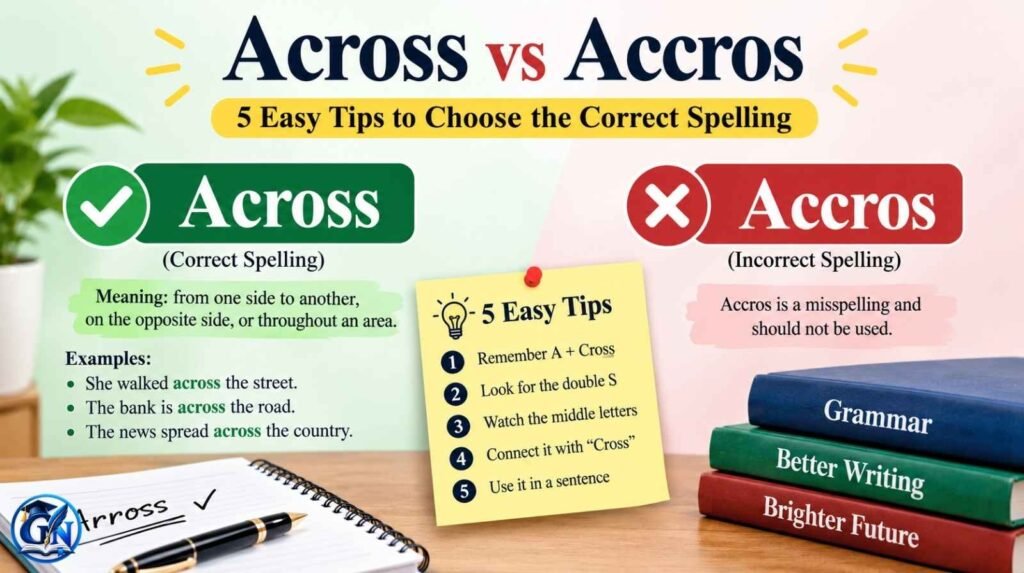
Have you ever wondered whether the correct spelling is “across” vs “accros”? You are not alone. When typing quickly, it is easy to leave out one letter or place letters in the wrong order. However, there is a simple answer: across is the correct spelling, while accros is a misspelling.
In this guide, you will learn the difference between across vs accros, what across means, how to use it correctly, and five easy tips that can help you remember its spelling permanently.
Across vs Accros: Which Spelling Is Correct?
The correct spelling is across.
Accros is an incorrect spelling and should not be used in standard English. Major dictionaries list across as an English word meaning, among other things, “from one side to the other” or “on the opposite side.”
| Spelling | Correct? | Example |
|---|---|---|
| across | ✅ Correct | We walked across the bridge. |
| accros | ❌ Incorrect | We walked accros the bridge. |
The easiest way to remember “across”
Look closely at the word:
A + CROSS = ACROSS
The word across contains cross:
a + cross → across
That connection gives you a useful spelling clue. If you remember cross, you are much less likely to accidentally write accros.
Why “accros” looks tempting
The mistake usually happens because across is pronounced quickly, and when people type from memory, they may accidentally leave out the second s.
Compare them:
- ❌ accros
- ✅ across
The difference is small visually, but only across is the standard English spelling.
What Does “Across” Mean?
Across is commonly used as a preposition or adverb. It can describe movement from one side to another, something positioned on the opposite side, or something extending over an area.
Across from one side to another
Use across when someone or something moves from one side of an area to another.
Examples:
- She walked across the street.
- We swam across the river.
- The children ran across the field.
- They drove across the bridge.
Cambridge Dictionary gives similar examples, including walking across a road and building a bridge across a river.
Across meaning “on the opposite side”
Across can also describe something located on the other side.
Examples:
- The bank is across the street.
- There is a café across from my office.
- She lives across the river.
This is especially common in phrases such as across from, meaning opposite or on the other side of something.
Across meaning “throughout an area”
The word can also indicate something happening throughout a particular place, group, or area.
Examples:
- The news spread across the country.
- The company has offices across Europe.
- The campaign was successful across the region.
So, across does not always involve physical movement. It can also describe something that extends or happens throughout an area.
5 Easy Tips to Remember Across vs Accros

If you frequently confuse across vs accros, these five simple tricks can make the correct spelling easier to remember.
1. Remember “A + Cross”
The easiest trick is to break the word into two parts:
A + CROSS = ACROSS
Since cross ends with two s letters, across also ends with ss.
Think:
“I go across the road because I cross it.”
This creates a natural connection between the meaning and spelling.
2. Remember the Double S
One of the most common mistakes is writing accros with only one s at the end.
Correct:
across
Not:
accros
A quick mental check is:
Does it end with SS?
If yes, you probably have the correct spelling.
3. Watch the Middle Letters
Another common error is adding an extra c:
- ❌ accross
- ❌ accros
- ❌ acros
- ✅ across
The correct spelling has one c and two s’s:
A C R O S S
4. Connect It With “Cross”
When you see the word across, look for the familiar word cross inside it:
a + cross
For example:
We walked across the street.
You are essentially thinking about crossing the street.
This makes the spelling easier to recall than memorizing six individual letters.
5. Use It in a Sentence
One of the best ways to remember spelling is to use the word repeatedly.
Try these sentences:
- I walked across the road.
- She looked across the room.
- The bridge goes across the river.
- There is a store across from the school.
- The message spread across the country.
The more naturally you use across, the easier its spelling becomes.
Across vs Accros: Quick Comparison
Here is a simple checklist you can use whenever you are unsure.
| Check | Across | Accros |
|---|---|---|
| Standard English word? | ✅ Yes | ❌ No |
| Correct spelling? | ✅ Yes | ❌ No |
| One c? | ✅ Yes | ❌ No |
| Two s’s at the end? | ✅ Yes | ❌ No |
| Used for movement from one side to another? | ✅ Yes | ❌ No |
Quick rule: If you mean “from one side to another,” use across.
A Real-Life Example: How a Small Spelling Error Can Happen
Imagine a student writing an English assignment about a trip. She wants to describe walking from one side of a bridge to the other. She quickly types:
“We walked accros the bridge and stopped to take pictures.”
The sentence is understandable, but the spelling is incorrect. The student knows the word and its meaning; the problem is simply that one s was omitted.
She could correct it by remembering the word cross:
“We walked a + cross the bridge.”
The corrected sentence becomes:
“We walked across the bridge and stopped to take pictures.”
This example shows why spelling mistakes such as accros are easy to make. The writer may completely understand the sentence but still type the word incorrectly. Google has noted that spelling errors are common in search: its published Search research says one in 10 search queries is misspelled, which is why Google has developed systems specifically designed to understand misspelled queries.
For learners, the important lesson is not to feel discouraged by a small spelling error. Instead, create a memorable connection. In this case, across = a + cross is a simple association that can prevent the mistake next time.
2025–2026 Data: Why Correct Spelling Still Matters Online
Spelling is especially important when writing online because English remains the dominant language of web content.
According to W3Techs’ September 2026 data, English is used by about 49.5% of websites whose content language is known.
Google has also reported that spelling mistakes are a significant part of search behavior. Its Search team says that one out of every 10 queries is misspelled, demonstrating how frequently people search with spelling errors.
Google’s 2025 Year in Search report also found that searches beginning with “How do I…” increased by 25% year over year, showing continued interest in direct, instructional searches.
These figures are not specific to the word across, and there is no reliable public 2025–2026 dataset showing exactly how many people search for accros. However, they demonstrate a broader point: people regularly encounter spelling uncertainty online, and clear explanations of common spelling mistakes remain useful.
Common Sentences With “Across”
Seeing across in different contexts can help you understand both its meaning and correct spelling.
Movement
The boy ran across the playground.
Here, across shows movement from one side of the playground to another.
Position
The supermarket is across the street.
Here, across describes a position on the opposite side.
Extension
A large crack appeared across the wall.
Here, across indicates that something stretches from one part of the wall toward another.
Throughout an area
The company operates across the country.
Here, across means throughout the country.
Communication
She tried to get her message across.
Here, across means successfully communicated or understood. Merriam-Webster includes this sense among its definitions of across.
Common Spelling Mistakes Similar to “Accros”
The incorrect spelling accros is not the only variation people may type.
Accros
❌ Incorrect
Example:
He walked accros the street.
Acros
❌ Incorrect
Example:
She ran acros the field.
Accross
❌ Incorrect
This version adds an unnecessary c.
Correct:
She walked across the bridge.
Across
✅ Correct
Example:
They drove across the country.
The standard spelling is always across when you mean movement from one side to another, an opposite position, or an extension over an area.
FAQs
Q1: Is “accros” a correct spelling?
A: No. Accros is a misspelling. The correct spelling is across.
Q2: Which is correct: across or accros?
A: Across is correct. Accros is not the standard English spelling.
Q3: How do you spell across correctly?
A: Spell it A-C-R-O-S-S: across.
Q4: What does across mean?
A: Across can mean from one side to another, on the opposite side, throughout an area, or extending from one side to another.
Q5: Does across have one C or two?
A: Across has one C. The spelling is A-C-R-O-S-S.
Q6: Does across have one S or two?
A: Across ends with two S’s: -ss.
Q7: Is “across from” correct English?
A: Yes. Across from is a standard phrase meaning opposite or on the other side of something.
Example:
The library is across from the school.
Cambridge Dictionary specifically lists across from as a way to describe something on the opposite side.
Q8: What is an easy trick for remembering across?
A: Remember:
A + CROSS = ACROSS
The word contains cross, which helps you remember the spelling and meaning.
Final Verdict
When choosing between across vs accros, there is no complicated rule to learn: across is the correct spelling, and accros is incorrect.
Remember the simple formula:
A + CROSS = ACROSS
Use across when talking about movement from one side to another, something on the opposite side, something extending over an area, or something happening throughout a place.
For example:
We walked across the street.
Not:
❌ We walked accros the street.
Save this simple spelling trick, and the next time you hesitate between across and accros, you will know exactly which one to choose.
👉 Discover more simple and practical grammar guides on Gramnora

Explore the world of English grammar with simple explanations, practical examples, and easy-to-follow guides by Zia Tarar, the founder and author of Gramnora. From essential grammar rules and sentence structure to common mistakes and advanced concepts, Gramnora helps learners improve their English, strengthen their writing skills, and communicate with greater clarity and confidence.