
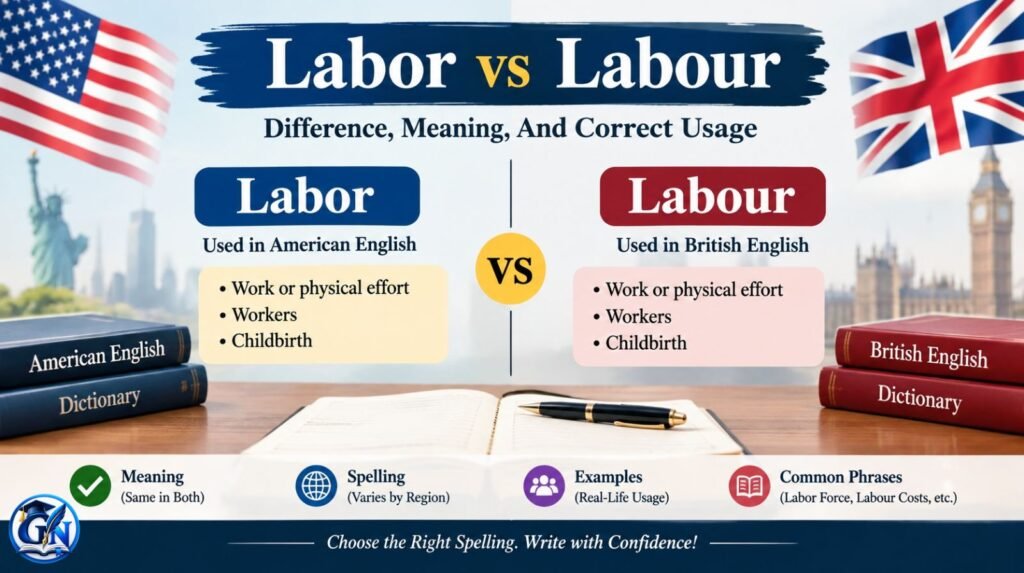
If you have ever wondered whether labor vs labour is the correct spelling, you are not alone. Both words are correct, but the spelling you should use depends mainly on the variety of English you are writing in.
So, what is the difference between labor vs labour?
The short answer is simple: labor is the standard spelling in American English, while labour is generally used in British English and many other varieties influenced by British English. The meaning is essentially the same in ordinary contexts.
In this guide, we will explain the difference between labor and labour, show you real examples, explain which spelling to choose, and cover common expressions such as labor force, manual labour, and labor of love.
Labor vs Labour: What Is the Difference?
The main difference between labor and labour is spelling rather than meaning.
Labor Is American English
Labor is the usual spelling in American English.
For example:
- The company is trying to reduce labor costs.
- The construction project requires skilled labor.
- She went into labor early.
- The country has a large labor force.
American dictionaries such as Merriam-Webster define labor as work or effort, workers collectively, and the process of giving birth, among other meanings.
Labour Is British English
Labour is the standard spelling in British English.
For example:
- The company wants to reduce labour costs.
- The construction project requires skilled labour.
- She went into labour early.
- The country has a large labour force.
Cambridge Dictionary identifies labour as the UK spelling of labor. Oxford likewise lists labour as the British English form.
Is Labor or Labour Correct?
Both are correct.
The important point is consistency.
| English variety | Preferred spelling | Example |
|---|---|---|
| American English | labor | Labor costs are rising. |
| British English | labour | Labour costs are rising. |
| Canadian English | labour is generally preferred | Labour laws vary by province. |
| Australian English | labour | Labour shortages can affect businesses. |
Therefore, neither spelling is inherently more correct than the other. Your choice should match your intended variety of English.
What Does Labor or Labour Mean?
The word can have several meanings depending on the context.
Labor Means Work or Physical Effort
One common meaning is work, especially work that requires physical or mental effort.
For example:
The workers performed difficult labor throughout the day.
In British English, you would normally write:
The workers performed difficult labour throughout the day.
Cambridge defines the word as practical work, particularly work involving physical effort.
Labor Can Mean Workers
Labor/labour can also refer collectively to workers or people available for work.
For example:
- The factory needs skilled labor.
- The country has a shortage of skilled labour.
- The company is looking for cheap labor.
- The industry depends on skilled labour.
This meaning is particularly common in economic and business writing.
Oxford includes the meaning of people who work or are available for work, which is why expressions such as labor force, labor market, and labor shortage are so common.
Labor or Labour Can Refer to Childbirth
The word also has a medical meaning related to childbirth.
American English:
She went into labor last night.
British English:
She went into labour last night.
Both forms refer to the process of childbirth.
So, the spelling changes with the variety of English, but the basic meaning does not.
Labor vs Labour in American and British English
Understanding regional spelling is important because many English words have different American and British forms.
American English Uses Labor
If your audience primarily uses American English, choose labor.
Common American expressions include:
- labor force
- labor market
- labor costs
- labor law
- labor shortage
- manual labor
- organized labor
- labor union
- labor productivity
For example:
The business is struggling with rising labor costs.
British English Uses Labour
For British English, use labour.
Common expressions include:
- labour force
- labour market
- labour costs
- labour law
- labour shortage
- manual labour
- organised labour
- labour union
- labour productivity
For example:
The business is struggling with rising labour costs.
Notice that other spellings can change as well. For instance, American English generally uses organized, while British English commonly uses organised.
Australian English Also Uses Labour
Australian English generally follows the labour spelling.
For example:
The country is experiencing a shortage of skilled labour.
This is one reason readers may encounter labour outside the United Kingdom.
The key lesson is simple: choose the spelling that matches your audience and stay consistent throughout your content.
Common Labor and Labour Expressions
Some phrases appear frequently in business, education, economics, and everyday English.
Labor Force vs Labour Force
A labor force or labour force generally refers to people who are working or actively available and looking for work.
American English:
The labor force participation rate increased.
British English:
The labour force participation rate increased.
The U.S. Bureau of Labor Statistics explains that the labor force consists of employed and unemployed people, while the participation rate measures the labor force as a percentage of the civilian noninstitutional population.
Labor Market vs Labour Market
A labor market is the system in which employers and workers interact.
American:
Technology is changing the labor market.
British:
Technology is changing the labour market.
This distinction is especially useful when reading economic reports because American sources will normally use labor, while British sources will normally use labour.
Labor Costs vs Labour Costs
The phrase refers to the cost of employing workers.
American:
Rising labor costs affected the company’s profits.
British:
Rising labour costs affected the company’s profits.
Manual Labor vs Manual Labour
This means physical work, especially work involving the hands.
American:
He spent years doing manual labor.
British:
He spent years doing manual labour.
Cambridge and Oxford both identify this as a standard meaning and collocation of the word.
Labor of Love vs Labour of Love
A labor/labour of love is a difficult or time-consuming task that someone does because they genuinely enjoy or care about it.
American:
Building the website was a labor of love.
British:
Building the website was a labour of love.
A Real-Life Example: Choosing the Right Spelling
Imagine that a writer from the United States is preparing an article about employment trends for an American audience.
She writes:
“The U.S. labor market has changed significantly in recent years. Companies are searching for skilled labor, while rising labor costs are affecting hiring decisions.”
The spelling labor is appropriate because the article is written in American English and discusses the U.S. economy.
Now imagine a British writer covering a similar topic for readers in the United Kingdom:
“The UK labour market has changed significantly in recent years. Companies are searching for skilled labour, while rising labour costs are affecting hiring decisions.”
Here, labour is appropriate because the article follows British English conventions.
Neither writer has made a spelling mistake. They are simply following different English standards.
This distinction matters particularly for professional writers, websites, newspapers, academic papers, and businesses that publish for a specific country. Mixing the two forms unnecessarily can make writing look inconsistent. For example, an article that repeatedly uses labor market but suddenly changes to labour costs may appear poorly edited, even though both individual spellings are correct.
The best approach is therefore to decide on your English variety before writing. If your target readers are mainly in the United States, use labor. If they are mainly in the United Kingdom, Australia, or another region that follows British spelling conventions, use labour. Consistency makes your writing clearer and more professional.
Labor and Labour in 2025–2026: Why the Spelling Still Matters
Although labor and labour are spelling variants, the words remain extremely common in discussions about employment and the economy.
Recent U.S. Labor Statistics
The U.S. Bureau of Labor Statistics reported an annual unemployment rate of 4.3% for 2025. Its Current Population Survey also continues to track employment, unemployment, and labor-force participation as major measures of the U.S. labor market.
As of August 2026, BLS reported a U.S. unemployment rate of 4.1% and a labor-force participation rate of 61.6%.
These figures demonstrate why terms such as labor force, labor market, and labor participation remain important in modern economic writing.
Recent UK Labour Statistics
British sources use labour instead.
The UK’s Office for National Statistics estimated an employment rate of 75.1% for people aged 16–64 in September–November 2025, while the unemployment rate for people aged 16 and over was 5.1%.
More recent ONS data reported that payrolled employees fell by 78,000 (0.3%) between June 2025 and June 2026.
These examples highlight an important writing rule: the underlying economic concept is the same, but official organizations naturally follow their regional spelling conventions.
Labor vs Labour: How to Choose the Correct One
If you are unsure which spelling to use, follow this simple guide.
Step 1: Identify Your Audience
Ask yourself who will read your content.
- U.S. readers → labor
- UK readers → labour
- Australian readers → labour
- International audience → choose one standard and use it consistently
Step 2: Follow Your Publication’s Style Guide
If you are writing for a school, company, newspaper, academic institution, or website, check its preferred English style.
For example, an American publication may require:
labor, organize, color, center
A British publication may require:
labour, organise, colour, centre
Step 3: Don’t Mix Styles Without a Reason
Consistency is more important than choosing one spelling as universally “correct.”
For example, avoid writing:
The labour market is creating new labor opportunities.
Instead, choose one variety:
The labour market is creating new labour opportunities.
or:
The labor market is creating new labor opportunities.
Quick Decision Checklist
Use this checklist whenever you are unsure:
- Writing for Americans? → Use labor.
- Writing for British readers? → Use labour.
- Writing for Australians? → Usually use labour.
- Quoting a source? → Preserve the source’s original spelling.
- Writing for an international website? → Pick one style and remain consistent.
Labor vs Labour: Common Mistakes to Avoid
A common mistake is assuming labour is an incorrect spelling of labor, or vice versa.
It is not.
Both forms are standard English spellings used in different varieties of the language. Cambridge explicitly identifies labor as the U.S. spelling of labour and labour as the UK spelling of labor.
Mixing American and British English
Another common problem is switching between spelling systems in the same piece of writing.
For example:
The company reduced labor costs but reorganised its workforce.
This mixes American labor with British reorganised.
A consistent American version would be:
The company reduced labor costs but reorganized its workforce.
A consistent British version would be:
The company reduced labour costs but reorganised its workforce.
Confusing Labor With Labour as a Political Name
Capitalization can also matter.
In British English, Labour can refer specifically to the British Labour Party.
For example:
The Labour Party won the election.
Similarly, Labor can refer to the Australian Labor Party.
Therefore, context and capitalization can change the specific reference.
FAQs
Q1: Is labor or labour correct?
A: Both are correct. Labor is the standard American English spelling, while labour is the standard British English spelling and is also used in several other varieties of English.
Q2: What is the main difference between labor and labour?
A: The main difference is spelling, not meaning. Both words can refer to work, physical effort, workers, or childbirth depending on context.
Q3: Is labor American or British English?
A: Labor is primarily the American English spelling. British English normally uses labour.
Q4: Is labour British or American English?
A: Labour is primarily the British English spelling. American English normally uses labor.
Q5: Should I use labor or labour in an article?
A: Use the spelling that matches your target audience. If your article targets American readers, use labor. If it targets British readers, use labour.
Q6: Is it labor force or labour force?
A: Both are correct. Labor force is the American spelling, while labour force is the British spelling.
Q7: Is it labor cost or labour cost?
A: Again, both are correct. American English uses labor cost, while British English uses labour cost.
Q8: Does Australia use labor or labour?
A: Australian English generally uses labour for the general word meaning work or workers. However, Labor is used in the official name of the Australian Labor Party, so context matters.
Conclusion:
So, labor vs labour is not really a question of right versus wrong. Both spellings are correct; the difference is mainly regional.
Use labor when writing in American English. Use labour when writing in British English and other varieties that follow British spelling conventions. The meanings including work, workers, physical effort, and childbirth remain essentially the same.
The most important rule is consistency. Choose the English variety that suits your readers, follow that spelling throughout your article, and avoid switching between American and British forms without a specific reason.
👉 Discover more simple and practical grammar guides on Gramnora

Explore the world of English grammar with simple explanations, practical examples, and easy-to-follow guides by Zia Tarar, the founder and author of Gramnora. From essential grammar rules and sentence structure to common mistakes and advanced concepts, Gramnora helps learners improve their English, strengthen their writing skills, and communicate with greater clarity and confidence.