
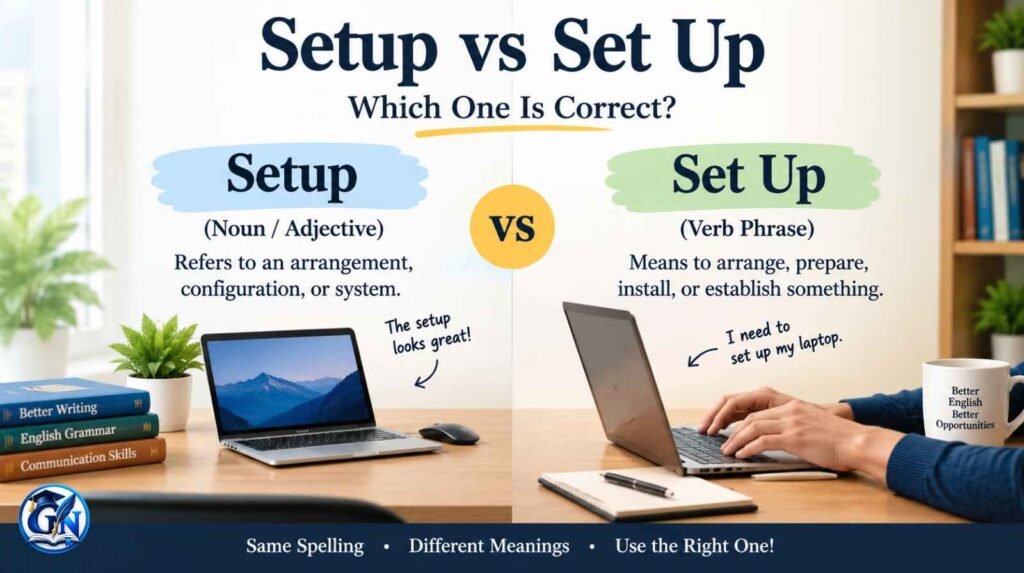
Have you ever wondered whether to write Setup vs Set Up? These two forms look almost identical, so it is easy to confuse them when writing an email, preparing a document, or publishing an article. However, both “setup” and “set up” are correct, but they serve different grammatical purposes.
The main difference is that setup is usually a noun or adjective, while set up is a verb phrase that describes an action. Knowing when to use each form will help you avoid common grammar mistakes and make your writing clearer.
In this guide, you will learn the meaning of setup and set up, understand their grammatical differences, explore practical examples, and discover a simple trick for choosing the correct form every time.
What Is the Difference Between Setup and Set Up?
The easiest way to understand setup vs set up is to identify the role each expression plays in a sentence.
Setup: Meaning and Definition
Setup is a noun that refers to an arrangement, configuration, system, or the way something is organized. It can also function as an adjective before another noun, as in setup instructions.
Examples:
- The computer setup in my office is simple and efficient.
- We need a better setup for the online meeting.
- The gaming setup includes two monitors and a comfortable chair.
- Please check the equipment setup before the presentation.
In each example, setup refers to an arrangement, configuration, or something associated with preparing an arrangement.
Set Up: Meaning and Definition
Set up is a verb phrase that means to arrange, install, prepare, establish, or organize something.
Examples:
- I need to set up my new computer.
- They will set up the meeting room tomorrow.
- Can you set up an account for me?
- We plan to set up a new business next year.
In these sentences, set up describes an action performed by someone.
A Quick Comparison Table
| Feature | Setup | Set up |
|---|---|---|
| Grammatical role | Usually a noun; sometimes an adjective | Verb phrase |
| Meaning | An arrangement or configuration | To arrange or establish something |
| Example | The setup looks professional. | Please set up the equipment. |
| Common use | Describing a system or arrangement | Describing an action |
| Memory trick | Something you have | Something you do |
Quick answer: If you are talking about an arrangement, use setup. If you are describing the act of arranging something, use set up.
When Should You Use Setup?
Use setup when you need a noun to describe how something is arranged, organized, or configured. It is common in technology, business, education, and everyday communication.
Use Setup for Equipment and Technology
In technology, setup often refers to the configuration of a device, computer, application, or network.
Examples:
- My home office setup helps me work comfortably.
- The software setup requires only a few minutes.
- Your wireless network setup looks complicated.
- The new computer setup includes a keyboard, mouse, and monitor.
Notice that setup names the arrangement rather than describing the action of creating it.
Use Setup for Events and Meetings
The word also describes the arrangement of a room, event, or activity.
Examples:
- The wedding setup was beautiful.
- Our classroom setup encourages group discussions.
- The conference setup includes a stage and several screens.
- I like the seating setup in this restaurant.
In these sentences, setup identifies the arrangement that already exists.
Use Setup as an Adjective
Although setup is primarily a noun, it can also modify another noun.
Examples:
- Read the setup instructions before installing the program.
- The technician explained the setup process.
- I downloaded the setup file for the application.
Here, setup describes the type of instructions, process, or file. You would not normally write set up instructions when you mean instructions for configuring something.
When Should You Use Set Up?
Use set up when describing an action, such as preparing equipment, arranging an event, creating an account, or establishing a business.
Use Set Up for Preparing Something
When someone arranges or prepares an item or space, set up is the appropriate verb phrase.
Examples:
- Please set up the chairs before the guests arrive.
- I will set up my desk this afternoon.
- She helped us set up the projector.
- They need to set up the classroom for the workshop.
Each sentence describes an action that someone needs to perform.
Use Set Up for Accounts and Systems
The phrase is especially common when discussing digital services, software, and technology.
Examples:
- I want to set up a new email account.
- He will set up the website this weekend.
- We must set up two-factor authentication.
- The company plans to set up a secure database.
These examples show how set up describes the process of creating or configuring something.
Use Set Up for Businesses and Organizations
You can also use set up when someone establishes a company, organization, meeting, or arrangement.
Examples:
- My friends want to set up a small business.
- The manager will set up an appointment with the client.
- They decided to set up a charity organization.
- We need to set up a meeting to discuss the project.
Remember that set up is a verb phrase. You can change its tense depending on when the action happens.
For example:
- Present: I set up my workspace every morning.
- Past: I set up my workspace yesterday.
- Future: I will set up my workspace tomorrow.
Setup vs Set Up: Common Grammar Mistakes
Writers often confuse these forms because they sound the same when spoken. However, recognizing their grammatical functions makes the correct choice much easier.
Writing Setup When You Need a Verb
Incorrect: I need to setup my new laptop.
Correct: I need to set up my new laptop.
Why? The word to is followed by the base form of a verb here. The action is preparing the laptop, so the two-word verb phrase is required.
Writing Set Up When You Need a Noun
Incorrect: My computer set up is excellent.
Correct: My computer setup is excellent.
Why? The sentence describes the arrangement of the computer equipment. Since the word names an arrangement, the one-word noun is correct.
Confusing Setup Instructions With the Action
Incorrect: Please read the set up instructions carefully.
Correct: Please read the setup instructions carefully.
Why? The instructions are a thing, and setup modifies the noun instructions. The phrase set up would be correct in a sentence such as, “Please set up the equipment according to the instructions.”
Forgetting That the Verb Can Be Separated
The verb phrase set up is separable when it takes an object.
Examples:
- Please set up the printer.
- Please set the printer up.
Both sentences are correct.
However, when the object is a pronoun, it normally goes between set and up.
Correct: Please set it up before the meeting.
Incorrect: Please set up it before the meeting.
This rule is particularly useful when writing natural English sentences.
A Real-Life Example: Using Setup and Set Up at Work
Imagine that Sara has recently started working from home. Her company sends her a laptop, a monitor, a keyboard, and other equipment. On her first day, she wants to prepare everything before joining an online meeting.
Sara tells her colleague, “I need to set up my computer before the meeting begins.” This is correct because she is describing an action she needs to perform.
After connecting the monitor and keyboard, she looks at her desk and says, “My new setup looks much better than my old workspace.” This is also correct because she is describing the arrangement of her equipment.
Later, Sara needs to install a work application. She opens the setup instructions and follows the steps. Here, setup describes the instructions related to configuration.
When she finishes, her manager asks, “Have you set up your work account yet?” Sara replies, “Yes, I set it up this morning.”
This short conversation demonstrates the difference between the two forms in a realistic situation. Set up describes actions such as preparing a computer or creating an account, while setup names the arrangement or describes related instructions.
The same distinction applies outside the workplace. You might set up a classroom, arrange a gaming desk, establish a business, or prepare a family event. Once the arrangement is ready, you can describe it as the setup.
The important lesson is to focus on what the word does in the sentence instead of relying on how it sounds. When you identify whether you mean an action or an arrangement, choosing between setup and set up becomes much easier.
How to Choose Between Setup and Set Up

If you are unsure which form to use, follow this simple step-by-step guide.
Step 1: Ask Whether You Mean an Action
If the sentence describes someone preparing, arranging, installing, or establishing something, use set up.
Examples:
- We need to set up the equipment.
- She will set up a meeting.
- I want to set up my account.
Step 2: Ask Whether You Mean an Arrangement
If the sentence names a configuration, system, or arrangement, use setup.
Examples:
- The equipment setup is complete.
- Our meeting setup needs improvement.
- His office setup is comfortable.
Step 3: Check the Words Around It
The surrounding words often reveal the correct grammatical form.
| Sentence | Correct choice | Reason |
|---|---|---|
| I will ___ the new printer. | Set up | Describes an action |
| The printer ___ is simple. | Setup | Names an arrangement |
| Follow the ___ instructions. | Setup | Modifies “instructions” |
| We need to ___ a meeting. | Set up | Describes an action |
| The meeting ___ was impressive. | Setup | Names an arrangement |
| Please ___ it before noon. | Set it up | Pronoun placement |
Step 4: Remember the Simple Rule
Keep this distinction in mind:
- Setup = a thing or arrangement.
- Set up = an action.
This rule works for most everyday uses and is a reliable way to avoid this common English grammar mistake.
Setup vs Set Up: What Do Grammar References and Current Data Tell Us?
Understanding word forms is more useful than memorizing spellings alone. Dictionaries and established writing guidance help explain how English words function in context.
What Established Grammar References Show
The distinction between setup and set up is a matter of grammatical usage, not a difference between correct and incorrect English. The noun setup refers to an arrangement or configuration, whereas the verb phrase set up refers to performing the action of arranging or establishing something. Grammar.com explains this distinction with definitions and examples.
For broader writing guidance, Google’s Search Central documentation emphasizes clear, accurate, helpful content written for people. That principle also applies to grammar articles: definitions should be accurate, examples should be natural, and explanations should answer the reader’s question directly.
Are There Reliable 2025–2026 Statistics About This Spelling Difference?
There is no verified, authoritative 2025–2026 statistic established here that measures how often people confuse setup and set up. It would be misleading to invent a percentage or claim that one spelling is used incorrectly by a specific share of writers.
Instead, the most reliable approach is to use the established grammatical distinction and check each word in context. If you are researching search demand for this topic, Google Trends can help you explore relative search interest over time, although it does not directly measure grammar accuracy or provide absolute search-volume counts.
For writers, the practical takeaway remains simple: choose setup for the noun or adjective and set up for the verb phrase.
FAQs
Q1: Is setup one word or two?
A: Both forms are correct. Setup is generally a noun or adjective, while set up is a verb phrase. The correct choice depends on the sentence.
Example: “The setup is ready” and “We need to set up the equipment.”
Q2: Is it setup or set up a meeting?
A: Use set up a meeting because the phrase describes the action of arranging a meeting.
Example: “I will set up a meeting with the manager tomorrow.”
You can use setup when describing the arrangement itself, as in “The meeting setup was excellent.”
Q3: Is it setup or set up an account?
A: The correct expression is set up an account because you are describing the action of creating or configuring an account.
Example: “Please set up an account before using the service.”
Q4: Is setup a noun or a verb?
A: Setup is usually a noun, meaning an arrangement, configuration, or system. It can also function as an adjective, as in setup instructions. The verb phrase is set up.
Example: “The setup is complete” versus “They set up the equipment.”
Q5: Is set-up hyphenated?
A: In most everyday writing, use setup as a noun and set up as a verb. Hyphenated set-up appears in some varieties of English and certain editorial styles, but it is generally unnecessary when following the standard noun-versus-verb distinction.
For consistency, choose setup for the noun and set up for the verb unless your organization’s style guide specifies otherwise.
Q6: Is “I have set up” correct?
A: Yes. “I have set up” is grammatically correct when using the present perfect tense.
Examples:
- I have set up my new computer.
- She has set up her account.
- They have set up the meeting room.
The past participle of the phrasal verb is set, so the form remains set up.
Q7: What is the past tense of set up?
A: The past tense is set up. The verb set has the same form in the present and past tense.
Examples:
- Present: I set up the room every morning.
- Past: I set up the room yesterday.
- Future: I will set up the room tomorrow.
The surrounding words indicate the tense.
Q8: How can I remember the difference between setup and set up?
A: Remember this simple rule: you have a setup, but you set something up.
Examples:
- My office setup is comfortable.
- I need to set up my office.
If the word describes an arrangement, choose setup. If it describes an action, choose set up.
Conclusion:
The difference between setup and set up is simple once you understand their grammatical roles. Setup is usually a noun describing an arrangement or configuration, while set up is a verb phrase describing the action of preparing, arranging, installing, or establishing something.
For example, you can set up your computer, but the arrangement of your computer and accessories is your setup. Similarly, you set up a meeting, while the meeting’s setup describes its organization.
Whenever you are unsure, ask yourself whether you are describing a thing or an action. This quick check will help you choose the correct form and improve your everyday writing.
👉 Explore more useful grammar tips and guides on Gramnora

Explore the world of English grammar with simple explanations, practical examples, and easy-to-follow guides by Zia Tarar, the founder and author of Gramnora. From essential grammar rules and sentence structure to common mistakes and advanced concepts, Gramnora helps learners improve their English, strengthen their writing skills, and communicate with greater clarity and confidence.