
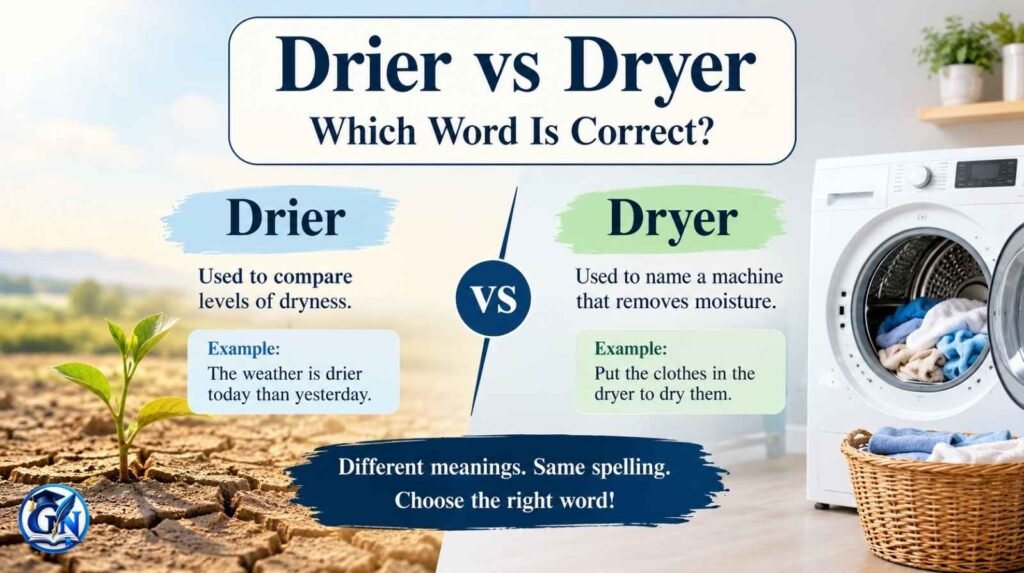
Have you ever wondered whether to write Drier vs Dryer? These two words look almost identical and sound the same in many varieties of English, making it easy to confuse them. However, their most common uses are different.
In the drier vs dryer debate, both spellings are correct English words, but the right choice depends on what you want to say. Drier usually means “more dry,” while dryer generally refers to a machine that removes moisture, such as a clothes dryer or hair dryer.
Understanding this simple distinction will help you avoid spelling mistakes and write more clearly. In this guide, you will learn their meanings, grammatical rules, differences, and practical examples.
What Is the Difference Between Drier and Dryer?
The main difference between drier and dryer is their function in a sentence. Although both words are related to the word dry, they usually serve different grammatical purposes.
Drier: Meaning and Definition
Drier is the comparative form of the adjective dry. It describes something that contains less moisture than something else.
For example:
- The weather is drier today than it was yesterday.
- My skin feels drier during the winter.
- This towel is drier than the one on the floor.
- The soil becomes drier when it receives less rain.
In each example, drier compares two conditions or things. It tells the reader that something has less moisture than before or than another object.
The word can also describe figurative qualities. For example, “The second half of the book contains drier material” means the content is more factual or less entertaining.
Dryer: Meaning and Definition
Dryer is primarily a noun that refers to a machine or device used to remove moisture from something.
Common examples include:
- Hair dryer
- Clothes dryer
- Tumble dryer
- Grain dryer
- Hand dryer
Consider these sentences:
- I bought a new hair dryer yesterday.
- Please put the wet clothes in the dryer.
- The hotel has a hand dryer in every restroom.
- Farmers use a grain dryer to reduce moisture in harvested crops.
In these examples, dryer names an object that performs the action of drying.
However, there is an important detail: dictionaries also recognize dryer as an alternative spelling of the comparative adjective drier. Therefore, context matters, but drier for comparisons and dryer for appliances is the clearest rule for everyday writing. definition in the Cambridge English Dictionary+1
When Should You Use Drier vs Dryer?
Choosing the correct spelling becomes easier when you identify the meaning you want to communicate.
Use Drier When Comparing Moisture Levels
Use drier when describing something that is less wet or contains less moisture than another thing.
Examples:
- The desert climate is drier than the coastal climate.
- My hair becomes drier after swimming in chlorinated water.
- This piece of bread is drier than the fresh one.
- The ground looks drier after several sunny days.
Grammar tip: If you can replace the word with “more dry,” drier is generally the best choice.
For example:
“The air is drier today.”
This means:
“The air is more dry today.”
Although “more dry” is grammatically possible, drier is usually more natural and concise.
Use Dryer When Referring to a Machine
Use dryer when naming a device that removes moisture from clothes, hair, hands, crops, or other materials.
Examples:
- The clothes dryer stopped working.
- She uses a hair dryer after washing her hair.
- The restaurant installed a powerful hand dryer.
- The farmer repaired the grain dryer.
Here, the word does not compare two things. Instead, it identifies a machine or device.
Remember the Difference With a Simple Rule
Ask yourself one question: Am I comparing dryness, or am I naming a machine?
- Comparing dryness? Use drier.
- Naming a machine? Use dryer.
For example:
“The towel is drier now, so I can put it in the dryer.”
This sentence uses both words correctly because they perform different jobs.
Drier vs Dryer: Grammar Rules and Spelling Patterns
Understanding the grammar behind these words makes it easier to remember their spelling.
How the Word Dry Changes to Drier
In English, many adjectives ending in a consonant followed by y change the y to i before adding -er to form the comparative.
Examples include:
- Dry → drier
- Happy → happier
- Easy → easier
- Busy → busier
- Heavy → heavier
The same pattern applies when forming the superlative:
- Dry → driest
- Happy → happiest
- Easy → easiest
- Busy → busiest
Therefore, when you want to compare two things based on their dryness, drier follows the standard spelling pattern.
Example: “This summer has been drier than last summer.”
Why Dryer Keeps the Letter Y
The word dryer is formed from the verb dry with the suffix -er, which can describe a person or thing that performs an action.
Similar examples include:
- Teach → teacher
- Print → printer
- Mix → mixer
- Dry → dryer
In dryer, the letter y remains because the word refers to something that dries.
For example: “The new dryer removes moisture from clothes quickly.”
Remember that English has exceptions and alternative spellings. Some dictionaries accept dryer as a comparative adjective and drier as a noun for a drying device. Nevertheless, keeping the common distinction makes your writing easier to understand. Oxford Learner’s Dictionaries+1
Common Grammatical Mistakes to Avoid
Here are several mistakes writers make when choosing between these words.
| Incorrect or less-preferred usage | Recommended usage | Reason |
|---|---|---|
| The weather is dryer today. | The weather is drier today. | Use drier for comparisons. |
| Put the clothes in the drier. | Put the clothes in the dryer. | Dryer is the standard appliance spelling. |
| My skin is more dryer now. | My skin is drier now. | Avoid using two comparative forms together. |
| I bought a new clothes drier. | I bought a new clothes dryer. | Dryer is the familiar spelling for the machine. |
| This towel is driest than that one. | This towel is drier than that one. | Use the comparative form when comparing two things. |
The goal is not simply to memorize two spellings. It is to understand the role each word plays in a sentence.
Drier vs Dryer: Real-Life Examples and Practical Usage
Real-life situations make the distinction easier to remember. Both words appear in everyday conversations, household instructions, weather reports, and descriptions of materials.
Examples From Everyday Life
Weather
- Correct: The air is drier this week than last week.
- Explanation: Drier compares the moisture levels of the air.
Laundry
- Correct: The dryer is making an unusual noise.
- Explanation: Dryer identifies the machine used to dry clothes.
Personal care
- Correct: My hair feels drier after using that shampoo.
- Explanation: Drier describes a change in the condition of the hair.
Household appliances
- Correct: We need to buy a new hair dryer.
- Explanation: Dryer names the device.
Gardening
- Correct: This plant needs less water because it grows well in drier soil.
- Explanation: Drier compares the moisture levels of the soil.
A Real-Life Example: Choosing the Correct Word in a Blog Post
Imagine a writer preparing a home-care article about drying clothes during rainy weather. The writer initially drafts the following paragraph:
“Rainy weather makes clothes take longer to dry. When the air becomes dryer, clothes may dry more quickly. If the clothes remain damp, place them in a drier to finish the job.”
Although readers may understand the paragraph, two word choices can be improved.
First, “when the air becomes dryer” should preferably read “when the air becomes drier.” The writer is comparing the moisture level of the air, so drier is the clearest choice.
Second, “place them in a drier” should preferably read “place them in a dryer.” The sentence refers to a household appliance, making dryer the standard spelling.
The corrected paragraph becomes:
“Rainy weather makes clothes take longer to dry. When the air becomes drier, clothes may dry more quickly. If the clothes remain damp, place them in a dryer to finish the job.”
This example demonstrates why understanding word function matters. A spell-checking tool might accept both spellings because both are legitimate English words. However, choosing the appropriate form for the context makes the writing more precise.
The same principle applies to website articles, school assignments, emails, product descriptions, and professional documents. Before choosing a spelling, identify whether you are describing a condition or naming an object.
Quick Checklist for Choosing the Right Word
Use this checklist whenever you are unsure.
- Does the word mean “more dry”? Choose drier.
- Does the word name a machine that dries something? Choose dryer.
- Are you describing weather, soil, skin, or fabric? Drier is usually appropriate when comparing moisture.
- Are you writing about a hair dryer, clothes dryer, or hand dryer? Choose dryer.
- Does the sentence remain ambiguous? Rewrite it to make the intended meaning clear.
Drier vs Dryer: 2025–2026 Usage and Dictionary Evidence
Readers often want to know whether one spelling has become more correct or popular in recent years. The answer depends on how the word is used, rather than on a recent change in English spelling.
What Do Modern Dictionaries Say?
Current online dictionary entries continue to distinguish the two common meanings.
- Cambridge Dictionary identifies drier as the comparative form of dry and dryer as a machine that dries things. It also recognizes drier as an alternative noun spelling. definition in the Cambridge English Dictionary+1
- Oxford Advanced Learner’s Dictionary lists drier as another spelling for a machine that dries something. Oxford Learner’s Dictionaries+1
- Collins Dictionary, including its 2025 Webster’s New World College Dictionary entry, recognizes drier as a comparative adjective and also records alternative noun usage. Collins English Dictionary
These references show that both words belong to standard English. The most useful distinction is their typical function in a sentence.
Are There Official Statistics for 2025–2026?
There is no verified, authoritative 2025–2026 statistic available in the sources consulted that establishes the percentage of English speakers who use drier versus dryer.
It would therefore be misleading to invent a percentage or claim that one spelling has recently overtaken the other.
Google Trends can compare search interest over time, but its data represents relative search activity rather than a direct count of people using a particular word. Google also explains that spelling variations and misspellings may not be included when comparing search terms. Trends Help+1
For this grammar question, dictionary definitions and actual sentence meaning provide more reliable guidance than an unsupported popularity statistic.
What Should Writers Do in 2026?
For clear, professional English, follow these recommendations:
- Write drier when comparing levels of dryness.
- Write dryer when referring to a drying appliance.
- Apply the same distinction consistently throughout an article.
- Check a reputable dictionary when the intended meaning is unusual or ambiguous.
These practices are suitable for students, bloggers, editors, and anyone who wants to improve their English spelling.
FAQs
Q1: Is drier or dryer correct?
A: Both are correct English words. Drier is the usual comparative form of dry, while dryer is the standard spelling for a machine that removes moisture. Some dictionaries accept either spelling for the noun meaning a drying device.
Q2: Is it drier or dryer weather?
A: Drier weather is the preferred expression. You are comparing weather conditions based on their moisture levels, so the comparative adjective drier is appropriate.
Example: “We are expecting drier weather next week.”
Q3: Is it clothes drier or clothes dryer?
A: Clothes dryer is the standard and most familiar spelling in everyday English. Although clothes drier appears as an alternative in some dictionaries and writing, clothes dryer is generally the clearer choice.
Q4: Is it hair drier or hair dryer?
A: Hair dryer is the conventional spelling for the electrical appliance used to dry hair. Some dictionaries recognize hair drier as an alternative, but hair dryer is the safer choice for general writing.
Q5: Why does dry become drier instead of dryer?
A: The adjective dry usually changes its final y to i before the comparative suffix -er is added. This produces drier, just as happy becomes happier. The noun dryer, however, uses -er to identify something that performs the action of drying.
Q6: Can dryer mean more dry?
A: Yes. Some dictionaries recognize dryer as an alternative spelling of the comparative adjective drier. However, drier is the conventional and clearer choice when comparing dryness.
Q7: What is the difference between drier, dryer, and driest?
A: Drier means more dry and is the comparative form of dry. Driest is the superlative form, used to describe the greatest degree of dryness. Dryer usually refers to a machine that removes moisture.
Examples:
- This towel is drier than that one.
- This is the driest towel in the basket.
- The dryer is in the laundry room.
Q8: How can I remember drier vs dryer?
A: Use this simple memory trick: drier describes dryness; dryer dries things.
For example, “The air is drier, so I can hang my clothes outside instead of using the dryer.”
The sentence shows both meanings clearly and helps you remember which spelling to use.
Conclusion:
The difference between drier vs dryer becomes simple once you understand their meanings. Both spellings are correct, but they usually serve different purposes in everyday English.
Use drier when comparing dryness, such as drier weather, drier skin, or drier soil. Use dryer when referring to an appliance that removes moisture, such as a hair dryer or clothes dryer.
Although some dictionaries recognize alternative uses, following this simple distinction will help you write more accurately and avoid unnecessary confusion.
👉 Explore more useful grammar tips and guides on Gramnora

Explore the world of English grammar with simple explanations, practical examples, and easy-to-follow guides by Zia Tarar, the founder and author of Gramnora. From essential grammar rules and sentence structure to common mistakes and advanced concepts, Gramnora helps learners improve their English, strengthen their writing skills, and communicate with greater clarity and confidence.