
Have you ever paused while writing because you could not decide whether to use onto or on to? You are not alone. These two forms look almost identical, but they serve different grammatical purposes in English. Choosing the wrong one can change the meaning of a sentence or make your writing less clear.
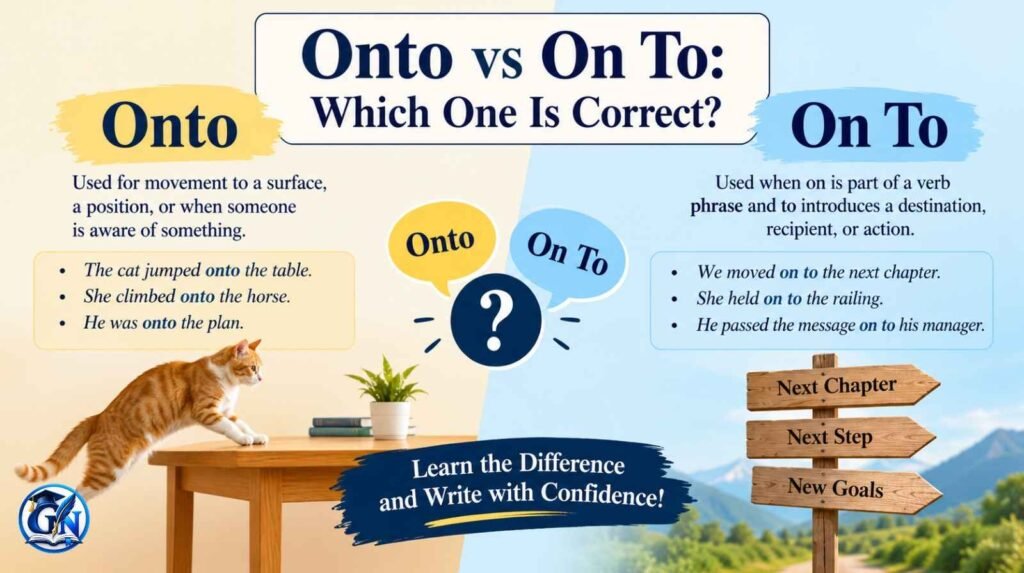
In the onto vs on to debate, both forms are correct. The right choice depends on the meaning of your sentence. Onto generally describes movement to a position on a surface, while on to is used when on belongs to a verb phrase and to introduces a destination, recipient, or action.
In this guide, you will learn the difference between onto and on to, understand their grammar rules, explore practical examples, and discover a simple trick to choose the correct form confidently.
What Is the Difference Between Onto and On To?
The main difference between onto and on to is how the words function in a sentence. Although they sometimes express similar ideas, they are not always interchangeable.
What Does Onto Mean?
Onto is a preposition that commonly describes movement toward or arrival at a position on a surface. It can also express awareness or discovery in informal English.
Examples:
- The cat jumped onto the kitchen counter.
- She climbed onto the horse.
- He placed the folder onto the desk.
- The detective was onto the suspect’s plan.
In the first three examples, onto describes movement to a surface or position. In the last example, it means that the detective had discovered or understood something suspicious.
What Does On To Mean?
On to consists of two separate words. Usually, on belongs to a verb or phrasal verb, while to connects the sentence to a destination, person, or action.
Examples:
- We moved on to the next chapter.
- She held on to the railing.
- He passed the message on to his manager.
- I logged on to my account.
In these examples, the words perform separate grammatical jobs. For instance, in “We moved on to the next chapter,” the phrase moved on expresses progression, and to the next chapter identifies what came next.
Quick Comparison Table
| Onto | On to |
|---|---|
| Usually a single preposition | Two separate words |
| Often describes movement to a surface | Often follows a phrasal verb |
| Can mean aware of or discovering something | Can indicate progression, direction, or transfer |
| Example: Jump onto the bed. | Example: Move on to the next task. |
| Example: She is onto our plan. | Example: Hold on to the rope. |
The easiest way to remember the difference is to focus on the meaning of the complete sentence rather than the appearance of the words.
When Should You Use Onto?
Use onto when you want to describe movement to a surface or position, or when you mean that someone has discovered something.
To Describe Movement to a Surface
The most common use of onto involves movement from one position to another, ending on a surface.
Examples:
- The child climbed onto the sofa.
- The ball rolled onto the road.
- She stepped onto the platform.
- The bird landed onto the branch.
The last example is grammatically possible, but “The bird landed on the branch” is more natural in standard English. With verbs such as land, the preposition on is often preferred.
To Describe Placement or Transfer
You can also use onto when something is moved or placed on a surface.
Examples:
- Pour the milk onto the cereal.
- Transfer the photographs onto your computer.
- The worker loaded the boxes onto the truck.
- She spread the blanket onto the grass.
In these sentences, onto highlights the destination or receiving surface.
To Mean Aware of Something
In informal English, onto can mean that someone has discovered a secret, understood a trick, or recognized what another person is doing.
Examples:
- I think the teacher is onto our plan.
- The journalist was onto an important story.
- She realized that her brother was onto her little trick.
This meaning is different from physical movement. Someone who is onto a secret has figured it out rather than moved onto a surface.
When Should You Use On To?
Use on to when on is part of a verb or phrasal verb and to has its own function in the sentence. This distinction is especially important when discussing progress, continuing an activity, or transferring something.
When Moving to the Next Stage
When move on means to progress or stop focusing on something, keep on and to separate if to introduces the next stage.
Examples:
- Let’s move on to the next question.
- After lunch, we went on to discuss the budget.
- She moved on to a more challenging course.
- The team progressed on to the final round.
The phrase move on describes progression, not movement onto a physical surface. Therefore, on to is generally the appropriate choice.
When Using Phrasal Verbs
A phrasal verb combines a verb with a word such as on, creating a particular meaning. If on belongs to that verb phrase and to serves a separate purpose, the words should remain separate.
Examples:
- Please pass the invitation on to Maria.
- He held on to the handle.
- She caught on to the joke.
- I need to log on to the website.
Notice that held on means maintained a grip, while on to the handle identifies what was being held. Similarly, caught on means understood, and to the joke identifies what was understood.
When Describing Continuation
The expression read on means to continue reading. When to introduces the reason or purpose, the words remain separate.
Examples:
- Read on to discover the answer.
- The story went on to inspire thousands of readers.
- She stayed on to help her colleagues.
- He worked on to complete the assignment.
Some sentences allow different interpretations, so consider what you want to communicate. For instance, “She went on to become a doctor” means she later became a doctor. It does not describe movement onto a surface.
Onto vs On To: Easy Rules to Remember
You do not need to memorize every possible example. A few practical grammar rules can help you make the right decision in everyday writing.
Rule 1: Try Replacing Onto With On
If replacing onto with on keeps the intended meaning, onto may be appropriate.
For example:
- Original: The cat jumped onto the table.
- Alternative: The cat jumped on the table.
Both sentences can be grammatical, although onto emphasizes the movement to the table.
However, this test is not perfect. Context and the intended meaning still matter.
Rule 2: Check Whether On Belongs to a Verb
If on is part of a phrasal verb such as move on, hold on, or pass on, you will often need to write on to when another word follows to.
Examples:
- Correct: We moved on to another subject.
- Correct: Hold on to your ticket.
- Correct: She passed the information on to her supervisor.
Writing onto in these examples could alter the meaning or make the sentence less clear.
Rule 3: Identify the Intended Meaning
Ask yourself whether the sentence describes movement onto a surface, awareness of something, or a separate action involving on and to.
| Sentence | Correct form | Reason |
|---|---|---|
| The dog jumped ___ the bed. | onto | Movement to a surface |
| Let’s move ___ the next topic. | on to | Progression to another topic |
| She held ___ the rope. | on to | The phrasal verb is hold on |
| The detective was ___ the suspect’s plan. | onto | Means aware of the plan |
| Pass the documents ___ your colleague. | on to | The phrasal verb is pass on |
These rules provide a useful starting point, but always check the complete sentence if both forms appear possible.
Real-Life Example: Choosing Between Onto and On To
Imagine that a student named Sarah is preparing an English assignment for her teacher. She wants to explain how she completed a school project and what she learned from the experience. While proofreading her work, she notices several sentences in which onto and on to might be confused.
Her first sentence reads, “I placed my research notes on to the desk.” Sarah is describing the movement of her notes to a surface. Therefore, she can revise the sentence to read, “I placed my research notes onto the desk.” The revised version emphasizes where the notes were placed.
Next, Sarah writes, “After finishing the introduction, I moved onto the next section.” Here, she does not mean that she physically climbed onto a section of paper. She means that she continued working. The clearer choice is “After finishing the introduction, I moved on to the next section.”
Later, she writes, “I held onto my notes while walking to class.” This sentence can be correct because onto can be used after hold when it means maintaining a grip on something. However, “I held on to my notes” is also a common and clear choice, especially when keeping the phrasal verb held on separate from to my notes is desirable.
Finally, Sarah writes, “My teacher was on to the mistake I had made.” If she means that her teacher had discovered the mistake, the more conventional expression is “My teacher was onto the mistake I had made.”
By examining what each sentence means instead of relying on appearance alone, Sarah can choose the appropriate wording. Her assignment becomes easier to understand, and she learns a method she can apply to future writing tasks, emails, and reports.
The key lesson from Sarah’s experience is simple: understand the role of each word before deciding whether to combine them. This approach is more reliable than memorizing isolated sentences.
Common Mistakes to Avoid
Even experienced writers sometimes confuse these expressions, especially when they appear after verbs that can take different prepositions.
Mistake 1: Using Onto for Every Situation
Incorrect for the intended meaning: “We moved onto the next lesson.”
Better: “We moved on to the next lesson.”
The second sentence clearly expresses progression to another lesson rather than movement onto a surface.
Mistake 2: Separating Onto When It Describes a Surface
Less natural for the intended meaning: “The child climbed on to the roof.”
More direct: “The child climbed onto the roof.”
Although on to can be acceptable in some contexts and varieties of English, onto is the straightforward choice when the intended meaning is movement to a surface.
Mistake 3: Ignoring Phrasal Verbs
Incorrect for the intended meaning: “Please hold onto the next question.”
Better: “Please move on to the next question.”
The problem is not simply spelling. The verb phrase must match the meaning you intend to express.
What Do Grammar References Recommend?
Established grammar resources support checking the grammatical role of each word rather than applying a spelling rule mechanically. Cambridge Dictionary explains the difference between on and onto for position and movement, while Purdue University’s Online Writing Lab discusses how prepositions of direction relate to movement and destination. Dictionary.com also explains why on to remains separate when on belongs to a phrasal verb. These references are useful for understanding the distinction in context.
What Grammar Data Tells Us in 2025–2026
There is no widely established, authoritative 2025–2026 statistic that measures how often English writers confuse onto and on to. It would be misleading to invent a percentage or claim that one form is universally more correct.
However, current online dictionary resources and established writing guides continue to distinguish the two forms according to meaning and grammatical function.
What Reliable References Confirm
- Cambridge Dictionary: Explains the difference between on and onto, particularly for position and movement.
- Purdue Online Writing Lab: Explains prepositions of direction, including to and onto, and how they relate to movement.
- Dictionary.com: Discusses the difference between onto and on to, including phrasal verbs and examples of both forms.
What This Means for Everyday Writing
The practical lesson remains the same in 2026: neither spelling is universally correct in every sentence. The right choice depends on the sentence’s structure and meaning.
For students, professionals, bloggers, and English learners, understanding this distinction is more useful than relying on a frequency statistic without a clear source.
FAQs
Q1: Is Onto One Word or Two?
A: Onto is one word. It is commonly used as a preposition to describe movement to a surface or position, as in “She jumped onto the stage.” The two-word form on to is also correct when on and to perform separate grammatical functions.
Q2: Is Onto Grammatically Correct?
A: Yes, onto is grammatically correct when used appropriately. For example, “The cat climbed onto the table” describes movement to a surface. It can also mean becoming aware of something, as in “The manager is onto the problem.”
Q3: Is On To Grammatically Correct?
A: Yes. On to is correct when on belongs to a verb phrase and to introduces a destination, recipient, or action. For example, “We moved on to the next chapter” uses both words separately.
Q4: Should I Write Move Onto or Move On To?
A: Use move on to when you mean progressing to another task, subject, or stage.
Example: “Let’s move on to the next question.”
Use move onto when the intended meaning is movement to a surface, although move on to is generally clearer for figurative progression.
Q5: Is It Hold Onto or Hold On To?
A: Both forms are commonly accepted when hold means maintaining a grip on something.
Examples:
- Hold on to the railing.
- Hold onto the railing.
The two-word form makes the phrasal verb hold on especially clear. Follow your preferred style guide if you are writing for a formal publication.
Q6: Is Onto or On To Correct in American English?
A: Both forms are used in American English. The correct choice depends on meaning, not simply on regional spelling. For example, “Jump onto the platform” and “Move on to the next stage” are both standard constructions.
Q7: Can Onto and On To Be Interchanged?
A: Sometimes, yes. Certain sentences allow both forms without a meaningful change in meaning, particularly with verbs involving movement or attachment. However, they are not interchangeable in every context. “Move on to the next chapter” does not mean the same thing as physically moving onto a surface.
Q8: How Can I Remember the Difference Between Onto and On To?
A: Think about what the sentence describes. If something moves to a surface, onto is often appropriate. If on belongs to a phrasal verb such as move on or hold on, and to introduces what follows, write on to. When in doubt, examine the sentence’s meaning and structure.
Conclusion:
The answer to onto vs on to is that both forms are correct, but they are used in different contexts.
Use onto when describing movement to a surface or position, or when saying that someone has discovered something. For example, “The child climbed onto the chair” and “The detective was onto the plan.”
Use on to when on belongs to a verb phrase and to introduces what follows. For example, “We moved on to the next lesson” and “She passed the information on to her manager.”
The most reliable way to choose is to understand the intended meaning and identify the grammatical role of each word. With practice, this distinction will become much easier, helping you write more clearly and confidently.
👉 Explore more useful grammar tips and guides on Gramnora

Explore the world of English grammar with simple explanations, practical examples, and easy-to-follow guides by Zia Tarar, the founder and author of Gramnora. From essential grammar rules and sentence structure to common mistakes and advanced concepts, Gramnora helps learners improve their English, strengthen their writing skills, and communicate with greater clarity and confidence.