
Have you ever wondered whether to write “Patient vs Patience” or “Please have patience”? These expressions look similar, sound similar, and share related meanings, but they follow different grammar rules. Choosing the wrong word can make your sentence sound unnatural or grammatically incorrect.
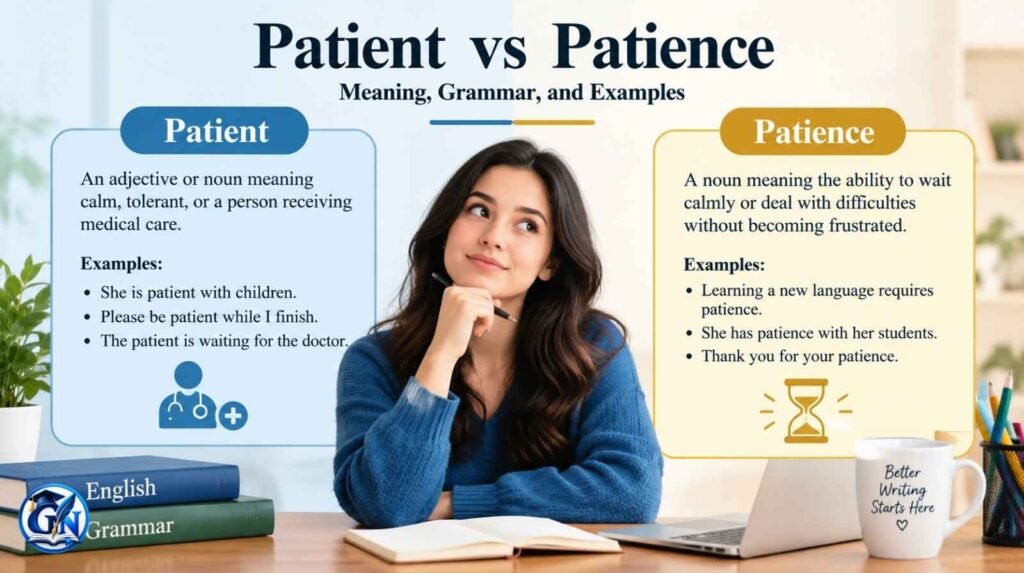
Understanding patient vs patience is easier than you might think. The word patient usually describes someone who can wait calmly, while patience refers to the ability to remain calm during delays or difficulties. Additionally, patient has another meaning: a person receiving medical care.
In this guide, you will learn the meaning of each word, discover how to use them correctly, explore practical examples, and avoid common English grammar mistakes.
What Is the Difference Between Patient vs Patience?
The main difference between patient and patience is their grammatical function. Patient is usually an adjective describing someone who remains calm, while patience is a noun describing the ability to wait or deal with difficulties calmly. Patient can also be a noun referring to someone receiving medical treatment.
| Feature | Patient | Patience |
|---|---|---|
| Part of speech | Adjective or noun | Noun |
| Main meaning | Calm and tolerant; or someone receiving medical care | Ability to wait calmly |
| Common expressions | Be patient, remain patient | Have patience, show patience |
| Example | She is patient with children. | She has patience with children. |
| Medical meaning | A person receiving treatment | No medical-person meaning |
| Opposite | Impatient | Impatience |
Both words are correct, but they cannot always replace one another.
For example:
- Correct: Please be patient while I finish the report.
- Correct: Please have patience while I finish the report.
- Incorrect: Please be patience while I finish the report.
- Incorrect: Please have patient while I finish the report.
The first correct sentence uses an adjective, while the second uses a noun.
Why Are Patient and Patience Confused?
These words are often confused because they look alike and express closely related ideas. However, their grammatical roles are different.
Think of it this way:
- Patient describes a quality: He is patient.
- Patience names that quality: He has patience.
This simple distinction will help you choose the correct word in everyday conversations, school assignments, professional emails, and blog posts.
What Does Patient Mean?
The word patient has two main meanings in English. It can describe someone who remains calm while waiting, or it can refer to a person receiving medical treatment.
Patient as an Adjective
As an adjective, patient describes someone who can wait without becoming frustrated or who handles difficult situations calmly.
Examples:
- My teacher is patient with beginners.
- Please be patient while the website loads.
- Sarah remained patient despite the long delay.
- A patient parent listens carefully to a child.
- You should be patient with yourself while learning English.
In these examples, patient describes a person’s behavior or attitude.
It can also describe an approach or action that involves care and restraint.
For example, “The team took a patient approach to solving the problem.”
Patient as a Noun
As a noun, patient means someone receiving medical attention or treatment from a doctor, nurse, dentist, or another healthcare professional.
Examples:
- The patient is waiting for the doctor.
- The nurse called the next patient.
- Every patient received clear instructions.
- The hospital admitted three new patients yesterday.
The plural form is patients, which refers to more than one person receiving medical care.
Remember that patient and patients can refer to people in a medical context, whereas patience refers to a personal quality.
Common Expressions With Patient
You will frequently see patient used in these expressions:
- Be patient with someone.
- Stay patient during difficult times.
- Remain patient while waiting.
- A patient teacher.
- A patient listener.
For instance, “Try to remain patient when learning a new skill” means you should avoid becoming frustrated when progress takes time.
What Does Patience Mean?
Patience is a noun that describes the ability to remain calm while waiting, facing challenges, or dealing with frustrating situations. It involves self-control, tolerance, and the willingness to accept that some things take time.
Patience as a Noun
Unlike patient, the word patience does not describe a person directly. Instead, it names the quality that a person possesses or demonstrates.
Examples:
- Learning a new language requires patience.
- Thank you for your patience.
- Her patience helped her manage the difficult situation.
- You need patience to become a skilled writer.
- He lost his patience after waiting for two hours.
Notice how naturally patience follows verbs such as have, show, need, and lose.
These expressions are particularly useful in everyday English.
Common Expressions With Patience
Here are several common phrases using patience:
| Expression | Example |
|---|---|
| Have patience | You must have patience when teaching children. |
| Show patience | She showed patience with the new employee. |
| Lose patience | I began to lose patience after another delay. |
| Test someone’s patience | The repeated interruptions tested his patience. |
| Thank you for your patience | Thank you for your patience while we resolve this issue. |
| Require patience | Learning to play the piano requires patience. |
These phrases demonstrate how patience works as a noun in different situations.
Patient, Patience, and Patiently
These three related words serve different grammatical purposes.
- Patient: An adjective describing calm behavior, or a noun for someone receiving medical care.
- Patience: A noun naming the ability to remain calm.
- Patiently: An adverb describing how someone performs an action.
Examples:
- She is patient with her students.
- She has patience with her students.
- She patiently explains the lesson.
Understanding these word forms can make your English sentences clearer and more natural.
Patient vs Patience: Grammar Rules and Examples
The easiest way to distinguish these words is to examine how they function in a sentence. The verb and the surrounding words often reveal which form you need.
When to Use Be Patient
Use patient after linking verbs such as be, remain, stay, and seem when describing calm behavior.
Correct examples:
- Please be patient with me.
- He stayed patient during the interview.
- She remained patient despite the difficulties.
- You seem patient when working with children.
Incorrect: “Please be patience with me.”
Why? The sentence requires an adjective describing the person, so patient is the correct choice.
When to Use Have Patience
Use patience after verbs such as have, show, need, and lose when referring to the quality of remaining calm.
Correct examples:
- You need patience to learn a new language.
- I have patience with my younger brother.
- The teacher showed patience with the students.
- She lost patience when the meeting ran late.
Incorrect: “You need patient to learn a new language.”
Why? The sentence requires a noun representing a quality, so patience is correct.
Comparison Table: Correct vs Incorrect Usage
| Incorrect sentence | Correct sentence |
|---|---|
| Be patience with me. | Be patient with me. |
| I need patient. | I need patience. |
| She is patience. | She is patient. |
| Have patient, please. | Have patience, please. |
| The patience is waiting for the doctor. | The patient is waiting for the doctor. |
| The doctor treated several patience. | The doctor treated several patients. |
One important detail is that the last two mistakes involve the medical noun patient and its plural patients. Always consider the meaning of the whole sentence before selecting a word.
Patient vs Patience in Real-Life Situations

Understanding grammar rules is useful, but seeing these words in realistic situations makes them easier to remember. Both words appear frequently in education, workplaces, healthcare, and everyday conversations.
In Education and Learning
Learning a difficult subject takes time. Students need patience, while teachers should be patient with learners who need extra help.
Examples:
- A patient teacher explains difficult concepts clearly.
- Learning mathematics requires patience.
- Students should be patient with themselves when making mistakes.
Here, patient describes the teacher or students, while patience names the quality needed for learning.
In the Workplace
Professional communication often requires patience, especially when dealing with deadlines, complicated projects, or customer concerns.
Examples:
- Please be patient while we review your application.
- Thank you for your patience during the system update.
- A patient manager listens to employees before making a decision.
These expressions are especially useful in professional emails and customer-service messages.
In Healthcare
Healthcare provides an interesting example because patient can have two meanings within the same sentence.
Consider this example:
“The patient was patient while waiting for the doctor.”
The first occurrence of patient is a noun referring to someone receiving medical care. The second is an adjective describing that person’s calm behavior.
Another example:
“The doctor treated several patients and showed patience throughout the busy afternoon.”
In this sentence, patients refers to the people receiving care, while patience describes the doctor’s ability to remain calm.
A Real-Life Example: Learning English Without Losing Patience
Imagine a student named Ali who is learning English to improve his academic writing. At first, he struggles with spelling, sentence structure, and commonly confused words. Whenever he makes a mistake, he becomes frustrated and feels that his progress is too slow.
His teacher encourages him to be patient with himself and explains that language learning requires consistent practice. Ali begins spending twenty minutes each day reading articles, learning new vocabulary, and writing short paragraphs. Rather than expecting immediate perfection, he reviews his mistakes and corrects them one at a time.
After several weeks, Ali notices that he can write more clearly and recognize grammar errors more easily. He still makes mistakes, but he no longer gives up whenever something seems difficult.
This example illustrates the difference between the two words. Ali learns to be patient because patient describes how he approaches his learning. He also develops patience because patience names the quality that helps him continue practicing.
The lesson applies beyond language learning. Whether you are studying, developing a website, preparing for an examination, or working toward a professional goal, progress often requires time and persistence. Being patient with yourself and having patience with the process can help you stay focused without expecting instant results.
Patient vs Patience: Common Mistakes to Avoid
Many English learners understand the meanings of these words but still choose the wrong form when writing quickly. The following mistakes are easy to correct once you understand the grammatical difference.
Confusing Adjectives and Nouns
The most common mistake is using patience to describe a person directly.
Incorrect: She is patience.
Correct: She is patient.
Alternatively, you can write, “She has patience.” Both correct sentences communicate a similar idea, but their grammatical structures differ.
Confusing Patients With Patience
Because patients and patience sound similar, writers sometimes confuse them in medical or everyday contexts.
- Patients: People receiving medical treatment.
- Patience: The ability to wait calmly.
Examples:
- The patients are waiting outside.
- The doctor’s patience impressed everyone.
The verb also helps clarify the meaning. Patients are is correct when referring to multiple people, while patience is is correct in ordinary use.
Using the Wrong Word After a Verb
Some verbs commonly work with one form rather than the other.
Incorrect: I have patient.
Correct: I have patience.
Incorrect: He remained patience.
Correct: He remained patient.
A useful proofreading technique is to check the verb first. If you see be, remain, or stay describing calm behavior, patient is usually the right choice. If you see have, need, or show referring to the quality, patience is generally appropriate.
Patient vs Patience in Modern English: Facts and Usage
There is no reliable universal statistic showing what percentage of English writers confuse patient with patience in 2025 or 2026. It would therefore be misleading to invent a percentage or claim that one word is more frequently misspelled than the other.
However, current English-language reference resources continue to explain the distinction between these words.
What Current Reference Resources Show
- Microsoft 365: Its grammar guidance explains the difference between being patient and having patience, including examples of both forms. Read Microsoft 365’s writing guidance.
- Grammarly: Its explanations distinguish the adjective patient from the noun patience and highlight the related confusion between patience and patients. Read Grammarly’s grammar guide.
- Google News Initiative: Its Google Trends training explains that search-interest data is normalized on a scale from 0 to 100 rather than reporting absolute search counts. This matters when researching how people search for commonly confused words. Learn how Google Trends data works.
These resources support a practical conclusion: learning the grammatical function of each word is more useful than trying to memorize unsupported statistics about how often people make the mistake.
How to Apply This Knowledge in 2026
Whether you are writing an email, publishing a blog post, preparing an assignment, or communicating with customers, use these simple checks:
- Decide whether you are describing a person or naming a quality.
- Check the verb that comes before the word.
- Consider whether the sentence refers to someone receiving medical treatment.
- Read the complete sentence to make sure the meaning is clear.
These steps are useful for English learners and experienced writers alike.
FAQs
Q1: What is the difference between patient and patience?
A: Patient is usually an adjective meaning calm or tolerant, but it can also mean a person receiving medical care. Patience is a noun referring to the ability to wait calmly or handle difficulties without becoming frustrated.
Example: “She is patient, and she has patience.”
Q2: Is it correct to say “be patient” or “have patience”?
A: Both expressions are grammatically correct.
Use “be patient” when describing someone’s behavior and “have patience” when referring to the quality of remaining calm.
Examples:
- Be patient while the page loads.
- Have patience while the page loads.
Q3: Is patience a noun or an adjective?
A: Patience is a noun. It names a quality rather than describing a person directly.
Example: “Patience is important when learning a new skill.”
To describe a person who demonstrates this quality, use the adjective patient.
Q4: Can patient mean a person receiving medical treatment?
A: Yes. As a noun, patient means a person receiving care from a doctor or another healthcare professional.
Example: “The patient spoke with the nurse.”
The plural form is patients: “The doctor examined five patients.”
Q5: What is the difference between patience and patients?
A: Patience means the ability to remain calm during waiting or difficulty. Patients refers to two or more people receiving medical care.
Examples:
- The nurse showed patience.
- The nurse helped several patients.
Although these words sound similar, their meanings and spellings are different.
Q6: How can I remember when to use patient or patience?
A: Remember these two expressions:
- Be patient: Patient describes a person or behavior.
- Have patience: Patience names the quality.
If you are talking about someone receiving medical treatment, use patient as a noun.
Q7: What is the opposite of patient and patience?
A: The adjective patient has the opposite impatient, which describes someone who becomes frustrated easily or struggles to wait calmly.
The noun patience has the opposite impatience, which refers to the feeling or quality of being impatient.
Examples:
- He became impatient while waiting.
- Her impatience was obvious.
Q8: Can patient and patience be used in the same sentence?
A: Yes. They can appear together because they perform different grammatical functions.
Example: “The patient showed patience while waiting for the doctor.”
The first word identifies a person receiving medical care, while the second names the quality of remaining calm.
Conclusion
Understanding patient vs patience becomes simple when you focus on meaning and grammar. Use patient when describing someone who remains calm or referring to a person receiving medical care. Use patience when talking about the ability to wait calmly, tolerate delays, or deal with difficult situations.
Remember the two most useful expressions: be patient and have patience. They will help you avoid common mistakes in everyday conversations, academic writing, and professional communication.
👉 Explore more useful grammar tips and guides on Gramnora

Explore the world of English grammar with simple explanations, practical examples, and easy-to-follow guides by Zia Tarar, the founder and author of Gramnora. From essential grammar rules and sentence structure to common mistakes and advanced concepts, Gramnora helps learners improve their English, strengthen their writing skills, and communicate with greater clarity and confidence.