
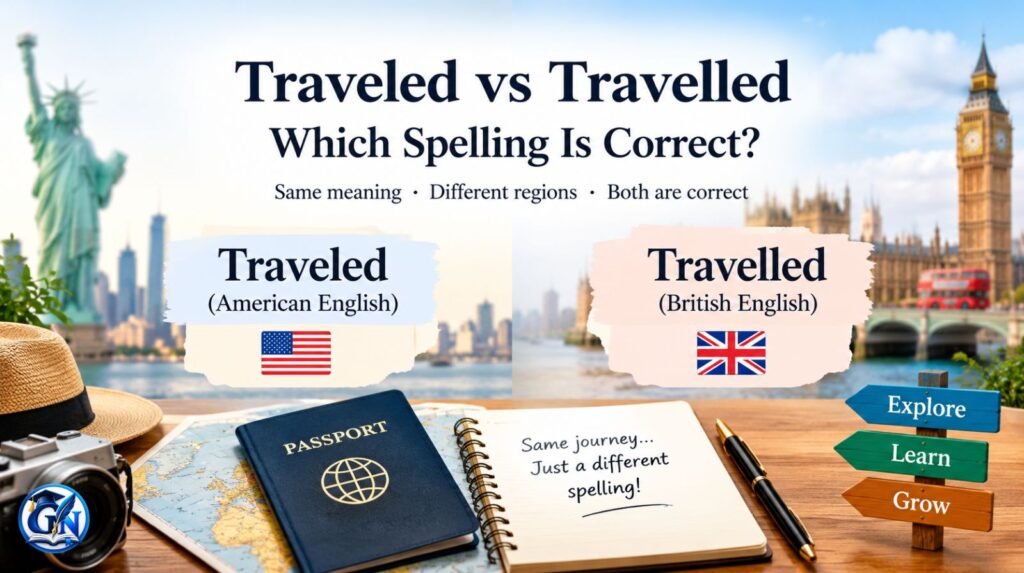
Have you ever wondered whether to write traveled or travelled? If you have seen both spellings in books, articles, or online conversations, you might think one of them is a spelling mistake. However, both forms are correct in English. The difference depends on whether you follow American or British English spelling conventions.
Traveled is the standard spelling in American English, while travelled is the standard spelling in British English. Both words have the same meaning and are used to describe someone who made a journey or moved from one place to another.
In this guide, you will learn the difference between traveled and travelled, understand when to use each spelling, explore practical examples, and discover how to keep your writing consistent.
Traveled vs Travelled: What Is the Difference?
The main difference between traveled and travelled is regional spelling. American English generally uses one “l,” while British English uses two.
Both words are the past tense and past participle of the verb travel. Neither spelling is universally more correct than the other; the appropriate choice depends on your audience and preferred English variety.
When to Use Traveled
Use traveled when writing in American English. This spelling follows the American convention of keeping a single “l” in words such as travel when adding certain suffixes.
Examples:
- We traveled to New York during our summer vacation.
- She traveled across the country to visit her family.
- My brother has traveled to several European countries.
- They traveled by train because it was more comfortable.
In each sentence, traveled describes a completed journey or an experience of going somewhere.
When to Use Travelled
Use travelled when writing in British English. This spelling follows the British convention of doubling the final “l” in words such as travel before adding certain endings.
Examples:
- We travelled to London during our summer holiday.
- She travelled across Europe with her friends.
- My brother has travelled to several European countries.
- They travelled by train because it was more comfortable.
Notice that the meaning remains unchanged. Only the spelling differs.
Quick Comparison Table
| Feature | Traveled | Travelled |
|---|---|---|
| English variety | American English | British English |
| Number of “l” letters | One | Two |
| Meaning | Made a journey | Made a journey |
| Past tense | Correct | Correct |
| Past participle | Correct | Correct |
| Example | We traveled yesterday. | We travelled yesterday. |
Quick answer: Choose traveled for American English and travelled for British English.
Why Are Traveled and Travelled Both Correct?
English spelling developed differently across regions. Over time, American and British English adopted different conventions for spelling certain words, including those ending in the letter “l.”
These differences are part of standard English usage rather than evidence that one form is incorrect.
The American English Spelling Convention
American English generally avoids doubling the final “l” in words such as travel when adding endings like -ed and -ing.
For example:
- Travel → traveled
- Travel → traveling
- Traveler → traveler
These spellings are standard in American writing, including newspapers, educational materials, and professional documents.
The British English Spelling Convention
British English generally doubles the final “l” in these forms.
For example:
- Travel → travelled
- Travel → travelling
- Traveller → traveller
You will commonly encounter these spellings in British publications, educational resources, and other materials that follow British English conventions.
The same pattern appears in other spelling differences, such as canceled versus cancelled and labeled versus labelled, although individual words can have their own usage patterns.
What Do Dictionaries and Style Guides Say?
Reputable dictionaries and editorial style guides recognize the difference between American and British spellings.
For example, the Chicago Manual of Style explains that American English uses traveled, while British English uses travelled. Grammarly also explains the regional distinction in its guide to traveling and travelling.
Therefore, you do not need to worry if you encounter both spellings. The important thing is to choose the appropriate version for your writing.
Traveled vs Travelled in American and British English
Understanding regional spelling conventions helps you choose the correct form for essays, blog posts, emails, and professional documents.
American English Examples
American English uses traveled and related single-“l” forms.
Examples:
- I traveled to California last year.
- She has traveled extensively for work.
- We are traveling to Chicago next week.
- He is an experienced traveler.
These spellings are appropriate when writing for an American audience or following an American publication’s style guide.
British English Examples
British English uses travelled and related double-“l” forms.
Examples:
- I travelled to Scotland last year.
- She has travelled extensively for work.
- We are travelling to Manchester next week.
- He is an experienced traveller.
These spellings are appropriate when writing for a British audience or following a British publication’s style guide.
What About Canadian, Australian, and Other English Varieties?
British-style spellings such as travelled are commonly used in Australia and New Zealand. Canadian English can use a mixture of British and American conventions, so the preferred form may depend on the publication or organization.
If you are writing for an international audience, choose a consistent spelling system and follow it throughout your article.
For instance, if your article uses colour, organise, and centre, then travelled will generally fit that British-oriented spelling style. If you use color, organize, and center, then traveled will generally be the better match.
How to Use Traveled and Travelled Correctly
The easiest way to avoid spelling mistakes is to identify your audience before writing. Once you choose American or British English, apply that convention consistently.
Step 1: Identify Your Audience
Ask yourself who will read your content.
- Writing for readers in the United States? Use traveled.
- Writing for readers in the United Kingdom? Use travelled.
- Writing for readers in several countries? Follow your publication’s preferred style.
For example, an American travel blog might write, “We traveled through Arizona,” while a British travel magazine might write, “We travelled through Wales.”
Step 2: Keep Related Words Consistent
Remember that the difference affects more than the past tense.
| American English | British English |
|---|---|
| Traveled | Travelled |
| Traveling | Travelling |
| Traveler | Traveller |
| Travels | Travels |
| Travel | Travel |
The base verb travel and the present-tense form travels are spelled the same in both varieties.
Step 3: Check Your Entire Article
Imagine writing the following paragraph:
“We traveled through Italy last summer. During our journey, we met several travelers who were also traveling around Europe.”
This paragraph consistently follows American English spelling.
In British English, it would become:
“We travelled through Italy last summer. During our journey, we met several travellers who were also travelling around Europe.”
Both paragraphs are correct. The problem arises when you switch between the two systems without a reason.
A Real-Life Example: Choosing the Right Spelling for a Blog
Imagine that a travel writer is preparing two versions of an article about a family holiday. The first version is intended for readers in the United States, while the second is written for a British travel magazine.
The writer initially drafts this sentence: “Our family travelled across France last summer, and we met several travelers along the way.”
Although readers will understand the sentence, it mixes British and American spelling conventions. The writer has used travelled, which is standard in British English, alongside travelers, which is standard in American English.
For the American publication, the writer changes the sentence to: “Our family traveled across France last summer, and we met several travelers along the way.”
For the British publication, the sentence becomes: “Our family travelled across France last summer, and we met several travellers along the way.”
The writer then reviews related words throughout each article, checking forms such as traveling and travelling. The American version uses the single-“l” forms, while the British version uses the double-“l” forms.
This small editing step improves consistency and makes each article more appropriate for its intended audience. It also demonstrates an important principle of professional writing: correct spelling is not always about choosing one universal form; sometimes it is about following the right convention consistently.
For bloggers, students, editors, and website owners, this approach is particularly useful when preparing content for different countries.
Traveled vs Travelled: Common Mistakes to Avoid
Although both spellings are correct, writers sometimes use them incorrectly by mixing regional conventions or misunderstanding their grammatical role.
Assuming One Spelling Is Always Wrong
A common mistake is believing that travelled is misspelled because an American spell-checker flags it, or that traveled is incorrect because a British publication prefers the double-“l” form.
Neither assumption is accurate. The preferred spelling depends on the English variety being used.
Mixing American and British Spellings
Consider this sentence:
“We travelled around California and visited several famous centers.”
The spelling travelled follows British English, while centers follows American English.
For a consistent British English version, write:
“We travelled around California and visited several famous centres.”
For a consistent American English version, write:
“We traveled around California and visited several famous centers.”
Confusing Spelling With Grammar
The choice between traveled and travelled does not change the tense or meaning of the sentence.
For example:
- Present: I travel every summer.
- Past: I traveled last summer. (American English)
- Past: I travelled last summer. (British English)
- Present perfect: I have traveled before. (American English)
- Present perfect: I have travelled before. (British English)
The grammatical structure remains the same. Only the regional spelling changes.
FAQs
Q1: Is traveled or travelled correct?
A: Both are correct spellings. Traveled is standard in American English, while travelled is standard in British English. Choose the version that matches your audience or style guide.
Q2: Is travelled British or American English?
A: Travelled is the standard British English spelling. It is also commonly used in Australia and New Zealand. American English generally prefers traveled.
Q3: Is traveled American English?
A: Yes. Traveled is the standard American English spelling of the past tense and past participle of travel.
Q4: Do traveled and travelled mean the same thing?
A: Yes. Both words describe making a journey or going from one place to another. The difference is spelling, not meaning.
Q5: Should I write traveling or travelling?
A: Use traveling in American English and travelling in British English. The same regional spelling convention applies to traveled and travelled.
Q6: Which spelling should I use in academic writing?
A: Follow the spelling convention required by your institution, instructor, publisher, or academic style guide. Consistency is more important than choosing one form as universally correct.
Q7: Is travelled acceptable in American English?
A: Readers in the United States will understand travelled, but traveled is the standard American spelling. For formal American writing, use traveled unless a specific style guide requires otherwise.
Q8: Which spelling is better for SEO: traveled or travelled?
A: Neither spelling is universally better for SEO. Choose the form that matches your target audience and use it naturally throughout your content. Search visibility depends on many factors, including relevance, usefulness, and overall content quality, rather than this spelling choice alone.
Conclusion
The difference between traveled vs travelled is simple: traveled is the standard American English spelling, while travelled is the standard British English spelling. Both forms are correct, have the same meaning, and describe a journey that someone has made.
If you write for an American audience, choose traveled. If you write for a British audience, choose travelled. For international content, select a consistent spelling style and apply it throughout your article.
Remember, good writing is not just about spelling individual words correctly. It is also about making your content clear, consistent, and easy for readers to understand.
👉 Explore more useful grammar tips and guides on Gramnora

Explore the world of English grammar with simple explanations, practical examples, and easy-to-follow guides by Zia Tarar, the founder and author of Gramnora. From essential grammar rules and sentence structure to common mistakes and advanced concepts, Gramnora helps learners improve their English, strengthen their writing skills, and communicate with greater clarity and confidence.