
Have you ever wondered whether to write inconsolable or unconsolable when describing someone who cannot stop crying or feeling sad? These words look similar, but one is much more common and widely accepted in modern English.
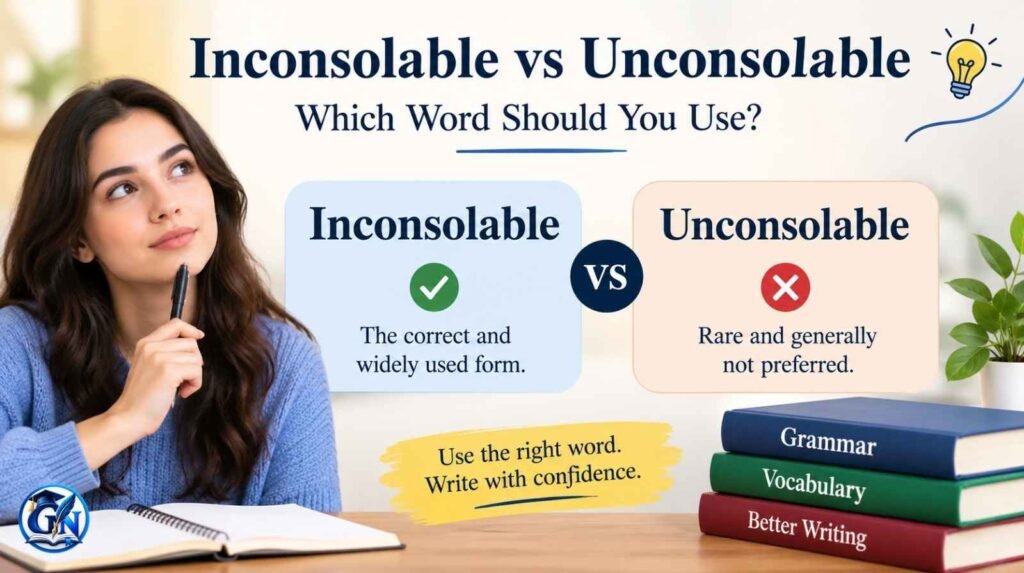
In the comparison of inconsolable vs unconsolable, inconsolable is the standard choice for describing someone who cannot be comforted. It is commonly used when a person experiences deep grief, overwhelming sadness, or emotional distress. Unconsolable has the same general meaning, but it is rare and is generally not the preferred option in modern writing.
Understanding the difference can help you choose the right word in everyday conversations, school assignments, professional writing, and online content. This guide explains both terms, provides practical examples, and shows you how to use them naturally.
What Does Inconsolable Mean?
Inconsolable is an adjective that describes someone who cannot be comforted or whose sadness is so intense that attempts to reassure them do not seem to help.
It is often associated with grief, disappointment, heartbreak, or another deeply upsetting experience. The word emphasizes the intensity of a person’s feelings rather than simply saying that they are sad.
Definition of Inconsolable
According to standard English usage, inconsolable means impossible or extremely difficult to console, comfort, or reassure.
For example:
- The child was inconsolable after losing his favorite toy.
- She became inconsolable when she heard the heartbreaking news.
- His family tried to comfort him, but he remained inconsolable.
In each sentence, the word describes someone whose emotional pain cannot easily be relieved.
Origin and Word Formation
The word inconsolable is formed from the negative prefix in-, the root associated with console, and the adjective-forming suffix -able.
The verb console means to comfort someone who is unhappy or distressed. Therefore, inconsolable describes someone who cannot be consoled.
This word formation helps explain its meaning and makes it easier to remember the correct spelling.
When Should You Use Inconsolable?
Use inconsolable when you want to communicate intense sadness or grief that comfort does not relieve.
Examples include:
- A parent who is grieving a significant loss.
- A child crying uncontrollably after a frightening experience.
- A friend overwhelmed by an unexpected disappointment.
Example: “After her beloved dog died, Maria was inconsolable for several days.”
This sentence communicates more emotional intensity than simply saying Maria was upset.
Inconsolable vs Unconsolable: What Is the Difference?
The main difference between inconsolable and unconsolable is their frequency and acceptance in contemporary English.
Inconsolable is the established, widely preferred word. Unconsolable is a rare alternative that readers may understand, but it is much less common and is generally avoided in formal and professional writing.
| Feature | Inconsolable | Unconsolable |
|---|---|---|
| Meaning | Cannot be comforted | Cannot be comforted |
| Commonness | Widely used | Rarely used |
| Standard usage | Preferred | Generally not preferred |
| Formal writing | Recommended | Best avoided |
| Everyday English | Natural and familiar | Uncommon |
| Example | She was inconsolable after the loss. | She was unconsolable after the loss. |
Although the two words have essentially the same intended meaning, they are not equally suitable for everyday writing.
Is Unconsolable a Real Word?
Unconsolable appears occasionally in English, and its meaning is understandable. However, it is far less established in modern usage than inconsolable.
The fact that a word can be understood does not automatically make it the best choice in every context. When writing an essay, article, email, or social media post, inconsolable is the safer and more natural option.
Example:
- Preferred: “The grieving family was inconsolable.”
- Less common: “The grieving family was unconsolable.”
The first sentence follows standard contemporary usage.
Why Do People Confuse These Words?
The confusion largely comes from the negative prefix un-, which appears in many familiar English adjectives, including unhappy, uncomfortable, and unacceptable.
Because un- can express the opposite of a quality, it may seem logical to create unconsolable. However, English spelling and word choice are not always determined by simple prefix rules.
For this reason, it is better to remember the established expression rather than assume that a similar-looking alternative is equally common.
How to Use Inconsolable in a Sentence
The easiest way to use inconsolable correctly is to connect it with a person experiencing intense emotional distress.
Examples of Inconsolable in Everyday English
Here are several natural examples:
- The little boy was inconsolable when his parents left for the airport.
- She was inconsolable after receiving the sad news.
- His best friend tried to help, but he remained inconsolable.
- The mother was inconsolable following the unexpected loss.
- The young athlete became inconsolable after the devastating defeat.
- Even her closest friends could not comfort her because she was inconsolable.
These examples show that the word can describe sadness caused by many different circumstances.
Inconsolable in Formal and Informal Writing
In formal writing, inconsolable can communicate emotional intensity without requiring a lengthy explanation.
For example:
“The family remained inconsolable following the tragic event.”
In informal writing, the word is equally useful:
“I was inconsolable when I found out my favorite show had ended.”
The second example uses a lighter situation to express exaggerated sadness. Context determines whether the word sounds serious, dramatic, or humorous.
Common Synonyms for Inconsolable
Depending on the context, you may use these related expressions:
- Heartbroken: Deeply saddened, especially by loss or disappointment.
- Distraught: Extremely upset, worried, or distressed.
- Grief-stricken: Overwhelmed by grief.
- Devastated: Experiencing intense emotional pain.
- Uncomforted: Not comforted, although this is less common in everyday descriptions of emotional distress.
These words are related but not interchangeable in every sentence. For example, distraught can describe someone who is extremely worried, while inconsolable specifically emphasizes the inability to provide comfort.
Real-Life Example: Choosing the Right Word
Consider a fictional situation involving a student named Emma who has just learned that her beloved grandmother has passed away.
Understanding the Situation
Emma has always been close to her grandmother. After receiving the news, she begins crying and struggles to speak. Her parents sit beside her, offer reassurance, and remind her of the happy memories they shared as a family. However, Emma continues to cry and cannot find relief from her sadness.
Her brother later writes a message describing the family’s experience.
He considers two sentences:
- “Emma was inconsolable after learning about her grandmother’s death.”
- “Emma was unconsolable after learning about her grandmother’s death.”
Both sentences communicate a similar idea. Nevertheless, the first sentence uses the standard, widely accepted adjective.
Why Inconsolable Is the Better Choice
The first sentence is clearer and more natural for contemporary English readers. It communicates Emma’s profound grief while following established usage.
If her brother were writing a school assignment, a personal essay, or a tribute to his grandmother, inconsolable would be the more appropriate choice.
The same principle applies to professional writing. Writers should generally select familiar, standard vocabulary when an uncommon alternative provides no meaningful difference in meaning.
This example also illustrates an important point: choosing the right word is not only about understanding a definition. It is about considering the audience, context, and conventions of modern English.
What Can Writers Learn From This Example?
Three useful lessons emerge:
- Choose established vocabulary: Prefer words that readers recognize and commonly encounter.
- Consider the context: Emotional writing benefits from precise words that communicate the intended feeling.
- Avoid unnecessary alternatives: When two words express the same idea, the more widely accepted term is usually the better choice.
These principles can improve clarity in grammar articles, academic assignments, personal writing, and professional communication.
Inconsolable: Usage Trends and Language Data
When deciding between two spellings, it is helpful to distinguish between documented language evidence and general advice about usage.
What Can Current Language Data Tell Us?
Established dictionaries and large text collections, known as language corpora, help writers investigate how words are defined and used. Dictionary entries establish meanings, while corpus searches can reveal how frequently words appear in different types of writing.
For inconsolable and unconsolable, the practical distinction is clear: inconsolable is the conventional choice, while unconsolable is rare.
What About 2025–2026 Statistics?
There is no verified, universal 2025–2026 statistic available here that establishes an exact percentage difference in the usage of these two words. Reporting a specific figure without a reliable dataset would be misleading.
For a current comparison, writers can investigate both terms using the Google Books Ngram Viewer and consult established dictionaries such as Merriam-Webster.
These resources serve different purposes:
- Google Books Ngram Viewer: Helps compare word frequency in its searchable collection of published books over time.
- Merriam-Webster: Provides definitions, spelling information, and usage guidance for established English vocabulary.
- Oxford English Dictionary: Offers historical and descriptive evidence about English words and their development.
Book-corpus frequency is not the same as the frequency of words in all modern conversations or online writing. Therefore, any numerical comparison should identify its dataset, date range, and search method.
What Should You Do With This Information?
You do not need a precise frequency percentage to make the practical choice. In ordinary contemporary English, use inconsolable when describing someone who cannot be comforted.
This recommendation reflects established usage rather than an unsupported claim about a specific 2025 or 2026 search trend.
Common Mistakes to Avoid
Understanding the preferred spelling is easier when you recognize a few common mistakes.
Treating Both Words as Equally Common
Although unconsolable may be understandable, it is not as widely established as inconsolable.
Better: “The child was inconsolable after the accident.”
Confusing Inconsolable With Simply Sad
Inconsolable expresses a particularly intense emotional state. It usually suggests that attempts to comfort someone have not eased their distress.
For example:
- “She was sad about the cancellation.” This describes ordinary disappointment.
- “She was inconsolable after the loss.” This suggests much deeper emotional pain.
Assuming Prefixes Always Follow the Same Pattern
English contains many words with un- and in-, but there is no universal rule that allows writers to substitute one prefix for another.
Learning established vocabulary and checking reliable dictionaries are more effective than guessing.
FAQs
Q1: Which Is Correct: Inconsolable or Unconsolable?
A: Inconsolable is the standard and preferred word in modern English. It describes someone who cannot be comforted, especially when experiencing intense sadness or grief.
Q2: Is Unconsolable Incorrect?
A: Unconsolable is a rare alternative that can be understood, but it is generally not preferred in contemporary standard English. For clear, professional writing, choose inconsolable.
Q3: What Does Inconsolable Mean in Simple Words?
A: It means being so sad or upset that other people cannot comfort you easily.
For example: “He was inconsolable after his beloved pet died.”
Q4: Can Inconsolable Describe Someone Who Is Angry?
A: It is possible to use the word in contexts involving strong emotional distress, but it is most commonly associated with sadness, grief, and sorrow. For anger alone, words such as furious or enraged are usually more precise.
Q5: What Is a Synonym for Inconsolable?
A: Depending on the context, suitable alternatives include heartbroken, grief-stricken, devastated, and distraught. However, each word has a slightly different meaning.
Q6: How Do You Spell Inconsolable Correctly?
A: The correct spelling is i-n-c-o-n-s-o-l-a-b-l-e: inconsolable. Remember the initial in- and the root associated with console.
Q7: What Is the Opposite of Inconsolable?
A: There is no single perfect opposite for every context. Words such as comforted, reassured, consoled, and content can express contrasting ideas.
For example: “After talking with her family, she finally felt comforted.”
Q8: Is Inconsolable Formal or Informal?
A: Inconsolable works in both formal and informal English. You can use it in academic writing, news reporting, personal stories, everyday conversation, and professional articles.
Conclusion:
When comparing inconsolable vs unconsolable, the choice is straightforward: inconsolable is the preferred word in modern English.
Both terms convey the idea of being unable to receive comfort, but inconsolable is much more familiar and widely accepted. Use it when describing deep sadness, grief, heartbreak, or emotional distress that reassurance cannot easily relieve.
Remember these key points:
- Inconsolable is the standard spelling and the best choice for most situations.
- Unconsolable is rare and generally best avoided in formal writing.
- Use inconsolable when you want to communicate intense sadness that cannot easily be comforted.
Improving your vocabulary starts with learning small but meaningful distinctions like this one.
👉 Explore more useful grammar tips and guides on Gramnora

Explore the world of English grammar with simple explanations, practical examples, and easy-to-follow guides by Zia Tarar, the founder and author of Gramnora. From essential grammar rules and sentence structure to common mistakes and advanced concepts, Gramnora helps learners improve their English, strengthen their writing skills, and communicate with greater clarity and confidence.