
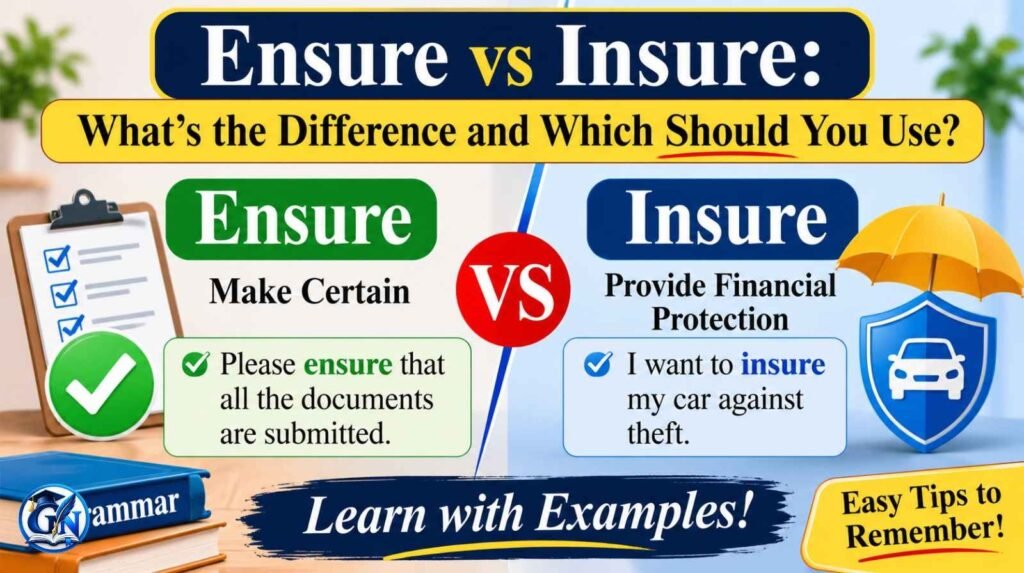
Choosing between Ensure vs Insure can be confusing because these two English words sound almost identical and share a similar meaning. However, they are not interchangeable in every situation. Using the wrong word can make your writing unclear, particularly in professional emails, business communication, and formal documents.
The good news is that understanding the difference between ensure vs insure is relatively simple. Both words relate to making something certain or protecting against a possible loss, but they serve different purposes.
In this guide, you’ll learn what ensure and insure mean, how to use each word correctly, and which one belongs in different situations. You’ll also find practical examples, everyday conversations, professional emails, and helpful tips to remember the difference.
Ensure vs Insure: What’s the Difference?
The main difference between ensure and insure is their purpose.
Ensure means to make certain that something happens or that a particular condition is achieved. It is commonly used when discussing responsibilities, arrangements, instructions, and expected results.
Insure means to protect someone or something financially against potential loss or damage, usually through an insurance policy.
Although both words can relate to security and certainty, their meanings are different.
Consider these examples:
- Please ensure that all the documents are submitted before Friday.
- We need to insure the company vehicles against accidents and damage.
In the first sentence, ensure means making certain that the documents are submitted on time. In the second, insure refers to purchasing financial protection for company vehicles.
A simple way to remember the difference is that ensure means make certain, while insure means provide financial protection.
What Does Ensure Mean?
Ensure is a verb that means to make certain, guarantee, or take the necessary steps to make something happen as expected.
You use ensure when you want to confirm that something is completed, maintained, arranged, or achieved.
It is particularly common in professional writing, workplace communication, instructions, and everyday conversations.
For example:
- Please ensure that the meeting room is ready before the guests arrive.
- We must ensure that every customer receives excellent service.
- Sarah checked the equipment twice to ensure everything was working properly.
- The manager introduced new procedures to ensure employee safety.
In each example, ensure expresses the idea of making something certain or taking steps to achieve a particular result.
When Should You Use Ensure?
Use ensure when talking about:
- Making certain that something happens.
- Completing tasks and responsibilities.
- Maintaining quality or standards.
- Following rules and instructions.
- Preventing mistakes or misunderstandings.
- Achieving a particular result.
For example, imagine that you are organizing a business meeting. You want everyone to arrive on time and have the necessary documents.
You might write:
“Please ensure that all team members receive the meeting agenda before Thursday.”
Here, ensure is correct because you are asking someone to make certain that the agenda reaches everyone.
Scenario Examples of Ensure
Understanding ensure becomes easier when you see how people use it in real-life situations.
Professional Email
Imagine that Emma is a project manager who needs to remind her colleague about an important deadline.
EMAIL EXAMPLE
Subject: Project Submission Deadline
Hi Daniel,
I hope you’re doing well. Please ensure that all project files are reviewed and submitted by Thursday afternoon. We need to complete everything before the client meeting. Thank you for your cooperation.
Best regards,
Emma
In this email, ensure means making certain that all project files are reviewed and submitted before the deadline.
Workplace Conversation
Imagine a supervisor speaking to an employee before an important presentation.
“Please ensure that the presentation slides are ready before the clients arrive.”
The supervisor wants the employee to make certain that the slides are prepared on time.
Everyday Conversation
A mother might tell her son:
“Ensure that you lock the front door before leaving the house.”
Here, ensure means making certain that the door is locked.
Academic Situation
A teacher might tell students:
“Ensure that you write your names on your examination papers before submitting them.”
The teacher is reminding students to complete an important requirement.
Business Situation
A restaurant manager might say:
“We introduced additional quality checks to ensure that every meal meets our standards.”
In this example, ensure describes the steps taken to maintain food quality.
What Does Insure Mean?
Insure is a verb that means to provide financial protection against possible loss, damage, accidents, or other unexpected events.
It is most commonly associated with insurance policies, companies, vehicles, homes, businesses, health coverage, and valuable possessions.
When you insure something, you arrange financial protection through an insurance provider. Depending on the policy, the insurer may cover certain expenses if a specified event occurs.
For example:
- I want to insure my new car against theft and accidental damage.
- The company decided to insure its office building.
- They insured their valuable equipment before transporting it overseas.
- Mark contacted an insurance company to insure his delivery van.
In these sentences, insure refers to obtaining financial protection against possible risks.
When Should You Use Insure?
Use insure when discussing:
- Car and vehicle insurance.
- Home and property insurance.
- Business insurance.
- Travel insurance.
- Insurance for valuable belongings.
- Financial protection against specified risks.
For example, if you purchase a new house, you might decide to insure it against fire, theft, or certain types of damage.
The word insure is appropriate because you are arranging financial protection through an insurance policy.
Scenario Examples of Insure
Let’s look at some practical situations where insure is the correct word.
Professional Email
Imagine that James works for a company that needs to arrange insurance coverage for its office equipment.
EMAIL EXAMPLE
Subject: Insurance Coverage for Office Equipment
Hi Olivia,
I hope you’re having a great day. We recently purchased new office equipment and would like to insure these items against theft and accidental damage. Could you please provide information about the available insurance policies and their coverage options? Thank you for your assistance.
Best regards,
James
In this email, insure is correct because James is discussing financial protection for office equipment.
Car Insurance Situation
Imagine that Daniel has recently purchased a new vehicle.
He tells his friend:
“I need to insure my new car before I start driving it regularly.”
Here, insure refers to arranging an appropriate car insurance policy.
Home Insurance Situation
A homeowner might say:
“We decided to insure our house against fire and other covered risks.”
The word insure is correct because the homeowner is talking about financial protection for a property.
Business Situation
A business owner might explain:
“Our company insures its delivery vehicles to protect against certain financial losses resulting from accidents.”
This example demonstrates how insure is used in business and financial contexts.
Travel Situation
Before going on holiday, Sophie might say:
“I always insure my trips because unexpected cancellations can be expensive.”
Here, insure relates to purchasing travel insurance that may cover certain unexpected expenses.
Ensure vs Insure: Key Differences Explained
Although ensure and insure sound similar, their meanings and applications are different.
Here is a quick comparison to help you understand both words.
| Feature | Ensure | Insure |
|---|---|---|
| Meaning | Make certain | Provide financial protection |
| Main purpose | Guarantee a result | Protect against financial loss |
| Common use | Instructions and responsibilities | Insurance policies |
| Example | Ensure the report is complete. | Insure the vehicle. |
| Word type | Verb | Verb |
The most important distinction is that ensure focuses on making something happen, whereas insure focuses on financial protection.
For example:
- Ensure the house is locked before leaving.
- Insure the house against covered damage.
Both sentences are correct, but they communicate different ideas.
Ensure vs Insure in Professional Writing
Choosing the correct word is especially important in professional communication. Both words appear in workplace emails, business reports, company policies, and formal instructions.
However, the intended meaning determines which word you should choose.
Using Ensure in Professional Writing
When writing professional emails, use ensure when asking someone to complete a task, follow instructions, or maintain a particular standard.
For example:
PROFESSIONAL EMAIL
Subject: Final Review of the Marketing Report
Hi Michael,
Could you please ensure that the final marketing report is checked for errors before sending it to the client? We want to make sure that everything is accurate and professionally presented. Thank you.
Best regards,
Rebecca
Here, ensure communicates the expectation that Michael will make certain the report is reviewed properly.
Using Insure in Professional Writing
Use insure when discussing insurance arrangements, financial coverage, or protection against potential risks.
For example:
PROFESSIONAL EMAIL
Subject: Insurance for Company Vehicles
Hi Robert,
We are planning to insure our newly purchased company vehicles. Could you please review the available insurance options and recommend a suitable policy that covers accidents, theft, and other relevant risks? I would appreciate your assistance.
Kind regards,
Natalie
In this example, insure is appropriate because the email concerns financial protection through an insurance policy.
Can Ensure and Insure Be Used Interchangeably?
No. Ensure and insure are not generally interchangeable because they have different meanings.
Although both words are associated with certainty and protection, using one instead of the other can change the meaning of a sentence.
Consider these examples:
Incorrect usage:
- Please insure that everyone attends the meeting.
- We need to ensure our company vehicles against theft.
Correct usage:
- Please ensure that everyone attends the meeting.
- We need to insure our company vehicles against theft.
The first sentence requires making certain that people attend a meeting. The second concerns financial protection for company vehicles.
However, there is an interesting historical connection between the two words. In some varieties of English, particularly American English, insure is occasionally used with the broader meaning of ensure. Nevertheless, ensure remains the clearer and more widely recommended choice when you mean make certain.
Ensure vs Insure vs Assure: What’s the Difference?
Another word that often causes confusion is assure.
Ensure, insure, and assure look and sound similar, but each has a different purpose.
- Ensure: To make certain that something happens.
- Insure: To provide financial protection against potential loss.
- Assure: To tell someone confidently that something is true or will happen, helping them feel certain.
Let’s look at some examples:
Ensure:
“Please ensure that the documents are ready before the meeting.”
You are asking someone to make certain that the documents are prepared.
Insure:
“We decided to insure our new property.”
You are arranging financial protection for the property.
Assure:
“I assure you that your application is being reviewed carefully.”
You are giving someone confidence or reassurance.
Scenario Examples of Assure
Imagine that a customer, Emily, is worried about whether her order will arrive on time.
A customer service representative might write:
CUSTOMER SERVICE EMAIL
Subject: Update on Your Order
Hi Emily,
I understand your concern about the delivery date. I can assure you that our team is monitoring your order, and we will keep you informed about any updates. Thank you for your patience.
Best regards,
Oliver
Here, assure is correct because Oliver is reassuring Emily.
Remember this simple distinction: ensure something, insure something, but assure someone.
Common Mistakes When Using Ensure and Insure
Even experienced English speakers sometimes confuse these words, especially when writing quickly.
Here are some common mistakes and their corrections.
Using Insure Instead of Ensure
Incorrect: “Please insure that all employees complete their training.”
Correct: “Please ensure that all employees complete their training.”
Why? The sentence is about making certain that employees complete their training, not purchasing insurance.
Using Ensure Instead of Insure
Incorrect: “I want to ensure my car against theft.”
Correct: “I want to insure my car against theft.”
Why? The sentence refers to financial protection for a vehicle.
Confusing Ensure With Assure
Incorrect: “I assure that the meeting room is ready.”
Correct: “I ensure that the meeting room is ready.”
Why? Ensure is appropriate when talking about making certain that something is ready. Assure usually involves giving someone confidence.
Choosing a Word Without Considering Its Meaning
Incorrect word choices often happen when writers focus on how words sound instead of what they mean.
For example:
- “We need to ensure our office against fire.”
- “We need to insure our office against fire.”
The second sentence is correct because it refers to obtaining insurance protection.
Tip: Before choosing between ensure and insure, ask yourself whether you mean making something certain or arranging financial protection.
Easy Tricks to Remember Ensure vs Insure
If you frequently confuse these words, a few simple memory tricks can help.
Remember the Meaning of Ensure
Think of ensure as make certain.
Example: “Ensure that the lights are switched off.”
You are making certain that the lights are off.
Connect Insure With Insurance
The word insure contains the same opening letters as insurance.
Example: “Insure your vehicle before driving.”
This connection makes it easier to remember that insure relates to financial protection.
Think About the Situation
Ask yourself what the sentence is discussing:
- A task, instruction, or expected result? Use ensure.
- A financial policy or protection against loss? Use insure.
- Reassuring or giving confidence to someone? Use assure.
These simple distinctions can help you choose the correct word in everyday and professional writing.
Ensure vs Insure: Examples in Everyday Sentences
The following examples show how both words work in different situations.
| Ensure Examples | Insure Examples |
|---|---|
| Ensure that the door is locked. | Insure your home against covered risks. |
| Please ensure that the food is fresh. | They insure their business equipment. |
| We must ensure customer satisfaction. | She wants to insure her new car. |
| Ensure that your password is secure. | The company decided to insure its building. |
| Please ensure that the payment is completed. | He insured his valuable collection. |
| The teacher checked to ensure accuracy. | They insured their delivery vehicles. |
Notice that ensure is associated with actions, responsibilities, and results, while insure is associated with insurance coverage and financial protection.
Frequently Asked Questions
1. Is Ensure or Insure Correct?
Both ensure and insure are correct English words, but they have different meanings. Ensure means to make certain that something happens, while insure means to provide financial protection against potential loss or damage.
2. Is Ensure the Same as Insure?
No. Ensure and insure are not the same. Ensure refers to making something certain or guaranteeing a result, whereas insure refers to obtaining financial protection through an insurance policy.
3. How Do You Use Ensure in a Sentence?
You use ensure when you want to make certain that something happens or is completed. For example: “Please ensure that all employees receive the updated company guidelines.” Here, ensure means making certain that employees receive the information.
4. How Do You Use Insure in a Sentence?
You use insure when referring to financial protection against possible risks. For example: “We decided to insure our new house against fire and certain types of property damage.” Here, insure means arranging financial protection through an insurance policy.
5. Is It Ensure Safety or Insure Safety?
Ensure safety is the correct expression when you mean making certain that people remain safe. For example: “The company introduced additional safety measures to ensure employee safety.” Insure is generally not appropriate here because the sentence is about maintaining safety rather than purchasing insurance.
6. Can I Use Ensure in a Business Email?
Yes. Ensure is commonly used in professional emails when requesting that someone complete a task, follow instructions, or meet a particular requirement. For example: “Please ensure that the revised documents are shared with the entire team before Monday.”
7. Is Insure Only Used for Cars?
No. Insure is not limited to car insurance. You can use it when discussing financial protection for homes, businesses, equipment, valuable belongings, travel, and other eligible risks. For example: “The company decided to insure its office building and expensive machinery.”
8. What Is the Difference Between Ensure, Insure, and Assure?
Ensure means to make certain that something happens. Insure means to provide financial protection against possible loss. Assure means to give someone confidence or reassurance.
For example:
- Ensure that the report is complete.
- Insure the vehicle against theft.
- Assure the customer that the issue will be addressed.
Conclusion
Understanding ensure vs insure becomes much easier when you focus on what each word communicates.
Use ensure when you want to make certain that something happens, a task is completed, or a particular result is achieved. Use insure when discussing financial protection against potential loss, damage, or unexpected events through an insurance policy.
For example, you ensure that your home is locked before leaving, but you insure your home against covered risks.
And if you want to reassure someone, remember the third word: assure.
By understanding these differences and practising with everyday examples, professional emails, and workplace conversations, you can use all three words confidently and make your English writing clearer and more accurate.
👉 Explore more useful grammar tips and guides on Gramnora

Explore the world of English grammar with simple explanations, practical examples, and easy-to-follow guides by Zia Tarar, the founder and author of Gramnora. From essential grammar rules and sentence structure to common mistakes and advanced concepts, Gramnora helps learners improve their English, strengthen their writing skills, and communicate with greater clarity and confidence.