
Have you ever wondered whether to write Anytime vs Any Time? You’re not alone. These two expressions look almost identical, and both are commonly used in everyday English. However, they don’t always serve the same grammatical purpose.
The difference between anytime vs any time can be confusing, especially when writing emails, professional messages, school assignments, or everyday conversations. Although both forms are correct, choosing the wrong one can make your sentence sound awkward or change its intended meaning.
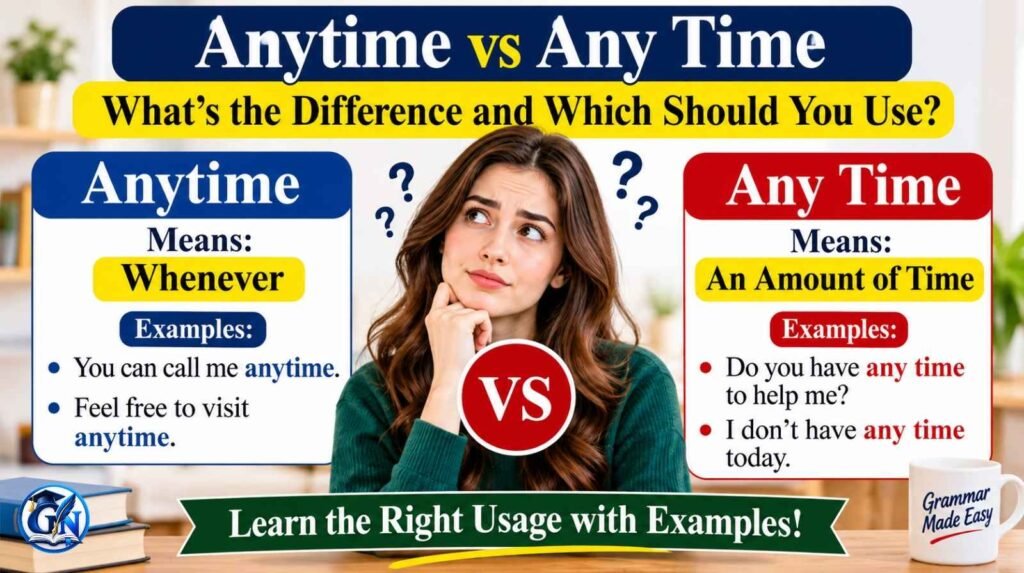
The good news is that understanding the difference is easier than you might think. Anytime is generally an adverb meaning whenever or at any moment, while any time is a two-word expression that refers to an unspecified amount of time or a particular opportunity.
In this article, we’ll explore the meanings, grammatical differences, and practical examples of both expressions. You’ll also learn when to use each form so you can communicate clearly and confidently.
What Is the Difference Between Anytime and Any Time?
The main difference between anytime and any time is how they function in a sentence.
Anytime is usually an adverb that means whenever or at whatever time. It describes when something can or does happen.
Any time, on the other hand, is a two-word phrase that generally refers to an unspecified period, amount, or opportunity. It commonly appears in questions and negative sentences.
Here is a simple comparison:
| Anytime | Any Time |
|---|---|
| Written as one word. | Written as two words. |
| Usually functions as an adverb. | Functions as a noun phrase. |
| Means whenever or at any moment. | Refers to an unspecified amount of time. |
| Example: Call me anytime. | Example: Do you have any time today? |
Examples:
- Anytime: You can visit my office anytime.
- Any time: Do you have any time to discuss the project?
Both sentences are grammatically correct, but they communicate slightly different ideas.
Remembering this distinction will help you choose the appropriate expression in different writing situations.
What Does Anytime Mean?
Anytime is a one-word adverb that means whenever, at any time, or at whatever moment is convenient.
It is commonly used when someone wants to express that something can happen without a specific time restriction.
For example:
- You can call me anytime if you need help.
- Sarah is welcome to visit anytime.
- I can help you with your homework anytime.
- Feel free to contact our support team anytime.
In each example, anytime suggests flexibility. There is no particular hour or date that someone must follow.
When Should You Use Anytime?
Use anytime when you want to communicate that an action can happen whenever someone chooses or whenever an opportunity becomes available.
Here are some common situations.
1. In Everyday Conversations
Imagine your friend wants to visit you but doesn’t know when you’re available.
You could say:
“You’re welcome to come over anytime. I’ll be happy to see you.”
Here, anytime means your friend can visit whenever it is convenient.
In Professional Emails
Suppose your colleague needs assistance with an important assignment.
You could write:
“Hi Daniel,
I’ve reviewed your project proposal and added a few suggestions. If you need any additional assistance, feel free to contact me anytime.
Best regards,
Michael
In this email, anytime communicates that the recipient can reach out whenever necessary.
In Customer Service Messages
Businesses often use anytime to communicate availability and encourage customers to contact them.
For example:
“Thank you for choosing our services. If you have questions or need further assistance, you can contact our support team anytime.”
This expression makes the message sound welcoming and helpful.
When Offering Help
Imagine your friend is preparing for an important examination.
You could say:
“If you need help preparing for your exams, you can call me anytime.”
Here, anytime indicates that your assistance is available whenever your friend needs it.
What Does Any Time Mean?
Any time is a two-word expression that generally refers to an unspecified amount of time, period, or opportunity.
It is often used when asking whether someone has time available, discussing time restrictions, or referring to how much time is needed for an activity.
For example:
- Do you have any time to help me?
- I don’t have any time to waste.
- We didn’t spend any time discussing the issue.
- Is there any time available for another meeting?
In these examples, any time refers to an amount or period of time rather than simply meaning whenever.
When Should You Use Any Time?
Use any time when you are talking about time as something someone has, needs, spends, or makes available.
Let’s look at some practical situations.
1. When Asking About Someone’s Availability
Suppose you want to arrange a meeting with your manager.
You could write:
“Hi Olivia,
I wanted to discuss the upcoming marketing campaign with you. Do you have any time available this afternoon? Please let me know what works best for your schedule.
Kind regards,
James”
Here, any time refers to an amount of time that Olivia might have available.
When Talking About a Busy Schedule
Imagine your friend has several assignments and responsibilities.
You could say:
“I haven’t had any time to relax this week because I’ve been busy with work and university assignments.”
Here, any time means an amount of free time.
When Discussing Deadlines
Suppose a teacher asks students whether they have enough time to complete an assignment.
You could say:
“We don’t have any time left to make major changes to the presentation.”
In this sentence, any time refers to the remaining amount of time.
When Requesting an Appointment
Imagine you’re contacting a dentist to arrange an appointment.
You could write:
“Hello,
I would like to schedule a dental appointment next week. Do you have any time available on Tuesday or Wednesday?
Thank you,
Emily”
Here, any time refers to an available appointment slot or period.
Anytime vs Any Time: Understanding the Grammar Rules
Understanding the grammatical roles of these expressions makes choosing between them much easier.
Although they are closely related, they do not always work interchangeably.
Anytime Functions as an Adverb
An adverb provides additional information about an action, including when something happens.
Anytime commonly modifies verbs by explaining when an action can take place.
Examples:
- You can visit us anytime.
- Please call me anytime you need assistance.
- We can discuss the matter anytime.
- She can complete the assignment anytime this week.
In these sentences, anytime communicates flexibility about when an action happens.
Any Time Functions as a Noun Phrase
The expression any time consists of the determiner any and the noun time.
It refers to an amount or period of time.
Examples:
- Do you have any time for lunch?
- I don’t have any time today.
- We need any time we can get to finish this project.
The last example is less natural in ordinary English. A clearer version would be: “We need all the time we can get to finish this project.”
Notice how any time can be used with expressions such as have, spend, waste, and make.
Anytime Can Mean Whenever
One of the easiest ways to identify anytime is to replace it with whenever.
If the sentence still makes sense, anytime is often the appropriate choice.
For example:
- You can contact me anytime.
- You can contact me whenever you want.
Both sentences communicate the same general meaning.
However:
- Do you have any time to talk?
- Do you have whenever to talk?
The second sentence is incorrect because any time is functioning as a noun phrase.
This replacement trick is a simple way to avoid common spelling mistakes.
Anytime vs Any Time in Different Sentences
Sometimes, seeing both expressions in similar situations makes their differences easier to understand.
Consider these examples:
Example 1:
- Correct: You can email me anytime.
- Correct: Do you have any time to send me an email?
The first sentence offers flexibility. The second asks whether someone has time available.
Example 2:
- Correct: We can meet anytime next week.
- Correct: I don’t have any time next week.
The first sentence suggests scheduling flexibility. The second explains that someone is unavailable.
Example 3:
- Correct: Call me anytime you need advice.
- Correct: I don’t have any time to give advice today.
The first sentence invites someone to call whenever necessary. The second describes a lack of available time.
Can Anytime and Any Time Be Used Interchangeably?
In some situations, anytime and any time can appear in sentences with similar meanings. However, they are not always interchangeable.
For example:
- You can visit me anytime.
- You can visit me at any time.
Both sentences are correct and communicate that someone is welcome to visit whenever they want.
However, consider this sentence:
“Do you have any time to help me with my assignment?”
You cannot replace any time with anytime without changing the grammatical structure.
The sentence “Do you have anytime to help me?” is not standard English in this context.
The important thing to remember is that anytime usually expresses when something can happen, while any time refers to an amount or period of time.
Common Mistakes to Avoid When Using Anytime and Any Time
Even experienced English speakers sometimes confuse these expressions. Understanding a few common mistakes can help you avoid them.
Mistake 1: Using Anytime When Talking About Available Time
Incorrect: Do you have anytime to discuss the project?
Correct: Do you have any time to discuss the project?
Why? The sentence asks whether someone has an amount of time available. Therefore, the two-word expression is appropriate.
Mistake 2: Using Any Time Instead of Anytime in an Adverbial Expression
Incorrect: You can call me any time you need help.
Correct: You can call me anytime you need help.
The one-word form is generally preferred when it means whenever.
However, the version “You can call me at any time you need help” is also correct.
Mistake 3: Confusing Anytime With Every Time
Although anytime and every time can sometimes appear in similar contexts, they have different meanings.
- Anytime: Whenever an opportunity is available.
- Every time: On each occasion something happens.
Examples:
“You can visit me anytime.”
“Every time I visit my grandmother, she makes my favourite meal.”
The first sentence expresses flexibility, while the second describes repeated occasions.
Mistake 4: Forgetting the Difference in Professional Writing
Using the wrong expression in an email can make your writing less clear.
For example:
Incorrect: Please let me know if you have anytime tomorrow.
Correct: Please let me know if you have any time tomorrow.
The second version correctly asks about someone’s availability.
Anytime vs Any Time: Which One Should You Use?
Choosing the correct expression depends on what you want to communicate.
Use anytime when you mean:
- Whenever.
- At any moment.
- Whenever it is convenient.
- Without a fixed time restriction.
Use any time when you mean:
- An amount of time.
- An available period.
- Time someone has or needs.
- Time spent on an activity.
Here is a quick comparison:
| Situation | Correct Expression |
|---|---|
| You can call me whenever you want. | Anytime |
| Do you have time for lunch? | Any time |
| Contact us whenever you need assistance. | Anytime |
| I don’t have time today. | Any time |
| You can visit whenever you like. | Anytime |
| Did you spend time studying? | Any time |
Quick tip: If you can replace anytime with whenever, the one-word version is usually correct. If you’re talking about an amount of time, use any time.
Frequently Asked Questions
1. Is Anytime One Word or Two?
Anytime is one word when it means whenever or at any moment. However, any time is written as two words when referring to an amount or period of time. Both forms are correct, depending on the context.
2. Is Anytime Grammatically Correct?
Yes, anytime is grammatically correct. It is commonly used in everyday conversations, professional emails, and informal writing to express that something can happen whenever someone wants or needs it.
3. Is Any Time Two Words?
Yes, any time is written as two separate words when referring to an unspecified amount or period of time. For example, “Do you have any time to help me with this task?”
4. Can I Say “Thank You Anytime”?
“Thank you anytime” is not a natural response to someone’s gratitude. Instead, you can say “You’re welcome,” “Anytime!” or “No problem!” In this context, anytime means that you are always happy to help.
5. Is It “Call Me Anytime” or “Call Me Any Time”?
Both can be correct. “Call me anytime” is commonly used to express that someone can call whenever they want. “Call me at any time” is also correct and communicates the same general idea.
6. Is Anytime Formal or Informal?
Anytime is suitable for both formal and informal communication. You can use it in professional emails, customer service messages, everyday conversations, and friendly text messages.
7. What Is Another Word for Anytime?
Depending on the context, alternatives to anytime include whenever, at any moment, whenever convenient, and at any hour. These expressions can help you avoid repetition while keeping your meaning clear.
Final Thoughts
Understanding anytime vs any time doesn’t have to be difficult. Although these expressions look similar, their grammatical functions and meanings help distinguish them.
Use anytime when you mean whenever or at any moment. Choose any time when referring to an amount or period of time, especially when discussing someone’s availability or schedule.
For example, “You can contact me anytime” offers flexibility, while “Do you have any time to talk?” asks whether someone has time available.
Once you understand this simple difference, you’ll find it much easier to use both expressions correctly in emails, conversations, and professional writing.
Remember: Anytime means whenever, while any time refers to an amount or period of time.
👉 Explore more useful grammar tips and guides on Gramnora

Explore the world of English grammar with simple explanations, practical examples, and easy-to-follow guides by Zia Tarar, the founder and author of Gramnora. From essential grammar rules and sentence structure to common mistakes and advanced concepts, Gramnora helps learners improve their English, strengthen their writing skills, and communicate with greater clarity and confidence.