
Have you ever confused relieving with reliving while writing an email, completing an assignment, or having a conversation? These two words look and sound quite similar, but they have completely different meanings. Using the wrong one can change the meaning of your sentence and leave readers confused.
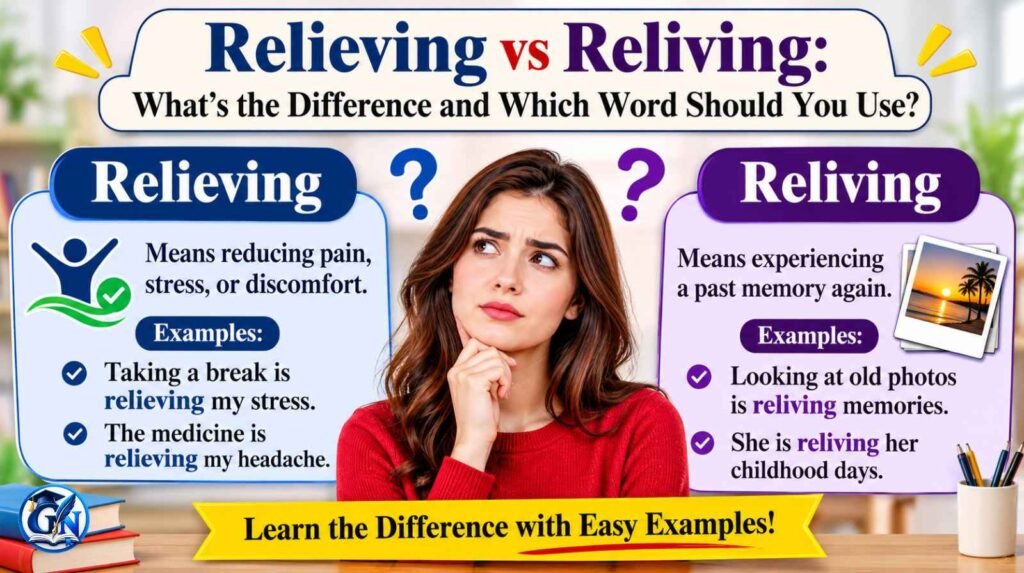
The difference between relieving vs reliving is mainly related to their meanings and how they are used in everyday English. Relieving refers to reducing pain, stress, worry, or discomfort, while reliving means experiencing or remembering something from the past as if it were happening again.
Although both words are grammatically correct, they cannot be used interchangeably. Understanding when to use each one will help you communicate more clearly and avoid common spelling mistakes.
In this article, you’ll learn the meanings of relieving and reliving, their grammatical differences, practical examples, common mistakes, and how to use both words correctly in everyday conversations and professional writing.
What Is the Difference Between Relieving and Reliving?
The main difference between relieving and reliving is their meaning. Both words come from different base verbs and describe completely different actions.
Relieving is the present participle of the verb relieve. It describes the action of making something less painful, stressful, uncomfortable, or difficult.
Reliving is the present participle of the verb relive. It describes experiencing a past event again in your thoughts or memories, often with the same emotions you felt when it originally happened.
Here is a quick comparison:
| Word | Meaning | Example |
|---|---|---|
| Relieving | Reducing pain, stress, or discomfort | The medicine is relieving my headache. |
| Reliving | Experiencing a past memory again | She is reliving her childhood memories. |
For example:
- Relieving: Drinking warm tea is relieving my sore throat.
- Reliving: Ahmed is reliving his happiest childhood memories.
Remember that relieving focuses on reducing discomfort, whereas reliving focuses on experiencing the past again.
What Does Relieving Mean?
Relieving means reducing or removing something unpleasant, such as pain, pressure, stress, anxiety, or discomfort. It comes from the verb relieve and is commonly used when something makes a difficult situation easier or more comfortable.
People frequently use this word when discussing health, emotions, responsibilities, and everyday problems.
For instance, if someone has a headache and takes medicine that reduces the pain, the medicine is relieving their headache.
Similarly, if a person feels stressed about an important examination and talks to a supportive friend, the conversation may be relieving their stress.
Examples of relieving in sentences:
- Drinking enough water is relieving my headache.
- The new treatment is relieving her back pain.
- Talking to my best friend is relieving my stress.
- Taking a short break is relieving my mental pressure.
- The warm shower was relieving my muscle tension.
- His encouraging words were relieving everyone’s worries.
In each example, relieving describes something that reduces an unpleasant feeling or condition.
When Should You Use Relieving?
You should use relieving when describing an action, treatment, experience, or situation that makes something uncomfortable less difficult.
Here are some common situations where this word is appropriate:
- Health and medicine: When something reduces physical pain or discomfort.
- Emotional situations: When an action helps someone feel less worried or anxious.
- Work responsibilities: When someone helps reduce another person’s workload.
- Stressful experiences: When an activity makes someone feel calmer.
- Difficult situations: When something makes a challenging circumstance easier.
For example:
The new employee is relieving Sarah of some of her daily responsibilities.
This sentence means that the new employee is helping Sarah by taking some of her work responsibilities.
Scenario Example: Relieving in a Professional Email
Imagine that Sarah has been working under pressure for several weeks. Her manager, Daniel, wants to inform her that additional support will help reduce her workload.
Here is how the word can be used naturally in a professional email:
Subject: Additional Support for Your Workload
Hi Sarah,
I understand that the recent workload has been challenging, and I appreciate all the effort you’ve put into completing your responsibilities. We have decided to assign another team member to assist you with some of your daily tasks. Hopefully, this arrangement will be relieving some of the pressure and giving you more time to focus on important projects. Thank you for your continued dedication.
Best regards,
Daniel
In this example, relieving is correct because it describes reducing Sarah’s work pressure.
What Does Reliving Mean?
Reliving means experiencing or remembering something that happened in the past as if you were going through it again. It comes from the verb relive.
This word is commonly associated with memories, emotions, personal experiences, and past events.
For example, when someone looks at old photographs from a family vacation and remembers the happiness they experienced, they may feel as though they are reliving those moments.
Reliving can describe both positive and negative experiences. Someone might relive a wonderful childhood memory, an unforgettable celebration, or even a frightening experience.
Examples of reliving in sentences:
- I am reliving my childhood memories through these old photographs.
- She enjoys reliving the beautiful moments of her wedding day.
- Watching the old football match made him relive his greatest victory.
- They were reliving their school memories during the reunion.
- He is reliving the excitement of his first international trip.
- The documentary helped us relive an important historical event.
In all these examples, reliving describes remembering or mentally experiencing something that happened previously.
When Should You Use Reliving?
Use reliving when talking about memories, past experiences, or events that someone is experiencing again in their mind.
Here are some common situations:
- Childhood memories: Remembering special moments from childhood.
- Family experiences: Thinking about memorable family gatherings.
- Travel memories: Remembering an enjoyable holiday or adventure.
- Historical events: Experiencing past events through photographs, videos, or documentaries.
- Emotional experiences: Remembering moments that created strong feelings.
- Personal achievements: Thinking about previous successes or important milestones.
For example:
Watching my graduation video made me relive one of the happiest days of my life.
This sentence explains that watching the video brought back memories and emotions from the graduation day.
Scenario Example: Reliving in a Personal Email
Imagine that Ahmed wants to email his old school friend, Michael, after discovering some photographs from their school days.
Subject: Remembering Our School Days
Hi Michael,
I was going through some old photographs yesterday and found a few pictures from our school days. Looking at them brought back so many wonderful memories. I couldn’t help reliving those unforgettable moments, especially our classroom activities, school trips, and funny conversations. Those were truly special days, and I hope we can meet again soon and talk about all those memories.
Best wishes,
Ahmed
Here, reliving is the correct word because Ahmed is remembering and mentally experiencing moments from his past.
Relieving vs Reliving: Understanding Their Grammatical Differences
Although relieving and reliving look similar, they are formed from two different verbs: relieve and relive.
Understanding their grammatical forms makes it easier to recognize which word belongs in a particular sentence.
| Grammatical form | Relieve | Relive |
|---|---|---|
| Base verb | Relieve | Relive |
| Past tense | Relieved | Relived |
| Present participle | Relieving | Reliving |
| Past participle | Relieved | Relived |
| Noun form | Relief | Reliving (gerund) |
Both words ending in -ing can function as present participles or gerunds, depending on how they are used in a sentence.
Examples:
- Relieving: The medicine is relieving his pain.
- Reliving: She is reliving her childhood memories.
- Relieving as a gerund: Relieving stress is important for maintaining a healthy lifestyle.
- Reliving as a gerund: Reliving old memories can bring happiness.
The important thing to remember is that their grammatical forms do not change their basic meanings.
Relieving vs Reliving: Examples in Everyday Situations
Sometimes, the easiest way to understand confusing English words is to see how people use them in realistic situations.
Let’s explore some examples from everyday life.
Health and Physical Comfort
Relieving:
The painkiller is relieving my toothache.
This means the medicine is reducing the pain.
Reliving:
He is reliving the frightening experience of his accident.
This means he is remembering the accident and experiencing its emotions again.
Family and Personal Memories
Relieving:
Spending time with my family is relieving my stress after a busy week.
This means family time is helping reduce stress.
Reliving:
Looking through our family album is making us relive wonderful childhood memories.
This means the photographs are bringing back memories of the past.
Workplace Situations
Relieving:
The new assistant is relieving me of several administrative responsibilities.
This means the assistant is helping reduce the amount of work.
Reliving:
During the office reunion, everyone was reliving their favorite workplace memories.
This means colleagues were remembering experiences from their previous working days.
Education and School Life
Relieving:
Taking a short break is relieving the pressure of studying for final examinations.
This means the break is making the student feel less stressed.
Reliving:
The students were reliving their school memories during the annual reunion.
This means they were remembering experiences from their school days.
Travel and Holidays
Relieving:
Taking a peaceful walk along the beach is relieving my stress.
This means the walk is helping reduce stress.
Reliving:
Looking at pictures from our trip to London makes me feel like I am reliving that wonderful vacation.
This means the pictures are bringing back memories of the trip.
Common Mistakes to Avoid When Using Relieving and Reliving
Because these words have similar spellings, people sometimes use one when they actually mean the other.
However, choosing the wrong word can completely change the intended meaning.
Here are some common mistakes and their corrections.
Mistake 1:
Incorrect: Looking at old photographs is relieving my childhood memories.
Correct: Looking at old photographs is reliving my childhood memories.
Explanation: The sentence describes remembering past experiences, so reliving is correct.
Mistake 2:
Incorrect: This medicine is reliving my headache.
Correct: This medicine is relieving my headache.
Explanation: Medicine reduces physical pain, so relieving is the appropriate word.
Mistake 3:
Incorrect: Talking to my friend is reliving my stress.
Correct: Talking to my friend is relieving my stress.
Explanation: The sentence describes reducing stress, not experiencing a past event again.
Mistake 4:
Incorrect: Watching our wedding video is relieving those special moments.
Correct: Watching our wedding video is reliving those special moments.
Explanation: Watching the video brings back memories of the past, making reliving the correct choice.
Mistake 5:
Incorrect: The new treatment is reliving her back pain.
Correct: The new treatment is relieving her back pain.
Explanation: A treatment that reduces discomfort is relieving the pain.
A simple trick can help you remember the difference: Relieving is about making something better, while reliving is about experiencing something again.
Easy Ways to Remember the Difference Between Relieving and Reliving
If you frequently confuse these words, a few simple memory tricks can make them easier to remember.
Associate Relieving With Relief
The word relieving comes from relieve, which is closely connected to the noun relief.
Relief means a feeling of comfort after pain, worry, or difficulty becomes less severe.
For example:
- The medicine is relieving my pain.
- Exercise is relieving my stress.
- Her advice was relieving my worries.
Whenever your sentence involves reducing discomfort or pressure, think of relieving.
Associate Reliving With Living Again
The word reliving contains the word living.
Think of it as living through an experience again, even though the original event happened in the past.
For example:
- I am reliving my childhood memories.
- He is reliving his wedding day through photographs.
- They are reliving their favorite travel experiences.
Whenever your sentence involves remembering or mentally experiencing the past, think of reliving.
Ask Yourself One Simple Question
Before choosing either word, ask yourself:
Am I reducing something unpleasant or experiencing something from the past again?
- If you are reducing pain, stress, or pressure, use relieving.
- If you are remembering or experiencing a past event again, use reliving.
This simple question can help you choose the correct word in almost any everyday situation.
Are Relieving and Reliving Interchangeable?
No, relieving and reliving are not interchangeable because they have different meanings.
Although they share similar spelling patterns and pronunciation, they communicate different ideas.
Consider these two sentences:
- Talking to my mother is relieving my anxiety.
- Talking to my mother is reliving my childhood memories.
The first sentence means that talking to the speaker’s mother is reducing anxiety.
The second sentence suggests that talking to the speaker’s mother is bringing back memories of childhood.
Replacing one word with the other changes the meaning of the entire sentence.
Therefore, you should always choose the word that accurately communicates your intended message.
Which Word Should You Use: Relieving or Reliving?
Choosing between these words depends entirely on the context of your sentence.
Use relieving when you want to describe reducing something unpleasant, such as pain, stress, anxiety, pressure, or responsibility.
Use reliving when you want to describe remembering a past experience or mentally experiencing an event again.
Here are a few additional examples to make the distinction clearer:
| Sentence | Correct word |
|---|---|
| The medicine is ___ my headache. | Relieving |
| She is ___ her childhood memories. | Reliving |
| Taking a vacation is ___ my stress. | Relieving |
| He is ___ his happiest moments. | Reliving |
| The treatment is ___ her discomfort. | Relieving |
| They are ___ their wedding day through videos. | Reliving |
Remember that relieving describes a reduction in discomfort, while reliving describes revisiting the past.
Frequently Asked Questions
1. Is Relieving or Reliving Correct?
Both relieving and reliving are correct English words, but they have different meanings. Relieving means reducing pain, stress, or discomfort, while reliving means experiencing or remembering something from the past again.
2. What Is the Difference Between Relieving and Reliving?
Relieving refers to making something unpleasant less severe, such as reducing stress or pain. Reliving refers to remembering or mentally experiencing a past event again. The correct choice depends on what you want to express.
3. Is Relieving a Real Word?
Yes, relieving is a real English word. It is the present participle of the verb relieve and describes the action of reducing pain, pressure, stress, or discomfort. For example, taking a break is relieving my stress.
4. Is Reliving a Correct Word?
Yes, reliving is a correct English word. It is the present participle of the verb relive and means experiencing or remembering a past event again. For example, she is reliving her childhood memories.
5. How Do You Use Relieving in a Sentence?
You can use relieving when describing something that reduces pain, stress, or discomfort. For example, drinking warm tea is relieving my sore throat. In this sentence, relieving describes the action of making the discomfort less severe.
6. How Do You Use Reliving in a Sentence?
Use reliving when discussing memories or past experiences that someone is remembering or mentally experiencing again. For example, watching our old family videos is making us relive our happiest moments.
7. Can Relieving and Reliving Be Used in the Same Sentence?
Yes, both words can appear in the same sentence when they describe different actions. For example, reliving happy childhood memories is relieving my stress. Here, reliving describes remembering the past, while relieving describes reducing stress.
8. What Is the Past Tense of Relieving and Reliving?
The past tense of relieve is relieved, while the past tense of relive is relived. For example, the medicine relieved my pain, and she relived her childhood memories through old photographs.
9. Is Reliving the Same as Remembering?
Reliving and remembering are closely related, but they are not exactly the same. Remembering means recalling something from the past, while reliving often suggests experiencing the emotions or feelings associated with that event again.
10. What Is an Easy Way to Remember Relieving vs Reliving?
Remember that relieving is connected to relief, which means reducing pain, stress, or discomfort. Reliving is connected to living again, which means mentally experiencing a past event another time. This simple distinction makes choosing the correct word easier.
Conclusion
Understanding the difference between relieving vs reliving is easier when you remember their meanings and the situations in which they are used.
Relieving comes from the verb relieve and means reducing pain, stress, pressure, or discomfort. On the other hand, reliving comes from the verb relive and means remembering or experiencing a past event again.
Both words are correct English spellings, but they serve different purposes. Use relieving when something makes an unpleasant situation easier, and use reliving when discussing memories or past experiences.
By remembering this simple distinction and practicing with real-life examples, you can use both words confidently in conversations, emails, academic assignments, and professional writing.
👉 Explore more useful grammar tips and guides on Gramnora

Explore the world of English grammar with simple explanations, practical examples, and easy-to-follow guides by Zia Tarar, the founder and author of Gramnora. From essential grammar rules and sentence structure to common mistakes and advanced concepts, Gramnora helps learners improve their English, strengthen their writing skills, and communicate with greater clarity and confidence.