
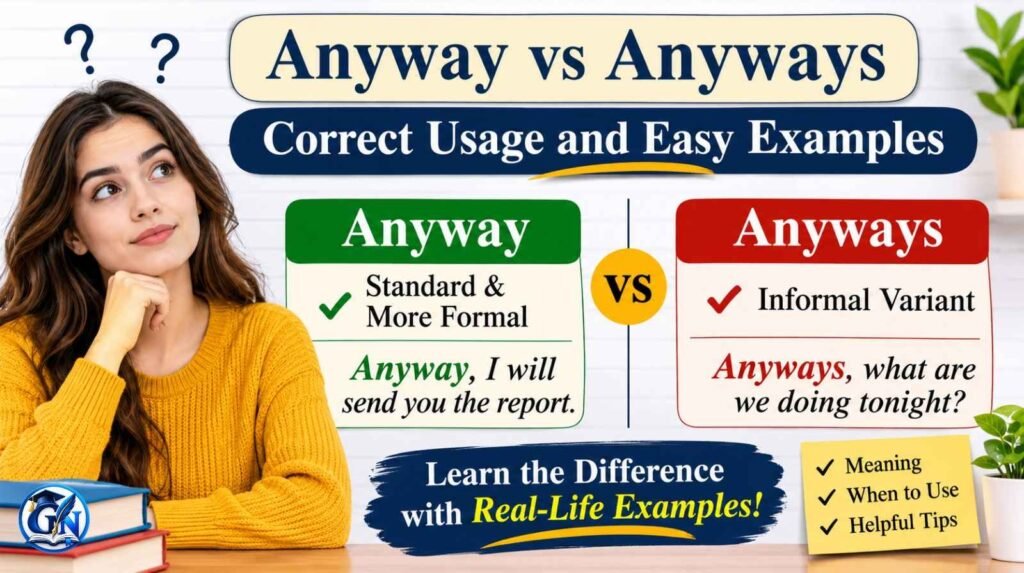
Have you ever wondered whether to write Anyway vs Anyways in a text message, email, or everyday conversation? Both words are commonly used in English, and they often express the same general idea. However, they are not equally appropriate in every situation.
Understanding the difference between anyway vs anyways can help you communicate more naturally and avoid mistakes in formal writing. Although you may hear both words in conversations, one is generally preferred in professional and academic settings.
For example, you might write, “Anyway, I will send you the report tomorrow,” in a work email. In a casual conversation with a friend, you might hear, “Anyways, what are we doing tonight?”
So, which word should you use? Is anyways actually incorrect, or is it simply more informal?
In this guide, you will learn the meaning of each word, understand the main grammatical differences, and explore practical examples from emails, workplace conversations, text messages, and everyday situations.
What Does Anyway Mean?
Anyway is an adverb that can mean regardless, in any case, or despite what has happened. It can also help a speaker return to a previous topic or move a conversation forward.
It is the standard form in modern English and is appropriate for both formal and informal communication.
Here are some examples:
- I was feeling tired, but I went to the gym anyway.
- The weather was terrible. Anyway, we enjoyed our trip.
- I do not know whether he will agree, but I will ask him anyway.
- Anyway, let’s get back to the main topic.
- She did not need my help, but I offered anyway.
In each example, anyway helps explain that something happened regardless of a situation, or it signals a change in the conversation.
Common Meanings of Anyway
1. Regardless of the circumstances
Use anyway when an action happens despite a problem, difficulty, or obstacle.
Example: “It was raining heavily, but we continued playing anyway.”
The rain did not stop the people from playing.
2. Returning to a topic
Use anyway to return to the main subject after a distraction or interruption.
Example: “Anyway, as I was saying, we need to finish the project by Friday.”
Here, the speaker brings the conversation back to the original subject.
3. Adding a final point
You can use anyway to introduce a concluding thought or explain what will happen next.
Example: “I have already submitted the application, so there is nothing else to do anyway.”
In this sentence, the word reinforces the speaker’s final point.
What Does Anyways Mean?
Anyways is an informal variant of anyway. It is frequently heard in casual conversations and appears in text messages, social media posts, and relaxed online communication.
In many situations, anyways has the same meaning as anyway. However, it is generally less suitable for formal writing.
Examples include:
- Anyways, what did you decide about the party?
- I was not sure she would come, but I went anyways.
- Anyways, I should get going now.
- He said he was busy, but I called him anyways.
These examples show how people use anyways naturally in informal English.
It is worth remembering that anyways is not universally considered a grammatical error. It has a long history of use, and it is common in several varieties of English. Nevertheless, anyway is the safer choice in professional communication, academic assignments, and most edited writing.
Is Anyways a Real Word?
Yes, anyways is a real English word, but its acceptability depends on the context and the style of writing.
Some people use it regularly in conversation, while others consider it unnecessary or less polished. Many style-conscious writers prefer anyway because it is the more widely accepted standard form.
For example:
- Informal: “Anyways, I’ll see you tomorrow!”
- Professional: “Anyway, I will see you tomorrow.”
Both sentences communicate the same basic idea, but the second is more suitable for a professional setting.
Anyway vs Anyways: What Is the Difference?
The main difference between these words is formality and standard usage, rather than meaning.
| Feature | Anyway | Anyways |
|---|---|---|
| Meaning | Regardless; in any case | Usually the same |
| Grammatical status | Standard adverb | Informal variant |
| Formal emails | Recommended | Usually avoid |
| Academic writing | Recommended | Usually avoid |
| Casual conversations | Common | Common in some varieties |
| Text messages | Appropriate | Appropriate in casual contexts |
| Professional documents | Preferred | Less suitable |
The important point is that anyway is the better default choice. It works in almost every context without sounding overly casual.
Consider these examples:
Example 1: Formal communication
“Anyway, I will review the documents and send my feedback by Monday.”
This sentence sounds natural in a professional email.
Example 2: Informal communication
“Anyways, I’ll check the documents later.”
This sentence is perfectly understandable in a casual chat, although anyway would also work.
Example 3: Academic writing
“The results were inconclusive. Anyway, further research is necessary.”
A more polished academic version would be:
“The results were inconclusive. Nevertheless, further research is necessary.”
Although anyway is grammatically acceptable, words such as nevertheless, however, or in any case may be more precise in formal academic writing.
When Should You Use Anyway?
Use anyway when you want your English to sound clear, natural, and appropriate across different situations. It is particularly useful when you are writing for work, school, or a general audience.
In Professional Emails
In a workplace email, anyway can help you transition to the next point or conclude a discussion. However, it should not replace a more precise transition when the message requires a formal tone.
Scenario: Sarah needs to follow up with her colleague about an unfinished report.
Hi Daniel,
I understand that you have been busy with the other assignments. Anyway, could you please send me the latest version of the project report by Thursday? We need to review it before the team meeting on Friday. Thank you for your help.
Best regards,
Sarah
Why it works: Anyway moves the email forward without changing the main request. In a more formal corporate email, Sarah could also write, “In any case, could you please send me the latest version of the project report by Thursday?”
In Academic Writing
Although anyway is acceptable English, it can sound conversational in an academic paper. It is often better to use a more precise expression.
Scenario: A student is discussing a research project.
Less formal: “The experiment did not produce the expected results. Anyway, the findings were useful.”
More polished: “The experiment did not produce the expected results. Nevertheless, the findings provided useful insights.”
Why it works: Nevertheless clearly expresses a contrast and gives the paragraph a more academic tone.
In Everyday Conversations
In ordinary conversations, anyway is useful when you want to return to a subject or move past an interruption.
Scenario: Two friends are talking about weekend plans.
“Anyway, have you decided where we should go on Saturday?”
Here, anyway helps the speaker return to the original discussion.
In Text Messages
You can use anyway in text messages without sounding overly formal.
Scenario: Ahmed wants to end a conversation because he needs to leave.
“Anyway, I have to go now. I’ll call you tonight!”
The word signals that the conversation is coming to an end.
When Something Happens Despite a Problem
Use anyway to show that an action occurred despite an obstacle or an unfavorable situation.
Scenario: Maria plans to attend a family dinner even though she is tired.
“I was exhausted after work, but I went to the family dinner anyway.”
This sentence emphasizes that Maria attended despite feeling exhausted.
When Should You Use Anyways?
Use anyways mainly in relaxed conversations and informal writing, particularly when it matches your natural speaking style or the variety of English you use.
It is common in casual speech, but you should consider your audience before using it in writing.
In Casual Text Messages
Scenario: Emily is chatting with her friend about a movie.
Hey Olivia! Anyways, did you watch the new movie last night? Everyone keeps talking about it, and I’m curious to know if it’s actually good.
Why it works: The message is friendly and informal. Using anyways fits the relaxed tone, although anyway would be equally natural.
In Conversations With Friends
Scenario: Jack and Ryan are discussing their plans for the weekend.
Jack: “I don’t think the weather will be good on Saturday.”
Ryan: “Yeah, it might rain. Anyways, we can stay home and watch a movie.”
In this example, anyways introduces an alternative plan without making the conversation sound formal.
In Informal Social Media Posts
Scenario: A person wants to share a quick update with followers.
“Anyways, I finally finished decorating my room! It took all weekend, but I’m so happy with how it turned out.”
The informal word choice matches the friendly tone of a personal post.
In Casual Storytelling
Scenario: Noah is telling a friend about a missed bus.
“I missed the bus this morning, so I had to walk to work. Anyways, I arrived just in time for the meeting.”
The word helps Noah move the story toward its conclusion.
When Speaking Naturally
Some speakers habitually say anyways when changing topics or concluding a conversation.
For example:
“Anyways, I should probably head home before it gets too late.”
This sounds natural in casual speech for many English speakers. However, if you are unsure whether your audience will appreciate the informal style, choose anyway.
Anyway vs Anyways in Different Situations
The best word depends on the purpose of your communication, your audience, and the level of formality you want to maintain.
Here are some practical comparisons.
Example 1: A Work Email
Preferred:
“Anyway, I have attached the revised document for your review.”
Less suitable:
“Anyways, I have attached the revised document for your review.”
The first version sounds more standard and professional.
Example 2: A Message to a Friend
Both are acceptable:
“Anyway, I’ll see you at the café.”
“Anyways, I’ll see you at the café.”
Both sound natural in casual communication. Your choice may depend on your personal speaking style.
Example 3: A School Assignment
Preferred:
“Anyway, the evidence supports the main argument.”
More academic:
“Overall, the evidence supports the main argument.”
Although anyway is standard English, overall may communicate the intended meaning more precisely in this context.
Example 4: A Conversation With a Customer
Preferred:
“In any case, we will contact you once your order has been processed.”
Less suitable:
“Anyways, we’ll contact you once your order has been processed.”
The first version is more polished and customer-friendly.
Example 5: Ending a Phone Call
Both can work in casual conversation:
“Anyway, I need to go now. Talk to you later!”
“Anyways, I need to go now. Talk to you later!”
If you are speaking with a manager or a client, however, a more professional closing may be better.
Common Mistakes to Avoid
Even though anyway and anyways are easy to understand, a few common mistakes can make your writing less effective.
Mistake 1: Using Anyways in Every Situation
Some learners assume that anyways is more correct because it ends in -s. That is not the case.
Incorrect assumption: “Anyways must be the proper form because many English adverbs have different endings.”
Better understanding: Anyway is the standard form, and anyways is an informal variant.
For example:
- Preferred: “Anyway, let’s start the meeting.”
- Informal: “Anyways, let’s start the meeting.”
Both are understandable, but the first is the safer choice in a professional setting.
Mistake 2: Thinking Anyways Is Always Wrong
The opposite mistake is believing that anyways is never acceptable.
In reality, the word is used in established varieties of English, particularly in informal speech. It may be discouraged in formal writing, but that does not mean every use is automatically a grammatical error.
Tip: Focus on the context rather than labeling every informal expression incorrect.
Mistake 3: Confusing Anyway With Any Way
Although they look similar, anyway and any way have different grammatical functions.
- Anyway: An adverb meaning regardless or in any case.
- Any way: A combination of words meaning any method or manner.
Examples:
“Anyway, we should leave now.”
“Is there any way to solve this problem?”
In the second sentence, any way refers to a possible method of solving the problem.
Mistake 4: Using Anyway When a More Precise Word Is Needed
Sometimes, anyway is too conversational or vague for a particular sentence.
For example:
“Anyway, the company increased its revenue last year.”
Depending on the intended meaning, a better version might be:
“Furthermore, the company increased its revenue last year.”
Or:
“Despite these challenges, the company increased its revenue last year.”
Choose the transition that accurately expresses the relationship between your ideas.
Mistake 5: Overusing Either Word
Repeating anyway or anyways in every paragraph can make your writing repetitive.
Instead, consider alternatives such as:
- In any case
- Regardless
- Nevertheless
- Still
- At any rate
- Moving on
- Overall
Remember that these expressions are not interchangeable in every sentence. Select one that fits the meaning you want to convey.
Quick Grammar Test: Anyway or Anyways?
Test your understanding with these five sentences. Choose the best word for each situation.
1. You are writing a formal email to your manager.Anyways, I will send the report tomorrow.Anyway, I will send the report tomorrow.
2. You are texting your best friend casually.Anyways, what time should I come over?Both anyway and anyways can work here.
3. The weather was bad, but we went hiking anywayanyways the only correct answer
4. Which phrase means a possible method of doing something?AnywayAny way
5. You are preparing a university research paper.Nevertheless, the findings were significant.Anyways, the findings were significant.
0 of 5 answeredTry again
Tips to Remember the Difference
If you want to remember the difference between anyway and anyways, use these simple guidelines.
- Choose anyway for formal writing. It is appropriate for professional emails, reports, assignments, and most other situations.
- Use anyways in casual conversation if it feels natural. It is an informal variant, not automatically an error.
- Consider your audience. A message to a friend may sound different from a message to a customer.
- Check your intended meaning. If you mean a possible method, use any way as two words.
- Avoid unnecessary repetition. Alternatives such as nevertheless, regardless, or in any case may communicate your meaning more clearly.
One particularly useful habit is to write anyway whenever you are uncertain. You will rarely need to change it simply because the situation is formal.
Frequently Asked Questions
1. Is Anyway or Anyways Correct?
Anyway is the standard form and is the best choice for formal and informal writing. Anyways is also used in English, particularly in informal conversations and messages, but it is generally less preferred in formal contexts.
2. Is Anyways Grammatically Incorrect?
No, anyways is not universally considered grammatically incorrect. It is an informal variant of anyway that is recognized in many varieties of English. However, some editors, teachers, and style guides discourage it in formal writing.
3. Is Anyway More Professional Than Anyways?
Yes. Anyway is generally more professional because it is the standard form used in edited English. For work emails, academic assignments, business reports, and customer communications, anyway is usually the better choice.
4. Can I Use Anyways in an Email?
You can use anyways in a casual email to a friend or someone you know well. However, for a job application, a message to your manager, or communication with a client, use anyway or a more precise alternative such as in any case.
5. Do Anyway and Anyways Mean the Same Thing?
In many situations, they have the same meaning: regardless, in any case, or a conversational transition. The main difference is that anyway is more widely accepted as the standard form, while anyways is generally more informal.
6. Which Word Should English Learners Memorize?
English learners should memorize anyway as the default choice. Once you understand how it works, you can recognize anyways in casual speech and decide whether it suits your own writing.
7. Is Anyway Used in Both American and British English?
Yes. Anyway is common in both American and British English. Anyways is also used in both, although its frequency and acceptance can vary by speaker, region, and context.
Conclusion
Understanding anyway vs anyways is straightforward once you focus on standard usage and context. Both words can express the same general meaning, but they do not carry exactly the same level of formality.
Anyway is the preferred standard form for professional emails, academic writing, business communication, and everyday English. Anyways is a familiar informal variant that you may hear in conversations or see in casual messages and social media posts.
For example, you can write, “Anyway, I will send you the details tomorrow,” in a professional email. When chatting with a friend, “Anyways, I’ll see you tomorrow!” may sound perfectly natural.
The most important lesson is simple: use anyway when in doubt. It is versatile, widely accepted, and suitable for almost any situation. By choosing your words according to your audience and purpose, you can make your English clearer, more confident, and more effective.
👉 Explore more useful grammar tips and guides on Gramnora

Explore the world of English grammar with simple explanations, practical examples, and easy-to-follow guides by Zia Tarar, the founder and author of Gramnora. From essential grammar rules and sentence structure to common mistakes and advanced concepts, Gramnora helps learners improve their English, strengthen their writing skills, and communicate with greater clarity and confidence.