
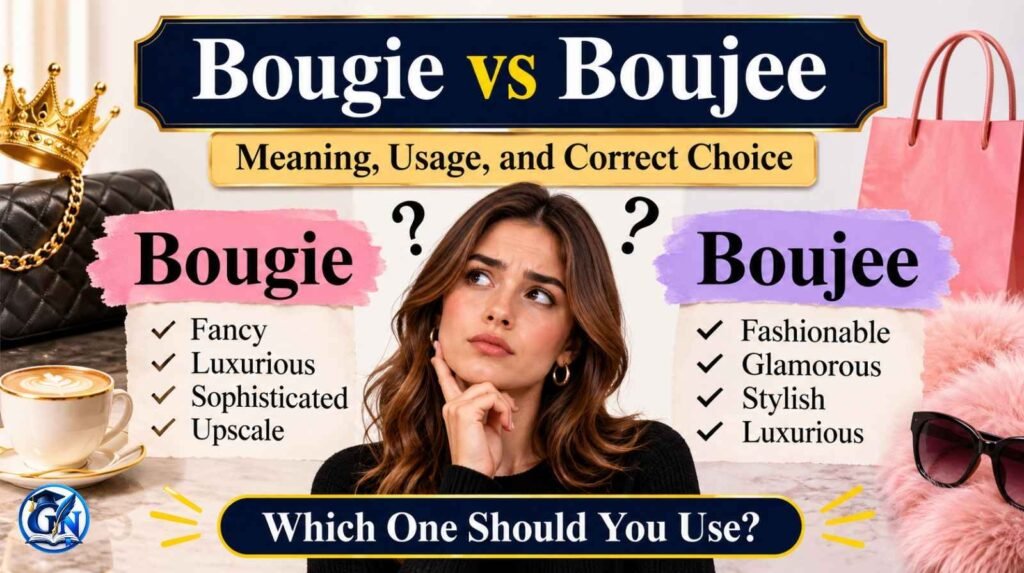
When comparing bougie vs boujee, you may wonder whether these two words mean the same thing or whether one spelling is more correct than the other. You might see someone describe an expensive restaurant as bougie, call a friend’s fashionable outfit boujee, or use either word in a social media caption. Both spellings are widely used in informal English, but their meanings, origins, and typical contexts have some interesting differences.
Understanding these words can help you choose the right expression when writing a text message, posting on social media, describing a lifestyle, or having a casual conversation. Although bougie and boujee are closely related, they can carry slightly different tones depending on the speaker and situation.
In this article, you will learn the meaning of bougie and boujee, their origins, how they are used in everyday English, and which spelling you should choose. You will also find practical examples, including text messages, emails, and everyday scenarios, to help you use both words naturally and confidently.
What Does Bougie Mean?
Bougie is an informal adjective used to describe someone or something that seems fancy, luxurious, expensive, sophisticated, or concerned with appearing upper-class. Depending on the context, the word can express admiration, playful teasing, or criticism.
The word is associated with the French term bourgeoisie, which historically refers to the middle class and, in certain contexts, people associated with wealth, social status, and conventional respectability.
In modern English, however, bougie is often used more casually. Someone might call a café bougie because it serves expensive coffee in stylish cups, or describe a friend as bougie because they prefer luxury hotels and high-end restaurants.
For example:
- “That restaurant is so bougie.” This suggests that the restaurant is stylish, expensive, or luxurious.
- “My sister has bougie taste.” This means that she likes sophisticated or expensive things.
- “He bought a bougie coffee machine.” This suggests that the machine is fancy, premium, or more elaborate than an ordinary one.
The word does not always have a negative meaning. It can be affectionate or humorous, especially when people use it to describe their own preferences.
Examples of Bougie in Everyday Situations
Scenario 1: Talking about a restaurant
Maya and her friend Olivia are choosing a place for dinner. Olivia suggests a restaurant with elegant furniture, expensive meals, and a formal atmosphere.
Maya says:
“That place looks really bougie. Let’s go there for your birthday!”
Here, bougie describes the restaurant’s luxurious appearance and atmosphere. Maya is using the word positively.
Scenario 2: Describing someone’s habits
Daniel usually buys ordinary coffee, but his friend Ethan prefers specialty coffee made with premium beans.
Daniel jokes:
“Ethan has become so bougie. He won’t drink coffee unless it comes from his favorite café.”
In this example, bougie playfully describes Ethan’s particular taste in coffee. It does not necessarily mean Daniel disapproves of his friend’s choices.
Scenario 3: Describing an expensive purchase
Sarah buys a comfortable velvet sofa, a designer lamp, and decorative cushions for her apartment.
Her sister says:
“Your living room looks so bougie now!”
The word suggests that Sarah’s living room looks stylish, expensive, and sophisticated.
What Does Boujee Mean?
Boujee is an informal spelling associated with the same general idea of luxury, wealth, and an upscale lifestyle. It is especially recognizable in contemporary slang, popular culture, music, and social media.
The spelling is strongly associated with African American Vernacular English (AAVE) and became more widely recognized through hip-hop culture. The song Bad and Boujee by Migos, featuring Lil Uzi Vert, helped bring the word to a much broader audience.
In everyday conversation, boujee often describes someone who enjoys looking fashionable, living comfortably, or showing off a luxurious lifestyle. It can also suggest confidence, ambition, or a desire to enjoy the finer things in life.
For example:
- “She’s living her boujee life.” This suggests that she enjoys a stylish or luxurious lifestyle.
- “That outfit looks boujee.” This means the outfit looks fashionable, glamorous, or expensive.
- “We’re having a boujee brunch this Sunday.” This suggests an upscale or stylish brunch experience.
Like bougie, boujee can be complimentary, humorous, or mildly critical. Its tone depends on the situation and the speaker’s intention.
Examples of Boujee in Everyday Situations
Scenario 1: Complimenting a friend’s outfit
Aisha attends a party wearing a stylish dress, elegant shoes, and sparkling accessories.
Her friend Zara tells her:
“Girl, you look so boujee tonight!”
Here, boujee is a compliment. Zara is saying that Aisha looks glamorous, fashionable, and confident.
Scenario 2: Planning a special weekend
Two friends, Noah and Liam, decide to celebrate the end of their exams. Noah suggests booking a luxury hotel, ordering room service, and visiting an upscale restaurant.
Liam replies:
“Let’s make this weekend boujee. We’ve earned it!”
In this context, boujee describes a luxurious, enjoyable experience. The word adds a playful and enthusiastic tone.
Scenario 3: Sharing a social media caption
Emma posts a photograph of herself enjoying a fancy dessert at a stylish café.
She writes:
“Coffee, dessert, and a little boujee energy.”
The word fits the casual, expressive style of social media. It communicates a taste for luxury without requiring a formal explanation.
Bougie vs Boujee: What Is the Difference?
The main difference between bougie vs boujee is not a strict difference in dictionary meaning. Both words can describe luxury, expensive tastes, fashionable things, or an upscale lifestyle.
The distinction is more about spelling, tone, cultural associations, and personal preference.
| Feature | Bougie | Boujee |
|---|---|---|
| General meaning | Fancy, upscale, expensive, or pretentious | Luxurious, fashionable, glamorous, or status-conscious |
| Common tone | Playful, descriptive, sometimes critical | Playful, expressive, often associated with contemporary slang |
| Typical contexts | Everyday conversation, lifestyle descriptions, informal writing | Social media, casual conversations, pop culture, slang |
| Example | “This café is bougie.” | “She’s feeling boujee today.” |
| Formal writing | Usually too informal for professional writing | Usually too informal for professional writing |
| Spelling status | Established informal English spelling | Established slang spelling and variant |
These distinctions are tendencies, not strict rules. A person can use bougie as a compliment and boujee sarcastically. Another speaker might use the two spellings interchangeably.
The important point is that neither spelling has an exclusive claim to the general idea of luxury or upscale taste.
Are Bougie and Boujee Interchangeable?
Yes, bougie and boujee are often interchangeable in casual English, especially when describing expensive tastes, stylish outfits, luxury experiences, or people who enjoy high-end products.
For example, both of these sentences are understandable:
- “This hotel is so bougie.”
- “This hotel is so boujee.”
Both suggest that the hotel feels luxurious, expensive, or upscale.
However, the spelling can affect how the sentence feels. Bougie may appear more familiar in general informal writing, while boujee can give a sentence a more distinctly slang-oriented or pop-culture feel.
Consider these examples:
Example 1: A fashionable outfit
“Your new jacket looks bougie.”
“Your new jacket looks boujee.”
Both sentences can compliment the jacket. The second may sound more playful or expressive to some readers.
Example 2: An expensive restaurant
“That restaurant is too bougie for me.”
“That restaurant is too boujee for me.”
Both sentences suggest that the restaurant feels too fancy, expensive, or pretentious for the speaker’s preferences.
Example 3: A luxury holiday
“We’re planning a bougie vacation.”
“We’re planning a boujee vacation.”
Both sentences describe a holiday involving luxurious accommodation, fine dining, or upscale experiences.
The best choice depends on your audience, your preferred writing style, and the impression you want to create.
When Should You Use Bougie?
Use bougie when you want to describe something as fancy, expensive, sophisticated, or perhaps unnecessarily luxurious. It works well in everyday conversations, informal blog posts, lifestyle discussions, and humorous descriptions.
Here are some practical situations.
Describing a Fancy Restaurant
Imagine that your friend recommends a restaurant with expensive menus, elegant table settings, and premium service.
You might say:
“That restaurant looks a little bougie, but I’d love to try it.”
This sentence uses bougie to describe the restaurant’s upscale atmosphere. The phrase a little softens the judgment and makes the statement sound conversational.
Talking About Expensive Preferences
Suppose your friend only buys premium skincare products and refuses to use ordinary brands.
You might joke:
“Your skincare routine is getting bougie!”
The word describes a preference for higher-end products. Because the sentence is playful, it is unlikely to sound like a serious criticism between close friends.
Writing a Casual Email to a Friend
Suppose you want to invite your friend Sophie to a restaurant for a birthday celebration.
Hi Sophie,,
I found a new restaurant downtown that looks a little bougie, but the food and atmosphere look amazing. Would you like to try it for my birthday dinner on Saturday? We could dress up a bit and make it a special evening. Let me know what you think!
Best, Olivia
In this email, bougie creates a relaxed and friendly tone. It communicates that the restaurant looks upscale without making the invitation sound overly formal.
Describing a Stylish Home
Suppose your cousin has renovated her living room with designer furniture, modern lighting, and expensive decorations.
You might tell her:
“Your new apartment looks so bougie. I love the way you’ve decorated it!”
Here, bougie describes the sophisticated appearance of the home and functions as a compliment.
When Should You Use Boujee?
Use boujee when you want a more slang-oriented, expressive, or playful description of luxury and fashionable living. It is particularly suitable for casual conversations, social media captions, and messages among friends who understand the expression.
Complimenting Someone’s Style
Imagine that your friend Amir arrives at a party wearing a designer jacket and polished shoes.
You say:
“Okay, Amir! You’re looking boujee tonight.”
This sentence sounds playful and complimentary. It suggests that Amir looks fashionable, confident, and well-dressed.
Talking About a Luxury Experience
Suppose you and your friends decide to celebrate a promotion by booking a premium hotel and enjoying a fine-dining experience.
You might say:
“Let’s have a boujee night out to celebrate your promotion!”
Here, boujee adds excitement and emphasizes the upscale nature of the celebration.
Writing a Social Media Caption
Imagine that your friend Mia shares a photograph of a beautifully presented meal at an expensive restaurant.
She could write:
“Living my best life, one boujee dinner at a time.”
This caption uses boujee in a casual, playful way. It suggests that Mia enjoys fine dining and luxurious experiences.
Sending a Casual Text Message
Suppose your friend Daniel asks what you want to do on Saturday.
You could respond:
Let’s do something boujee this weekend 😂 Maybe brunch at that fancy café and then a little shopping?
The word works naturally in this message because the conversation is informal. The emoji reinforces the playful tone.
Can You Use Bougie or Boujee in Professional Emails?
Although both words are common in informal English, neither is usually the best choice for formal or professional communication.
In a business email, academic paper, job application, or official report, it is generally better to choose a more precise word, such as:
- Luxurious — offering comfort and high-quality features.
- Upscale — belonging to a higher-priced or more sophisticated market.
- Elegant — stylish and attractive in a refined way.
- Premium — positioned as a high-quality or higher-priced option.
- Pretentious — trying too hard to appear important, sophisticated, or impressive.
The right alternative depends on what you mean. If you intend a compliment, luxurious or elegant may be appropriate. If you mean that something seems unnecessarily showy, pretentious might communicate your point more accurately.
Professional Email Example
Suppose you work in marketing and need to describe a hotel to your manager, Rebecca.
Instead of writing:
“The hotel looks really boujee, and I think our clients will love it.”
You could write:
Hi Rebecca,
I reviewed the hotel options for our upcoming client event, and the property on Riverside Avenue appears to be an excellent choice. It offers luxurious accommodation, elegant meeting spaces, and premium guest services, which should create a positive impression on our clients. Please let me know if you would like me to prepare a more detailed comparison.
Best regards,
James
This version communicates the same general idea in a professional tone without relying on slang.
Formal Writing Example
Suppose you are writing a report about consumer preferences.
Instead of writing:
“Younger consumers often prefer boujee brands.”
Write:
“Younger consumers may be attracted to premium brands that emphasize quality, exclusivity, and status.”
The revised sentence is more precise and appropriate for formal writing. It also avoids making a broad generalization about all younger consumers.
Is Bougie or Boujee More Correct?
There is no universal rule that makes one spelling correct in every informal context.
Bougie is an established spelling in informal English and is widely used to describe something fancy, expensive, or associated with upscale tastes.
Boujee is also an established slang spelling. It is especially associated with contemporary popular culture and expressive descriptions of wealth, fashion, and luxury.
Neither word is inherently incorrect when used in an appropriate informal context. However, a particular publication, brand, or style guide may prefer one spelling for consistency.
If you are writing for a general audience and want a familiar informal expression, bougie is a reasonable choice. If you are writing a playful social media caption or deliberately using contemporary slang, boujee may better match your intended tone.
For formal communication, consider replacing either word with a more precise alternative.
It is also worth remembering that the words can carry different emotional implications. Describing someone as bougie or boujee might be a compliment in one conversation and a criticism in another. Context matters more than the spelling alone.
Common Mistakes to Avoid When Using Bougie and Boujee
Even though these words are relatively easy to understand, a few common mistakes can make your writing less clear.
Assuming That Boujee Is Always Correct
Some people assume that boujee is the only correct spelling because they have seen it in songs or social media posts.
That is not the case. Bougie is also a recognized informal spelling, and both forms are used in contemporary English.
Instead of treating one as universally correct, consider your audience and the context.
Assuming That Bougie Always Means Wealthy
Calling something bougie does not necessarily mean that the person or object is genuinely wealthy.
For example:
“My friend bought an expensive-looking notebook, and now she thinks she’s bougie.”
This sentence suggests that the friend is adopting a sophisticated image. It does not establish anything about her actual financial situation.
The word often describes a perceived lifestyle, attitude, or taste, rather than a person’s real income or social class.
Using Slang in Formal Documents
Writing boujee in an academic essay or a formal business report may sound too casual.
For example:
Incorrect for a formal report: “The company launched a boujee new product.”
More appropriate: “The company launched a premium product with an upscale design.”
The second sentence is clearer and more professional.
Confusing Luxury With Pretentiousness
Both words can have a critical tone, but they do not always mean that someone is trying to impress others.
For example:
“She likes bougie restaurants” may simply mean that she enjoys upscale dining.
“She is pretentious” is a stronger judgment that suggests she tries to appear more important or sophisticated than she is.
Do not assume that enjoying luxury automatically makes someone pretentious. The surrounding sentence determines the intended meaning.
Switching Spellings Without a Reason
Although the spellings can be interchangeable, switching between them repeatedly in the same article may look inconsistent.
If you are writing a blog post, choose a primary spelling and use it consistently unless you are specifically comparing the two.
For an article about bougie vs boujee, of course, both spellings should appear because the distinction is the subject of the discussion.
Bougie vs Boujee: More Example Sentences
The following examples show how both words can be used naturally in different situations.
| Situation | Example with Bougie | Example with Boujee |
|---|---|---|
| Food | “This is a pretty bougie brunch spot.” | “We’re having a boujee brunch tomorrow.” |
| Fashion | “Her outfit looks bougie.” | “That dress is giving boujee vibes.” |
| Home decor | “They have a bougie kitchen.” | “Your new apartment looks boujee!” |
| Travel | “We booked a bougie hotel.” | “We’re going on a boujee vacation.” |
| Coffee | “This café sells bougie coffee.” | “I feel boujee drinking coffee from this place.” |
| Social events | “That’s a bougie party.” | “Let’s throw a boujee birthday party.” |
| Lifestyle | “He enjoys a bougie lifestyle.” | “She’s embracing her boujee side.” |
| Shopping | “That’s a bougie handbag.” | “I bought a boujee new handbag.” |
These examples illustrate typical informal usage. They are not strict grammatical rules, and the same sentence could often use either spelling.
How to Remember the Difference Between Bougie and Boujee
If you frequently confuse these spellings, a simple way to remember them is to associate each one with its typical writing style.
- Bougie: Think of an informal description of something fancy, upscale, or expensive.
- Boujee: Think of expressive slang used to describe luxury, glamour, fashionable living, or a playful attitude toward wealth.
For example, imagine describing a stylish café in a review for a general lifestyle blog. You might write, “The café has a bougie atmosphere.”
Now imagine posting a photograph of your expensive coffee on social media. You might write, “Feeling boujee today.”
These are useful memory aids, not fixed rules. Both spellings can work in either situation.
Another helpful tip is to ask yourself whether the word fits the audience. In a friendly conversation, slang may make your message sound natural. In a professional report, a word such as upscale, luxurious, or premium is usually more suitable.
Frequently Asked Questions
1. Is Bougie the Same as Boujee?
Yes, bougie and boujee generally have similar meanings. Both describe luxury, expensive tastes, fashionable things, or an upscale lifestyle. Their differences mainly involve spelling, tone, and cultural associations.
2. Is Boujee a Real Word?
Yes, boujee is an established informal slang spelling used in contemporary English, especially in casual conversations, popular culture, and social media. It is less suitable for formal writing.
3. Is Bougie an Insult?
Not necessarily. Bougie can be a compliment, a joke, or a mild criticism, depending on context. It may describe something elegant and luxurious or suggest that someone is overly concerned with appearances and status.
4. What Does Boujee Mean on Social Media?
On social media, boujee often describes a glamorous appearance, expensive taste, or luxurious lifestyle. For example, someone might write, “A little boujee moment” under a photo of a fancy dinner or designer accessories.
5. Which Spelling Should I Use in an Article?
Bougie is a reasonable default for a general informal article, while boujee may suit a more expressive, slang-oriented tone. If your article compares both words, explain each spelling and use them consistently.
6. Can I Use Bougie in a Formal Email?
It is usually better to avoid bougie in formal emails. Use alternatives such as luxurious, elegant, upscale, or premium, depending on your intended meaning. Bougie may be suitable in a friendly, informal email.
7. Does Boujee Mean Rich?
Not exactly. Boujee can suggest a taste for luxury or an upscale lifestyle, but it does not necessarily mean that someone is wealthy. It can describe a person’s style, preferences, or attitude rather than their actual financial status.
Conclusion:
When deciding between bougie vs boujee, remember that both spellings are used in informal English to describe fancy things, luxury, expensive tastes, and upscale lifestyles. The main distinction lies in their spelling, tone, and cultural associations.
Choose bougie when you want a familiar informal description of something fancy, expensive, or sophisticated. Choose boujee when you want a more expressive, slang-oriented tone, particularly in casual conversations, playful messages, and social media captions.
Neither spelling is universally correct for every situation, and neither is inherently wrong in informal use. Your audience, purpose, and intended tone should guide your decision.
Most importantly, avoid using either word in formal writing when a more precise alternative would communicate your meaning better. Words such as luxurious, elegant, upscale, and premium can help you express the same ideas clearly and professionally.
Once you understand these differences, choosing between bougie and boujee becomes much easier.
👉 Explore more useful grammar tips and guides on Gramnora

Explore the world of English grammar with simple explanations, practical examples, and easy-to-follow guides by Zia Tarar, the founder and author of Gramnora. From essential grammar rules and sentence structure to common mistakes and advanced concepts, Gramnora helps learners improve their English, strengthen their writing skills, and communicate with greater clarity and confidence.