
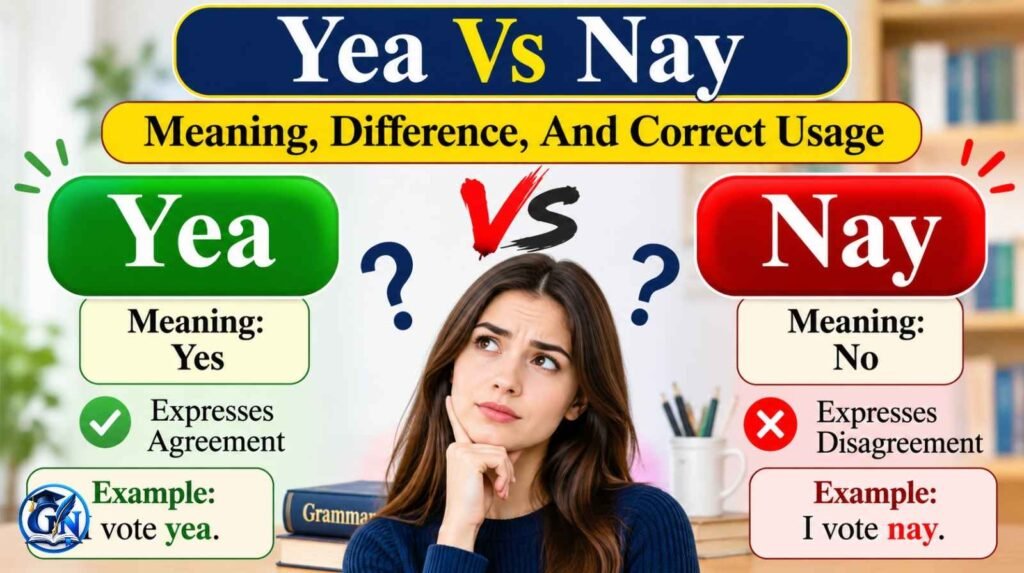
When expressing agreement or disagreement, English offers several words that communicate a person’s opinion. Two interesting examples are Yea Vs Nay. Although they may sound unfamiliar in everyday conversations, these words have a long history in English and are still used in particular situations today.
You may have come across them during a formal vote, a parliamentary discussion, a historical speech, or even a casual conversation. Both words are short, but they communicate opposite responses. Yea expresses an affirmative response, while nay expresses a negative one.
However, their meanings are not always as straightforward as simply saying yes or no. Their usage can depend on context, tone, and the type of communication.
In this article, we will explore the meaning of yea and nay, their differences, pronunciation, practical examples, and situations where each word is appropriate. By the end, you will understand how to use both terms confidently and correctly.
What Does Yea Mean?
Yea is an affirmative word that means yes, indicating agreement, approval, or a positive response. It is commonly associated with formal voting, traditional English, and certain expressions.
Although people sometimes use yea in everyday conversations, it is much more common in formal or ceremonial situations than in ordinary discussions.
For example, when members of a committee vote on a proposal, they may respond with “yea” to show their support.
Example sentences:
- The committee members voted yea on the proposed changes.
- If you agree with the decision, say yea.
- The final result showed 25 yea votes and 10 nay votes.
- Everyone responded with a loud yea when the announcement was made.
In these examples, yea communicates approval or agreement.
How Is Yea Used in Everyday Communication?
Although yea is not the most common replacement for yes in everyday English, it can appear in informal conversations, particularly when someone wants to sound playful, traditional, or enthusiastic.
For example:
Scenario: Talking With a Friend
Suppose your friend asks whether you want to attend a weekend concert.
Friend: Are you coming to the concert on Saturday?
You: Yea! I’ve been waiting for this all week.
Here, yea communicates excitement and agreement.
However, in ordinary messages, most English speakers would simply write “Yes!” instead.
How Is Yea Used in Formal Voting?
One of the most recognized uses of yea is in voting procedures.
During a formal meeting, members may be asked to vote on a particular proposal. Those who support it can say “yea,” while those who oppose it can say “nay.”
Example:
The meeting chairperson asks:
“All those in favor of approving the new office policy, please say yea.”
Members who support the policy respond:
“Yea!”
This usage is particularly common in parliamentary and legislative settings.
What Does Nay Mean?
Nay is a negative response that means no. It is traditionally used to express disagreement, rejection, or opposition to a suggestion, proposal, or decision.
Like yea, nay is strongly associated with formal voting and traditional English. It is less common in everyday conversations, where people generally prefer the word no.
Example sentences:
- The members voted nay on the proposed budget.
- If you disagree with the motion, your answer should be nay.
- The final count included 15 yea votes and 8 nay votes.
- She answered nay when asked whether she supported the proposal.
In each example, nay indicates disagreement or a negative response.
How Is Nay Used in Everyday Communication?
Nay can occasionally appear in casual conversations, particularly when someone wants to add humor or a slightly old-fashioned tone to their response.
Scenario: Talking With a Friend
Imagine your friend suggests ordering expensive food for dinner.
Friend: Should we spend $100 on dinner tonight?
You: Nay! Let’s save some money and cook at home.
Here, nay communicates disagreement with the suggestion.
Although this sentence is understandable, saying “No!” would sound more natural in most everyday conversations.
How Is Nay Used in Formal Voting?
Nay is frequently paired with yea in voting situations.
When a proposal is presented, members who oppose it may respond with nay.
Example:
Meeting Chairperson: All those against the proposed changes, please say nay.
Committee Members: Nay!
This response indicates that those members do not support the proposal.
Yea Vs Nay: What Is the Main Difference?
The primary difference between yea and nay is their meaning. Yea expresses agreement, while nay expresses disagreement.
Both words are traditionally used in formal voting, but they communicate opposite positions.
Here is a simple comparison:
| Feature | Yea | Nay |
|---|---|---|
| Meaning | Yes | No |
| Purpose | Agreement | Disagreement |
| Response type | Affirmative | Negative |
| Common usage | Formal voting | Formal voting |
| Opposite word | Nay | Yea |
| Everyday alternative | Yes | No |
| Tone | Traditional or formal | Traditional or formal |
For example:
- Yea: I support the proposed changes.
- Nay: I do not support the proposed changes.
Understanding this distinction makes it easier to use both words correctly.
Yea Vs Nay in Email Communication
When writing professional emails, choosing the right words can help make your message clear and appropriate.
Although yea and nay are recognizable English words, they are not usually the best choices for ordinary workplace emails. Most professional communication benefits from straightforward language.
However, you may encounter these words when discussing voting, approvals, or decisions.
Example 1: Using Yea in an Email
Imagine that a company is asking employees to approve a new workplace schedule.
Subject: Approval of the New Work Schedule
Hi Daniel,
I have reviewed the proposed work schedule, and I support the changes. The updated arrangement looks practical and should make our daily tasks easier to manage. My vote is yea.
Best regards,
Michael
In this example, yea communicates approval of the proposed schedule.
Example 2: Using Nay in an Email
Suppose an employee disagrees with a suggested change to the company’s working hours.
Subject: Feedback on the Proposed Working Hours
Hi Sarah,
Thank you for sharing the proposed changes to our working hours. After reviewing the schedule, I don’t think the new arrangement will work well for our team. My vote is nay because the current schedule better supports our responsibilities.
Best regards,
James
Here, nay expresses disagreement in a formal voting context.
Example 3: Using Yes and No Instead
For ordinary professional emails, yes and no are usually more natural.
Subject: Confirmation of Meeting Attendance
Hi Emily,
Thank you for inviting me to the meeting scheduled for Thursday. I have checked my calendar, and I am available to attend. Yes, I will be there.
Best regards,
Robert
This example demonstrates why everyday professional communication generally favors yes over yea.
When Should You Use Yea?
Use yea when you want to express an affirmative response, particularly in traditional or formal voting situations.
Here are some situations where the word is appropriate:
During Formal Voting
When members of a committee, organization, or legislative body vote on a proposal, yea is an appropriate response.
Example:
The board members voted yea to approve the company’s annual budget.
In Historical or Traditional Language
Yea may appear in historical texts, speeches, religious writing, and traditional expressions.
Example:
The speaker declared that the proposal deserved a resounding yea.
In Informal Conversations for a Playful Tone
You can use yea in casual conversations when you want to sound enthusiastic or humorous.
Example:
Friend: Are you ready for our road trip?
You: Yea! Let’s get going.
However, yes remains the more widely accepted everyday choice.
When Should You Use Nay?
Use nay when you want to express a negative response, particularly when opposing a proposal or voting against a decision.
Consider these situations:
During Formal Voting
Nay is suitable when a committee or organization needs to record votes against a particular proposal.
Example:
Three members voted nay because they disagreed with the proposed changes.
In Traditional or Historical Writing
Nay is sometimes used in historical documents, speeches, and traditional expressions.
Example:
The leader answered nay and refused to accept the agreement.
In Casual Conversations
You can occasionally use nay humorously or playfully when responding negatively.
Example:
Friend: Do you want to wake up at 5 a.m. tomorrow?
You: Nay! That’s far too early for me.
For everyday conversations, however, no is generally the more natural option.
Are Yea and Yeah the Same?
No. Although yea and yeah look similar, they are different words with different usage patterns.
Yea traditionally means yes and is commonly associated with formal voting.
Yeah is an informal way of saying yes. It is widely used in everyday conversations, text messages, and casual communication.
Consider these examples:
- Yea: The committee voted yea on the proposal.
- Yeah: Yeah, I would love to join you for lunch.
The distinction is important because using yea instead of yeah in a casual conversation may make your writing sound unnecessarily formal or unusual.
Similarly, using yeah in an official voting record may not be appropriate.
Is Yea More Formal Than Yes?
Yea is more traditional and specialized than yes, but that does not necessarily make it more formal in every situation.
Yes is the standard affirmative response used in professional emails, academic writing, business communication, and everyday conversations.
Yea is mainly appropriate in voting procedures and certain traditional expressions.
For example:
- Professional: Yes, I approve the proposed changes.
- Formal voting: My vote is yea.
Both responses communicate agreement, but their contexts are different.
Is Nay More Formal Than No?
Nay is a traditional alternative to no, but it is not necessarily more professional or appropriate in every formal situation.
In modern business communication, no is generally clearer and more natural.
For example:
Less natural:
Nay, I cannot attend the scheduled meeting.
More natural:
No, I cannot attend the scheduled meeting because I have another commitment.
However, in a formal voting situation, nay is perfectly appropriate.
Example:
The final voting record showed 18 yea votes and 6 nay votes.
Common Mistakes to Avoid When Using Yea and Nay
Although these words are relatively easy to understand, people sometimes confuse them with other English expressions.
Here are a few mistakes worth avoiding.
Confusing Yea With Yeah
Yea and yeah are not interchangeable in every situation.
Use yea for traditional affirmative voting and yeah for informal agreement.
Using Nay in Ordinary Professional Emails
Nay may sound unusual when used in everyday business correspondence.
Instead of writing:
“Nay, I cannot approve your request.”
Write:
“No, I cannot approve your request at this time.”
Thinking Yea and Nay Are Modern Everyday Words
Both words are still used, but they are not as common as yes and no in everyday English.
Understanding their specific contexts helps you avoid awkward sentences.
Assuming Nay Always Sounds Rude
Nay is not inherently rude. It simply communicates a negative response.
However, the tone of the surrounding sentence can influence how the message is received.
For example, “Nay, I disagree with the proposal” is a direct response, while “I respectfully disagree with the proposal” sounds more suitable for many professional situations.
Frequently Asked Questions
1. Is Yea the Same as Yes?
Yes. Yea traditionally means yes and expresses agreement or approval. However, it is more commonly used in formal voting and traditional expressions, while yes is the standard word for everyday communication.
2. Is Nay the Same as No?
Yes. Nay means no and communicates disagreement or opposition. It is particularly common in traditional voting procedures, where members use it to indicate that they do not support a proposal.
3. Which Is Correct, Yea or Nay?
Both yea and nay are correct English words. They have opposite meanings: yea means yes, while nay means no. The appropriate choice depends on whether you want to express agreement or disagreement.
4. Can I Use Yea and Nay in Everyday Conversations?
Yes. You can use both words in everyday conversations, especially when speaking playfully or humorously. However, yes and no are more natural and widely used in modern English.
5. What Is the Difference Between Yea and Yeah?
Yea is a traditional affirmative response commonly used in voting, while yeah is an informal alternative to yes. Although they communicate agreement, their usage and tone are different.
6. Is Yea a Formal Word?
Yea is a traditional English word associated with formal voting and certain historical expressions. However, it is not necessarily more appropriate than yes in professional communication.
7. Is Nay an Old-Fashioned Word?
Nay is considered somewhat old-fashioned in everyday English. Nevertheless, it remains relevant in formal voting, historical writing, and situations where a traditional style is preferred.
8. What Is the Plural of Yea and Nay?
When discussing voting results, the plural forms are yeas and nays. For example, “The proposal received 20 yeas and 5 nays.” These forms refer to affirmative and negative votes.
Conclusion
Understanding yea vs nay is simple once you recognize their opposite meanings and appropriate contexts. Yea means yes and expresses agreement, while nay means no and communicates disagreement.
Both words remain relevant, particularly in formal voting, traditional expressions, and historical writing. However, they are less common in everyday English, where yes and no are generally preferred.
If you are writing a professional email, having a casual conversation, or communicating with friends, choose words that sound natural for your situation. Use yea and nay when their traditional voting context or distinctive tone is appropriate, and use yes and no for most everyday communication.
The key is not just knowing what these words mean but understanding when and how to use them correctly.
👉 Explore more useful grammar tips and guides on Gramnora

Explore the world of English grammar with simple explanations, practical examples, and easy-to-follow guides by Zia Tarar, the founder and author of Gramnora. From essential grammar rules and sentence structure to common mistakes and advanced concepts, Gramnora helps learners improve their English, strengthen their writing skills, and communicate with greater clarity and confidence.