
Have you ever written a sentence and suddenly wondered whether Your vs You’re is correct? You are not alone. Your vs you’re is one of those small English grammar questions that can cause surprisingly big confusion.
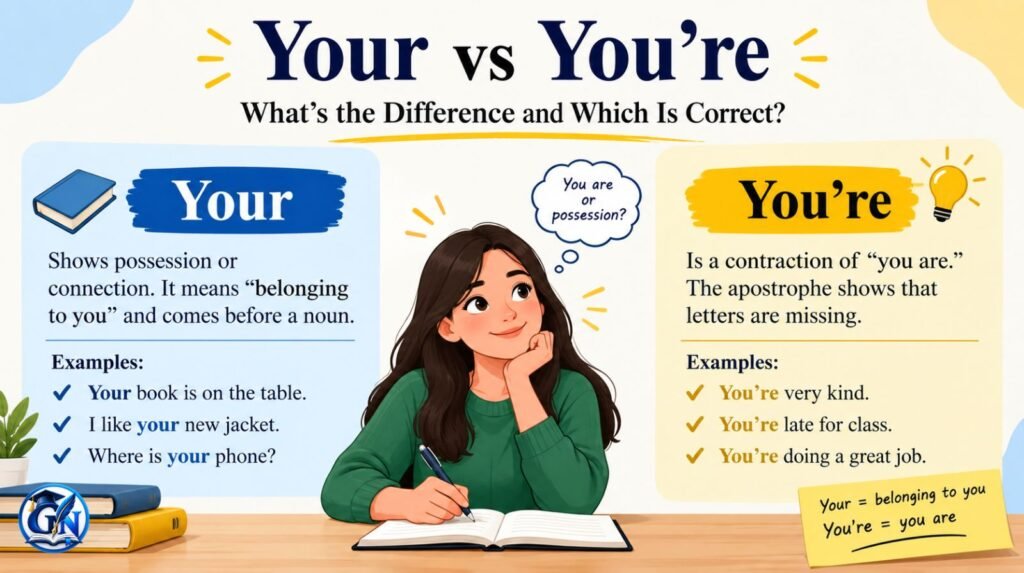
The good news is that the difference is actually simple. Your shows that something belongs to or is connected with someone. You’re is the shortened form of you are.
For example:
- Your phone is ringing.
- You’re late for class.
Both words sound alike in normal speech, but they perform completely different jobs in a sentence. Once you learn one simple replacement test, choosing the correct word becomes much easier.
What Is the Difference Between Your and You’re?
The easiest way to understand your vs you’re is to look at what each word means.
Your Means “Belonging to You”
Your is a possessive determiner. It is used before a noun to show that something belongs to, relates to, or is associated with the person being addressed.
Examples:
- Is this your book?
- I like your new jacket.
- Where is your car?
- Please check your email.
- What is your opinion?
In each sentence, your comes before a noun and tells us that the noun is connected with “you.”
Cambridge Grammar explains that your is used as a determiner and normally comes before a noun, such as in “your letter” or “your house.”
You’re Means “You Are”
You’re is a contraction of you are. The apostrophe represents letters removed from the original phrase.
Examples:
- You’re very kind. → You are very kind.
- You’re late. → You are late.
- You’re my best friend. → You are my best friend.
- You’re doing a great job. → You are doing a great job.
Cambridge Dictionary defines you’re as the short form of you are, while Cambridge Grammar explains that ’re is used as a contraction of are.
The Quickest Way to Remember
Think of the two words this way:
Your = belonging to you
You’re = you are
If you can replace the word with you are, use you’re.
If replacing it with you are makes the sentence incorrect, you probably need your.
Your vs You’re: The Simple Rule That Works
The most useful trick for your vs you’re is the “you are” test.
Step 1: Replace the Word With “You Are”
Look at this sentence:
You’re going to enjoy the movie.
Replace you’re with you are:
You are going to enjoy the movie.
The sentence still makes perfect sense. Therefore, you’re is correct.
Now consider:
I like you’re new shoes.
Replace you’re with you are:
I like you are new shoes.
That does not make sense. Therefore, you’re is incorrect. The correct sentence is:
I like your new shoes.
Step 2: Check What Comes After “Your”
If the word is showing possession and is followed by a noun, your is usually the right choice.
Examples:
| Sentence | Correct Word | Why? |
|---|---|---|
| I like ___ house. | your | The house belongs to you. |
| ___ very helpful. | you’re | Means “you are.” |
| Where is ___ phone? | your | The phone belongs to you. |
| ___ going home. | you’re | Means “you are.” |
| Is this ___ bag? | your | Shows possession. |
| ___ absolutely right. | you’re | Means “you are.” |
Step 3: Remember That the Apostrophe Matters
The apostrophe in you’re is not decorative. It signals that the word is a contraction.
You’re = you are
The apostrophe takes the place of the missing a in are.
This is consistent with the general rule for contractions: an apostrophe is commonly used where letters have been omitted.
Common Your vs You’re Mistakes
Because your and you’re sound alike, writers can easily choose the wrong spelling when writing quickly.
Mistake 1: “Your Amazing”
❌ Your amazing!
This is incorrect if the intended meaning is “You are amazing.”
✅ You’re amazing!
The sentence can be expanded to:
You are amazing!
Therefore, you’re is correct.
Mistake 2: “You’re Book”
❌ Where is you’re book?
Here, the writer means a book belonging to someone.
The correct version is:
✅ Where is your book?
You cannot say:
Where is you are book?
So your is required.
Mistake 3: “Your Going to Love It”
❌ Your going to love it.
The intended meaning is:
You are going to love it.
Therefore:
✅ You’re going to love it.
Mistake 4: “I Like You’re Idea”
❌ I like you’re idea.
The intended meaning is an idea belonging to the person.
✅ I like your idea.
Here, your modifies the noun idea.
Why Do People Confuse Your and You’re?
The confusion is understandable because your and you’re are pronounced alike or very similarly in many varieties of English.
They Sound the Same
When someone says:
“Your welcome.”
and
“You’re welcome.”
you may hear almost the same sound.
But in writing, the meanings are different.
- Your welcome → describes something belonging to you, but the sentence is incomplete or incorrect in the intended expression.
- You’re welcome → means You are welcome.
This is why listening alone cannot always help you distinguish the two words.
Both Words Are Real English Words
Another reason the mistake survives spell-checking is that your and you’re are both correctly spelled English words.
A spell-checker may not recognize that you selected the wrong word for the sentence.
For example:
Your going to win.
Every individual word is spelled correctly, but the sentence contains a grammatical error.
The correct version is:
You’re going to win.
Fast Writing Makes the Problem Worse
People often write emails, comments, messages, and social media posts quickly. When writing speed is high, it is easy to choose a familiar spelling without checking its grammatical function.
The solution is not to memorize dozens of complicated rules. Instead, use the you are test whenever you hesitate.
Your vs You’re: 2025–2026 Grammar Evidence
Recent writing research and current grammar resources show that basic grammatical accuracy remains an important challenge for English learners and writers.
What Recent Research Shows
A 2025 study of 140 Pakistani undergraduate ESL learners at the National University of Modern Languages in Faisalabad examined grammatical errors in student writing. The researchers reported improvements in areas such as punctuation, subject–verb agreement, and lexical accuracy, while some difficulties—including tense consistency, preposition use, and sentence fragmentation persisted.
Another 2025 study analyzed 40 student writing samples and identified 78 grammatical and mechanical errors. The most frequent categories included capitalization, verbs, and nouns, with errors also occurring in pronouns, articles, adjectives, and prepositions.
A separate 2025 study of 50 university essays in Kosovo reported 894 grammatical errors, including punctuation errors at 52.7%, run-on sentence errors at 17.9%, preposition errors at 13.2%, and article errors at 12.5%.
These studies do not establish a specific percentage for your/you’re errors. However, they provide useful current evidence that grammatical accuracy and word-choice problems remain relevant areas for English learners.
Current language resources also continue to identify your vs. you’re as a common English mistake. LanguageTool’s guide, published in 2025 and revised in 2026, lists “Your vs. You’re” among its common English grammar mistakes.
What This Means for Everyday Writers
The practical lesson is simple: small grammar choices can make writing clearer and more polished.
Whether you are writing:
- a school assignment,
- a job application,
- an email,
- a blog post,
- a social media caption, or
- an important message,
choosing your or you’re correctly helps your writing communicate exactly what you mean.
A Real-Life Example: The One-Word Mistake That Changed the Message
Imagine that a student named Daniel is preparing an important email to his professor.
He writes:
“Your one of the best teachers I’ve ever had.”
Daniel knows exactly what he wants to say. He wants to tell his professor, “You are one of the best teachers I’ve ever had.” However, he accidentally chooses your instead of you’re.
At first glance, the mistake may seem tiny. After all, both words sound almost identical when spoken. But the grammatical role is completely different.
Your needs to connect something to the person being addressed. For example:
“Your lessons are easy to understand.”
Here, your describes whose lessons they are.
Daniel’s original sentence needs a contraction:
“You’re one of the best teachers I’ve ever had.”
Now apply the replacement test:
You are one of the best teachers I’ve ever had.
The sentence works perfectly.
This example shows why proofreading should focus on meaning, not just spelling. A computer can recognize that your is spelled correctly, but it may not know that the writer intended you’re.
Daniel can avoid the problem by developing a simple habit. Whenever he sees your or you’re during proofreading, he can temporarily replace you’re with you are. If the expanded sentence works, you’re is correct. If it does not, he should consider your.
The same method works in professional emails, academic assignments, blog posts, and everyday messages. It takes only a few seconds and can prevent one of the most recognizable English word-choice mistakes.
Your vs You’re Comparison Table
Here is a quick reference you can bookmark:
| Feature | Your | You’re |
|---|---|---|
| Meaning | Belonging to you | You are |
| Type | Possessive determiner | Contraction |
| Apostrophe | No | Yes |
| Usually followed by | A noun | An adjective, noun, verb phrase, etc. |
| Example | Your car is outside. | You’re late. |
| Quick test | Ask “Does it show possession?” | Replace with “you are” |
Your Examples
- Your phone is on the table.
- I love your new haircut.
- What is your name?
- Please bring your passport.
- Your idea sounds interesting.
You’re Examples
- You’re very talented.
- You’re going to enjoy this.
- You’re the person I need.
- You’re doing well.
- You’re absolutely right.
How to Remember Your vs You’re Every Time
You do not need a complicated grammar formula. Use these three simple steps.
Use “Your” for Possession
Ask:
Does this word show that something belongs to or relates to you?
If yes, use your.
Your laptop
Your house
Your friend
Your answer
Use “You’re” for “You Are”
Ask:
Can I replace the word with “you are”?
If yes, use you’re.
You’re happy.
→ You are happy.
You’re working hard.
→ You are working hard.
You’re my best friend.
→ You are my best friend.
Use the 5-Second Proofreading Trick
When proofreading, scan specifically for your and you’re.
For every you’re, expand it:
you’re → you are
If the sentence still works, keep it.
If it does not, check whether your is needed.
This simple habit is especially useful for students, bloggers, professionals, and English learners.
FAQs
Q1: Is “your” or “you’re” correct?
A: Both are correct English words, but they are used differently. Your shows possession or association, while you’re means you are.
Q2: What is the easiest way to remember your vs you’re?
A: Remember:
Your = belonging to you
You’re = you are
When uncertain, replace you’re with you are. If the sentence still makes sense, use you’re.
Q3: Is “your welcome” correct?
A: No, not when you are responding to someone who has thanked you. The correct phrase is:
You’re welcome.
It means:
You are welcome.
Q4: Is “you’re” a possessive word?
A: No. You’re is a contraction of you are. Your is the word used to show possession or association.
Q5: Can “your” come before a noun?
A: Yes. In standard English, your normally comes before a noun or noun phrase.
Examples:
- your car
- your idea
- your friend
- your English teacher
Cambridge Grammar describes your as a determiner used before a noun.
Q6: Why do your and you’re sound the same?
A: They are homophonous or near-homophonous in many varieties of English, meaning they have the same or very similar pronunciation. Their different meanings therefore become much clearer in writing than in speech.
Q7: Can I use “you’re” in formal writing?
A: Yes, you’re is grammatically correct in formal writing when the meaning is you are. However, some formal styles may prefer fewer contractions and use you are instead. Cambridge notes that contractions are common in everyday speech and informal writing and may be less appropriate in some formal contexts.
Q8: What is the difference between your, you’re, and yours?
A: Your shows possession and normally comes before a noun:
Your book is here.
Yours is a possessive pronoun that can stand in place of a noun:
The book is yours.
You’re means you are:
You’re reading a book.
Conclusion:
The difference between your vs you’re is much easier once you focus on meaning instead of pronunciation.
Remember the golden rule:
Your = belonging to you
You’re = you are
If you’re unsure, use the “you are” test. Replace you’re with you are. If the sentence still makes sense, you’re is correct. If it does not, your is probably the word you need.
For example:
- Your car is new. ✅
- You’re driving a new car. ✅
- Your very kind. ❌
- You’re very kind. ✅
This is a small grammar distinction, but getting it right can make your writing look clearer, more polished, and more professional.
Google’s current Search guidance emphasizes useful, accurate, people-first content and advises creators to make information genuinely helpful rather than writing primarily for search engines.
So, before you hit Send, Publish, or Submit, take five seconds to check your your and you’re. That tiny habit can save you from a very common English mistake.
👉 Discover more simple and practical grammar guides on Gramnora

Explore the world of English grammar with simple explanations, practical examples, and easy-to-follow guides by Zia Tarar, the founder and author of Gramnora. From essential grammar rules and sentence structure to common mistakes and advanced concepts, Gramnora helps learners improve their English, strengthen their writing skills, and communicate with greater clarity and confidence.