
If you have ever paused while writing a sentence and wondered whether who vs whom is correct, you are not alone. Even fluent English speakers sometimes hesitate between these two pronouns. The good news is that the basic difference is much easier to understand than it first appears.
In U.S. English, who generally functions as a subject, while whom functions as an object. However, everyday American English often favors who, especially in conversation. Understanding when each form is appropriate can help you write clearer emails, essays, professional documents, and formal communication.
In this guide, you will learn the difference between who and whom, the most important usage rules, a simple replacement trick, common mistakes, and plenty of real-world examples.
Who vs Whom: What Is the Difference?
The simplest way to understand who vs whom is to look at their grammatical roles.
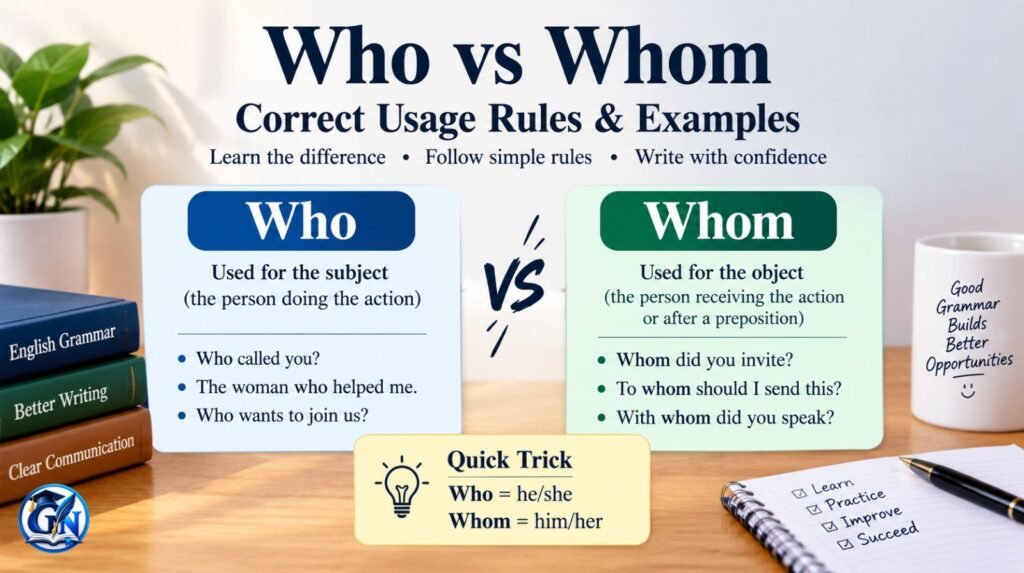
Who is the subjective form. It normally refers to the person performing an action.
Whom is the objective form. It normally refers to the person receiving an action or following a preposition.
Purdue OWL’s pronoun-case guide gives the basic pattern as who → subject, whom → object, whose → possession.
Who Is the Subject Pronoun?
Use who when the person is doing the action.
Examples:
- Who called you last night?
- Who wrote this report?
- Who opened the door?
- The woman who helped me was very kind.
- I know someone who works at the university.
Consider this sentence:
Who sent the email?
The unknown person performed the action of sending. Therefore, who is correct.
Whom Is the Object Pronoun?
Use whom when the person receives the action or is the object of a preposition.
Examples:
- Whom did you invite?
- Whom did you call?
- To whom should I send the application?
- The person whom I contacted replied quickly.
- The manager with whom I worked was helpful.
For example:
Whom did you invite to the meeting?
The person being asked about received the action of being invited. Therefore, whom is the traditional formal choice.
The Easy He/Him Test
When you are unsure, replace who/whom with he/him or she/her.
- If he/she sounds correct → use who.
- If him/her sounds correct → use whom.
Example:
Who/Whom called?
Try:
He called. ✅
Therefore:
Who called? ✅
Now try:
Who/Whom did you call?
Replace the pronoun:
You called him. ✅
Therefore:
Whom did you call? ✅
This simple test is one of the most useful ways to remember the difference.
When to Use Who in U.S. English
In modern American English, who is extremely common. It is not limited to questions; it can also introduce relative clauses describing people.
Purdue OWL notes that in American English, whom is not used very often and is more formal than who, particularly in conversational usage.
Use Who for the Person Doing the Action
Use who when the pronoun acts as the subject of the clause.
Examples:
- The student who won the award is my cousin.
- I met a doctor who specializes in surgery.
- She is the person who organized the event.
- Who wants to join us?
- Do you know who made this decision?
Notice the difference:
The woman who called me left a message.
The woman performed the action of calling, so who is correct.
Who Is Common in Everyday Questions
American English frequently uses who in ordinary conversation, even when traditional grammar would classify it as an object.
For example:
Who did you meet?
Traditional formal grammar would favor:
Whom did you meet?
However, Who did you meet? is completely natural in everyday American English.
Cambridge likewise explains that whom is used for objects in formal styles and is much less common in ordinary speech.
Who in Relative Clauses
Who commonly introduces a clause describing a person.
Examples:
- She is the teacher who inspired me.
- I hired an employee who has excellent communication skills.
- The man who lives next door is a firefighter.
- We spoke with a customer who had a question.
Here, who is performing the action inside the relative clause.
When to Use Whom in U.S. English
Although whom is less common than who, it has not disappeared from American English. It remains especially useful in formal writing and after prepositions.
Use Whom as the Object of a Verb
When the person is receiving the action, whom is the traditional objective form.
Examples:
- Whom did you invite?
- Whom did she interview?
- Whom are they hiring?
- Whom did the committee select?
Try the replacement test:
The committee selected him.
Therefore:
Whom did the committee select?
Use Whom After a Preposition
One of the clearest situations for whom is when it directly follows a preposition.
Examples:
- To whom should I address this letter?
- With whom did you speak?
- For whom was this gift purchased?
- By whom was the decision made?
- From whom did you receive the information?
Purdue OWL specifically identifies whom as the objective form and gives formal examples such as “To whom am I talking?
Whom in Formal and Professional Writing
Whom can be particularly appropriate in formal documents, legal writing, academic prose, official correspondence, and carefully edited text.
For example:
To whom it may concern:
This traditional expression remains common in formal letters.
Another example:
The candidate whom we interviewed had extensive experience.
In casual conversation, however, many Americans would naturally say:
The candidate who we interviewed had extensive experience.
The difference is largely one of grammatical case and formality rather than meaning.
Who vs Whom: Quick Comparison Guide
The following table makes the distinction easier to remember.
| Situation | Use | Example |
|---|---|---|
| Subject of a verb | Who | Who called you? |
| Person performing an action | Who | Who wrote the letter? |
| Object of a verb | Whom | Whom did you invite? |
| Object after a preposition | Whom | To whom did you speak? |
| Everyday conversation | Usually who | Who did you meet? |
| Formal writing | Whom may be preferred | Whom did you contact? |
| Relative clause subject | Who | The woman who called me |
| Relative clause object | Whom in formal usage | The woman whom I called |
The Fastest Rule to Remember
Think:
Who = he/she
Whom = him/her
For example:
Who called?
→ She called.
Whom did you call?
→ You called her.
That is the core rule behind who vs whom.
Who vs Whom in Real-Life American English
Understanding grammar rules is useful, but real-world usage matters too. A writer should know not only what traditional grammar recommends, but also how Americans actually use these forms.
Case Study: A Professional Email
Imagine that an employee is writing to a company’s human resources department.
The employee wants to ask:
Who should I contact about my benefits?
This is clearly natural American English. The employee is asking which person should perform the action of contacting or helping, so who works naturally.
Now consider a more formal sentence:
To whom should I send my benefits documentation?
Here, whom follows the preposition to, making it the traditional objective form.
The two sentences demonstrate an important distinction. Who is not simply the “casual version” of every sentence, and whom is not automatically required whenever a question involves a person. The grammatical role still matters.
Consider another example. A manager writes:
I would like to thank the employee who completed the project.
Here, who is correct because the employee completed the project.
But:
I would like to thank the employee whom the manager praised.
In this sentence, whom is the object of praised: the manager praised him/her.
In everyday American conversation, however, many speakers would simply say:
I would like to thank the employee who the manager praised.
This reflects an important feature of modern U.S. English: who is increasingly common where traditional formal grammar would use whom. LanguageTool’s 2026 revision similarly describes whom as declining in everyday English while remaining relevant in formal writing.
Therefore, a good writer should understand both the traditional rule and current usage. If you are writing a formal letter, academic paper, or official document, whom can provide grammatical precision. If you are writing conversationally, who will often sound more natural.
Who vs Whom: What Does the Data Tell Us?
There is no single annual 2025–2026 government statistic that measures how often Americans correctly choose who versus whom. Therefore, it would be misleading to invent a percentage for current usage.
However, corpus research provides useful evidence about the long-term pattern. A corpus-based study comparing American English samples from 1961, 1992, and 2006 found whom to be far less frequent than who in the American data. In the study’s American corpora, who occurred 2,164 times in 1961 and 2,436 times in 2006, while whom occurred 140 times and 141 times respectively.
More recent 2025–2026 language guidance continues to describe the same broad pattern. Collins wrote in May 2025 that whom is a formal word while who is generally acceptable in standard English, and LanguageTool’s March 2026 revision notes that whom is becoming less common in everyday English.
What This Means for U.S. Writers
The practical takeaway is simple:
- Who is the normal choice for subjects.
- Whom is the traditional object form.
- Who is widely used instead of whom in informal American speech.
- Whom remains useful in formal writing.
- To whom, with whom, and similar constructions remain especially recognizable in formal English.
So, rather than asking whether whom is “dead,” it is more accurate to say that its use is more restricted and formal.
Common Who vs Whom Mistakes
Knowing the rules is only half the battle. You also need to recognize common mistakes.
Mistake 1: Using Whom as the Subject
Incorrect:
Whom called the office?
Correct:
Who called the office?
Why? The person called the office. The person is performing the action.
Mistake 2: Always Using Who
Although who is common in modern American English, formal writing may still require or strongly favor whom.
For example:
Who should I send the application to?
This is natural and common.
But in a highly formal context:
To whom should I send the application?
The second version follows traditional formal grammar.
Mistake 3: Using Whom Without Checking the Sentence
Some writers assume that whom always sounds more intelligent or professional.
That can lead to errors.
Incorrect:
Whom is coming to the meeting?
Correct:
Who is coming to the meeting?
Use the he/him test:
He is coming.
Therefore, who is correct.
Mistake 4: Forgetting the Preposition
Compare:
To whom did you speak?
with:
Who did you speak to?
Both are commonly encountered in English, but the first is more formal. Cambridge explains that whom is especially associated with formal usage and prepositions.
A Step-by-Step Guide to Choosing Who or Whom
When you are unsure, follow these steps.
Step 1: Find the Verb
Identify the action in the sentence.
Example:
Who/whom contacted the manager?
The verb is contacted.
Step 2: Ask Who Performed the Action
If the missing person performed the action, choose who.
Who contacted the manager?
She contacted the manager.
Step 3: Check Whether the Person Receives the Action
If the person receives the action, traditional grammar calls for whom.
Whom did the manager contact?
The manager contacted her.
Step 4: Look for a Preposition
Words such as to, for, with, by, from, about, and between can signal an object.
To whom did you send the email?
With whom did you travel?
Step 5: Consider the Level of Formality
If you are writing an academic paper, official letter, legal document, or highly formal business communication, whom may be preferable where it is grammatically appropriate.
For everyday conversation, who is often the more natural choice.
FAQs
Is it who or whom?
It depends on the grammatical role. Use who for a subject and traditionally use whom for an object. The easiest test is to substitute he/she or him/her.
Is “Who did you call?” grammatically correct?
Yes. It is standard and extremely common in modern American English. Traditional formal grammar would use “Whom did you call?”, but who is widely accepted in ordinary usage.
Should I use who or whom after “to”?
In formal grammar, use whom after to:
To whom did you speak?
However, everyday American English commonly places the preposition at the end:
Who did you speak to?
Is “whom” still used in American English?
Yes. Whom remains in use, particularly in formal writing and constructions following prepositions. It is much less common in casual speech.
What is the easiest way to remember who vs whom?
Use the he/him test:
He/she → who
Him/her → whom
For example, “She called” gives you Who called? “I called him” gives you Whom did I call?
Is “who” replacing “whom”?
In many informal contexts, yes. Modern English increasingly uses who where traditional grammar would use whom, especially in conversation and when a preposition is placed at the end of a sentence. Current grammar references continue to recognize this variation. (Purdue OWL)
Which is more formal, who or whom?
Whom is generally more formal. It is especially common in constructions such as to whom, for whom, and with whom.
Do native English speakers always use whom correctly?
No. Many native speakers rarely use whom in everyday conversation. Because modern American English often favors who, even fluent speakers may avoid whom altogether when a sentence feels complicated.
Conclusion:
The difference between who vs whom becomes much easier once you focus on grammatical function instead of memorizing dozens of isolated rules.
Use who when the person is performing the action:
Who called you?
Use whom when the person is the object of a verb or preposition, especially in formal writing:
Whom did you call?
To whom did you speak?
When you’re uncertain, use the he/him test. If he or she fits, choose who. If him or her fits, choose whom.
Most importantly, remember that U.S. English is flexible. Whom remains grammatically useful, but who is extremely common in everyday American communication. Knowing both forms allows you to adjust your writing naturally to the situation.
👉 Discover more simple and practical grammar guides on Gramnora

Explore the world of English grammar with simple explanations, practical examples, and easy-to-follow guides by Zia Tarar, the founder and author of Gramnora. From essential grammar rules and sentence structure to common mistakes and advanced concepts, Gramnora helps learners improve their English, strengthen their writing skills, and communicate with greater clarity and confidence.