
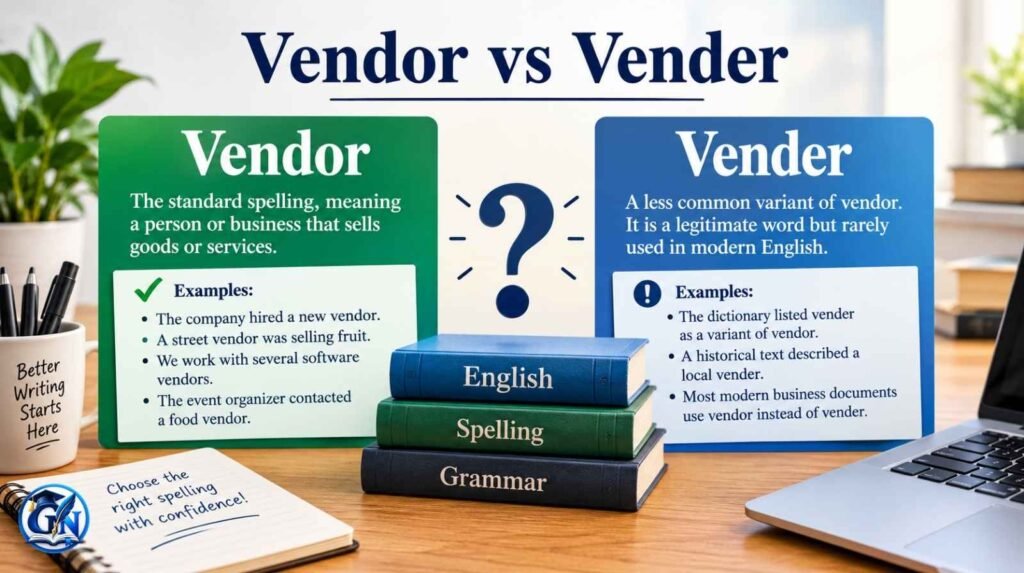
Have you ever wondered whether Vendor vs Vender is the correct spelling? These two words look almost identical, making it easy to confuse them when writing emails, business documents, school assignments, or online content.
The good news is that vendor is the standard and widely accepted spelling in modern English, especially in American English. It refers to a person or business that sells goods or services. Although vender is also a legitimate English word, it is much less common and is generally considered an uncommon variant of vendor.
In this guide, you will learn the difference between vendor and vender, discover when each spelling is appropriate, and explore practical examples to help you choose the correct word confidently.
What Is the Difference Between Vendor and Vender?
The main difference between vendor and vender is their usage and popularity. Both words can refer to someone who sells goods, but vendor is the preferred spelling in contemporary English.
Vendor: The Standard Spelling
A vendor is a person, company, or organization that sells products or services to customers or other businesses.
The word is widely used in business, retail, technology, and everyday communication.
Examples:
- The company hired a new vendor to supply office furniture.
- A street vendor was selling fresh fruit near the market.
- Our business works with several software vendors.
- The event organizer contacted a food vendor to arrange catering.
In each example, vendor identifies someone who provides goods or services for sale.
Vender: A Less Common Variant
A vender is an alternative spelling of vendor. It can refer to a person who sells something, but it is considerably less common in modern usage.
Examples:
- The dictionary listed vender as a variant of vendor.
- The historical text described a local vender selling handmade goods.
- Most contemporary business documents use vendor instead of vender.
Although vender is not necessarily a spelling error in every context, it may look unusual to modern readers. Therefore, use vendor unless you have a specific reason to preserve the alternative spelling.
Vendor vs Vender at a Glance
| Feature | Vendor | Vender |
|---|---|---|
| Meaning | A person or business that sells goods or services | An alternative spelling of vendor |
| Modern usage | Common | Rare |
| Business writing | Preferred | Generally avoided |
| American English | Standard choice | Uncommon variant |
| Professional documents | Recommended | May appear unusual |
| Spelling advice | Use by default | Use only when context requires it |
Quick answer: If you are unsure whether to write vendor or vender, choose vendor.
Why Is Vendor the Preferred Spelling?
The spelling vendor has become firmly established in modern English. It appears regularly in business communication, purchasing documents, commercial contracts, and everyday descriptions of people who sell products.
Vendor in Business and Commerce
Businesses frequently use the term vendor when discussing suppliers, purchasing arrangements, payments, and services.
For example:
- We need to approve the new vendor before placing an order.
- The vendor delivered the equipment ahead of schedule.
- Our accounting team reviewed the vendor’s invoice.
- The company is searching for a reliable vendor for website hosting.
In these sentences, replacing vendor with vender would make the writing less conventional.
Vendor in Technology
The word vendor is also common in the technology industry. It can refer to a company that sells software, hardware, cloud services, or other technical products.
Examples:
- The software vendor released a security update.
- We contacted the cloud service vendor about the problem.
- The business compared prices from three technology vendors.
In professional technology writing, vendor is the clear choice because it aligns with established industry terminology.
Vendor in Everyday English
The word is not limited to large businesses. It also describes people selling goods in markets, at festivals, or on streets.
Examples:
- A flower vendor stood outside the train station.
- The festival invited several local food vendors.
- A street vendor sold handmade bracelets to tourists.
Whether you are writing about a global software company or a small market stall, vendor is the spelling readers will most readily recognize.
Is Vender Ever Correct?
Yes. Vender is a recognized alternative spelling, but its use is uncommon compared with vendor. Understanding this distinction helps you avoid incorrectly labeling every occurrence of vender as a spelling mistake.
When Vender May Appear
You may encounter vender in older texts, historical documents, or dictionaries that record spelling variants.
For example:
- An old document referred to a vender of household goods.
- A historical dictionary included vender as an alternative form.
- A writer reproduced the original spelling found in an archival record.
In these cases, retaining vender may be appropriate, particularly when quoting or transcribing a historical source.
Should You Use Vender in Modern Writing?
For most writing tasks, no. Although the spelling has a legitimate history, it is not the normal choice in contemporary business or general English.
Consider these examples:
Less conventional: The vender sent us the updated price list.
Preferred: The vendor sent us the updated price list.
Less conventional: We need to find a reliable vender for our products.
Preferred: We need to find a reliable vendor for our products.
The preferred versions sound more natural in modern professional communication.
A Simple Rule to Remember
Use this rule whenever you are uncertain:
- Write vendor for business documents, articles, emails, and everyday communication.
- Recognize vender as an uncommon alternative spelling.
- Preserve vender when accurately quoting a source that uses it.
This straightforward rule will help you choose the appropriate spelling without overthinking the difference.
Real-Life Example: Choosing Between Vendor and Vender
Imagine that Sarah manages purchasing for a small online clothing business. Her company needs packaging materials, shipping labels, and a new inventory management system. To find suitable suppliers, she contacts several businesses and compares their prices.
In her first draft, Sarah writes:
“Our company is looking for a dependable vender who can supply packaging materials at an affordable price.”
Although readers may understand what she means, the spelling vender is unusual in modern business English. Sarah wants her message to look professional because she is contacting potential suppliers for the first time.
She revises the sentence:
“Our company is looking for a dependable vendor who can supply packaging materials at an affordable price.”
The revised sentence uses the standard spelling and communicates the message naturally.
Later, Sarah prepares a spreadsheet listing her suppliers. She labels one column “Vendor Name,” another “Vendor Contact,” and a third “Payment Status.” These headings are clear, familiar, and suitable for business records.
When discussing the inventory software, she also writes, “We contacted the software vendor to ask about the monthly subscription fee.”
Throughout her work, Sarah uses vendor consistently. She does not need to memorize complicated rules or avoid the word altogether. She simply chooses the conventional spelling used in modern business communication.
The lesson: Whether you are contacting suppliers, writing invoices, preparing reports, or publishing business content, vendor is the safest and most natural choice. The alternative vender may appear in certain references, but it is rarely necessary in everyday professional writing.
Vendor vs Vender: Common Mistakes and Spelling Tips
Choosing the correct spelling becomes easier when you recognize common mistakes and use a few practical techniques.
Mistake 1: Assuming Both Spellings Are Equally Common
Both forms exist, but they are not equally common in modern English.
Incorrect assumption: “Vendor and vender are interchangeable in every situation.”
Better understanding: Vender is a rare alternative, while vendor is the standard spelling.
Mistake 2: Using Vender in Professional Emails
Professional emails should use familiar, conventional spelling to avoid distracting readers.
Less conventional:
“Could you please send the vender agreement?”
Preferred:
“Could you please send the vendor agreement?”
The second version follows standard contemporary usage.
Mistake 3: Confusing Vendors With Employees
A vendor is not necessarily an employee of the business purchasing from them. A vendor generally supplies goods or services in exchange for payment.
For example:
- The vendor supplies computer equipment.
- The employee manages the purchasing process.
- The customer purchases products from the business.
Understanding the meaning of vendor makes it easier to use the word accurately.
A Quick Spelling Checklist
Before publishing your writing, ask yourself:
- Am I referring to a person or company that sells goods or services?
- Am I writing for a modern business or general audience?
- Am I quoting a historical source that specifically uses vender?
If you are writing contemporary English and are not quoting a source, choose vendor.
What Do Dictionaries and Current Data Tell Us About Vendor vs Vender?
Reliable dictionaries are useful for checking spelling, meaning, and accepted variants. However, it is important to distinguish established dictionary definitions from measurable evidence about how frequently people use a word.
Dictionary References
You can verify the meaning and spelling of vendor through these reputable references:
These resources are helpful when deciding which spelling to use in a professional document or educational article.
What About 2025–2026 Usage Statistics?
As of 2026, this article does not rely on an independently verified 2025–2026 numerical dataset comparing vendor and vender. Therefore, it would be misleading to invent a percentage or claim a specific frequency ratio without a verifiable source.
You can investigate the difference using the following resources:
- Google Books Ngram Viewer: Compare word usage over time. Enter vendor and vender to explore their frequency in the books included in Google’s corpus.
- Google Trends: Explore search interest. Compare the two terms to investigate relative search interest over a selected period and region.
Keep in mind that Google Trends measures relative search interest, not the percentage of correct spellings in published writing. Likewise, Google Books Ngram Viewer reflects its underlying book collection rather than every instance of English usage.
The practical recommendation remains straightforward: use vendor in contemporary writing unless a particular source or context calls for vender.
FAQs
Q1: Is vendor or vender the correct spelling?
A: Vendor is the standard and widely preferred spelling in modern English. Vender is a less common alternative spelling, so vendor is the best choice for most writing.
Q2: Is vender a real word?
A: Yes. Vender is a recognized alternative spelling of vendor. However, it is uncommon in contemporary English and is generally avoided in professional writing.
Q3: What does vendor mean?
A: A vendor is a person, company, or organization that sells goods or services. For example, a company that supplies office furniture or software can be called a vendor.
Q4: Why do people confuse vendor and vender?
A: The words differ by only one letter and have essentially the same general meaning. Because both forms exist, writers may assume they are equally common. In modern usage, however, vendor is much more conventional.
Q5: Is vendor correct in American English?
A: Yes. Vendor is the standard spelling in American English and is widely used in business, retail, technology, and everyday communication.
Q6: Should I write vendor or vender in a business email?
A: Use vendor. It is the familiar spelling in professional communication and is appropriate for supplier inquiries, invoices, contracts, and purchasing documents.
Q7: What is the plural of vendor?
A: The plural of vendor is vendors.
Example: “We contacted three vendors to compare prices.”
The uncommon variant vender would form the plural venders, but vendors is the normal choice in contemporary writing.
Q8: How can I remember the correct spelling of vendor?
A: Remember that vendor is the version used in standard business vocabulary. If you are writing about a supplier, seller, or service provider, choose vendor unless you need to reproduce a different spelling from a specific source.
Conclusion:
When comparing vendor vs vender, the choice is simple for most modern writing: vendor is the preferred spelling.
Both words can refer to someone who sells goods or services, but vendor is the standard form used in contemporary business communication, technology, retail, and everyday English. Although vender exists as an alternative spelling, it is uncommon and may look unusual to readers.
Remember these key points:
- Vendor: The standard spelling and the best choice for most situations.
- Vender: A legitimate but uncommon alternative spelling.
- Professional writing: Use vendor in emails, reports, articles, invoices, and business documents.
Now that you understand the difference, you can confidently choose the right spelling in your writing.
👉 Explore more useful grammar tips and guides on Gramnora

Explore the world of English grammar with simple explanations, practical examples, and easy-to-follow guides by Zia Tarar, the founder and author of Gramnora. From essential grammar rules and sentence structure to common mistakes and advanced concepts, Gramnora helps learners improve their English, strengthen their writing skills, and communicate with greater clarity and confidence.