
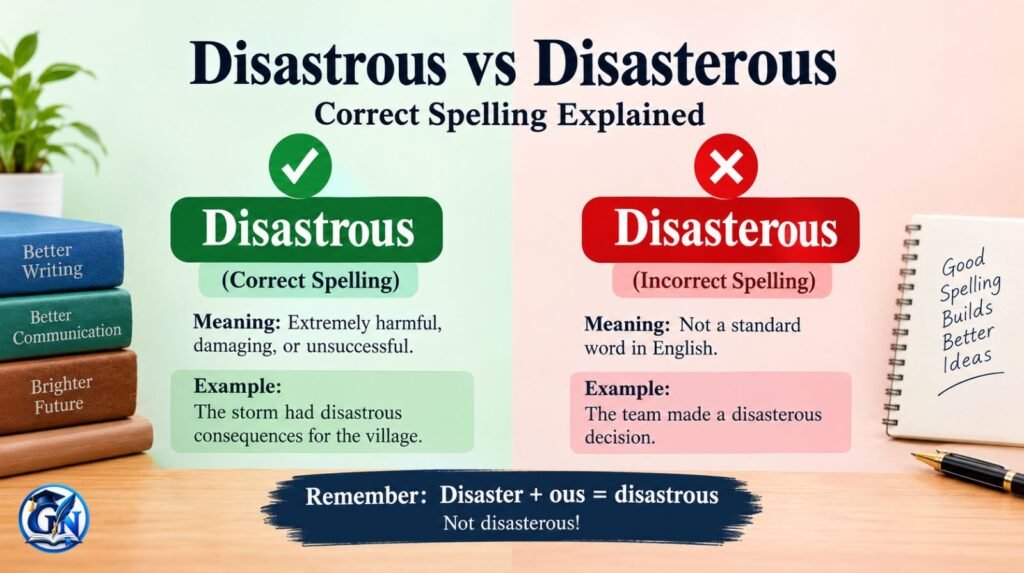
Have you ever wondered whether the correct spelling is Disastrous vs Disasterous? You’re not alone. English contains many words that seem as though they should follow familiar spelling patterns but actually do not.
The correct spelling is disastrous, while disasterous is a common misspelling. Although the incorrect version may look logical because it resembles the word disaster, it is not the standard spelling used in modern English.
In this guide, you’ll learn the difference between disastrous and disasterous, understand the meaning of disastrous, explore practical sentence examples, and discover an easy way to remember the correct spelling.
What Is the Correct Spelling: Disastrous or Disasterous?
The correct spelling is disastrous. The word disasterous is incorrect in standard English and should be avoided in formal and informal writing.
Why Is Disastrous Correct?
The adjective disastrous means extremely harmful, damaging, unsuccessful, or terrible in its results. It describes situations, decisions, events, or actions that produce very bad consequences.
For example:
- The company experienced a disastrous financial year.
- A disastrous mistake delayed the entire project.
- The storm had disastrous consequences for nearby communities.
Notice that the correct spelling is d-i-s-a-s-t-r-o-u-s. There is no additional e between disaster and the ending.
Why Is Disasterous Incorrect?
The spelling disasterous may appear reasonable because the noun disaster ends with the letters -er. However, English word formation does not always preserve the entire spelling of a base word when an adjective is formed.
The established spelling is disastrous, not disasterous.
Incorrect: The team made a disasterous decision.
Correct: The team made a disastrous decision.
Remember: Whenever you need this adjective, write disastrous, not disasterous.
Quick Comparison Table
| Feature | Disastrous | Disasterous |
|---|---|---|
| Spelling status | Correct | Incorrect |
| Part of speech | Adjective | Not standard |
| Meaning | Extremely harmful or unsuccessful | No accepted standard meaning |
| Formal writing | Recommended | Avoid |
| Example | It was a disastrous result. | It was a disasterous result. |
What Does Disastrous Mean?
The word disastrous describes something that causes serious damage, produces terrible results, or ends in complete failure. It can refer to physical destruction, financial problems, personal mistakes, or unsuccessful plans.
Disastrous Definition and Pronunciation
Definition: Causing great harm, damage, suffering, or failure.
Part of speech: Adjective.
Pronunciation: /dɪˈzæs.trəs/ in American English.
Related noun: Disaster.
Examples:
- The disastrous flood damaged hundreds of homes.
- His disastrous performance disappointed the audience.
- Poor planning led to a disastrous business decision.
In each sentence, disastrous describes the negative consequences associated with a particular event or action.
Disastrous vs. Disaster: Understanding the Difference
Although these words are closely related, they perform different grammatical functions.
- Disaster is a noun that names an event or situation involving serious harm or failure.
- Disastrous is an adjective that describes something that causes or involves such harm or failure.
Consider these examples:
- Noun: The earthquake was a major disaster.
- Adjective: The earthquake had a disastrous impact on the region.
In the first sentence, disaster names the event. In the second, disastrous describes the impact.
Understanding this difference helps you choose the right word while avoiding the incorrect spelling disasterous.
Synonyms of Disastrous
Depending on the context, you can use several alternatives to disastrous.
| Synonym | Example |
|---|---|
| Catastrophic | The region suffered catastrophic damage. |
| Devastating | The news had a devastating effect on the family. |
| Ruinous | The company made a ruinous investment. |
| Terrible | We experienced a terrible delay. |
| Calamitous | The country faced a calamitous economic crisis. |
These synonyms are not always interchangeable. For example, catastrophic often suggests exceptionally severe consequences, while terrible is more general.
Why Do People Misspell Disastrous as Disasterous?
Many English spelling errors occur because people rely on familiar patterns rather than established spellings. The confusion between disastrous and disasterous is a good example.
The Influence of the Word Disaster
The noun disaster naturally influences how people spell its adjective form.
Someone who knows the spelling of disaster might assume that adding -ous creates disasterous. This seems logical at first, but the standard English form is different.
For example:
- Correct: The experiment produced disastrous results.
- Incorrect: The experiment produced disasterous results.
The best approach is to learn disastrous as a complete word rather than attempting to reconstruct its spelling every time you use it.
Confusion About the Suffix -ous
The suffix -ous commonly helps form adjectives that describe a quality, condition, or characteristic.
Examples include:
- Danger → dangerous
- Fame → famous
- Courage → courageous
- Disaster → disastrous
These examples show that the spelling of a base word may change when an adjective is formed. However, there is no single rule that predicts every spelling perfectly.
Therefore, learning common word families and checking a reliable dictionary can help you avoid similar mistakes.
How to Remember the Correct Spelling
Try this simple memory technique:
Disaster + ous = disastrous, not disasterous.
Focus on the spelling of the final adjective: disastrous contains the sequence astr, followed by ous.
You can also remember this example:
One disaster can have disastrous consequences.
The sentence uses both the noun and the adjective, making their different spellings easier to recognize.
Disastrous vs Disasterous: Real Examples and Usage
Understanding the spelling is important, but seeing the word in context makes it easier to use correctly in everyday communication.
Examples in Everyday English
Here are some practical sentences using disastrous correctly.
At school:
- Forgetting to submit the final assignment had disastrous consequences for his grade.
- The student’s disastrous preparation resulted in a poor examination score.
At work:
- A disastrous communication error confused the entire team.
- The company avoided a disastrous financial decision after reviewing the data.
In daily life:
- Leaving the windows open during the storm proved disastrous.
- Their disastrous travel plans forced them to spend another night at the airport.
In news and public events:
- The severe storm had a disastrous effect on local agriculture.
- Officials warned that ignoring the safety instructions could have disastrous consequences.
In all these examples, disastrous describes something with seriously negative results.
A Real-Life Writing Example: Correcting a Business Report
Imagine that a student is preparing a report about a small business that has lost customers after introducing a poorly planned marketing campaign.
The student writes:
“The company launched a disasterous advertising campaign that damaged its reputation and reduced customer confidence.”
Although readers can probably understand the sentence, the spelling mistake makes the report appear less polished. A teacher or editor may notice the error and question the care taken with the rest of the document.
The corrected sentence is:
“The company launched a disastrous advertising campaign that damaged its reputation and reduced customer confidence.”
The student can improve the report further by explaining exactly what went wrong:
“The company launched a disastrous advertising campaign that damaged its reputation and reduced customer confidence. The advertisements contained misleading information, and the business failed to respond promptly to customer complaints. As a result, several customers chose competitors instead.”
This example illustrates two useful lessons. First, disastrous is the correct spelling when describing a campaign with seriously negative results. Second, precise details make writing more informative and credible.
This scenario is illustrative rather than a report of a specific documented company incident, but the proofreading lesson applies to school assignments, business reports, emails, and website articles.
Common Mistakes to Avoid
Use this checklist when proofreading your writing.
- Write disastrous, not disasterous.
- Use disaster when naming a harmful event.
- Use disastrous when describing something that causes harm or failure.
- Check the spelling of unfamiliar adjectives in a reliable dictionary.
- Review important documents before submitting or publishing them.
Following these steps can help you improve spelling accuracy without making proofreading unnecessarily complicated.
Disastrous vs Disasterous: Spelling Facts and Recent Data
When comparing spelling variants, it is important to distinguish established spelling rules from search popularity statistics.
What Established English Usage Confirms
In standard modern English, disastrous is the accepted spelling. The word describes something extremely bad, harmful, damaging, or unsuccessful.
For example:
- The disastrous decision affected the entire organization.
- The unexpected storm had disastrous consequences.
- Poor communication resulted in a disastrous outcome.
The alternative spelling disasterous is a common error rather than a standard spelling variant.
What We Know About Spelling Statistics
There is no verified statistic presented here showing exactly how many people misspell disastrous as disasterous during 2025 or 2026. Similarly, there is no confirmed percentage available here showing how frequently each version appears in online searches.
Rather than inventing search volumes, error rates, or percentages, it is more accurate to focus on the established spelling and practical ways to improve writing.
For readers who want to understand how to create helpful online content, one important principle is to provide accurate information that answers the reader’s question clearly.
How to Verify the Spelling Yourself
If you encounter a word that looks questionable, follow these simple steps:
- Search for the word in a reputable dictionary.
- Confirm its part of speech and definition.
- Read example sentences to understand its usage.
- Check whether the alternative spelling is recognized.
- Use the established spelling consistently throughout your writing.
These steps can help you avoid common spelling mistakes and improve your confidence in English.
FAQs
Q1: Is it disastrous or disasterous?
A: Disastrous is the correct spelling. Disasterous is a misspelling and should not be used in standard English writing.
Example: The disastrous decision cost the company thousands of dollars.
Q2: What does disastrous mean?
A: Disastrous means extremely harmful, damaging, unsuccessful, or likely to produce serious negative consequences.
Example: The disastrous storm destroyed several buildings.
Q3: Why is disasterous incorrect?
A: The standard adjective formed from disaster is disastrous. The extra e in disasterous does not belong in the established spelling.
Q4: Is disastrous an adjective or a noun?
A: Disastrous is an adjective. It describes a person, event, action, decision, or outcome.
Example: It was a disastrous mistake.
The related noun is disaster.
Q5: How do you pronounce disastrous?
A: In American English, disastrous is pronounced approximately /dɪˈzæs.trəs/, with the main stress on the second syllable.
Q6: Can I use disasterous in formal writing?
A: No. In formal writing, use disastrous. The incorrect spelling may distract readers and reduce the professionalism of your work.
Q7: What is the difference between disaster and disastrous?
A: Disaster is a noun that names an event or situation involving serious harm or failure. Disastrous is an adjective that describes something with very bad consequences.
Examples:
- The fire was a disaster.
- The fire had a disastrous effect on the neighborhood.
Q8: What is an easy way to remember disastrous?
A: Remember the sentence: “One disaster can have disastrous consequences.”
Practicing this sentence helps you distinguish the noun disaster from the adjective disastrous and remember the correct spelling.
Conclusion:
When comparing disastrous vs disasterous, the answer is straightforward: disastrous is the correct spelling. The word disasterous is a common spelling mistake that should be avoided in schoolwork, professional communication, blog posts, and other forms of writing.
Remember that disastrous is an adjective meaning extremely harmful, damaging, or unsuccessful. Use it to describe negative outcomes, serious mistakes, failed plans, and damaging events.
For example, you can write, “The disastrous decision affected the entire team.” You should not write, “The disasterous decision affected the entire team.”
The easiest way to improve your spelling is to practice correct examples, learn common word patterns, and consult trusted dictionaries whenever you are unsure.
👉 Explore more useful grammar tips and guides on Gramnora

Explore the world of English grammar with simple explanations, practical examples, and easy-to-follow guides by Zia Tarar, the founder and author of Gramnora. From essential grammar rules and sentence structure to common mistakes and advanced concepts, Gramnora helps learners improve their English, strengthen their writing skills, and communicate with greater clarity and confidence.