
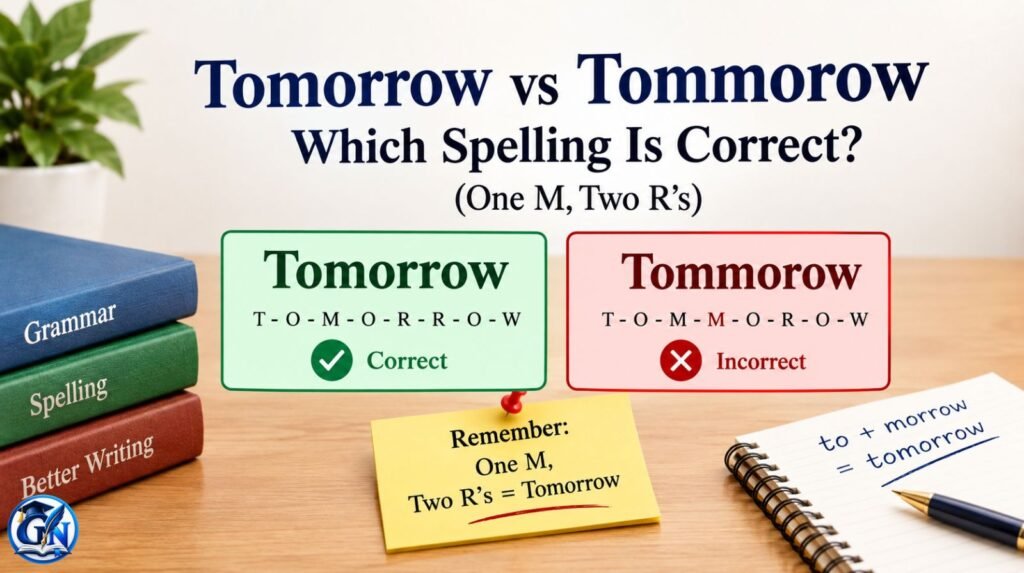
Have you ever typed “Tomorrow vs Tommorow” and wondered whether it is actually correct? You are not alone. Tomorrow vs tommorow look almost identical, so it is easy to accidentally add an extra m when writing quickly.
The correct spelling is tomorrow with one m and two r’s.
Tommorow is a misspelling and should not be used in standard English. Major dictionaries, including Merriam-Webster and Cambridge Dictionary, list tomorrow as the standard form.
In this guide, you will learn the difference between tomorrow vs tommorow, why the mistake happens, how to remember the correct spelling, and how to use tomorrow naturally in sentences.
Tomorrow vs Tommorow: Which One Is Correct?
The answer is simple: tomorrow is correct, while tommorow is incorrect.
The Correct Spelling: Tomorrow
Tomorrow is spelled:
T-O-M-O-R-R-O-W
Notice the spelling pattern:
- One m
- Two r’s
- Ends with ow
The word tomorrow means the day after today. It can function as both an adverb and a noun. Cambridge Dictionary gives the same core meaning and provides examples such as doing something tomorrow or referring to tomorrow’s meeting.
Examples:
- I will call you tomorrow.
- We have an important meeting tomorrow.
- She is leaving tomorrow morning.
- Tomorrow is another day.
The Incorrect Spelling: Tommorow
Tommorow is incorrect because it contains two m’s:
T-O-M-M-O-R-O-W ❌
There is no standard English spelling tommorow.
Merriam-Webster specifically identifies tommorow and tommorrow, among other variants, as common misspellings of tomorrow.
Quick Comparison
| Spelling | Correct? | Example |
|---|---|---|
| tomorrow | ✅ Yes | I will see you tomorrow. |
| tommorow | ❌ No | Incorrect spelling |
| tommorrow | ❌ No | Incorrect spelling |
| tomorow | ❌ No | Incorrect spelling |
| tomarrow | ❌ No | Incorrect spelling |
Easy answer: If you are choosing between tomorrow vs tommorow, always choose tomorrow.
Why Is Tomorrow Spelled With One M and Two R’s?
The spelling becomes easier to remember when you understand how the word is built.
Think of Tomorrow as “To + Morrow”
One useful way to remember tomorrow is to break it into:
to + morrow = tomorrow
The word morrow is an older English word associated with the morning or the following day. Merriam-Webster traces tomorrow back to Middle English to morgen, from Old English tō morgen, involving to and morrow/morning.
This explains why the word does not need a second m.
Instead, the important spelling pattern is:
TO + MORROW → TOMORROW
Remember “Morrow”
If you remember the spelling of morrow, the spelling of tomorrow becomes much easier.
Morrow:
M-O-R-R-O-W
Now add to:
TO + MORROW = TOMORROW
So you get:
One M + Two R’s = TOMORROW
A Simple Memory Trick
Try this:
Tomorrow has one M because “morrow” starts with one M.
Then remember:
One M, two R’s tomorrow is the right choice.
This is more reliable than simply trying to memorize all seven letters individually.
How to Use Tomorrow Correctly in a Sentence
The word tomorrow is usually used to talk about the day after today, but it can also refer more broadly to the future. Cambridge Dictionary lists both meanings.
Tomorrow as an Adverb
When tomorrow tells us when something will happen, it works as an adverb.
Examples:
- I will finish the project tomorrow.
- We are traveling tomorrow.
- She will call me tomorrow.
- They are arriving tomorrow evening.
Here, tomorrow tells us when the action happens.
Tomorrow as a Noun
Tomorrow can also function as a noun.
Examples:
- Tomorrow is a new day.
- We should prepare for tomorrow.
- I am looking forward to tomorrow.
- What are your plans for tomorrow?
In these examples, tomorrow refers to the day after today or, depending on context, the future.
Tomorrow in Possessive Expressions
You may also see tomorrow’s when something belongs to or is associated with tomorrow.
Examples:
- I am preparing for tomorrow’s meeting.
- Did you check tomorrow’s schedule?
- We need to discuss tomorrow’s event.
- She is organizing tomorrow’s lesson.
The spelling remains tomorrow before the apostrophe:
tomorrow’s ✅
tommorow’s ❌
Common Misspellings of Tomorrow
Tomorrow is a word people frequently spell incorrectly because its pronunciation does not make every letter obvious.
Tommorow
Tommorow is one of the most common mistakes.
❌ I will finish it tommorow.
✅ I will finish it tomorrow.
The problem is the extra m.
Tommorrow
Some writers add both an extra m and an extra r:
❌ tommorrow
✅ tomorrow
This version has too many letters in the middle.
Tomorow
Another common mistake is leaving out one of the two r’s:
❌ tomorow
✅ tomorrow
Remember that tomorrow has two r’s.
Tomarrow
Some people replace the o after tom with a:
❌ tomarrow
✅ tomorrow
The correct sequence is:
tom-or-row
not:
tom-ar-row
A 2026 Spelling Check: What Do Major Dictionaries Say?
When there is uncertainty about a spelling, authoritative dictionaries are among the best places to verify the standard form.
Current Dictionary Evidence
Merriam-Webster’s current dictionary entry defines tomorrow as the day after the present day and lists tomarrow, tommorow, tommorrow, and tomorow as common misspellings.
Merriam-Webster also published an updated Commonly Misspelled Words resource in February 2026 that specifically highlights tomorrow and explains the spelling through morrow.
Cambridge Dictionary likewise lists tomorrow as the standard English word meaning the day after today and provides examples of its use as both a noun and adverb.
What This Data Tells Us
The important takeaway from the 2026 reference data is not that English has competing spellings. Rather, major dictionary sources consistently recognize tomorrow as the standard spelling while treating forms such as tommorow as errors.
| 2025–2026 Reference Check | Finding |
|---|---|
| Merriam-Webster dictionary | tomorrow is the standard entry |
| Merriam-Webster 2026 misspelling guide | Identifies tommorow and other variants as misspellings |
| Cambridge Dictionary | Lists tomorrow as the standard English form |
| Standard spelling | One M + Two R’s |
For grammar and spelling content, this kind of first-party dictionary evidence is more useful than relying on random spelling websites.
Case Study: Why People Write “Tommorow” Instead of “Tomorrow”
Imagine a student writing an email to a teacher:
“I will submit my assignment tommorow.”
At first glance, the sentence looks perfectly understandable. The reader will probably know that the student means tomorrow. However, the spelling is still incorrect.
Why did the mistake happen?
The student may have remembered that tomorrow contains a repeated sound in the middle and unconsciously added another m. This is a common type of spelling error: writers sometimes add letters because a word’s pronunciation or visual pattern makes the repetition feel natural.
Now consider the correction:
“I will submit my assignment tomorrow.”
The difference is only one letter, but the second version follows standard English spelling.
A useful strategy for the student would be to stop thinking of the word as one long sequence of letters. Instead, they can remember to + morrow. The word morrow contains one m and two r’s, giving the complete spelling tomorrow.
The same technique works outside school. A job applicant might write, “I will send the documents tommorow,” in a professional email. Although the recipient can understand the message, the spelling error may make the writing look less polished. In professional, academic, or published writing, using the standard form tomorrow is therefore the better choice.
The lesson is simple: when a word feels difficult to spell, breaking it into meaningful parts can be more effective than repeatedly memorizing the whole word.
How to Remember the Spelling of Tomorrow
If you regularly write tommorow, use one of these simple techniques.
Use the “One M, Two R’s” Rule
The easiest rule is:
Tomorrow = one M, two R’s.
Visualize the middle:
M O R R
Not:
M M O R
Connect It to “Morrow”
Remember:
TO + MORROW = TOMORROW
Since morrow has one m, you do not need to add another one.
Write It in Chunks
Instead of memorizing:
T-O-M-O-R-R-O-W
Try:
TO + MORROW
This makes the spelling pattern easier to recognize.
Use It in Sentences
Writing the correct form several times can reinforce the pattern:
- I will go tomorrow.
- See you tomorrow.
- Tomorrow will be busy.
- We have a test tomorrow.
The goal is not to repeat the word mindlessly. It is to become familiar with its correct visual pattern.
Tomorrow vs Tommorow: Quick Checklist
Before publishing an email, assignment, article, or social post, use this checklist:
- Is the word spelled tomorrow?
- Does it have only one M?
- Does it have two R’s?
- Did you avoid tommorow?
- Did you avoid tomorow?
- Did you avoid tommorrow?
- If using a possessive form, did you write tomorrow’s?
The Fastest Way to Check
If you are unsure, simply remember:
TOM + ORROW = TOMORROW
Or even shorter:
One M, two R’s.
FAQs
Q1: Is “tommorow” correct?
A: No. Tommorow is a misspelling. The correct spelling is tomorrow, with one m and two r’s. Merriam-Webster lists tommorow among common misspellings.
Q2: Is it “tomorrow” or “tommorow”?
A: The correct spelling is tomorrow.
✅ tomorrow
❌ tommorow
The incorrect version adds an unnecessary second m.
Q3: Does tomorrow have one M or two M’s?
A: Tomorrow has one M.
The correct spelling is:
T-O-M-O-R-R-O-W
So, it has one M and two R’s.
Q4: Does tomorrow have one R or two R’s?
A: Tomorrow has two R’s.
The middle of the word is:
ORR
not OR.
Q5: Why do people spell tomorrow as “tommorow”?
A: The error probably comes from the word’s pronunciation and visual pattern. Writers may unconsciously add another m or omit one of the r’s. Breaking the word into to + morrow can make its spelling easier to remember.
Q6: What is the correct plural or possessive form of tomorrow?
A: Tomorrow is generally used as an uncountable noun when referring to the day after today, so you normally do not need a plural form. For possession or association, use tomorrow’s:
Tomorrow’s meeting starts at 9 a.m.
Q7: Is “tomorrow” used in both American and British English?
A: Yes. Tomorrow is standard in both American and British English. Cambridge provides both UK and US pronunciations while retaining the same spelling.
Q8: Is “tomorrow” one word or two words?
A: Tomorrow is one word.
Correct:
See you tomorrow.
Incorrect:
See you to morrow.
The modern standard spelling is the single word tomorrow.
Final Answer:
If you are wondering “tomorrow vs tommorow: which spelling is correct?”, the answer is clear:
✅ Tomorrow — correct
❌ Tommorow — incorrect
The easiest rule to remember is one M and two R’s:
T-O-M-O-R-R-O-W
You can also remember the historical word morrow:
TO + MORROW = TOMORROW
So the next time you need to write about the day after today, choose tomorrow with confidence.
👉 Discover more simple and practical grammar guides on Gramnora

Explore the world of English grammar with simple explanations, practical examples, and easy-to-follow guides by Zia Tarar, the founder and author of Gramnora. From essential grammar rules and sentence structure to common mistakes and advanced concepts, Gramnora helps learners improve their English, strengthen their writing skills, and communicate with greater clarity and confidence.