
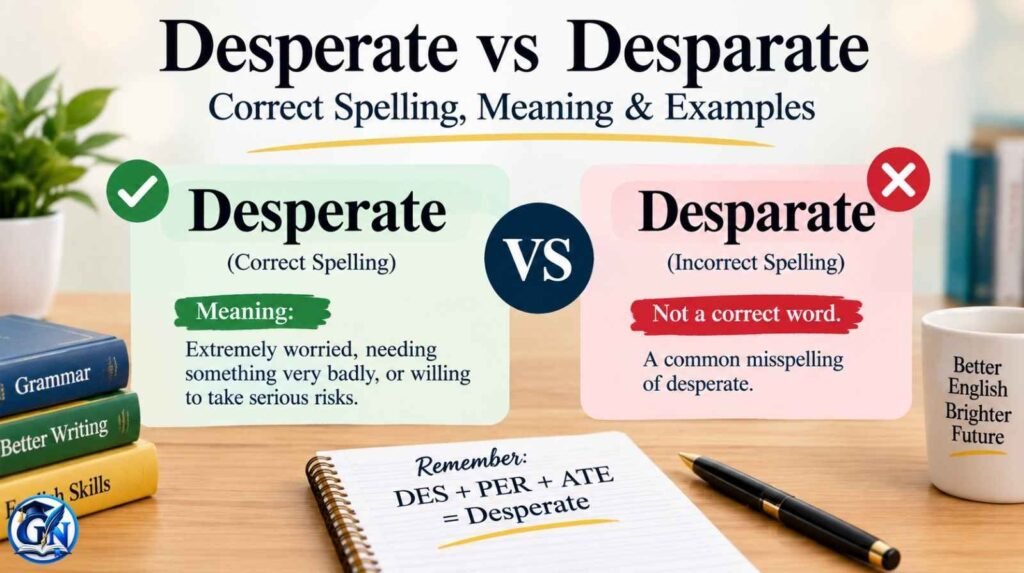
Have you ever typed “desparate” when you actually meant “desperate”? You are not alone. Desperate vs desparate is a common spelling confusion because both versions look and sound similar. However, only one is the standard English spelling: desperate.
In this guide, you will learn the correct spelling, meaning, pronunciation, common uses, examples, and an easy memory trick to help you avoid this mistake permanently.
Desperate vs Desparate: Which Spelling Is Correct?
The correct spelling is desperate.
Desparate is an incorrect spelling in standard English. It is a common misspelling, but it should not be used in formal writing, academic work, professional communication, or published content.
| Word | Correct? | Meaning |
|---|---|---|
| Desperate | ✅ Yes | Extremely worried, needing something very badly, or willing to take serious risks |
| Desparate | ❌ No | Common misspelling of desperate |
For example:
- ✅ She was desperate to find a job.
- ❌ She was desparate to find a job.
Cambridge defines desperate as describing someone who has a very great need or desire, a very serious situation, or someone willing to take risks because they see few alternatives.
Is “Desparate” Ever Correct?
No. If you are writing standard English, use desperate.
You may encounter desparate online because people make spelling mistakes, but its appearance in search results, social media, comments, or informal writing does not make it a correct dictionary spelling.
Why Do People Spell It “Desparate”?
The confusion is understandable because English spelling does not always perfectly match pronunciation.
When people say desperate, the middle vowel can be easy to overlook. As a result, some writers instinctively write desparate instead.
The correct sequence is:
des + per + ate → desperate
Not:
des + par + ate → desparate
What Does “Desperate” Mean?
Desperate is an adjective with several closely related meanings.
It can describe someone who urgently needs or wants something, a situation that is extremely serious, or a person who is prepared to take significant risks because they see no easy solution.
Desperate Meaning: Needing Something Very Much
This is one of the most common uses.
Examples:
- I am desperate for a cup of coffee.
- She was desperate for good news.
- They are desperate for financial help.
- He was desperate to find his missing phone.
In these sentences, desperate communicates a very strong need or desire.
Desperate Meaning: Extremely Serious
The word can also describe a situation that is very bad or serious.
Examples:
- The country is facing a desperate shortage of food.
- They were in a desperate situation.
- The family was in desperate need of assistance.
Cambridge lists “very serious or bad” and “very great or extreme” among the meanings of desperate.
Desperate Meaning: Willing to Take Risks
A person can also be described as desperate when they feel they have no good options and are willing to take risks to change their situation.
For example:
The team made a desperate attempt to win the match.
Here, desperate suggests an extreme or last-chance effort.
Other examples include:
- He made a desperate attempt to escape.
- They took desperate measures to save the business.
- She made a desperate plea for help.
Desperate vs Desparate: Easy Examples
Seeing the correct word in different sentences is one of the easiest ways to remember its spelling.
Examples With “Desperate”
- She was desperate to pass the examination.
- He was desperate for a new opportunity.
- The workers were in desperate need of water.
- It was a desperate attempt to solve the problem.
- They took desperate measures to protect the building.
- I was desperate to hear from my family.
- The situation became increasingly desperate.
- She made a desperate request for assistance.
Examples With the Common Misspelling
These examples show what not to write:
- ❌ He was desparate for help.
- ❌ She made a desparate attempt.
- ❌ The situation was desparate.
Correct them to:
- ✅ He was desperate for help.
- ✅ She made a desperate attempt.
- ✅ The situation was desperate.
“Desperate” in Everyday English
The word is common in everyday phrases such as:
- desperate need
- desperate situation
- desperate attempt
- desperate measures
- desperate plea
- desperate desire
- desperate for help
- desperate to succeed
These combinations can help you recognize the correct spelling naturally when you read or write English.
A Real-Life Writing Example: How One Letter Changes Accuracy
Imagine a university student named Daniel preparing an application for an internship. He writes this sentence in his personal statement:
“I am desparate to gain practical experience in digital marketing.”
The meaning is understandable, but the spelling error weakens the professionalism of the sentence. A reviewer may notice the mistake immediately, particularly because the sentence appears in a formal application.
Daniel checks the word and discovers that the correct spelling is desperate. He changes the sentence to:
“I am desperate to gain practical experience in digital marketing.”
Now the sentence uses standard English spelling.
This small correction illustrates an important lesson about spelling. A single misplaced letter does not necessarily make a sentence impossible to understand, but it can affect how polished and credible the writing appears.
The same issue can occur in emails, school assignments, resumes, websites, blog posts, and business documents. Because desparate looks plausible at first glance, writers may miss the error during proofreading.
A useful proofreading habit is to pause whenever a word “looks right” but you are not completely certain about its spelling. Checking a reputable dictionary can prevent the mistake from appearing in your final work. For desperate, remembering the “per” in the middle is especially useful:
des + per + ate = desperate
That simple pattern is much easier to recall than trying to memorize the entire word every time.
How to Remember the Spelling of “Desperate”
The easiest way to remember desperate is to focus on the middle letters.
Remember “PER” in Desperate
Break the word into three parts:
DES + PER + ATE
The important part is:
PER
So remember:
Desperate has “per” in the middle.
Not:
Desparate
This gives you a quick mental check:
des-PER-ate → desperate
Connect It With “Desperation”
Another useful spelling connection is the related noun:
desperate → desperation
For example:
- She was desperate for help.
- Her desperation was obvious.
Both words begin with desper-.
Cambridge also identifies desperation as the noun related to the feeling or condition associated with being desperate.
Check the Word Before Publishing
If you are unsure, do not rely only on how the word sounds. Look at the spelling:
Correct: desperate
Incorrect: desparate
This is particularly useful for students and writers who are proofreading formal English.
Desperate vs Desparate: Pronunciation and Word Forms
Understanding related forms can make the spelling easier to recognize.
How to Pronounce “Desperate”
Cambridge gives the pronunciation as approximately /ˈdes.pər.ət/ in American English and /ˈdes.pər.ət/ in British English, with slight phonetic differences between varieties.
The pronunciation can contribute to the spelling confusion because the unstressed middle sound is not always pronounced as clearly as the spelling suggests.
Related Words
| Word | Part of Speech | Example |
|---|---|---|
| desperate | Adjective | She was desperate for help. |
| desperately | Adverb | He desperately needed assistance. |
| desperation | Noun | His desperation was clear. |
For example:
Adjective:
She was desperate to succeed.
Adverb:
She desperately wanted to succeed.
Noun:
Her desperation was obvious.
Learning these related forms gives you more than one way to remember the spelling.
2025–2026 Data & What Reliable Sources Tell Us
There is an important distinction between dictionary evidence and search-volume statistics.
As of 2026, reputable dictionaries clearly recognize desperate as the standard English word, while desparate is not an accepted alternative spelling. Cambridge’s current dictionary entry provides definitions, pronunciation information, usage examples, and related forms for desperate.
For a spelling question like this, however, there is no authoritative public 2025–2026 statistic from Google that gives an exact global number of searches for the misspelling “desparate.” It would therefore be misleading to invent a search-volume percentage or claim that a particular number of people make this mistake.
What we can verify is:
- Desperate is an adjective.
- Cambridge lists multiple meanings, including extreme need, serious circumstances, and willingness to take risks.
- Desperation is the corresponding noun for the feeling or state of desperation.
- Google currently emphasizes helpful, reliable, people-first content and specifically advises publishers to avoid factual and spelling errors.
- Google’s 2026 guidance also emphasizes valuable, original, non-commodity information rather than simply producing content for search engines.
So, for this spelling question, dictionary authority is more useful than an unsupported search-volume statistic.
Quick Checklist: Desperate or Desparate?
Use this checklist whenever you are unsure.
Step 1: Look at the Middle
Does the word contain per?
- des-PER-ate ✅
- des-PAR-ate ❌
Step 2: Ask What You Mean
If you mean:
- urgently needing something,
- wanting something very badly,
- extremely serious,
- or willing to take a major risk,
the word you want is desperate.
Step 3: Check Related Words
Think of:
desperate → desperately → desperation
They all retain the desper- spelling.
Step 4: Use the Correct Form
| If You See | Use Instead |
|---|---|
| ❌ desparate | ✅ desperate |
| ❌ desparate need | ✅ desperate need |
| ❌ desparate attempt | ✅ desperate attempt |
| ❌ desparate situation | ✅ desperate situation |
| ❌ desparate for help | ✅ desperate for help |
FAQs
Q1: Is “desparate” a correct spelling?
A: No. Desparate is a misspelling. The correct standard English spelling is desperate.
Q2: What is the correct spelling: desperate or desparate?
A: The correct spelling is desperate, with “per” in the middle.
Desperate ✅
Desparate ❌
Q3: What does desperate mean?
A: Desperate can mean needing or wanting something very badly, being in an extremely serious situation, or being willing to take significant risks because there seem to be few alternatives.
Q4: How do you remember how to spell desperate?
A: Remember:
DES + PER + ATE = DESPERATE
The key is the PER in the middle.
Q5: Is desperate an adjective?
A: Yes. Desperate is an adjective.
Example:
She was desperate for help.
The related adverb is desperately, and the related noun is desperation.
Q6: What is the difference between desperate and desperation?
A: Desperate is an adjective describing a person, situation, need, or action.
Desperation is a noun describing the feeling or state of being desperate.
Examples:
- He was desperate for help.
- His desperation was obvious.
Q7: Can “desperate” mean “very serious”?
A: Yes. For example:
The country is facing a desperate shortage of food.
In this context, desperate means extremely serious or severe.
Q8: Why is “desparate” commonly misspelled?
A: The incorrect form is easy to create because the pronunciation does not make every letter obvious, and desparate visually resembles the correct word. Remembering the “per” in desperate is an effective way to avoid the error.
Conclusion:
When comparing desperate vs desparate, the answer is simple: desperate is the correct spelling, while desparate is a misspelling.
Desperate can describe someone who urgently needs or wants something, an extremely serious situation, or a person willing to take significant risks.
The easiest spelling trick is:
DES + PER + ATE = DESPERATE
Whenever you are tempted to write desparate, stop and remember the PER in the middle.
👉 Discover more simple and practical grammar guides on Gramnora

Explore the world of English grammar with simple explanations, practical examples, and easy-to-follow guides by Zia Tarar, the founder and author of Gramnora. From essential grammar rules and sentence structure to common mistakes and advanced concepts, Gramnora helps learners improve their English, strengthen their writing skills, and communicate with greater clarity and confidence.