
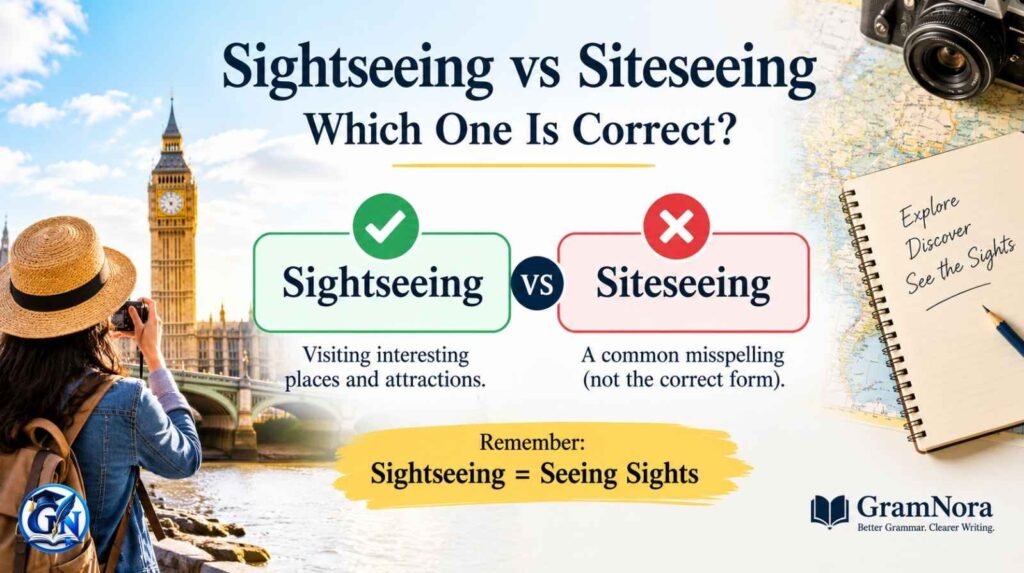
Have you ever wondered whether to write sightseeing or siteseeing when talking about visiting famous places? These words sound almost identical, so it is easy to confuse them. However, only one is the standard spelling for tourism.
In the sightseeing vs siteseeing debate, sightseeing is the correct word. It means visiting interesting places, landmarks, historical buildings, and tourist attractions, usually while traveling. Siteseeing is a common misspelling that results from confusing the words sight and site.
In this guide, you will learn the difference between these spellings, understand their meanings, explore practical examples, and discover a simple trick to remember the correct form.
What Is the Difference Between Sightseeing and Siteseeing?
The main difference is that sightseeing is the correct spelling for visiting interesting places as a tourist, while siteseeing is a misspelling of this word.
Although both forms sound similar, standard English uses sightseeing to describe the activity of exploring attractions and enjoying notable views.
What Does Sightseeing Mean?
Sightseeing is a noun that refers to visiting or viewing interesting places, especially while traveling for pleasure.
According to the Cambridge Dictionary, sightseeing involves visiting interesting places, particularly while on holiday or vacation.
Examples include:
- We spent the afternoon sightseeing in London.
- The family went sightseeing during their summer vacation.
- Our hotel is close to several popular sightseeing attractions.
- She enjoys sightseeing whenever she visits a new city.
In each sentence, sightseeing describes an activity involving the exploration of places worth seeing.
What Does Siteseeing Mean?
Siteseeing is not the standard spelling for the tourist activity. Writers commonly use it by mistake because they associate sightseeing with visiting tourist sites.
For example:
Incorrect: We spent the entire day siteseeing in Paris.
Correct: We spent the entire day sightseeing in Paris.
The second sentence uses the established English spelling and communicates the intended meaning clearly.
Quick Comparison Table
| Feature | Sightseeing | Siteseeing |
|---|---|---|
| Standard spelling | Correct | Incorrect for tourism |
| Meaning | Visiting interesting places | Common misspelling of sightseeing |
| Common context | Travel and tourism | Spelling error |
| Example | We went sightseeing. | We went siteseeing. |
| Recommended usage | Use it | Avoid it for this meaning |
The easiest rule is to remember that sightseeing means seeing the sights.
Why Is Sightseeing the Correct Spelling?
The reason for the correct spelling becomes easier to understand when you look at the meanings of sight and site.
Understanding the Word Sight
The word sight relates to vision or something that can be seen. It can also describe something interesting or impressive to look at.
For example:
- The mountains were a beautiful sight.
- The ancient castle is one of the city’s most famous sights.
- Tourists gathered to see the spectacular sight.
The word sightseeing is formed from sight and seeing. It describes the activity of looking at interesting places and attractions.
For example:
We spent the morning sightseeing around the historic district.
This sentence is correct because the travelers are exploring places and enjoying the sights.
Understanding the Word Site
The word site refers to a particular place or location. It is often used when discussing buildings, construction projects, archaeological discoveries, or websites.
For example:
- The company selected a site for its new office.
- Archaeologists discovered an ancient burial site.
- Workers inspected the construction site before starting the project.
Although tourists often visit important sites, the word site does not replace sight in the established word sightseeing.
How to Remember the Difference
Use this simple memory trick:
Sightseeing = seeing sights.
Think about a traveler visiting famous monuments, beautiful landscapes, and historic buildings. The traveler is seeing interesting sights, so the correct word is sightseeing.
Remember these examples:
- We went sightseeing in Rome.
- The Eiffel Tower is an impressive sight.
- The construction site is outside the city.
This distinction helps you choose the right word without memorizing complicated spelling rules.
How to Use Sightseeing Correctly in Sentences
Understanding a word’s meaning is useful, but seeing how it works in everyday English makes it easier to use correctly.
Sightseeing in Everyday Conversations
Sightseeing is commonly used when discussing vacations, weekend trips, and visits to new destinations.
Examples:
- We are going sightseeing tomorrow.
- Did you enjoy sightseeing during your trip?
- They spent the weekend sightseeing around the city.
- I would rather go sightseeing than stay in the hotel all day.
These sentences sound natural because sightseeing describes the activity of exploring interesting places.
Sightseeing in Travel and Professional Writing
The word also appears in travel guides, tourism websites, itineraries, and promotional materials.
Examples:
- The travel package includes accommodation and sightseeing tours.
- Visitors can enjoy sightseeing around the historic city center.
- The guide provides information about popular sightseeing destinations.
- Our itinerary includes a full day of sightseeing.
If you are writing travel content for a website, use sightseeing consistently in headings, descriptions, and body text.
Common Spelling Mistakes to Avoid
Here are some examples of incorrect and correct usage.
| Incorrect | Correct |
|---|---|
| We went siteseeing yesterday. | We went sightseeing yesterday. |
| I love siteseeing in new cities. | I love sightseeing in new cities. |
| The sightseeing tour was enjoyable. | The sightseeing tour was enjoyable. |
| They planned a siteseeing trip. | They planned a sightseeing trip. |
Notice that the third example is already correct. Recognizing correct usage is just as important as identifying mistakes.

Sightseeing vs Siteseeing: A Real-Life Example
Imagine that a traveler named Daniel is planning a three-day vacation in New York City. Before leaving home, he creates an itinerary that includes visiting the Statue of Liberty, exploring Central Park, viewing Times Square, and walking through several historic neighborhoods.
While preparing his travel notes, Daniel writes, “Day two: siteseeing around Manhattan.” He assumes that siteseeing is correct because he will visit several famous tourist sites.
However, his friend notices the spelling mistake and explains that the correct word is sightseeing. Daniel learns that sight refers to something worth seeing, while site refers to a location. Although both words relate to places in different ways, only sightseeing is the established term for this travel activity.
Daniel corrects his itinerary to read, “Day two: sightseeing around Manhattan.” He also updates the heading of his travel blog to “A Guide to Sightseeing in New York City.”
Later, he writes, “Our sightseeing tour included several famous landmarks.” The spelling now remains consistent throughout his travel notes and blog post.
This example illustrates why understanding word meanings is more effective than relying only on pronunciation. When you know the difference between sight and site, you can avoid this common error in travel plans, school assignments, emails, and website content.
The lesson is simple: whether you are exploring New York, visiting museums in London, or discovering historic places in Rome, use sightseeing when describing the activity.
Is Sightseeing One Word or Two?
Yes, sightseeing is written as one word when referring to the established tourism activity.
Is Sightseeing Written With a Hyphen?
No. The standard spelling is sightseeing, without a hyphen.
Use these forms in your writing:
- Correct: sightseeing
- Incorrect for the standard tourism term: sight-seeing
- Incorrect for the standard tourism term: siteseeing
For example:
Correct: We booked a sightseeing tour of the historic city.
Incorrect: We booked a site-seeing tour of the historic city.
Is Sightseeing the Same in American and British English?
Yes. Sightseeing is the standard spelling in both American and British English.
For example:
- American English: We went sightseeing during our vacation.
- British English: We went sightseeing during our holiday.
The words vacation and holiday differ in common usage between these varieties, but sightseeing retains the same spelling.
Is Sightseeing a Noun or a Verb?
Sightseeing is primarily used as a noun, although it can also appear as the -ing form of the verb sightsee.
Examples:
- Noun: Sightseeing was the highlight of our vacation.
- Verb form: We spent the afternoon sightseeing.
The related verb sightsee means to visit interesting places as a tourist.
For example:
We plan to sightsee in Rome before returning home.
The related noun for a person who goes sightseeing is sightseer.
Sightseeing Statistics and Language Resources for 2025–2026
When learning a spelling distinction, reliable dictionary definitions are more useful than unsupported claims about how often people make a mistake.
What Do Authoritative Dictionaries Say?
The Cambridge Dictionary lists sightseeing as a noun in both its British and American English entries. Its definition connects the word with visiting interesting places, particularly during a holiday or vacation.
Similarly, Dictionary.com identifies sightseeing as a noun and adjective and traces its formation to sight and seeing.
These references support three practical conclusions:
- Sightseeing is an established English word.
- Its spelling is the same in American and British English.
- Siteseeing should not be used as an alternative spelling for the tourism activity.
Is There Reliable 2025–2026 Data on This Spelling Mistake?
No verified, authoritative statistic specifically measuring how many English writers confuse sightseeing with siteseeing is available in the sources consulted for this article.
It would therefore be misleading to invent a percentage or claim that one spelling is searched a particular number of times without reliable data.
For writers and website owners, the practical takeaway is to prioritize dictionary-verified spelling, clear examples, and helpful explanations. These steps improve accuracy without relying on unsupported statistics.
FAQs
Q1: Which spelling is correct: sightseeing or siteseeing?
A: Sightseeing is the correct spelling when referring to visiting interesting places as a tourist. Siteseeing is a common misspelling of this word.
Q2: What does sightseeing mean?
A: Sightseeing means visiting or viewing interesting places, landmarks, and attractions, especially while traveling. For example, exploring famous monuments during a vacation is sightseeing.
Q3: Why do people spell sightseeing as siteseeing?
A: People often confuse sight with site because the two words sound alike. Since tourists visit places and attractions, some writers mistakenly assume that siteseeing is the correct form.
Q4: Is sightseeing one word or two?
A: Sightseeing is written as one word. When referring to tourism, avoid writing it as sight seeing, sight-seeing, or siteseeing.
Q5: Is sightseeing a noun or a verb?
A: Sightseeing is primarily a noun, as in “We enjoyed sightseeing.” The related verb is sightsee, as in “We plan to sightsee tomorrow.”
Q6: Is sightseeing spelled differently in American and British English?
A: No. Both American and British English use sightseeing. There is no standard spelling difference between these varieties.
Q7: Can I use siteseeing in a sentence?
A: You should not use siteseeing when you mean visiting tourist attractions. If you mean examining a particular location, expressions such as “visiting the site” or “inspecting the site” are clearer.
Q8: What is an easy way to remember the spelling of sightseeing?
A: Remember the phrase “seeing sights.” The word sightseeing refers to seeing interesting attractions, whereas site refers to a location. This simple distinction helps you remember the correct spelling.
Conclusion:
When comparing sightseeing vs siteseeing, the answer is straightforward: sightseeing is the correct spelling for the activity of visiting interesting places, landmarks, and tourist attractions. Siteseeing is a common spelling mistake caused by confusion between sight and site.
Remember the simple rule: you see sights, but you visit sites.
Use sightseeing in travel articles, vacation plans, school assignments, emails, and everyday conversations. If you are writing about examining a construction location or another specific place, use expressions such as site visit or site inspection instead.
Now that you understand the difference, you can use the correct spelling confidently.
👉 Explore more useful grammar tips and guides on Gramnora

Explore the world of English grammar with simple explanations, practical examples, and easy-to-follow guides by Zia Tarar, the founder and author of Gramnora. From essential grammar rules and sentence structure to common mistakes and advanced concepts, Gramnora helps learners improve their English, strengthen their writing skills, and communicate with greater clarity and confidence.