
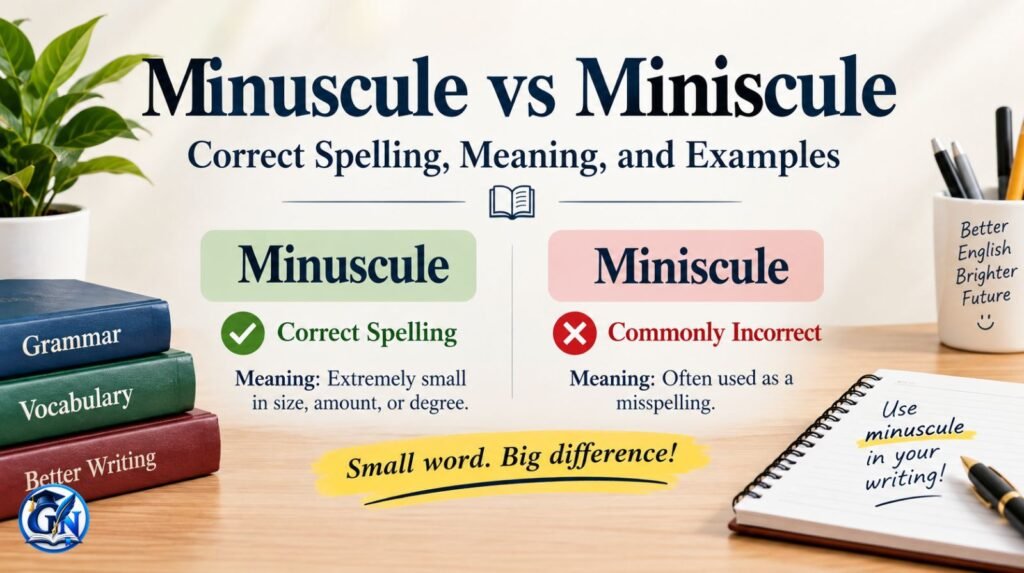
Have you ever wondered whether to write Minuscule vs Miniscule? These two spellings look almost identical and sound very similar, making it easy to confuse them in everyday writing. However, only one is the safest choice for standard English.
The correct spelling is minuscule, which means extremely small in size, amount, or degree. Miniscule is a common alternative spelling, but it is generally treated as a misspelling in formal writing.
In this guide, you’ll learn the difference between minuscule and miniscule, understand the word’s meaning and origin, explore practical examples, and discover an easy way to remember the correct spelling.
What Is the Difference Between Minuscule and Miniscule?
The main difference between minuscule and miniscule is their spelling. Both forms are used to express the idea of something very small, but minuscule is the standard spelling recommended for formal and professional English.
Minuscule: The Correct Standard Spelling
Minuscule is an adjective meaning extremely small or insignificant in size, quantity, or importance.
Examples:
- The chances of making a mistake were minuscule.
- She wrote the note in minuscule handwriting.
- The company reported a minuscule increase in profits.
- There was only a minuscule amount of sugar left in the jar.
In each sentence, the word describes something exceptionally small.
Miniscule: The Commonly Confused Spelling
Miniscule is a spelling that appears frequently because people associate the word with mini, meaning small. However, many dictionaries and style guides prefer minuscule.
For example:
- Less preferred: The difference between the prices was miniscule.
- Preferred: The difference between the prices was minuscule.
The meaning is usually clear in both sentences, but the second version follows the standard spelling.
Quick Comparison Table
| Feature | Minuscule | Miniscule |
|---|---|---|
| Spelling status | Standard spelling | Common alternative, often considered incorrect |
| Meaning | Extremely small | Usually intended to mean extremely small |
| Formal writing | Recommended | Best avoided |
| Academic writing | Preferred | May be marked as an error |
| Example | A minuscule amount | A miniscule amount |
Remember: When in doubt, use minuscule in essays, reports, emails, articles, and professional documents.
What Does Minuscule Mean?
The word minuscule means extremely small. It can describe physical objects, amounts, differences, chances, or changes that are so small they may seem almost insignificant.
Oxford’s dictionary defines minuscule as “extremely small.” The word can also refer to lowercase letters or particular styles of historical handwriting.
Meaning in Everyday English
In everyday conversations, minuscule emphasizes that something is much smaller than expected or barely noticeable.
Examples:
- The kitten had minuscule paws.
- He made a minuscule adjustment to the settings.
- The repair cost was minuscule compared with the original estimate.
- Only a minuscule percentage of customers complained.
In these examples, the word communicates smallness without requiring an exact measurement.
Synonyms of Minuscule
Several words can replace minuscule, depending on the context.
| Synonym | Example |
|---|---|
| Tiny | A tiny insect landed on the leaf. |
| Minute | A minute crack appeared in the glass. |
| Microscopic | A microscopic organism was observed. |
| Very small | The box contained a very small object. |
| Negligible | The difference in cost was negligible. |
| Insignificant | The error had an insignificant effect. |
These words are related, but they are not always interchangeable. For example, microscopic can suggest something visible only with a microscope, while negligible emphasizes a lack of importance.
Minuscule in Different Contexts
The word is useful in several types of writing.
- Education: The student noticed a minuscule error in the equation.
- Business: The company achieved a minuscule improvement in sales.
- Science: Researchers detected a minuscule change in temperature.
- Daily life: There was a minuscule gap between the two pieces of furniture.
Using the word naturally can make descriptions more precise and expressive.
Why Do People Confuse Minuscule and Miniscule?
The confusion largely comes from pronunciation, spelling patterns, and the influence of the familiar word mini.
The Influence of the Word Mini
People often connect minuscule with mini, which describes something small. Because miniscule appears to follow that pattern, the incorrect spelling may seem logical.
However, the standard word is spelled m-i-n-u-s-c-u-l-e, not m-i-n-i-s-c-u-l-e.
For example:
- Correct: The difference was minuscule.
- Incorrect in standard usage: The difference was miniscule.
The extra letter pattern associated with mini can make the spelling confusing, even for experienced writers.
Pronunciation Makes the Difference Hard to Notice
Both spellings are commonly pronounced similarly, so hearing the word does not necessarily tell you how to spell it.
The Oxford Advanced Learner’s Dictionary gives the pronunciation of minuscule as /ˈmɪnəskjuːl/.
For this reason, learners should memorize the written form rather than relying on sound alone.
A Simple Memory Trick
Use this reminder:
Minuscule contains “u” after “min.”
Think of the spelling as:
- MINU + SCULE = MINUSCULE
- MINI + SCULE = MINISCULE
The first form is the standard spelling. Practicing this pattern can help you avoid the mistake in future writing.
How to Use Minuscule Correctly in Sentences
Understanding a definition is useful, but seeing the word in context makes it easier to use naturally.
Examples in Everyday Situations
- The puppy left a minuscule footprint on the floor.
- I noticed a minuscule scratch on my phone screen.
- The recipe requires only a minuscule amount of salt.
- She made a minuscule change to her original design.
- The difference between the two answers was minuscule.
- His chances of winning seemed minuscule.
- The village had a minuscule population compared with the nearby city.
- The scientist observed a minuscule variation in the results.
Each example describes something very small in size, quantity, or degree.
Examples in Academic and Professional Writing
Minuscule also works well in more formal contexts.
- The study identified a minuscule variation between the samples.
- The revised policy produced a minuscule reduction in expenses.
- The report showed a minuscule difference between the two measurements.
- The researcher detected a minuscule change in the chemical composition.
In professional writing, use the word when you want to communicate that a difference or amount is extremely small.
A Real-Life Editing Example
Imagine that a student is preparing an assignment about a science experiment. In the first draft, the student writes:
“The experiment produced a miniscule difference between the two measurements.”
The teacher understands the sentence, but the spelling may be flagged during proofreading. The student checks a dictionary and finds that minuscule is the preferred standard form.
The revised sentence becomes:
“The experiment produced a minuscule difference between the two measurements.”
The correction is small, but it improves the accuracy of the assignment.
The student then reviews the rest of the document and notices another issue: the phrase “a very minuscule difference.” Because minuscule already means extremely small, adding very may be unnecessary. The student simplifies the sentence to “a minuscule difference,” making it more concise.
This example illustrates two useful editing habits. First, consult a reliable dictionary when a spelling looks uncertain. Second, choose words carefully so your writing remains clear and direct. These habits are useful for school assignments, business reports, blog posts, and everyday communication.
Minuscule vs Miniscule: Usage, Evidence, and Spelling Guidance
A reliable spelling decision should come from dictionaries and established editorial guidance rather than assumptions about how a word ought to look.
What Dictionaries Tell Us
Oxford lists minuscule as the standard headword and defines it as extremely small. Dictionary.com also notes that miniscule has become common enough that some references recognize it as a variant, although it remains criticized by many writers.
This explains why you may encounter both forms online. Seeing a spelling used does not automatically mean it is the best choice for formal writing.
What Recent Data Canand Cannot Tell Us
As of 2026, there is no verified, universally accepted statistic establishing the percentage of English writers who use minuscule versus miniscule. Without a reliable corpus study or published survey, assigning a precise percentage would be misleading.
Instead, the available dictionary evidence provides a practical basis for making the spelling choice:
- Minuscule is the established spelling listed by Oxford.
- Miniscule is a documented alternative spelling that remains disputed.
- For formal writing, consistency with the preferred dictionary spelling is the safer approach.
Google’s Search Central guidance also emphasizes useful, accurate, people-first content rather than writing designed solely to manipulate search rankings. That principle supports checking spelling claims against trustworthy references.
A Practical Checklist for Choosing the Correct Spelling
Before publishing or submitting your writing, follow these steps:
- Check the word: Make sure you have written minuscule.
- Review the context: Confirm that you mean extremely small.
- Consult a dictionary: Verify unfamiliar spellings using a trusted reference.
- Proofread your work: Look for the mistaken miniscule spelling.
- Maintain consistency: Follow the dictionary or style guide required by your school, publisher, or workplace.
These steps are simple and effective for improving spelling accuracy.
FAQs
Q1: Is minuscule or miniscule correct?
A: Minuscule is the standard spelling and the safest choice for formal English. Miniscule is a common alternative, but it is often treated as a misspelling.
Q2: Does minuscule mean very small?
A: Yes. Minuscule means extremely small in size, quantity, or degree. For example, “The error had a minuscule effect on the final result.”
Q3: Is miniscule ever accepted as a word?
A: Some dictionaries acknowledge miniscule as a variant spelling. However, acceptance varies by reference, and many editors prefer minuscule. For formal writing, use minuscule.
Q4: Is minuscule the same in American and British English?
A: Yes. Minuscule is the standard spelling in both American and British English. It is not a regional spelling difference like color and colour.
Q5: How do you pronounce minuscule?
A: It is commonly pronounced min-uh-skool, with slight variations among accents. Listening to a dictionary pronunciation can help you recognize the word, but you should memorize its spelling separately.
Q6: What is a synonym for minuscule?
A: Common synonyms include tiny, minute, microscopic, and very small. Negligible can also work when you mean that something is too small to matter significantly.
Q7: Can minuscule describe an amount or difference?
A: Yes. You can write “a minuscule amount of water,” “a minuscule difference in price,” or “a minuscule increase in sales.” The word works for both physical size and abstract quantities.
Q8: What is the easiest way to remember minuscule?
A: Remember the letters MINU at the beginning. The standard spelling is minuscule, not miniscule. Writing the correct form several times and checking it during proofreading can help you remember it.
Conclusion
When comparing minuscule vs miniscule, the safest answer is straightforward: minuscule is the standard spelling for something extremely small, while miniscule is a common alternative that many editors discourage.
Although the two spellings are frequently confused, you can avoid the mistake by remembering the “u” in minuscule, checking a trusted dictionary, and proofreading your writing carefully.
Whether you are a student, blogger, professional writer, or English learner, accurate spelling helps make your message clearer and more credible.
👉 Explore more useful grammar tips and guides on Gramnora

Explore the world of English grammar with simple explanations, practical examples, and easy-to-follow guides by Zia Tarar, the founder and author of Gramnora. From essential grammar rules and sentence structure to common mistakes and advanced concepts, Gramnora helps learners improve their English, strengthen their writing skills, and communicate with greater clarity and confidence.