
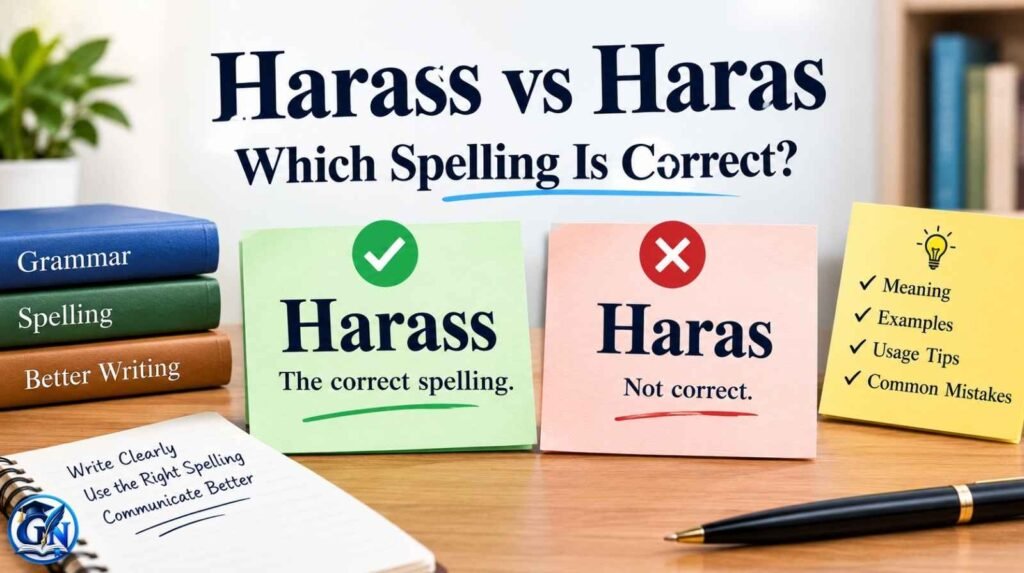
If you are confused about harass vs haras, you are not alone. These two spellings look almost identical, but when you mean “to repeatedly bother, annoy, pressure, or trouble someone,” only one is the standard English spelling: harass.
The correct spelling is harass, with one r and two s’s at the end. The form haras is not the standard spelling of this English verb. Oxford, Cambridge, and other major dictionaries list harass as the verb used for repeatedly annoying, troubling, or putting pressure on someone.
In this guide, you will learn the difference between harass and haras, their meanings, pronunciation, correct word forms, common mistakes, examples, and an easy trick for remembering the spelling.
Target audience: Students, English learners, bloggers, writers, professionals, and anyone checking the correct spelling of harass.
Tone: Friendly expert, clear, practical, and engaging.
Harass vs Haras: Quick Answer
Harass is the correct spelling when you mean to repeatedly bother, annoy, pressure, intimidate, or trouble someone.
Haras is not the standard English spelling of this verb.
| Spelling | Correct for the English verb? | Meaning |
|---|---|---|
| harass | Yes | To repeatedly bother, trouble, annoy, or pressure |
| haras | No | Not the standard spelling of the verb |
For example:
- Correct: The caller continued to harass her.
- Incorrect: The caller continued to haras her.
Cambridge defines harass as repeatedly annoying or upsetting someone, while Oxford similarly describes it as putting pressure on someone or doing unpleasant things to them.
The Easy Rule
Remember:
Harass = H-A-R-A-S-S
It has one R and two S’s.
If you are writing about someone being repeatedly bothered or troubled, use harass.
What Does Harass Mean?
Harass is a verb that means to repeatedly annoy, bother, trouble, pressure, intimidate, or upset someone.
Cambridge describes harass as continuing to annoy or upset someone over a period of time. Oxford also notes that the word can describe putting pressure on someone or saying or doing unpleasant things to them.
For example:
- The students were warned not to harass their classmates.
- She asked him to stop harassing her.
- The customer complained that the company continued to harass him with calls.
- Nobody should harass another person online.
The word can appear in many contexts, including workplace communication, education, social media, personal relationships, and formal complaints.
Harass as a Verb
The word harass is normally used as a verb.
Common structures include:
harass + someone
- They harassed the employee.
- The messages harassed the witness.
You can also use it in passive constructions:
- She was harassed at work.
- The employees were harassed by repeated calls.
Harass and Its Related Forms
Learning the word family can make the spelling easier:
- harass — base verb
- harasses — third-person singular
- harassed — past tense and past participle
- harassing — present participle
- harassment — noun
Oxford lists these forms, including harasses, harassed, and harassing.
Why Is Harass Spelled With Two S’s?
The most common mistake in harass vs haras is leaving out the final s.
The correct spelling is:
H-A-R-A-S-S
Not:
H-A-R-A-S
This can happen because the final two letters are pronounced as part of the same word, so a writer may remember only one s.
For example:
❌ The emails continued to haras the employee.
✅ The emails continued to harass the employee.
The same spelling pattern remains important when forming related words.
Harassed
The past tense is:
harassed
Example:
She was harassed by repeated unwanted messages.
Do not write harased when you mean the past tense of harass.
Harassing
The -ing form is:
harassing
Example:
He was accused of harassing his neighbor.
Notice that the spelling retains the double s from harass.
Harasses
The third-person singular form is:
harasses
Example:
The supervisor repeatedly harasses his employees.
This form can look unusual because several s letters appear close together, but harasses is the standard form. Oxford lists harasses as the third-person singular form.
Haras: Is It a Correct English Word?
If you are trying to write the English verb meaning “to repeatedly bother or trouble someone,” then haras is incorrect.
For example:
❌ Please do not haras other students.
✅ Please do not harass other students.
However, there is an important language detail: haras can appear in other contexts and languages. For example, Collins and Cambridge list French haras as a noun meaning a stud farm, or a place where horses are bred.
That does not make haras the correct spelling of the English verb harass.
Haras vs Harass in Ordinary English
For ordinary English writing, the distinction is simple:
If you mean “repeatedly bother, annoy, pressure, or trouble someone,” write harass.
For example:
The teacher told the students not to harass one another.
Not:
The teacher told the students not to haras one another.
So, when a spelling checker asks you to choose between these two forms for the English verb, harass is the form you want.
Harass Pronunciation: Why Does It Cause Confusion?
One reason people may misspell harass is that its pronunciation varies between English accents.
Cambridge gives multiple accepted pronunciations for both UK and US English. In UK English, pronunciations include /ˈhær.əs/ and /həˈræs/, while US English includes /həˈræs/ and /ˈher.əs/.
In simple terms, you may hear the stress placed differently depending on the speaker’s accent.
That means pronunciation alone is not a reliable way to remember the spelling.
Does Pronunciation Change the Spelling?
No.
Even when people pronounce the word differently, the standard spelling remains:
harass
So remember the written form rather than trying to spell it entirely from the way it sounds.
A Useful Memory Trick
Use this simple reminder:
HARASS has two S’s.
Think of the word as:
HAR + ASS
The important part for spelling is the ending:
SS
That small visual trick can help prevent the common haras mistake.
Harass vs Haras: Correct Examples
Here are several natural examples:
- The company has strict rules against workplace harassment.
- Please do not harass other users online.
- The customer said the company continued to harass him with repeated calls.
- She reported that someone had been harassing her through messages.
- The police warned the group not to harass the witness.
- Students should never harass their classmates.
- He was accused of harassing his neighbor.
These examples show how the word can be used in everyday, workplace, educational, and online contexts.
Incorrect Examples With Haras
These sentences contain the common spelling mistake:
❌ He continued to haras his coworker.
❌ They were told not to haras other students.
❌ The customer complained that the company would haras him.
The corrected versions are:
✅ He continued to harass his coworker.
✅ They were told not to harass other students.
✅ The customer complained that the company would harass him.
Harass vs Haras: Word-Form Comparison
Use this checklist whenever you are unsure:
- Am I using the verb meaning “to repeatedly bother or trouble”?
- Did I spell it harass?
- Does the base form end in ss?
- Is the past form harassed?
- Is the -ing form harassing?
- Is the third-person form harasses?
- Is the noun harassment?
| Word form | Correct spelling | Example |
|---|---|---|
| Base verb | harass | Do not harass him. |
| Third person | harasses | He harasses his coworkers. |
| Past tense | harassed | She was harassed online. |
| -ing form | harassing | They are harassing the employee. |
| Noun | harassment | The complaint involved harassment. |
What About Harassment?
The noun is harassment, not harasment.
For example:
The company investigated the complaint of workplace harassment.
Dictionary.com defines harassment as an act or instance of harassing and gives examples involving persistent unwanted behavior.
Learning the complete family is useful because it helps you recognize the correct spelling in different sentences.
2025–2026 Evidence Snapshot: What Current Sources Show
There is no authoritative 2025–2026 dataset that provides a reliable percentage comparing how often people search for harass versus haras. Therefore, it would be misleading to invent a search-volume percentage or claim that one spelling is searched a specific number of times.
However, recent educational evidence supports the standard spelling. A 2025 SSC Selection Post spelling question presented Harass alongside misspelled alternatives including Haras, and the published solution identified Harass as the correctly spelled word. The solution was updated in August 2026.
A current English-learning resource from the Oak National Academy also uses the sentence “It is wrong to haras others” as a spelling exercise and gives harass as the correct answer.
| Evidence | Date | Finding |
|---|---|---|
| SSC Selection Post spelling question | 2025 | Harass identified as correct |
| Published solution update | 2026 | Harass confirmed as correct |
| Oak National Academy spelling exercise | Current | haras → harass |
| Oxford Advanced Learner’s Dictionary | Current | Lists harass and its standard forms |
| Cambridge Dictionary | Current | Defines and lists harass |
The important takeaway is that current dictionary and educational references consistently support harass for the English verb.
A Real-Life Example: Why One Letter Matters
Imagine that an employee is writing a formal complaint about repeated unwanted messages from a coworker. The employee drafts this sentence:
“I would like to report that the coworker continued to haras me after I asked him to stop.”
The intended meaning is clear, but the spelling is incorrect. In a casual text message, a reader might understand the sentence immediately. However, in a workplace complaint, formal email, report, or other professional document, spelling accuracy matters because the writing needs to be clear and polished.
The corrected sentence is:
“I would like to report that the coworker continued to harass me after I asked him to stop.”
The difference is only one letter, but it changes an incorrect spelling into the standard English form.
This example also demonstrates why learning the complete word family is useful. If the writer later says “the behavior was harassing” or “the incident involved harassment,” knowing the root word harass makes the related forms easier to spell.
The same principle applies to school assignments, blog articles, professional correspondence, website content, and everyday writing. When the intended meaning is repeated unwanted behavior, use harass, not haras.
Common Mistakes With Harass
Haras
❌ haras
✅ harass
This is the mistake discussed throughout this article: one final s has been omitted.
Harased
❌ harased
✅ harassed
The past form keeps the double s:
harass → harassed
Harasing
❌ harasing
✅ harassing
The -ing form is:
harass → harassing
Harases
❌ harases
✅ harasses
The third-person singular form is:
harass → harasses
A useful strategy is to learn the entire word family instead of memorizing only one form.
FAQs
Q1: Is Harass or Haras Correct?
A: Harass is correct when you mean to repeatedly bother, annoy, pressure, intimidate, or trouble someone. Haras is not the standard spelling of this English verb.
Q2: How Do You Spell Harass Correctly?
A: The correct spelling is:
H-A-R-A-S-S
Remember: one R and two S’s.
Q3: Is Haras a Real Word?
A: Haras can occur as a word in other contexts. For example, French haras means a stud farm. It is also found in some historical or specialized English usage. However, it is not the standard spelling of the English verb harass.
Q4: What Is the Past Tense of Harass?
A: The past tense and past participle are harassed.
Example:
The employee was harassed by repeated messages.
Oxford lists harassed as the past and past participle form.
Q5: What Is the -Ing Form of Harass?
A: The -ing form is harassing.
Example:
The messages were harassing and unwanted.
Q6: What Is the Noun Form of Harass?
A: The noun form is harassment.
Example:
The company investigated the complaint of workplace harassment.
Q7: Why Do People Spell Harass as Haras?
A: The most likely reason is that writers remember the pronunciation but omit one of the two final s letters when writing the word. Because the final letters can sound like a single /s/ sound, the spelling can be easy to forget.
A simple reminder is:
Harass = two S’s.
Q8: Is Harass Used in Formal Writing?
A: Yes. Harass is a standard English verb and is used in formal as well as informal contexts. Dictionaries give examples involving workplaces, authorities, education, online behavior, and other situations.
Conclusion:
When choosing between harass vs haras, the correct spelling for the standard English verb is harass.
Harass means to repeatedly bother, annoy, pressure, intimidate, or trouble someone. Its common forms include harasses, harassed, harassing, and harassment. Major English dictionaries such as Oxford and Cambridge recognize harass as the standard verb.
The easiest way to remember the spelling is:
Harass = one R + two S’s.
So write:
✅ Please do not harass other people.
Not:
❌ Please do not haras other people.
Although haras can have meanings in other linguistic contexts, it is not the spelling you need when you mean the English verb harass.
Still unsure about another confusing English spelling? Explore more simple spelling and grammar guides on GramNora to write with greater confidence and accuracy.
👉 Discover more simple and practical grammar guides on Gramnora

Explore the world of English grammar with simple explanations, practical examples, and easy-to-follow guides by Zia Tarar, the founder and author of Gramnora. From essential grammar rules and sentence structure to common mistakes and advanced concepts, Gramnora helps learners improve their English, strengthen their writing skills, and communicate with greater clarity and confidence.