
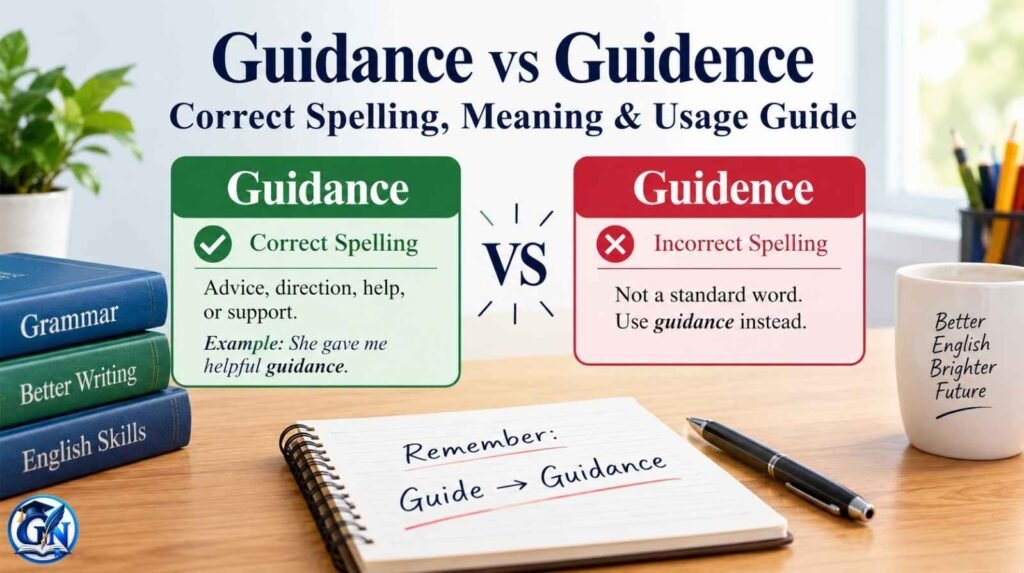
If you are unsure whether to write Guidance vs Guidence, you are not alone. The two spellings look almost identical, and their endings can sound very similar when spoken. However, there is a clear answer: guidance is the correct spelling. Guidence is a misspelling.
The word guidance is a noun that generally means advice, direction, help, or support given to someone. Oxford defines it as help or advice, particularly from someone with greater experience, and also uses it for the process of controlling the direction of something such as a rocket.
In this guide, you will learn the difference between guidance vs guidence, understand what guidance means, see real examples, and discover a simple trick for remembering the correct spelling.
Guidance vs Guidence: Which Spelling Is Correct?
Guidance is the standard English spelling.
It is a noun used when talking about advice, direction, instruction, assistance, or support.
Examples:
- My teacher gave me useful guidance before the exam.
- We need professional guidance before making a decision.
- Thank you for your guidance and support.
- The manual provides clear guidance for new users.
Guidence is incorrect
Guidence is not the standard spelling of the noun meaning advice or direction.
For example:
❌ Thank you for your guidence.
✅ Thank you for your guidance.
The difference is only one letter, but that small difference matters in formal writing, academic work, professional emails, websites, and other published content.
Quick comparison
| Word | Correct? | Meaning | Example |
|---|---|---|---|
| Guidance | ✅ Yes | Advice, direction, help, or support | She gave me helpful guidance. |
| Guidence | ❌ No | Misspelling of guidance | Avoid this spelling. |
So, when asking “guidance vs guidence which is correct?”, remember: guidance is correct; guidence is incorrect.
What Does Guidance Mean?
The most common meaning of guidance is advice or direction intended to help someone understand what to do or make a decision.
Oxford lists guidance as an uncountable noun and gives examples involving teachers, students, parents, counselors, and experienced people providing advice.
For example:
The student asked her teacher for guidance on choosing a university course.
Here, guidance means helpful advice or direction.
Another example:
My manager gave me guidance on how to complete the report.
In this sentence, guidance means instruction or helpful advice.
Guidance can mean different types of support
The exact meaning depends on the situation.
Academic guidance:
Advice that helps students with education or studies.
Career guidance:
Advice about jobs, careers, qualifications, or professional development.
Professional guidance:
Advice from someone with knowledge or experience in a particular field.
Personal guidance:
Support or advice concerning personal decisions.
Technical guidance:
Instructions that help someone use a product, system, or technology.
For example:
- The counselor provided career guidance.
- The instructor offered academic guidance.
- The technician gave us technical guidance.
Guidance can also mean directional control
Guidance does not always refer to advice from another person. It can also describe the process of controlling the direction of something.
For example:
The aircraft uses an advanced guidance system.
Oxford specifically includes this technical meaning, referring to systems that control the direction of rockets or similar objects.
Therefore, guidance can mean either helpful direction in a figurative sense or actual directional control in a technical context.
Why Do People Spell Guidance as Guidence?
One reason people write guidence is that English has many familiar words ending in -ence, including:
- difference
- confidence
- existence
- reference
- independence
Because guidance sounds similar to words with an -ence ending, some writers may naturally choose guidence.
However, pronunciation alone is not a reliable way to determine English spelling.
The established spelling is:
G-U-I-D-A-N-C-E
Not:
G-U-I-D-E-N-C-E
Remember the base word: guide
One of the easiest ways to remember the correct spelling is to connect guidance with the word guide.
Think:
guide → guidance
The important visual pattern is guid- followed by -ance.
For example:
- guide
- guided
- guiding
- guidance
This connection can help you avoid accidentally replacing the a with e.
Don’t assume every noun uses -ence
English spelling contains many patterns, but those patterns are not always predictable.
For example:
- assist → assistance
- perform → performance
- guide → guidance
But other words use -ence:
- exist → existence
- differ → difference
- prefer → preference
Therefore, it is better to remember the established spelling of guidance rather than trying to create the spelling from pronunciation.
How to Use Guidance Correctly in a Sentence
The word guidance commonly appears with phrases such as provide guidance, give guidance, seek guidance, and under the guidance of.
Provide guidance:
The teacher provided guidance throughout the project.
Give guidance:
My supervisor gave me useful guidance.
Seek guidance:
You should seek professional guidance when necessary.
Under the guidance of:
The students worked under the guidance of an experienced instructor.
These patterns make the word easy to use naturally.
Guidance is usually uncountable
In everyday English, guidance is generally treated as an uncountable noun.
So, these are natural:
✅ I need some guidance.
✅ She gave me helpful guidance.
✅ We received professional guidance.
A less natural construction would be:
❌ I need a guidance.
Instead, you can say:
✅ I need some guidance.
✅ I need a piece of advice.
The choice can also depend on what you are trying to express. If you mean several specific recommendations, advice, instructions, or guidelines may sometimes be more natural.
Guidance vs advice
Although guidance and advice are closely related, they are not always interchangeable.
Advice usually refers to a recommendation about what someone should do.
Guidance can be broader and may include direction, support, instruction, or help throughout a process.
For example:
My mentor gave me advice about changing careers.
versus:
My mentor provided guidance throughout my career transition.
Both sentences are correct, but guidance emphasizes ongoing direction or support.
Guidance vs Guidence: A Simple Step-by-Step Spelling Guide
Step 1: Start with “guide”
Begin with the familiar word:
GUIDE
Step 2: Think about the noun
The noun is:
GUIDANCE
Do not change the a to e.
Step 3: Check the ending
The correct ending is:
-ANCE
So:
GUID + ANCE = GUIDANCE
Step 4: Check before publishing
Before submitting an assignment, sending an email, or publishing an article, look for:
❌ guidence
✅ guidance
Quick memory checklist
| Check | Correct Form |
|---|---|
| Starts with | guid- |
| Middle vowel | a |
| Ending | -ance |
| Full spelling | guidance |
| “Guidence” acceptable? | ❌ No |
A useful memory sentence is:
A guide gives guidance.
Both guide and guidance begin with guid-, making the relationship easier to remember.
Real-Life Example: Guidance in Education and the Workplace
Imagine a college student named Sarah who has to choose between two academic programs. She enjoys both subjects but is uncertain about which one would better match her career goals. Instead of choosing randomly, Sarah schedules a meeting with an academic counselor.
During the meeting, the counselor asks about Sarah’s interests, previous coursework, strengths, and career plans. The counselor explains the differences between the two programs and discusses the types of careers associated with each one. Sarah then receives a list of resources and is encouraged to consider internships and speak with professionals in both fields.
The counselor has not simply made the decision for Sarah. Instead, the counselor has provided guidance—information, direction, and support that help Sarah make a more informed decision.
Later, Sarah begins an internship. Her supervisor also provides guidance by explaining workplace procedures, reviewing her first assignments, and showing her how to communicate with clients.
In both situations, the word guidance describes helpful direction from someone with relevant knowledge or experience.
Notice how naturally the word works:
The academic counselor provided Sarah with valuable guidance.
and:
Her supervisor continued to offer guidance during the internship.
Writing guidence in either sentence would be a spelling error. The correct form remains guidance.
2025–2026 Data Snapshot: Why Correct English Spelling Matters
The importance of clear English writing extends beyond native speakers. A 2025 dataset based on Ethnologue information reported approximately 1.528 billion English speakers worldwide, including about 390 million native speakers and 1.138 billion non-native speakers.
That means a large proportion of English users learn and use the language as an additional language. For learners, spelling distinctions such as guidance vs guidence can be particularly useful because pronunciation does not always reveal the correct written form.
A note about what this statistic does and does not show
The 2025 speaker figure does not measure how many people misspell guidance, nor does it prove that guidence is unusually common. Instead, it provides useful context: English is used by a very large and diverse international audience.
Current English-learning resources also continue to incorporate technology alongside human instruction. For example, in October 2025, the British Council announced an AI-supported English-learning system designed to give learners additional speaking practice and feedback between lessons.
For writers and learners, the practical lesson is simple: clear, standard spelling remains important when communicating with a global English-speaking audience.
Common Mistakes With Guidance
Mistake 1: Writing “guidence”
❌ We appreciate your guidence.
✅ We appreciate your guidance.
This is the most common issue addressed by the guidance vs guidence question.
Mistake 2: Using “a guidance”
❌ The teacher gave me a guidance.
✅ The teacher gave me some guidance.
Because guidance is normally uncountable, some guidance is usually the more natural choice.
Mistake 3: Confusing guidance with guidelines
These words are related but have different uses.
Guidance can mean general advice or direction:
The company provided guidance on workplace safety.
Guidelines usually means specific recommended rules or principles:
The company published new safety guidelines.
Choosing between them depends on the meaning you want to communicate.
Mistake 4: Relying only on pronunciation
The spoken form of guidance does not make every letter obvious. Therefore, spelling it based purely on sound can lead to guidence.
When in doubt, remember:
A guide gives guidance.
FAQs
Q1: Is “guidance” or “guidence” correct?
A: Guidance is correct. Guidence is a misspelling and should not be used when you mean advice, direction, or support.
Q2: Is guidence a word?
A: Guidence is not the standard English spelling of the noun guidance. If you mean advice or direction, use guidance.
Q3: What does guidance mean?
A: Guidance means advice, direction, help, instruction, or support that helps someone make a decision or take action. Oxford also records a technical meaning involving control of direction.
Q4: How do you spell guidance?
A: The correct spelling is:
G-U-I-D-A-N-C-E
A useful memory trick is:
guide → guidance
Q5: Why is guidance spelled with an A?
A: The established noun is guidance, with the -ance ending. English has both -ance and -ence endings, so pronunciation alone does not determine which spelling is correct.
Q6: Is guidance a noun?
A: Yes. Guidance is a noun.
For example:
The teacher gave us helpful guidance.
Q7: Can I say “a guidance”?
A: Usually, no. Guidance is generally uncountable when it means advice or direction.
Use:
I need some guidance.
rather than:
I need a guidance.
Q8: What is the difference between guidance and advice?
A: Advice generally means a recommendation about what someone should do. Guidance can be broader and include advice, direction, instruction, or ongoing support.
Conclusion
When comparing guidance vs guidence, the answer is straightforward: guidance is the correct spelling, while guidence is a misspelling.
Use guidance when you mean advice, direction, instruction, help, or support. The word can be used in education, careers, business, technology, everyday communication, and many other contexts. Dictionaries such as Oxford and Dictionary.com recognize guidance as the standard noun.
The easiest way to remember the spelling is to connect it with guide:
guide → guidance
So the next time you wonder whether to write guidance or guidence, choose guidance.
👉 Discover more simple and practical grammar guides on Gramnora

Explore the world of English grammar with simple explanations, practical examples, and easy-to-follow guides by Zia Tarar, the founder and author of Gramnora. From essential grammar rules and sentence structure to common mistakes and advanced concepts, Gramnora helps learners improve their English, strengthen their writing skills, and communicate with greater clarity and confidence.