
Have you ever wondered whether you should write “awhile” or “a while” in a sentence? Although these two expressions look almost identical and refer to a period of time, they serve different grammatical purposes. Choosing the wrong form can make your writing less accurate, especially in emails, school assignments, professional messages, and everyday conversations.
The good news is that understanding the difference between awhile vs a while is easier than you might think. Once you learn how each expression works, you can use both confidently without second-guessing yourself.
In this guide, you will discover the meanings of awhile and a while, their grammatical differences, common mistakes, and practical examples. You will also see how to use them in professional emails, casual conversations, workplace situations, and other real-life scenarios.
What Is the Difference Between Awhile and a While?
The main difference between awhile and a while is their grammatical function.
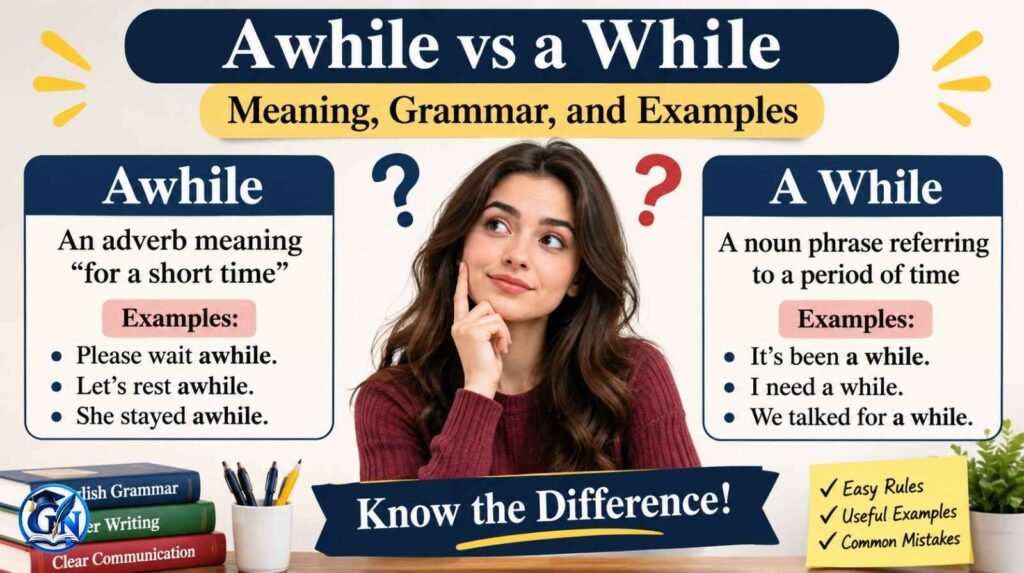
- Awhile is an adverb that means for a short time or for some time.
- A while is a noun phrase consisting of the article a and the noun while. It refers to a period of time.
Both expressions describe time, but they are not interchangeable in every sentence.
Consider these examples:
- Please wait awhile before opening the door.
- Please wait for a while before opening the door.
Both sentences are correct because awhile can replace the phrase for a while in this construction.
Now consider another example:
It has been a while since we last spoke.
Here, a while is correct because the sentence needs a noun phrase after been. You would not normally write, “It has been awhile since we last spoke.”
The easiest way to remember the distinction is to think of awhile as an adverb and a while as a noun phrase. This small grammatical difference explains most of the rules surrounding their usage.
What Does Awhile Mean?
Awhile is an adverb that means for a period of time. It usually describes how long an action continues or how long someone does something.
It often appears with verbs such as wait, rest, stay, sit, and think.
For example:
- Please sit awhile and enjoy the view.
- We waited awhile for the bus to arrive.
- Daniel rested awhile after finishing his workout.
- Let me think awhile before making a decision.
- She stayed awhile to help her colleagues.
In each sentence, awhile explains the duration of an action.
How to Use Awhile in Everyday Conversations
Imagine that your friend visits your home after a long time. You want to invite them to stay for a little longer.
You might say:
“Don’t leave yet. Stay awhile and tell me about your new job.”
Here, awhile means for some time. It sounds natural in this context and communicates your request clearly.
Another example is a conversation between two classmates.
Hassan: I’m feeling tired after studying for three hours.
Maya: Take a break and relax awhile.
Maya uses awhile to suggest that Hassan relax for a period of time.
Scenario Example: Awhile in an Email
Imagine that Olivia is sending an email to her colleague, Ethan, asking him to wait before reviewing a document.
Hi Ethan,
I’ve made a few changes to the project document and am checking the final details. Could you please wait awhile before reviewing it? I’ll send you the updated version shortly. Thanks for your patience.
Best regards,
Olivia
In this email, awhile means for a short period of time. The word is grammatically correct because it modifies the verb wait.
You could also write, “Could you please wait for a while before reviewing it?” Both versions are correct.
What Does a While Mean?
A while is a noun phrase that refers to a period of time. The word while functions as a noun, and a is the article that comes before it.
Unlike awhile, the phrase a while commonly appears after a preposition or in expressions that describe how much time has passed.
Examples include:
- It has been a while since I visited my hometown.
- We stayed there for a while.
- She needs a while to finish the report.
- After a while, everyone became comfortable.
- I haven’t watched that movie in a while.
Notice that a while can appear in several different grammatical structures. Its exact position depends on how the sentence is constructed.
How to Use A While in Everyday Conversations
Suppose you meet a friend you haven’t seen since graduation. You want to mention how much time has passed.
You might say:
“It’s been a while since we last met. How have you been?”
This sentence is correct because a while refers to the period of time since your last meeting.
Here is another example:
Ali: Are you ready to leave?
Sara: Give me a while. I need to finish this phone call.
Sara uses a while as a noun phrase referring to the amount of time she needs.
Scenario Example: A While in a Professional Email
Imagine that James needs additional time to prepare a business proposal. He writes to his manager, Sophia, to explain the delay.
Dear Sophia,
I’m still reviewing the figures for the quarterly proposal and want to ensure everything is accurate before submitting it. I may need a while to complete the final review. I’ll send you the finished document as soon as possible. Thank you for your understanding.
Best regards,
James
In this example, a while is correct because it is the object of the verb phrase need. James needs a period of time to finish the work.
Writing “I may need awhile” is not the standard choice in this sentence. The noun phrase a while is the appropriate form.
Awhile vs a While: Grammar Rules Explained
Understanding a few basic grammar rules will help you choose the correct expression in almost any situation.
Rule 1: Use Awhile When You Mean “For Some Time”
Use awhile when you need an adverb to describe the duration of an action.
Examples:
- Stay awhile.
- Let’s rest awhile before continuing.
- The children played awhile in the garden.
- Please wait awhile while I check your reservation.
- He sat quietly awhile before answering.
In these examples, awhile modifies the actions expressed by the verbs.
A useful substitution test is to replace awhile with for some time. If the sentence still makes sense, awhile may be the correct choice.
For example:
“Let’s rest awhile.”
“Let’s rest for some time.”
Both sentences communicate the same basic meaning.
Rule 2: Use A While After “For”
When the word for introduces a duration, use the noun phrase a while.
Correct examples:
- We talked for a while after the meeting.
- She waited for a while outside the office.
- I haven’t seen him for a while.
- They stayed at the hotel for a while.
Why is this important?
The word for is a preposition, and in these constructions, it takes the noun phrase a while as its complement.
Writing “for awhile” is generally avoided in standard edited English. Although you may encounter it in informal writing, for a while is the safer and more widely accepted choice.
Rule 3: Use A While After “It’s Been” or “Has Been”
When you want to say that a period of time has passed, use a while.
Correct examples:
- It’s been a while since we talked.
- It has been a while since I visited my grandparents.
- It’s been a while since the company introduced a new product.
- It had been a while since Rachel last contacted her former teacher.
These constructions describe the time elapsed since an event or action.
Incorrect in standard usage:
It’s been awhile since we talked.
Correct:
It’s been a while since we talked.
Remember this pattern whenever you write about something that happened some time ago.
Rule 4: Use A While When You Need a Noun Phrase
The phrase a while can function as the object of a verb or appear after a preposition.
Examples:
- I need a while to consider your offer.
- Give me a while to finish the assignment.
- After a while, the rain finally stopped.
- We haven’t spoken in a while.
In each sentence, a while refers to a period of time rather than directly modifying a verb as an adverb.
Awhile vs a While: Side-by-Side Examples
The following table highlights the main differences between the two expressions.
| Awhile | A while |
|---|---|
| Please wait awhile. | Please wait for a while. |
| Let’s sit awhile. | Let’s sit here for a while. |
| He rested awhile after lunch. | He rested for a while after lunch. |
| Stay awhile if you can. | Stay for a while if you can. |
| She thought awhile before replying. | She thought about the question for a while. |
Both forms can be correct in sentences where the meaning is for some time. The difference is their grammatical structure.
However, the following sentences require a while:
- It has been a while since I saw you.
- I need a while to complete the task.
- After a while, the noise stopped.
- We haven’t visited that restaurant in a while.
These examples demonstrate why the two expressions cannot simply be substituted for one another everywhere.
Common Mistakes When Using Awhile and a While
Even confident English speakers sometimes confuse these expressions. Here are some common mistakes and the corrections you should remember.
Mistake 1: Writing “It’s Been Awhile”
Incorrect in standard edited English:
“It’s been awhile since we last spoke.”
Correct:
“It’s been a while since we last spoke.”
The phrase a while functions as a noun phrase in this sentence. It refers to the period that has passed since the last conversation.
Tip: Whenever you write “It’s been,” “It has been,” or “It had been” to describe elapsed time, a while is generally the correct form.
Mistake 2: Writing “For Awhile”
Less preferred in standard edited English:
“I waited for awhile outside the building.”
Preferred:
“I waited for a while outside the building.”
The preposition for is followed by the noun phrase a while. Although the closed form appears in informal writing, using for a while avoids confusion and follows standard editorial conventions.
Mistake 3: Assuming Awhile and a While Always Mean Different Lengths of Time
Some people assume that awhile means a short period, while a while means a much longer period.
That is not a reliable grammatical rule.
Both expressions can refer to a relatively short or unspecified period. The main distinction is how they function in a sentence, not the exact number of minutes, hours, or days involved.
For example:
- I’ll stay awhile.
- I’ll stay for a while.
Both sentences can describe the same situation. Neither one specifies an exact duration.
Mistake 4: Treating Awhile as a Noun
Incorrect:
“I need awhile to think about the offer.”
Preferred:
“I need a while to think about the offer.”
The verb need takes a noun phrase here, so a while is the standard form.
A simple way to avoid this mistake is to ask yourself whether the sentence needs a noun phrase referring to a period of time. If it does, use a while.
Awhile vs a While in Professional and Academic Writing
In professional communication, correct word choice helps make your writing clear and polished. The distinction between these expressions is especially useful when drafting emails, reports, assignments, and workplace messages.
In Workplace Emails
Consider this message:
Hi Rebecca,
Thank you for sharing your feedback during today’s meeting. I’ll take a while to review your suggestions carefully and will send you an updated version of the report tomorrow.
Best regards,
Michael
Here, a while is correct because it refers to the period Michael needs for reviewing the suggestions.
If Michael instead wrote, “Please wait awhile while I check the report,” the adverb awhile would also be correct because it modifies wait.
In Academic Writing
Imagine a student explaining a research process in an assignment.
“After reviewing the initial results, the researcher paused awhile before examining the next set of observations.”
The word awhile is used as an adverb to describe how long the researcher paused.
Alternatively, the student could write:
“After reviewing the initial results, the researcher paused for a while before examining the next set of observations.”
Both versions are grammatically acceptable.
Academic writing often benefits from clarity and consistency. If a sentence becomes awkward when using awhile, the phrase for a while is a straightforward alternative.
In Customer Service Messages
A customer service representative might write:
“Please allow us a while to investigate the issue and respond to your request.”
Here, a while is a noun phrase referring to the time needed for the investigation.
Alternatively:
“Please wait awhile while we investigate the issue.”
Here, awhile modifies the verb wait.
In a formal customer service message, “Please allow us some time to investigate the issue” may sound even more natural, depending on the context.
Easy Tricks to Remember the Difference
If you regularly confuse awhile and a while, these simple techniques can help.
The “For Some Time” Test
Try replacing awhile with for some time.
- Rest awhile. → Rest for some time.
- Wait awhile. → Wait for some time.
- Sit awhile. → Sit for some time.
If the substitution works naturally, awhile is likely appropriate.
The “For a While” Test
If your sentence already contains the preposition for, use a while in standard writing.
- We waited for a while.
- They stayed for a while.
- She studied for a while.
This pattern is easy to remember because for a while is one of the most common expressions used to describe duration.
The Elapsed-Time Test
If you are describing how long it has been since something happened, choose a while.
- It’s been a while since I called him.
- It has been a while since our last meeting.
- We haven’t visited the museum in a while.
This test is especially helpful when writing emails or conversations about people and events from the past.
Practice Quiz: Awhile vs a While
Question 1: Please wait _____ while I find your file.
A) awhile
B) a while
Answer: A) awhile
Question 2: It’s been _____ since we last met.
A) awhile
B) a while
Answer: B) a while
Question 3: We talked for _____ after the class.
A) awhile
B) a while
Answer: B) a while
Question 4: I need _____ to think about your suggestion.
A) awhile
B) a while
Answer: B) a while
Question 5: Let’s rest _____ before continuing our journey.
A) awhile
B) a while
Answer: A) awhile
Frequently Asked Questions
1. Is Anyway or Anyways Correct?
Anyway is the standard form and is the best choice for formal and informal writing. Anyways is also used in English, particularly in informal conversations and messages, but it is generally less preferred in formal contexts.
2. Is Anyways Grammatically Incorrect?
No, anyways is not universally considered grammatically incorrect. It is an informal variant of anyway that is recognized in many varieties of English. However, some editors, teachers, and style guides discourage it in formal writing.
3. Is Anyway More Professional Than Anyways?
Yes. Anyway is generally more professional because it is the standard form used in edited English. For work emails, academic assignments, business reports, and customer communications, anyway is usually the better choice.
4. Can I Use Anyways in an Email?
You can use anyways in a casual email to a friend or someone you know well. However, for a job application, a message to your manager, or communication with a client, use anyway or a more precise alternative such as in any case.
5. Do Anyway and Anyways Mean the Same Thing?
In many situations, they have the same meaning: regardless, in any case, or a conversational transition. The main difference is that anyway is more widely accepted as the standard form, while anyways is generally more informal.
6. Which Word Should English Learners Memorize?
English learners should memorize anyway as the default choice. Once you understand how it works, you can recognize anyways in casual speech and decide whether it suits your own writing.
7. Is Anyway Used in Both American and British English?
Yes. Anyway is common in both American and British English. Anyways is also used in both, although its frequency and acceptance can vary by speaker, region, and context.
Conclusion
Understanding awhile vs a while comes down to recognizing a simple grammatical distinction. Awhile is an adverb that means for some time, while a while is a noun phrase that refers to a period of time.
Use awhile in sentences such as “Please wait awhile” and “Let’s rest awhile.” Choose a while in expressions such as “It’s been a while,” “I need a while,” and “for a while.”
Remember the most useful rule: use “a while” after “for” and when referring to elapsed time, and use “awhile” when you need an adverb to describe an action.
With a little practice, you can use both expressions confidently in emails, academic assignments, professional communication, and everyday conversations. The difference may seem small, but getting it right helps make your English writing more accurate, natural, and polished.
👉 Explore more useful grammar tips and guides on Gramnora

Explore the world of English grammar with simple explanations, practical examples, and easy-to-follow guides by Zia Tarar, the founder and author of Gramnora. From essential grammar rules and sentence structure to common mistakes and advanced concepts, Gramnora helps learners improve their English, strengthen their writing skills, and communicate with greater clarity and confidence.