
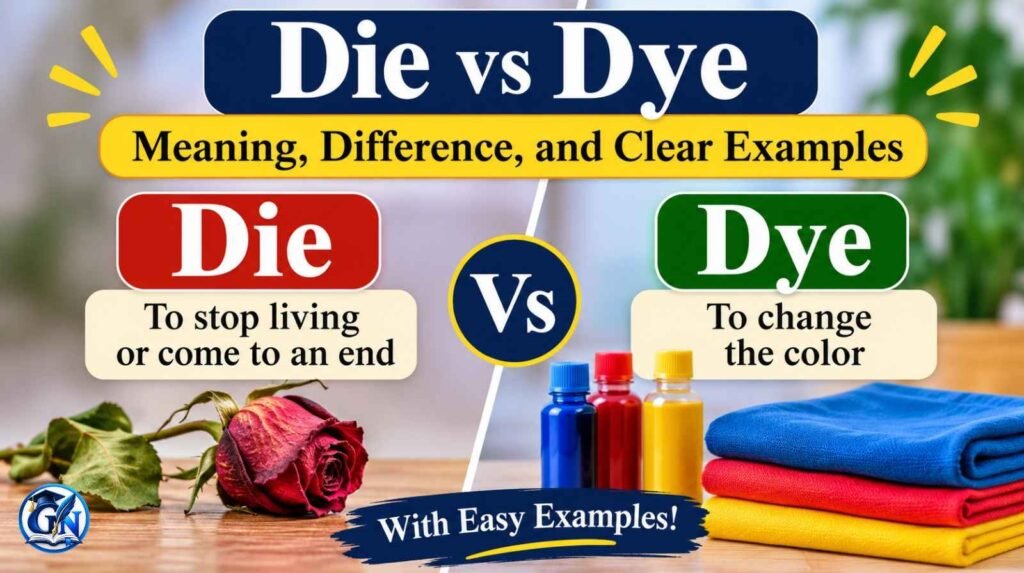
Have you ever wondered whether to write Die vs Dye? Although these two words sound exactly the same, they have completely different meanings and uses. This can make them confusing, especially when writing emails, messages, school assignments, or everyday sentences.
The good news is that understanding the difference between die vs dye is quite simple once you know what each word means. One word relates to life and death, while the other is associated with changing the color of something.
In this guide, we will explore the meanings, differences, grammatical uses, and practical examples of both words. You will also learn how to use them correctly in everyday conversations, professional emails, and other real-life situations.
Die vs Dye: Quick Difference
The main difference between die and dye is their meaning and grammatical function.
- Die is a verb that means to stop living or cease to exist. It can also describe something that stops functioning or loses its effectiveness.
- Dye is a verb that means to change the color of something using a special coloring substance. It can also be used as a noun to describe the coloring substance itself.
Here is a quick comparison:
| Word | Meaning | Example |
|---|---|---|
| Die | To stop living | Plants die without water. |
| Dye | To change the color of something | Sarah wants to dye her hair brown. |
Both words have the same pronunciation, but their spelling and meanings are different. Choosing the correct one depends entirely on what you want to communicate.
What Does Die Mean?
The word die is a verb that means to stop living. It is commonly used when talking about people, animals, plants, and other living organisms.
However, its meaning is not limited to living things. It can also describe something that stops working, disappears, or gradually comes to an end.
For example:
- Many plants die when they do not receive enough water.
- His grandfather died peacefully at home.
- The battery may die if you leave your phone switched on.
- Their friendship began to die after they moved to different cities.
In each example, die describes the ending of life, activity, or functionality.
Die as a Verb
The most common use of die is as a verb. It describes the process of losing life or coming to an end.
Consider these examples:
- People: Everyone eventually dies, but people leave memories behind.
- Animals: Small fish can die if the water in their aquarium becomes polluted.
- Plants: Flowers may die if they are not watered regularly.
- Technology: My old laptop might die if I do not replace its battery.
- Feelings: Sometimes, excitement begins to die when expectations are not met.
Notice that the word can be used in different situations, but its central idea remains the same: something is coming to an end or ceasing to function.
Die in Different Tenses
Like other English verbs, die changes its form depending on the tense.
| Tense | Word Form | Example |
|---|---|---|
| Present | Die / Dies | Plants die without sunlight. |
| Past | Died | The old tree died last winter. |
| Present participle | Dying | The flowers are dying. |
| Past participle | Died | Several plants have died. |
Remember that died is the past tense and past participle of die, while dying is its present participle.
One common spelling mistake is writing dieing instead of dying. The correct spelling is dying because the final silent e is removed before adding -ing.
Real-Life Scenario: Using Die in Everyday Conversation
Imagine that Ahmed has an old mobile phone that frequently shuts down because its battery is damaged.
He might tell his friend:
“My phone battery is about to die. I need to charge it before leaving home.”
In this sentence, die does not refer to a living thing. Instead, it means that the battery is about to stop working.
Another example:
“My grandmother’s favorite flowers died because nobody watered them while she was away.”
Here, died describes the flowers losing their life.
Email Example: Using Die Correctly
Suppose you are writing an email to your colleague about a computer that suddenly stopped working.
Subject: Computer Battery Problem
Hi Daniel,
I wanted to let you know that my laptop battery is about to die, and I may need to replace it before our next meeting. I’ll try to get it fixed as soon as possible so that it does not affect our work.
Best regards,
Michael
In this email, die is used correctly because it refers to a battery that is about to stop functioning.
What Does Dye Mean?
The word dye means to change the color of something by applying a coloring substance. It is commonly used when discussing hair coloring, clothing, fabrics, leather, and other materials.
Unlike die, which relates to life or the end of something, dye is associated with colors and appearance.
For example:
- She wants to dye her hair blonde.
- My mother used blue dye to color the fabric.
- They decided to dye their old curtains black.
- This company produces natural dyes for clothing.
In these sentences, dye describes the process or substance used to change an object’s color.
Dye as a Verb
When used as a verb, dye describes the action of coloring something.
For example:
- Hair: Jessica plans to dye her hair red before the wedding.
- Clothing: My sister wants to dye her white dress blue.
- Fabric: The workers dye the fabric before making clothes.
- Leather: The company uses special products to dye leather.
- Crafts: We decided to dye some cotton fabric for our art project.
In all these examples, the word dye describes changing the color of something.
Dye as a Noun
Interestingly, dye can also function as a noun. In this form, it refers to the substance used to give something a particular color.
For example:
- This hair dye contains natural ingredients.
- The blue dye changed the color of the white shirt.
- My mother purchased a black dye for her old trousers.
- Some fabric dyes work better on cotton than synthetic materials.
Here, dye is not describing an action. Instead, it identifies the coloring substance.
Dye in Different Tenses
The word dye also changes its form depending on the tense.
| Tense | Word Form | Example |
|---|---|---|
| Present | Dye / Dyes | I dye my clothes at home. |
| Past | Dyed | She dyed her hair brown. |
| Present participle | Dyeing | They are dyeing the fabric. |
| Past participle | Dyed | The material has been dyed. |
One important spelling detail is that dyeing is the correct present participle of dye.
Do not confuse dyeing with dying. Although they look similar, they have different meanings.
- Dying: Losing life or approaching death.
- Dyeing: Changing the color of something.
For example:
- The plant is dying because it has no water.
- The workers are dyeing the fabric blue.
This small spelling difference completely changes the meaning of a sentence.
Real-Life Scenario: Using Dye in Everyday Conversation
Imagine that Sarah has a white dress that she no longer likes. Instead of buying a new one, she decides to change its color.
She tells her friend:
“I’m planning to dye my white dress black because I want to wear it to the evening party.”
In this sentence, dye is correct because Sarah wants to change the color of her dress.
Another example:
“David bought a bottle of brown hair dye because he wanted to change his appearance.”
Here, dye is used as a noun because it refers to the coloring product.
Email Example: Using Dye Correctly
Suppose you work for a clothing company and need to inform your manager about a fabric-coloring process.
Subject: Fabric Coloring Update
Hi Olivia,
I wanted to update you about the fabric order. We have started to dye the new cotton materials in different colors according to the customer’s requirements. The blue and black batches are almost ready, and the remaining materials should be completed by tomorrow.
Best regards,
James
In this email, dye is used correctly because it describes the process of changing the fabric’s color.
Die vs Dye: Key Differences Explained
Although die and dye sound identical, their meanings, grammatical uses, and applications are quite different.
Let’s examine their main differences more closely.
Difference in Meaning
The biggest difference between these words is their meaning.
Die refers to losing life, stopping functioning, or coming to an end.
Example: The flowers will die without proper care.
Dye refers to changing the color of something using a coloring substance.
Example: I want to dye my old shoes black.
Therefore, use die when discussing life or something ending, and use dye when discussing colors.
Difference in Grammar
Both words can function as verbs, but dye can also function as a noun.
Examples:
- Verb (die): The plants die during extreme heat.
- Verb (dye): She wants to dye her hair.
- Noun (dye): This dye is suitable for cotton fabrics.
The word die can also appear as a noun in specialized contexts, such as a manufacturing tool or a singular gaming die. However, its everyday meaning is usually associated with the verb.
Difference in Spelling
The words differ by only one letter.
- Die: D-I-E
- Dye: D-Y-E
Although the spelling difference is small, the meanings are entirely different.
A simple spelling mistake can make your sentence confusing or change its intended meaning.
Difference in Pronunciation
One reason people confuse these words is that they are pronounced exactly the same.
Both die and dye are pronounced /daɪ/, which rhymes with words such as eye, buy, and sky.
They are examples of homophones: words that sound alike but have different meanings and spellings.
Common Mistakes When Using Die and Dye
Even people who speak English fluently sometimes confuse words that sound alike. Understanding common mistakes can help you avoid them in your writing.
Here are some incorrect and correct examples.
Mistake 1: Using Die Instead of Dye
Incorrect: I want to die my hair blonde.
Correct: I want to dye my hair blonde.
Explanation: The sentence describes changing hair color, so dye is the correct word.
Mistake 2: Using Dye Instead of Die
Incorrect: Plants dye without enough water.
Correct: Plants die without enough water.
Explanation: The sentence describes plants losing their lives, so die is appropriate.
Mistake 3: Confusing Dying and Dyeing
Incorrect: My flowers are dyeing because I forgot to water them.
Correct: My flowers are dying because I forgot to water them.
Explanation: The flowers are losing their life, not having their color changed.
Mistake 4: Confusing Dyeing With Dying in a Different Context
Incorrect: She is dying her hair red.
Correct: She is dyeing her hair red.
Explanation: The sentence describes a hair-coloring process, so dyeing is correct.
These mistakes are easy to avoid when you remember the basic meanings of both words.
Easy Tricks to Remember the Difference Between Die and Dye
If you frequently confuse these words, a few simple memory tricks can help you remember them.
Remember That Die Is Related to Life
Think about the word die whenever you are discussing life, death, or something that stops working.
For example:
- People die.
- Animals die.
- Plants die.
- Batteries die.
This connection makes it easier to choose the correct spelling.
Remember That Dye Is Related to Color
Think about dye whenever you are discussing changing colors.
For example:
- Dye your hair.
- Dye your clothes.
- Dye a piece of fabric.
- Buy hair dye.
You can associate the letter Y in dye with the idea of changing your appearance.
Remember the Difference Between Dying and Dyeing
This is particularly useful because these two words are often confused.
- Dying means losing life.
- Dyeing means applying color.
For example:
“The old flowers are dying, but I am dyeing my white shirt blue.”
This sentence uses both words correctly and shows their different meanings.
Die vs Dye: More Example Sentences
The best way to understand these words is to see how they work in different situations.
Here are additional examples to help you use them confidently.
Examples of Die in Sentences
- Some plants die when exposed to extreme temperatures.
- My phone will die soon if I do not charge it.
- The old man died peacefully in his sleep.
- Many animals struggle to survive when their natural habitats disappear.
- Their friendship began to die after years of separation.
- The battery died before I could finish my assignment.
- Without proper care, these flowers may die within a few days.
- The engine stopped working because its battery had died.
- Some traditions never die because people continue to preserve them.
- The sound of laughter slowly died as everyone left the room.
Examples of Dye in Sentences
- I want to dye my hair dark brown.
- My sister used blue dye to color her white shirt.
- The factory needs to dye the fabric before producing the clothes.
- She purchased a natural dye for her handmade project.
- They decided to dye their curtains a lighter shade.
- This hair dye is available in several different colors.
- My mother taught me how to dye cotton fabric at home.
- The company uses environmentally friendly dyes.
- He plans to dye his old sneakers black.
- The artist used natural dye to create colorful patterns.
Die vs Dye in Everyday Situations
Understanding the difference becomes easier when you see how these words are used in ordinary conversations.
Situation 1: Talking About a Phone Battery
Correct word: Die
Example:
“Please lend me your charger because my phone battery is going to die.”
Why? The battery is about to stop functioning.
Situation 2: Talking About Hair Color
Correct word: Dye
Example:
“Emma wants to dye her hair purple for the summer festival.”
Why? Emma wants to change her hair color.
Situation 3: Talking About Flowers
Correct word: Die
Example:
“The flowers will die if we leave them outside in the freezing weather.”
Why? The flowers may lose their life.
Situation 4: Talking About Clothes
Correct word: Dye
Example:
“Michael decided to dye his old white T-shirt green.”
Why? He wants to change the color of his clothing.
Situation 5: Talking About a Broken Machine
Correct word: Die
Example:
“The machine may die if we continue using it without maintenance.”
Why? The machine may stop working.
Why Do Die and Dye Sound the Same?
The words die and dye are examples of homophones. Homophones are words that have the same pronunciation but different spellings and meanings.
English contains many homophones, which can make spelling and writing challenging.
For example:
- Their, there, and they’re: These words have different meanings but similar pronunciation.
- See and sea: One refers to vision, while the other refers to a large body of salt water.
- Right and write: One relates to correctness or direction, while the other describes the act of writing.
- Flower and flour: One is a plant’s bloom, while the other is used in baking.
Similarly, die and dye sound alike, but their meanings are completely different.
The best way to avoid confusion is to understand the context of your sentence rather than relying only on pronunciation.
Frequently Asked Questions
1. What Is the Difference Between Die and Dye?
Die means to stop living, stop functioning, or come to an end. Dye means to change the color of something using a coloring substance. Both words sound the same but have different spellings and meanings.
2. Is It Die or Dye Your Hair?
The correct expression is dye your hair because it means changing your hair color. For example: “I want to dye my hair blonde before my birthday.” Writing “die your hair” would be incorrect in this context.
3. Is Dying or Dyeing Correct?
Both spellings are correct, but they have different meanings. Dying means losing life or approaching death, while dyeing means changing the color of something. For example: “The plant is dying” and “She is dyeing her hair.”
4. What Is the Past Tense of Die?
The past tense of die is died. Example: “The flowers died because they did not receive enough water.”
5. What Is the Past Tense of Dye?
The past tense of dye is dyed. Example: “She dyed her dress blue for the party.”
6. Is Dye a Verb or a Noun?
Dye can be both a verb and a noun. As a verb, it means to change the color of something. As a noun, it refers to the coloring substance used to create that change. Examples: Verb: “I want to dye my hair.” Noun: “This hair dye is expensive.”
7. Are Die and Dye Homophones?
Yes. Die and dye are homophones because they have the same pronunciation but different spellings and meanings.
8. Can Die Be Used for Things Other Than Living Organisms?
Yes. The word die can describe something that stops functioning or gradually comes to an end. For example: “My laptop battery died during the presentation.”
9. How Do You Remember When to Use Die or Dye?
A simple trick is to associate die with life and death and dye with colors. If you are talking about something losing its life or stopping work, use die. If you are talking about changing a color, use dye.
10. What Does Hair Dye Mean?
Hair dye is a coloring product used to change the natural or existing color of someone’s hair. For example: “Jessica bought a brown hair dye to cover her gray hair.”
Conclusion
Understanding the difference between die vs dye is simple once you remember their meanings and uses. Although both words sound exactly the same, they serve completely different purposes in English.
Die means to stop living, stop functioning, or come to an end. On the other hand, dye means to change the color of something or refers to the coloring substance itself.
Remember these simple examples:
- Flowers die without water.
- People eventually die.
- Batteries die when they run out of power.
- People dye their hair to change its color.
- Fabrics are dyed to create different colors.
The most important thing is to consider the meaning of your sentence before choosing a spelling. With a little practice, you will be able to use die and dye correctly in emails, conversations, and everyday writing.
👉 Explore more useful grammar tips and guides on Gramnora

Explore the world of English grammar with simple explanations, practical examples, and easy-to-follow guides by Zia Tarar, the founder and author of Gramnora. From essential grammar rules and sentence structure to common mistakes and advanced concepts, Gramnora helps learners improve their English, strengthen their writing skills, and communicate with greater clarity and confidence.