
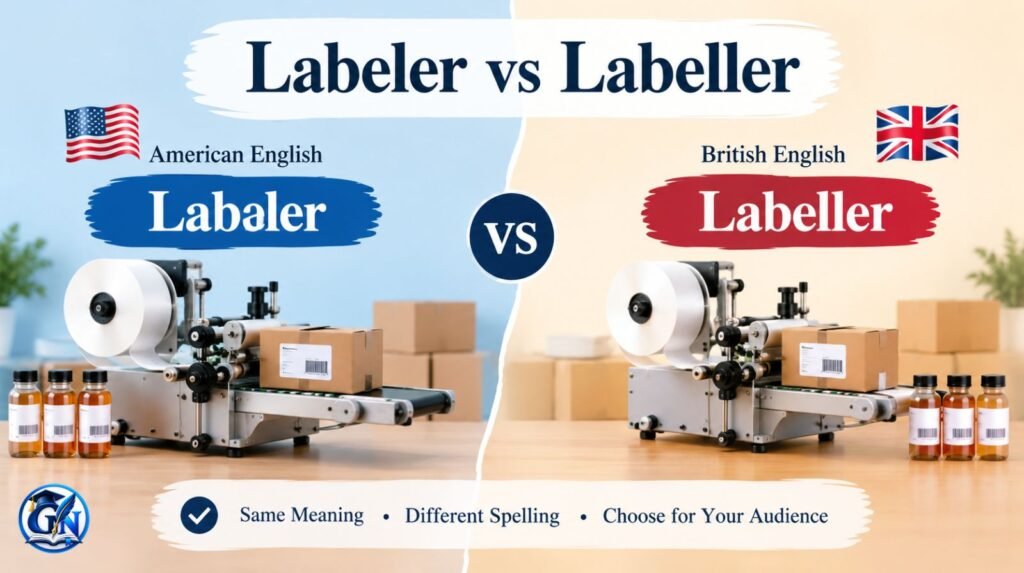
Have you ever wondered whether to write Labeler vs Labeller? Both spellings appear in English, so choosing the right one can be confusing. If you are writing an email, preparing a report, or creating professional content, knowing which spelling to use can help you communicate clearly.
The difference between labeler vs labeller mainly comes down to regional spelling conventions. Labeler is the standard American English spelling, while labeller is commonly used in British English and other varieties that follow British spelling conventions.
In this guide, you will learn the meaning of both words, their grammatical rules, the difference between American and British English, and practical examples to help you choose the correct spelling every time.
What Is the Difference Between Labeler and Labeller?
The main difference between labeler and labeller is spelling, not meaning. Both words refer to a person, machine, or device that applies labels to products, containers, packages, or other items.
Labeler Meaning and Usage
Labeler is the preferred spelling in American English. It describes someone or something that labels an object.
Examples:
- The factory hired a new labeler to organize its products.
- This automatic labeler prints and attaches labels to bottles.
- The labeler checked every package before shipping.
In American writing, labeler is generally the safest choice. It follows the common American spelling pattern of using a single l before the ending -er in this word.
Labeller Meaning and Usage
Labeller is a common spelling in British English and other English varieties that follow British conventions.
Examples:
- The labeller checked the labels on every package.
- Our company purchased a new labeller for its packaging line.
- The warehouse operator repaired the automatic labeller.
The word has the same meaning as labeler. The extra l reflects a spelling convention rather than a difference in function.
Quick Comparison: Labeler vs Labeller
| Feature | Labeler | Labeller |
|---|---|---|
| Preferred spelling | American English | British English |
| Meaning | A person or machine that labels | A person or machine that labels |
| Pronunciation | Same | Same |
| Grammatical role | Noun | Noun |
| Example | The labeler printed tags. | The labeller printed tags. |
Quick answer: Use labeler for American English and labeller for British English. Both are correct in their respective spelling conventions.
Why Are Labeler and Labeller Spelled Differently?
English spelling varies between countries because American and British English developed different conventions over time. Words formed from label provide a useful example of these differences.
The American English Spelling Rule
In American English, the final l in label is usually not doubled when adding the suffix -er.
Therefore:
- Label → Labeler
- Travel → Traveler
- Cancel → Canceler
These examples illustrate a common American spelling pattern, although English has exceptions and different words may follow different rules.
For instance, Americans generally write labeling rather than labelling.
The British English Spelling Rule
British English commonly doubles the final l in certain words when adding a vowel-initial suffix, even when the final syllable is not stressed.
Examples include:
- Label → Labeller
- Travel → Traveller
- Cancel → Cancelling
Consequently, labeller fits a familiar British English spelling pattern. However, doubling rules are not identical across all English varieties, so a dictionary suited to your intended audience remains helpful.
Does the Extra L Change the Meaning?
No. The extra l does not change the meaning, pronunciation, or grammatical function of labeler and labeller.
For example:
- American English: The labeler attached the product information.
- British English: The labeller attached the product information.
Both sentences communicate the same idea. The difference is regional spelling preference.
When Should You Use Labeler or Labeller?
The best spelling depends on your audience, the type of writing, and the spelling convention you are following. Consistency is especially important in professional documents and published content.
Use Labeler in American English
Choose labeler when writing for an American audience or following American English style guidelines.
Examples:
- The labeler operates at high speed.
- We replaced the old labeler with a modern machine.
- The labeler printed the shipping labels correctly.
This spelling is appropriate for American business documents, product descriptions, technical manuals, and website content aimed at readers in the United States.
Use Labeller in British English
Choose labeller when writing for a British audience or following a British English style guide.
Examples:
- The labeller applies labels to glass bottles.
- A technician inspected the labeller before production began.
- The labeller needs regular maintenance.
This spelling is suitable for British business communication, technical writing, and product documentation intended for readers accustomed to British spelling.
Follow One Spelling Convention Consistently
If you publish articles on a website, use the spelling convention that best matches your target audience.
For example, a website aimed primarily at American readers should generally use labeler, labeling, and other American spellings. A British-focused publication may prefer labeller and labelling.
Mixing conventions is not always grammatically wrong, but it can make a document feel inconsistent.
Labeler vs Labeller in Real-Life Situations
Understanding how the words appear in everyday contexts makes the distinction easier to remember.
Workplace and Manufacturing Examples
In manufacturing, a labeler or labeller may refer to a machine that attaches product labels to bottles, boxes, jars, or packages.
Examples:
- The American factory installed an automatic labeler on its production line.
- The British packaging company purchased a new labeller.
- The operator checked the labeler before starting the machine.
- The technician adjusted the labeller to prevent misplaced labels.
In these examples, both spellings refer to the same type of equipment.
Business Writing Examples
The words can also describe a person who labels items or performs labeling tasks.
Examples:
- The labeler organized the inventory according to product type.
- The labeller ensured that each box displayed the correct information.
- Our company needs an experienced labeler for its warehouse.
- The labeller completed the packaging process before the deadline.
The intended audience determines which spelling is preferable.
Website and Academic Writing Examples
Writers should also consider spelling conventions when creating articles, assignments, and online resources.
Examples:
- American English: “How to Choose an Industrial Labeler.”
- British English: “How to Choose an Industrial Labeller.”
- American English: “The labeler is responsible for applying product labels.”
- British English: “The labeller is responsible for applying product labels.”
Both versions are understandable. Matching the spelling to the audience helps make the writing more natural and professional.
A Practical Case Study: Choosing the Right Spelling
Imagine a packaging company called Northstar Packaging that sells labeling equipment to customers in the United States and the United Kingdom. Its marketing team is preparing two versions of a product brochure for a new automatic machine.
Initially, the team uses labeler throughout both brochures. The American version reads naturally, but the British marketing team prefers labeller because it aligns with its local spelling conventions.
The company reviews the brochures and creates two versions:
American English brochure
“Our automatic labeler applies product labels accurately and efficiently, helping businesses streamline their packaging operations.”
British English brochure
“Our automatic labeller applies product labels accurately and efficiently, helping businesses streamline their packaging operations.”
The product, meaning, and intended message remain exactly the same. Only the regional spelling changes.
The team then checks other related terms. For example, it uses labeling in the American brochure and labelling in the British version. This ensures that the content follows a consistent spelling convention instead of changing only one word.
The lesson is simple: writers do not need to decide that one spelling is universally correct and the other is wrong. They need to identify their audience and follow the appropriate English variety.
For a business serving multiple countries, maintaining separate regional versions can make product information feel more familiar to local readers. For a general English grammar website, explaining both forms helps readers understand the distinction without treating a valid regional spelling as a mistake.
FAQs
Q1: Is Labeler or Labeller Correct?
A: Both are correct. Labeler is the standard American English spelling, while labeller is commonly used in British English. Choose the version that matches your audience and style guide.
Q2: Is Labeller a British English Word?
A: Yes. Labeller is a recognized spelling commonly used in British English. It has the same meaning as the American English spelling labeler.
Q3: What Is the Plural of Labeler and Labeller?
A: The plural forms are labelers and labellers, respectively.
Examples:
- The labelers work on different production lines.
- The labellers need routine maintenance.
Q4: Is Labeling or Labelling Correct?
A: Both spellings are correct, depending on the English variety. American English generally uses labeling, while British English commonly uses labelling.
Q5: How Do You Spell Labeler in American English?
A: The American English spelling is labeler, with one l before the ending -er.
Example: “The labeler printed the shipping labels.”
Q6: How Do You Spell Labeller in British English?
A: The British English spelling is commonly labeller, with a double l before the ending -er.
Example: “The labeller applied the labels to the containers.”
Q7: Do Labeler and Labeller Have Different Pronunciations?
A: No. They are generally pronounced the same way. The difference is in written spelling, not pronunciation.
Q8: Which Spelling Should I Use for an International Website?
A: Choose a primary English variety based on your main audience, and apply it consistently across your content. If you serve both American and British readers, you can provide localized versions where useful.
Conclusion:
The difference between labeler vs labeller is straightforward: labeler is the preferred American English spelling, while labeller is commonly used in British English. Both words have the same meaning and can refer to a person or machine that applies labels.
The most important thing is to understand your audience and remain consistent. Use labeler for American English content and labeller for British English content. Apply the same principle to related words such as labeling and labelling.
👉 Explore more useful grammar tips and guides on Gramnora

Explore the world of English grammar with simple explanations, practical examples, and easy-to-follow guides by Zia Tarar, the founder and author of Gramnora. From essential grammar rules and sentence structure to common mistakes and advanced concepts, Gramnora helps learners improve their English, strengthen their writing skills, and communicate with greater clarity and confidence.