
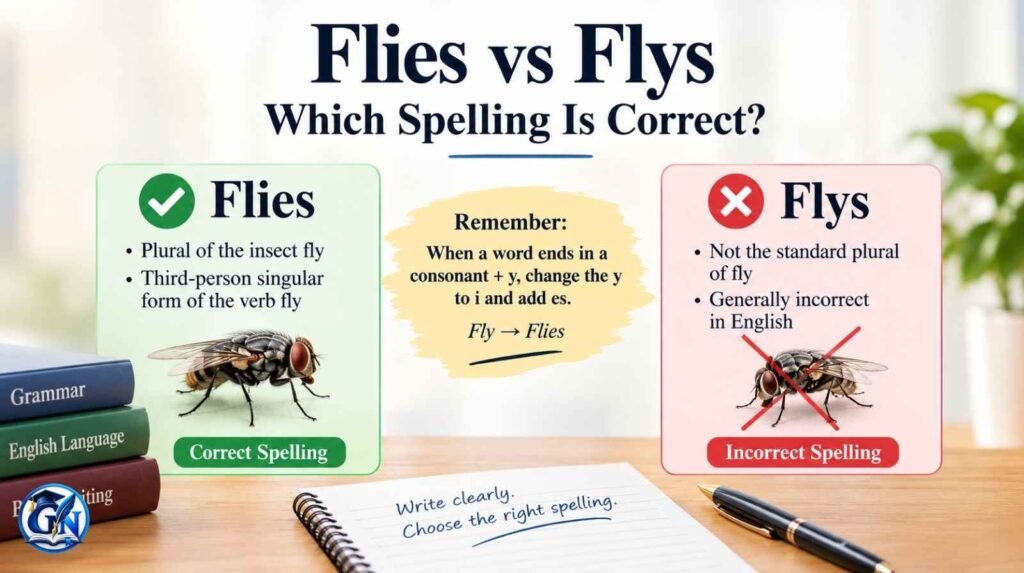
Have you ever wondered whether to write Flies vs Flys? Although both spellings might look reasonable, only one is the standard plural form of the noun fly in ordinary English. Choosing the correct spelling can help you write more clearly and avoid common grammar mistakes.
The correct spelling is “flies” when referring to more than one fly or to the third-person singular form of the verb “fly.” The word flys is generally considered a misspelling in standard English, although it may appear in specialized names or informal contexts.
In this guide, you will learn the difference between flies and flys, understand the spelling rule, explore practical examples, and discover how to remember the correct form.
What Is the Difference Between Flies and Flys?
The main difference between flies and flys is that flies is the standard spelling, while flys is generally incorrect in ordinary English writing. The word you need depends on whether you are talking about insects or describing an action.
When to Use Flies
The word flies has two common grammatical uses.
1. As a plural noun
It refers to more than one flying insect.
Examples:
- Several flies were buzzing around the kitchen.
- The farmer used a net to keep flies away from the food.
- Flies gathered near the open window.
2. As a verb
It is the third-person singular present-tense form of fly. It describes what one person, animal, or thing does.
Examples:
- The bird flies over the trees.
- My brother flies to London every summer.
- A butterfly flies from flower to flower.
When to Use Flys
In standard English, flys is not the accepted plural of fly or its standard third-person singular verb form.
Incorrect: Two flys were sitting on the wall.
Correct: Two flies were sitting on the wall.
Incorrect: The bird flys across the garden.
Correct: The bird flies across the garden.
However, Flys can appear in proper names, brand names, or specialized terminology. These exceptional uses do not change the ordinary spelling rule.
Why Is Flies the Correct Spelling?
English has a spelling rule that explains why fly becomes flies rather than flys when forming its regular plural or third-person singular verb form.
The Rule for Words Ending in Y
When a noun or verb ends in a consonant followed by y, the final y usually changes to i before adding -es.
For example:
- Fly → Flies
- Baby → Babies
- City → Cities
- Try → Tries
- Carry → Carries
This rule applies to many everyday English words.
For instance, we write, “The baby cries,” rather than “The baby crys.”
What Happens When a Word Ends in a Vowel Plus Y?
When a word ends in a vowel followed by y, the y usually remains unchanged when adding -s.
Examples include:
- Boy → Boys
- Toy → Toys
- Day → Days
- Play → Plays
- Enjoy → Enjoys
The difference is the letter immediately before the y. In fly, the letter before y is a consonant, so the spelling changes to flies.
How to Remember the Rule
A simple way to remember the correct spelling is to look at the word’s ending.
If a word ends in a consonant plus y, change the y to i and add es for the usual plural noun or third-person singular verb form.
For example:
- Fly becomes flies.
- Lady becomes ladies.
- Story becomes stories.
Remember that this is a general spelling rule, and English has some exceptions depending on the word and its grammatical form.
Flies vs Flys: Comparison Table
The following table summarizes the difference between the two spellings.
| Feature | Flies | Flys |
|---|---|---|
| Standard English spelling | Correct | Generally incorrect |
| Plural of the insect fly | Yes | No |
| Present-tense verb form | Yes | No |
| Accepted in ordinary formal writing | Yes | No |
| May appear in a specialized name | Yes | Yes, depending on the name |
Correct and Incorrect Examples
| Incorrect | Correct |
|---|---|
| Three flys entered the room. | Three flies entered the room. |
| The plane flys every day. | The plane flies every day. |
| These flys are annoying. | These flies are annoying. |
| The bird flys south in winter. | The bird flies south in winter. |
A Quick Spelling Checklist
Before using the word, ask yourself:
- Am I referring to more than one insect? Write flies.
- Am I describing what one person, animal, or thing does? Write flies.
- Am I copying an official name that specifically uses Flys? Preserve the official spelling if appropriate.
This checklist will help you choose the correct form in everyday writing.
Real-Life Example: How a Small Spelling Mistake Changes Your Writing
Imagine a student named Ahmed preparing an English assignment about insects. He writes the following sentence:
“During the summer, many flys enter our house because we leave the windows open.”
Ahmed understands the meaning perfectly, but the spelling is incorrect. His teacher asks him to review the plural spelling rule for words ending in a consonant followed by y.
After checking his work, Ahmed changes the sentence to:
“During the summer, many flies enter our house because we leave the windows open.”
The sentence now follows standard English spelling conventions.
Later, Ahmed writes another sentence about birds:
“The eagle flys high above the mountains.”
He initially thinks the same spelling should work because he is describing an action rather than an insect. However, the rule also applies to the third-person singular present-tense verb. He corrects the sentence to:
“The eagle flies high above the mountains.”
This example shows why understanding the rule is more useful than memorizing just one word. Once Ahmed recognizes the pattern, he can apply it to other words, including tries, carries, and cries.
The lesson is simple: spelling accuracy depends on recognizing how words change according to their grammatical roles. By learning the consonant-plus-y rule, students and writers can avoid similar mistakes in school assignments, emails, blog posts, and everyday communication.
What Do Grammar References and Current Guidance Tell Us?
There is no special spelling change in 2025 or 2026 that makes flys the standard plural of fly. The established spelling convention remains the same.
The Established English Spelling Rule
Standard English dictionaries list flies as the plural of the insect and as the third-person singular present-tense form of fly. This reflects the established consonant-plus-y spelling pattern.
What Current SEO Guidance Means for Grammar Articles
Google Search Central’s guidance on helpful, reliable, people-first content emphasizes accuracy, usefulness, and satisfying readers’ needs.
For a spelling article, that means answering the main question directly, providing accurate examples, explaining the underlying rule, and avoiding unnecessary repetition.
Are There Statistics for Flies vs Flys in 2025–2026?
There is no verified, authoritative 2025–2026 statistic available here that establishes how frequently people misspell flies as flys. It would be misleading to invent a percentage or claim that one spelling mistake has increased by a particular amount.
Instead, the reliable evidence is the established spelling rule itself: flies is the standard form in ordinary English. Writers who want to measure how often the alternative spelling appears can investigate a defined dataset, such as a collection of published texts or search-query reports, and clearly state the method and date range.
This distinction matters because credible grammar guidance should separate established language rules from unverified claims about current usage.
FAQs
Q1: Is it flies or flys?
A: Flies is correct in standard English when referring to multiple insects or using the verb fly with a third-person singular subject.
Example: The bird flies over the lake.
Q2: Why is flies spelled with IE instead of Y?
A: Because fly ends in a consonant followed by y. In the regular plural form and the third-person singular present-tense verb form, the y changes to i before adding -es.
Q3: What is the plural of fly?
A: The plural of the noun fly is flies.
Example: One fly landed on the table, but three flies were near the window.
Q4: Is flys ever correct?
A: It may be used in a proper name, brand name, or specialized context that deliberately uses that spelling. However, it is not the standard plural of the insect or the standard third-person singular form of the verb.
Q5: Is flies a noun or a verb?
A: It can be both.
- Noun: The flies are buzzing around the lamp.
- Verb: The helicopter flies over the city.
The grammatical role depends on how the word is used in the sentence.
Q6: What is the difference between fly and flies?
A: Fly is the singular noun or the base form of the verb. Flies is the plural noun or the third-person singular present-tense verb form.
Examples:
- A fly is sitting on the wall.
- Several flies are sitting on the wall.
- I fly to work destinations regularly.
- She flies to work destinations regularly.
Q7: Do all words ending in Y change to IES?
A: No. Words ending in a consonant plus y generally change to ies when forming regular plurals or third-person singular present-tense verbs. Words ending in a vowel plus y usually retain the y and add s.
Examples: city → cities, but boy → boys.
Q8: How can I avoid spelling mistakes like flys?
A: Learn common spelling patterns, proofread your sentences, and consult a reliable dictionary when uncertain. Reading regularly and practicing with examples can also help you recognize the correct forms more quickly.
Conclusion:
When comparing flies vs flys, the answer is straightforward: flies is the correct spelling in standard English for the plural of fly and the third-person singular present-tense form of the verb.
The reason is the consonant-plus-y spelling rule. When fly changes into flies, the final y becomes i before adding -es. The same pattern appears in words such as babies, cities, and tries.
Although flys may appear in certain names or specialized contexts, it should not be used as the ordinary plural of the insect or as the standard verb form.
The next time you write about insects buzzing around your kitchen or a bird soaring through the sky, remember to use flies.
👉 Explore more useful grammar tips and guides on Gramnora

Explore the world of English grammar with simple explanations, practical examples, and easy-to-follow guides by Zia Tarar, the founder and author of Gramnora. From essential grammar rules and sentence structure to common mistakes and advanced concepts, Gramnora helps learners improve their English, strengthen their writing skills, and communicate with greater clarity and confidence.