
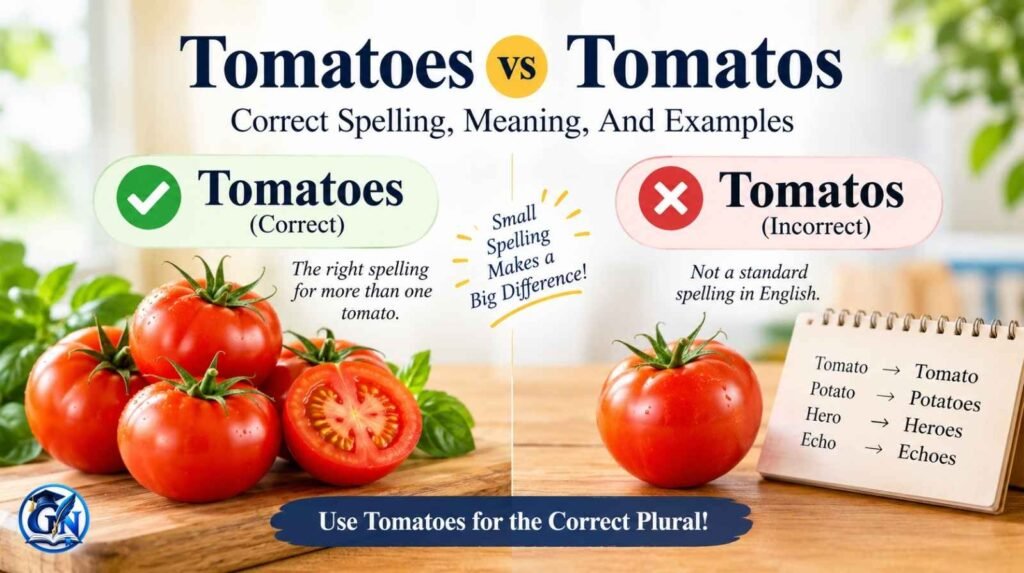
Have you ever wondered whether the correct spelling is tomatoes or tomatos? You are not alone. English plural rules can be confusing, especially when a word ends in the letter o. Although many nouns form their plurals by adding -s, some follow a different spelling pattern.
When comparing tomatoes vs tomatos, the answer is simple: tomatoes is the correct plural spelling, while tomatos is a misspelling in standard English. Understanding this small difference can help you write more accurately in recipes, school assignments, blog posts, shopping lists, and everyday conversations.
In this guide, you will learn the correct spelling, the meaning of each form, the plural rule, and practical examples to help you avoid this common mistake.
Tomatoes vs Tomatos: Which Spelling Is Correct?
The correct spelling is tomatoes. It is the standard plural form of the singular noun tomato. The spelling tomatos is incorrect in standard English and should be avoided in formal and informal writing.
The difference comes down to the plural ending. Instead of adding only -s, you add -es to the word tomato.
- Correct: I bought five fresh tomatoes.
- Incorrect: I bought five fresh tomatos.
- Correct: The tomatoes are growing in the garden.
- Incorrect: The tomatos are growing in the garden.
Why Is Tomatoes the Correct Form?
English has several ways to form plural nouns. While many words take only -s, certain nouns ending in -o take -es.
For example:
- Tomato → Tomatoes
- Potato → Potatoes
- Hero → Heroes
- Echo → Echoes
Therefore, the standard spelling is tomatoes, not tomatos. Learning the correct plural alongside the singular form can help you remember it more easily.
Is Tomatos Ever Acceptable?
You might encounter tomatos in online comments, informal messages, or unedited content. However, seeing a spelling mistake online does not make it an accepted standard form.
If you are writing an essay, preparing a recipe, publishing an article, or creating website content, always use tomatoes when referring to more than one tomato.
What Does Tomatoes Mean?
The word tomatoes means more than one tomato. A tomato is the fruit of the tomato plant, commonly used in cooking and often treated as a vegetable in everyday meals.
Tomatoes are popular ingredients in salads, soups, sandwiches, sauces, pizzas, and many other dishes. The word can refer to fresh tomatoes, cherry tomatoes, canned tomatoes, or tomatoes growing on a plant.
Tomato vs Tomatoes: Understanding the Difference
The main difference between tomato and tomatoes is number.
| Word | Meaning | Example |
|---|---|---|
| Tomato | One tomato | I sliced a tomato. |
| Tomatoes | Two or more tomatoes | I sliced three tomatoes. |
| Tomatos | Incorrect standard plural | I sliced three tomatos. |
Use tomato when referring to one item and tomatoes when referring to two or more.
Examples of Tomatoes in Everyday Sentences
Here are some natural examples showing how to use the correct plural spelling:
- My mother bought fresh tomatoes from the market.
- We need four tomatoes to prepare the sauce.
- The farmer grows organic tomatoes on his land.
- These cherry tomatoes taste sweet.
- She added chopped tomatoes to the salad.
- The tomatoes in our garden are finally ripe.
In each sentence, tomatoes refers to multiple fruits. Using the correct plural makes your writing grammatically accurate and easier to understand.
Why Do People Confuse Tomatoes and Tomatos?
The confusion usually happens because English learners become familiar with the simple plural rule of adding -s. For example, apple becomes apples, carrot becomes carrots, and onion becomes onions.
It is understandable to assume that tomato should become tomatos. However, English contains different plural spelling patterns, and not every noun follows the same rule.
The Role of English Plural Rules
For certain nouns ending in -o, the standard plural is formed by adding -es.
Consider these examples:
- Tomato → Tomatoes
- Potato → Potatoes
- Hero → Heroes
- Volcano → Volcanoes
However, some nouns ending in -o take only -s.
- Photo → Photos
- Piano → Pianos
- Radio → Radios
- Video → Videos
This explains why the spelling can be confusing. There is no single rule that applies to every English noun ending in -o. For tomato, the established standard plural is tomatoes.
A Simple Trick to Remember the Correct Spelling
An easy way to remember the spelling is to learn tomato and potato together.
One tomato, two tomatoes.
One potato, two potatoes.
Both words add -es to form their standard plurals. Remembering these word pairs can help you avoid writing tomatos or potatos by mistake.
Tomatoes vs Tomatos: Comparison Table and Usage Guide
A quick comparison can help you choose the right spelling whenever you write about tomatoes.
| Feature | Tomatoes | Tomatos |
|---|---|---|
| Standard spelling | Yes | No |
| Grammatical use | Plural noun | Common misspelling |
| Meaning | More than one tomato | Intended to mean multiple tomatoes |
| Appropriate for formal writing | Yes | No |
| Correct in recipes | Yes | No |
| Accepted US and UK plural | Yes | No |
How to Choose the Correct Form
Follow these simple steps when writing:
- Identify the number. If you mean one tomato, use tomato.
- Use the correct plural. If you mean two or more, use tomatoes.
- Check the ending. Remember that the plural ends in -oes, not simply -os.
- Proofread your sentence. Look for accidental use of tomatos.
For example:
- One tomato is enough for this sandwich.
- Two tomatoes are enough for the salad.
- Six tomatoes were delivered this morning.
Following these steps makes it easier to choose the correct form in everyday writing.
A Real-Life Example: Writing a Recipe Correctly
Imagine that you are preparing a recipe for homemade tomato sauce and writing the ingredients for your food blog. Your first draft says:
“To make the sauce, take five ripe tomatos, two onions, three cloves of garlic, and some olive oil.”
Although readers will probably understand the instructions, the word tomatos is misspelled. Before publishing the recipe, you should correct the sentence:
“To make the sauce, take five ripe tomatoes, two onions, three cloves of garlic, and some olive oil.”
Now imagine that the recipe is shared on social media, copied into a family cookbook, and printed for use in a cooking class. The corrected spelling helps maintain a professional appearance wherever the instructions are shared.
The same principle applies when writing grocery lists. You might write “buy two tomatoes” on a shopping list, but writing “buy two tomatos” introduces an avoidable spelling error. Similarly, a gardening article should say, “Our tomato plants produced 30 tomatoes this season,” rather than using the incorrect plural.
This example illustrates why small spelling details matter. Correct spelling supports clear communication, makes instructions look polished, and helps readers trust the care taken with written content. For bloggers and website owners, proofreading also improves the overall quality of published material. Although correct spelling alone cannot guarantee higher search rankings, it contributes to a better reading experience.
Tomatoes vs Tomatos in American and British English
Some English words have different spellings in American and British English. For example, Americans generally write color, while British writers commonly use colour. Likewise, organizing and organising are associated with different spelling conventions.
However, tomatoes is the standard plural in both American and British English. There is no regional spelling difference that makes tomatos correct.
American English Examples
In American English, use tomato for one and tomatoes for multiple items.
- I bought fresh tomatoes at the grocery store.
- These tomatoes are perfect for homemade salsa.
- The recipe calls for three tomatoes.
British English Examples
British English uses the same plural spelling.
- We bought some tomatoes at the supermarket.
- The tomatoes are ready for the salad.
- She grows tomatoes in her garden.
The pronunciation of tomato can differ between American and British English, but the written plural remains tomatoes.
What Do Dictionaries Say?
Reliable dictionaries are useful when you are uncertain about spelling. The Cambridge Dictionary and Merriam-Webster identify tomatoes as the plural form of tomato.
You can verify the spelling using these references:
- Cambridge Dictionary: Tomato definition, plural form, and pronunciation.
- Merriam-Webster: Tomato meaning and dictionary information.
These references support the standard spelling and help distinguish accepted usage from common spelling errors.
Common Mistakes to Avoid When Using Tomatoes
Even a familiar word can cause confusion when its plural form does not follow the pattern a writer expects. Paying attention to the ending and the role of the word in a sentence can prevent several common mistakes.
Mistake 1: Writing Tomatos Instead of Tomatoes
Incorrect: We picked ten tomatos from the garden.
Correct: We picked ten tomatoes from the garden.
The correct plural requires -es.
Mistake 2: Using Tomato for Multiple Items
Incorrect: I need three tomato for the recipe.
Correct: I need three tomatoes for the recipe.
When a countable noun follows a number greater than one, its plural form is generally required.
Mistake 3: Confusing Tomatoes With Tomato’s
An apostrophe can change the grammatical meaning of a word.
- Tomato: One tomato.
- Tomatoes: More than one tomato.
- Tomato’s: A possessive form referring to one tomato.
- Tomatoes’: A possessive form referring to multiple tomatoes.
Examples:
- The tomato’s skin is thin.
- The tomatoes’ color varies as they ripen.
Do not use an apostrophe simply to make a regular noun plural. For example, “I bought four tomato’s” is incorrect; write “I bought four tomatoes.”
2025–2026 Spelling and Usage Facts
For this spelling question, the most useful evidence comes from established dictionary entries rather than annual statistics. There is no need to invent a search-volume figure or percentage to explain a fixed spelling rule.
Here are the key facts to remember:
- Standard plural: Tomatoes.
- Standard singular: Tomato.
- Incorrect standard plural: Tomatos.
- US and UK spelling: Tomatoes in both varieties.
- Related plural pattern: Potato becomes potatoes.
- Important exception: Words such as photo and piano take -s in their standard plurals.
These are established spelling conventions, not a newly introduced rule for 2025 or 2026. Dictionary entries remain the appropriate source for verifying the correct form.
FAQs
Q1: Is it tomatoes or tomatos?
A: Tomatoes is correct. Tomatos is a common misspelling and is not the standard plural form of tomato.
Q2: What is the plural of tomato?
A: The plural of tomato is tomatoes. For example, “I bought one tomato” becomes “I bought three tomatoes.”
Q3: Why does tomato become tomatoes?
A: The standard plural adds -es rather than only -s. The spelling changes from tomato to tomatoes.
Q4: Is tomatos ever correct in English?
A: Not as the standard plural of tomato. If you are referring to multiple tomatoes, use tomatoes in both formal and informal writing.
Q5: Is tomatoes correct in American and British English?
A: Yes. Both American and British English use tomatoes as the standard plural. Pronunciation may vary, but the spelling does not.
Q6: What is the difference between tomato and tomatoes?
A: Tomato is singular and refers to one item. Tomatoes is plural and refers to two or more.
Q7: Should I write tomato’s or tomatoes?
A: Use tomatoes for the ordinary plural. Use tomato’s when showing possession by one tomato, as in “the tomato’s skin.” For possession by multiple tomatoes, use tomatoes’, as in “the tomatoes’ color.”
Q8: What is an easy way to remember tomatoes?
A: Remember the pair tomato → tomatoes, just as potato → potatoes. The extra e before the final s is part of the correct plural spelling.
Conclusion:
When comparing tomatoes vs tomatos, the answer is straightforward: tomatoes is the correct standard plural spelling, while tomatos is a misspelling. Use tomato when referring to one item and tomatoes when referring to two or more.
Remember that the plural takes -es, just like potato potatoes. This simple spelling pattern can help you write more accurately in recipes, school assignments, emails, gardening guides, and website articles.
👉 Explore more useful grammar tips and guides on Gramnora

Explore the world of English grammar with simple explanations, practical examples, and easy-to-follow guides by Zia Tarar, the founder and author of Gramnora. From essential grammar rules and sentence structure to common mistakes and advanced concepts, Gramnora helps learners improve their English, strengthen their writing skills, and communicate with greater clarity and confidence.