
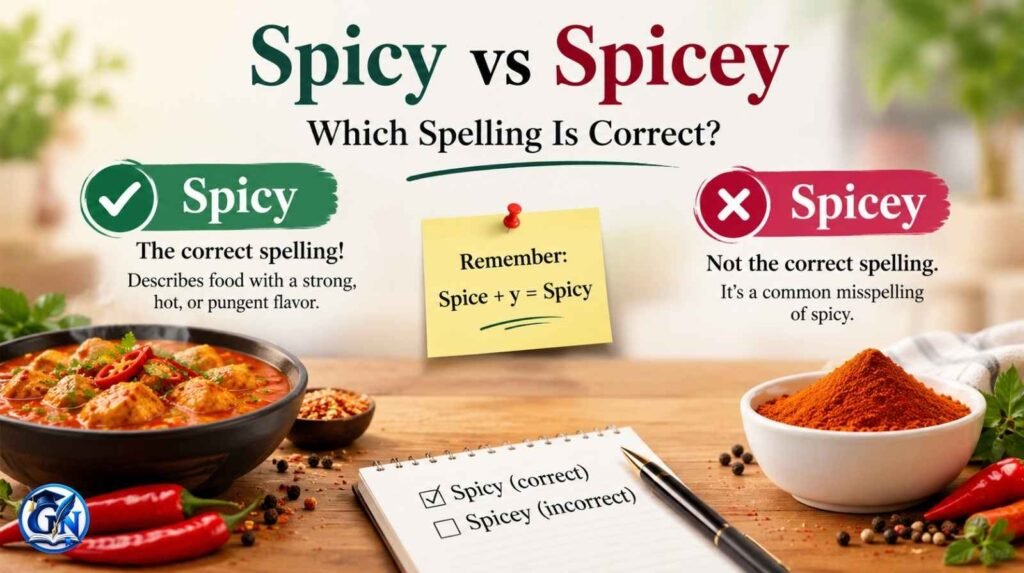
Have you ever wondered whether to write Spicy vs Spicey when describing food with a strong, hot flavor? These two spellings look similar, so it is easy to see why people get confused. However, only one is considered correct in standard English.
Spicy is the correct spelling, while spicey is a common misspelling. The word spicy describes food that contains spices or has a strong, hot, or pungent flavor. It can also describe something exciting or suggestive, depending on the context.
In this guide, you will learn the difference between spicy and spicey, understand why the mistake happens, and explore practical examples that will help you remember the correct spelling.
What Is the Difference Between Spicy and Spicey?
The main difference between spicy and spicey is spelling. Spicy is the standard English word, whereas spicey is not accepted as the standard spelling.
Spicy: The Correct Spelling
The word spicy is an adjective derived from the noun spice. It describes food or other things that have a strong flavor, especially one produced by spices such as chili, pepper, or ginger.
Examples:
- This curry is too spicy for me.
- She loves spicy Mexican food.
- The restaurant serves spicy chicken wings.
- He added chili powder to make the soup spicy.
The word can also describe something lively, exciting, or slightly provocative.
For example: “The television show features a spicy conversation between the two characters.”
Spicey: The Incorrect Spelling
Spicey is a misspelling of spicy in standard English. Although people sometimes use it in informal writing, online searches, or usernames, it is not the conventional spelling of the adjective.
Incorrect: The sauce is too spicey for the children.
Correct: The sauce is too spicy for the children.
If you are writing a school assignment, professional email, blog post, recipe, or restaurant menu, always use spicy.
Quick Comparison Table
| Feature | Spicy | Spicey |
|---|---|---|
| Correct spelling | Yes | No |
| Part of speech | Adjective | Nonstandard misspelling |
| Meaning | Hot, strongly flavored, or exciting | Intended to mean spicy |
| Suitable for formal writing | Yes | No |
| Example | Spicy noodles | Spicey noodles (incorrect) |
Why Do People Confuse Spicy and Spicey?
The confusion often happens because English spelling does not always follow predictable patterns. Since spicy comes from the noun spice, writers may assume that the adjective should retain the final e.
However, the standard spelling follows a familiar English word-formation pattern.
The Spelling Rule Behind Spicy
When the noun spice becomes the adjective spicy, the final e is dropped before adding -y.
The transformation is:
Spice + y = Spicy
The final e is removed, so the correct word is spicy, not spicey.
Other English words follow similar patterns:
- Ice → Icy
- Juice → Juicy
- Grease → Greasy
- Space → Spacy
These examples help demonstrate why keeping the final e is not necessary in spicy.
Why the Incorrect Version Looks Right
The spelling spicey may look reasonable because writers often try to preserve the appearance of the original noun. People may also make the mistake because they have seen the word written incorrectly online.
For example:
Incorrect: I ordered a spicey chicken sandwich.
Correct: I ordered a spicy chicken sandwich.
Remember that a spelling can look logical without being standard English.
How to Use Spicy Correctly in a Sentence
Understanding the meaning of spicy makes it easier to use the word naturally. Although it is most commonly associated with food, it has several uses.
Describing Food and Flavor
The most common use of spicy is to describe food that contains spices or produces a strong, hot sensation.
Examples:
- My mother makes delicious spicy rice.
- This spicy soup needs a little more salt.
- I prefer mild food to spicy food.
- The chef prepared a spicy sauce with fresh peppers.
Notice that spicy describes the flavor or character of the food in each sentence.
Describing Exciting or Provocative Things
The word can also describe something lively, bold, controversial, or suggestive.
Examples:
- The interview included some spicy questions.
- They shared a spicy story at dinner.
- The drama became more interesting after a spicy argument.
In these sentences, spicy is used figuratively rather than to describe the heat of food.
Using Spicy in Everyday Writing
Whether you are writing a recipe, restaurant review, food blog, or casual message, spicy is the correct choice.
For example:
- “This is the best spicy burger in town.”
- “Add more chili if you want a spicier flavor.”
- “The restaurant’s spicy noodles are very popular.”
You can also use related forms such as spicier and spiciest.
Examples:
- This curry is spicier than the last one.
- That is the spiciest dish on the menu.
These forms preserve the correct spelling without the final e.
Real-Life Example: Choosing Between Spicy and Spicey
Imagine that a food blogger is preparing a review of a new restaurant. The restaurant specializes in spicy chicken, chili noodles, and flavorful sauces. Before publishing the review, the blogger writes the following sentence:
“The restaurant is famous for its spicey chicken and delicious spicey noodles.”
Although readers can understand the intended meaning, the spelling error makes the review look less polished. Readers who care about spelling may notice the mistake, and it could affect their impression of the article’s overall quality.
The blogger checks a standard English dictionary and discovers that spicy is the correct adjective. The sentence is then revised to read:
“The restaurant is famous for its spicy chicken and delicious spicy noodles.”
The corrected version is clearer and follows standard English spelling conventions.
The blogger also checks the rest of the article for related words, including spicier, spiciest, and spiciness. These words are useful when comparing food flavors or describing the intensity of a dish.
This example illustrates a practical lesson: even when a misspelling does not prevent readers from understanding a sentence, using the standard form improves writing quality and consistency. For food bloggers, editors, students, and website owners, a simple spelling check can help produce more professional content.
Spicy vs Spicey: Spelling Trends and Dictionary Evidence
When deciding between two competing spellings, the best approach is to rely on established dictionaries and standard writing conventions rather than assuming that the more familiar-looking version is correct.
What Dictionaries Tell Us
Major English dictionaries recognize spicy as the standard adjective for something flavored with spices or having a hot, pungent taste.
For reliable verification, consult these references:
These references are useful for checking definitions, pronunciation, example sentences, and standard usage.
Are There Reliable Statistics for 2025–2026?
There is no widely established, authoritative 2025–2026 statistic that reliably measures how often English writers use spicey instead of spicy. Therefore, it would be misleading to invent a percentage or claim that one spelling mistake has increased by a particular amount.
The practical conclusion is supported by standard dictionary usage: spicy is the accepted spelling, and spicey is a nonstandard form.
For writers who want accurate, reader-friendly content, consulting a reputable dictionary is more useful than relying on unverified spelling statistics.
Common Mistakes to Avoid When Using Spicy
Even though the correct spelling is simple, writers sometimes make related errors when describing food or comparing flavors.
Keeping the Final E
The most common mistake is writing spicey because the base word is spice.
Incorrect: This spicey sauce tastes amazing.
Correct: This spicy sauce tastes amazing.
The solution is to remember that the final e is removed when forming spicy.
Confusing Spicy With Hot
Although spicy often describes food that feels hot on the tongue, the words are not always interchangeable.
For example, a dish can be rich in spices without being extremely hot. Likewise, hot can refer to temperature rather than flavor.
- The spicy soup contains chili and black pepper.
- The hot soup was served straight from the stove.
Understanding the context helps you choose the right adjective.
Using Incorrect Comparative Forms
When comparing the intensity of flavors, use spicier and spiciest, not forms based on spicey.
Correct examples:
- This salsa is spicier than that one.
- That curry is the spiciest dish I have ever tried.
Using these standard forms keeps your writing grammatically correct and easy to understand.
FAQs
Q1: Is spicy or spicey correct?
A: Spicy is correct. Spicey is a common misspelling and should generally be avoided in standard English writing.
Q2: Why is spicy spelled without an e?
A: The final e in spice is dropped before adding -y. Therefore, the correct transformation is spice to spicy.
Q3: Is spicey ever acceptable?
A: You may encounter spicey in informal online writing, names, or intentional stylizations. However, it is not the standard spelling of the adjective used to describe flavor.
Q4: What does spicy mean?
A: Spicy is an adjective that describes something flavored with spices or having a strong, hot, or pungent taste. It can also describe something exciting or provocative.
Q5: What is the plural of spicy?
A: Spicy is an adjective, so it does not have a plural form. It remains spicy whether it describes one dish or several dishes.
For example: “The restaurant serves spicy meals.”
Q6: Is it spicier or spiceyer?
A: Spicier is correct. The word changes from spicy to spicier when making a comparison.
Example: “This curry is spicier than the previous one.”
Q7: What is the superlative form of spicy?
A: The correct superlative is spiciest.
Example: “This is the spiciest sauce on the menu.”
Q8: How can I remember the correct spelling of spicy?
A: Remember this simple rule: spice + y = spicy, with the final e removed. You can also remember the related words icy and juicy, which follow a similar pattern.
Conclusion:
When comparing spicy vs spicey, the answer is straightforward: spicy is the correct spelling, while spicey is a nonstandard misspelling.
Use spicy to describe food with a strong or hot flavor, or to describe something lively or provocative. Remember to use spicier for comparisons and spiciest when describing the highest degree.
The easiest way to avoid this mistake is to remember that the final e in spice is dropped before adding -y.
👉 Explore more useful grammar tips and guides on Gramnora

Explore the world of English grammar with simple explanations, practical examples, and easy-to-follow guides by Zia Tarar, the founder and author of Gramnora. From essential grammar rules and sentence structure to common mistakes and advanced concepts, Gramnora helps learners improve their English, strengthen their writing skills, and communicate with greater clarity and confidence.