
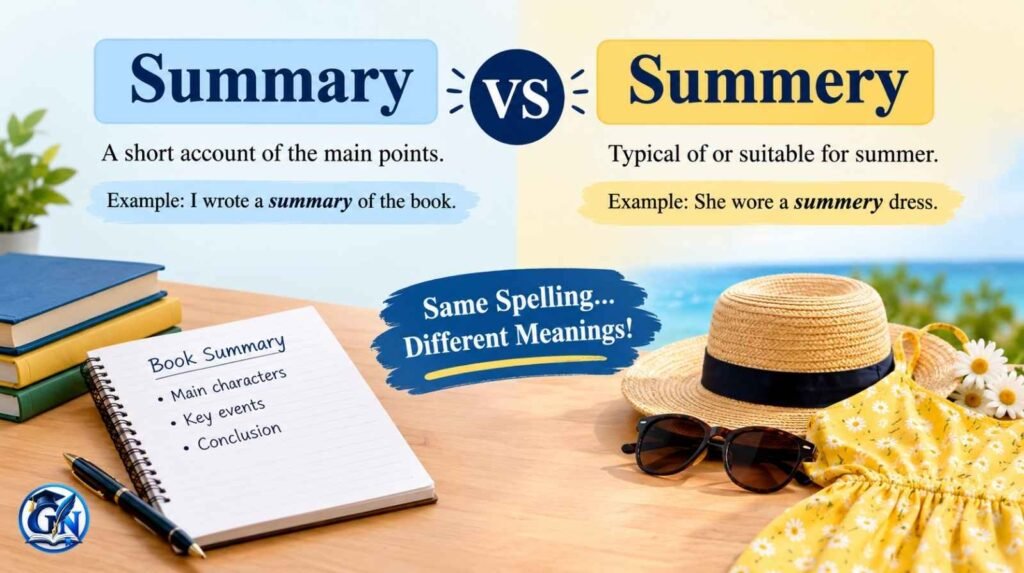
Have you ever wondered whether to write Summary vs Summery? These two words look and sound similar, but they have completely different meanings. Choosing the wrong one can change your sentence and make your writing confusing.
Understanding summary vs summery is simple once you know what each word means. Summary refers to a short account of the main points of something, while summery describes something that feels, looks, or seems suitable for summer.
For example, you might write a summary of a book, but you could describe a sunny afternoon as summery. In this guide, you will learn their definitions, spelling differences, practical examples, and easy ways to remember which word to use.
What Is the Difference Between Summary and Summery?
The main difference between summary and summery is their meaning and grammatical function. Although both are correctly spelled English words, they are not interchangeable.
- Summary: A short account of the main points of a longer piece of information.
- Summery: An adjective describing something characteristic of or suitable for summer.
What Does Summary Mean?
The word summary usually functions as a noun. It describes a shortened version of a book, article, report, meeting, speech, or other information that presents the essential points without every detail.
For example:
- I wrote a summary of the novel for my English class.
- Please send me a summary of yesterday’s meeting.
- The report includes a summary of the company’s annual performance.
- She prepared a brief summary of the research findings.
In each example, summary refers to condensed information that helps readers understand the main ideas quickly.
The word can also function as an adjective in certain expressions, such as summary judgment, a legal decision made without a full trial when the applicable requirements are met.
What Does Summery Mean?
The word summery is an adjective. It describes something that resembles summer or is appropriate for the summer season.
It often appears when describing clothing, weather, colors, food, decorations, or an atmosphere associated with warm and sunny days.
For example:
- She wore a summery dress to the outdoor party.
- The garden looked bright and summery.
- We enjoyed a summery afternoon by the beach.
- The restaurant has a light, summery atmosphere.
In these sentences, summery adds a seasonal description rather than providing a shortened version of information.
Summary vs Summery at a Glance
| Feature | Summary | Summery |
|---|---|---|
| Part of speech | Usually a noun | Adjective |
| Meaning | A brief account of the main points | Typical of or suitable for summer |
| Common context | Reports, books, essays, meetings | Clothing, weather, colors, atmosphere |
| Example | Write a summary of the story. | She wore a summery outfit. |
| Memory clue | Think of summing up information | Think of summer weather |
The easiest rule is to use summary when discussing information and summery when describing something related to summer.
How to Use Summary Correctly in a Sentence
Using summary correctly helps you communicate information clearly in academic, professional, and everyday writing.
Summary in Academic Writing
Students frequently use summaries when discussing books, articles, research papers, and classroom assignments.
A summary presents the central ideas of a source without reproducing every detail.
Examples:
- The teacher asked us to write a summary of the chapter.
- My assignment includes a summary of the historical events.
- He prepared a summary of the research paper before the presentation.
- The student explained the main argument in a short summary.
Notice that summary refers to condensed information in every example.
Summary in Business and Professional Communication
In the workplace, a summary helps people understand important information without reading a lengthy document.
Examples:
- Please include a summary of the meeting in your email.
- The manager reviewed the summary before approving the project.
- Our presentation begins with an executive summary.
- She sent a summary of the client’s requirements to the team.
An executive summary is particularly useful in business reports because it highlights the most important findings, recommendations, or decisions.
Common Mistakes When Using Summary
One frequent spelling mistake is writing summery when you mean a short explanation or overview.
Incorrect: Please prepare a summery of the report.
Correct: Please prepare a summary of the report.
Incorrect: I need a summery of the book before tomorrow.
Correct: I need a summary of the book before tomorrow.
The mistake happens because both words look similar. However, a spell-checker might accept summery because it is a real word. Therefore, checking the meaning of the sentence is just as important as checking spelling.
How to Use Summery Correctly in a Sentence
The word summery is useful when you want to describe something with the qualities of summer. It can make descriptions of weather, fashion, places, and experiences more expressive.
Summery in Clothing and Fashion
Fashion writers often use summery to describe lightweight clothing, bright colors, floral patterns, and styles suitable for warm weather.
Examples:
- She chose a summery yellow dress for the picnic.
- The store has a collection of summery outfits.
- He wore a summery shirt with light-colored trousers.
- Her floral scarf gave the outfit a summery appearance.
Here, summery describes the style or seasonal feel of clothing.
Summery in Weather and Atmosphere
You can also use summery to describe places, weather, and experiences that remind you of summer.
Examples:
- The warm breeze made the evening feel summery.
- We spent a summery afternoon relaxing in the garden.
- The café has a bright, summery interior.
- The fresh fruit salad was perfect for a summery lunch.
These examples show how the adjective creates a sense of warmth, brightness, and seasonal comfort.
Common Mistakes When Using Summery
Using summery instead of summary can make a sentence incorrect when the intended meaning is a shortened account.
Incorrect: The teacher asked me to write a summery of the lesson.
Correct: The teacher asked me to write a summary of the lesson.
Incorrect: Please provide a summery of the project results.
Correct: Please provide a summary of the project results.
However, this sentence is correct:
The presentation had a summery design.
In that example, summery describes the design rather than the content of a report.

Summary vs Summery: Real-Life Examples and a Practical Case Study
Understanding definitions is useful, but seeing these words in realistic situations makes the distinction easier to remember.
Everyday Examples of Summary and Summery
Consider these examples from daily life:
At school
A student finishes reading a novel and writes a short explanation of its plot and main characters.
Correct: I wrote a summary of the novel.
The student is describing shortened information, so summary is the correct word.
At work
An employee attends a long meeting and sends colleagues a short account of the important decisions.
Correct: I emailed a summary of the meeting to my colleagues.
Again, the word refers to the main points of a longer discussion.
While shopping
A customer chooses a lightweight floral dress for a summer vacation.
Correct: She bought a summery dress for her vacation.
The adjective describes the seasonal style of the dress.
While describing a place
A family visits a beach café decorated with bright colors and tropical plants.
Correct: The café had a relaxed, summery atmosphere.
The word describes the feeling and appearance of the place.
Case Study: A Student’s Spelling Mistake
Imagine a student named Daniel who is preparing an English assignment about a novel. His teacher asks him to explain the story in 200 words or fewer.
Daniel writes, “Here is a summery of the novel.”
At first glance, the sentence may seem correct because summery is a recognized English word. However, it does not communicate Daniel’s intended meaning. He is not describing anything related to summer; he is presenting the main points of a book.
After reviewing the assignment, Daniel changes the sentence to “Here is a summary of the novel.” Now the wording accurately describes his work.
Later that week, Daniel writes a paragraph about his summer vacation. He describes a bright yellow shirt as “a summary shirt.” This time, the problem is reversed. He needs an adjective that describes the shirt’s summer style, so he changes the phrase to “a summery shirt.”
These two situations demonstrate why context matters. Daniel cannot choose the correct word simply by looking at the spelling or relying on a spell-checker. Instead, he needs to identify the meaning he wants to express.
By connecting summary with main points and summery with summer, Daniel develops a practical proofreading habit. This approach helps him write more accurately in school assignments, emails, reports, and everyday conversations.
A Simple Step-by-Step Guide to Choosing the Correct Word
Use this checklist whenever you are unsure about summary vs summery.
- Identify the meaning. Are you talking about shortened information or something related to summer?
- Check the context. Reports, books, and meetings generally need summary. Clothing, weather, and seasonal settings may need summery.
- Replace the word mentally. If “a brief account” makes sense, choose summary. If “summer-like” makes sense, choose summery.
- Read the sentence again. Confirm that the word expresses your intended meaning.
For example:
- I need a ___ of the article. → summary
- She wore a ___ dress. → summery
This quick method works well for students, teachers, bloggers, and professionals.

Why Do People Confuse Summary and Summery?
These words are easy to mix up because they differ by only a small part of their spelling and may sound similar in everyday speech.
Similar Spelling and Pronunciation
Both words contain the letters summ- and have similar pronunciations. The difference between -ary and -ery can be difficult to notice when speaking quickly.
For example:
- Summary of the report.
- Summery weather.
Because the words look alike, writers may accidentally select the wrong one while typing.
Spell-Checkers May Not Catch the Error
A spelling tool may accept both words because neither spelling is inherently incorrect. The problem occurs when a correctly spelled word is used in the wrong context.
For example:
- Incorrect meaning: I prepared a summery of the report.
- Correct meaning: I prepared a summary of the report.
The first sentence contains a real English word, but it does not express the intended idea.
A Simple Memory Trick
Use these associations to remember the difference:
- Summary = sum it up. Think of reducing a large amount of information to its main points.
- Summery = summer. Think of sunshine, warm weather, light clothing, and summer activities.
For example, if you are writing about a book, remember that you are summing up the story. If you are describing a sunny afternoon, remember that it feels summery.
FAQs
Q1: Is summary or summery the correct spelling?
A: Both are correct English words, but they have different meanings. Use summary for a short account of information and summery to describe something characteristic of summer.
Q2: What does summary mean?
A: A summary is a brief account of the main points of a longer text, speech, event, or document.
Example: The report contains a summary of the findings.
Q3: What does summery mean?
A: Summery is an adjective meaning typical of or suitable for summer.
Example: She wore a summery dress to the garden party.
Q4: Is summery a real word?
A: Yes. Summery is a standard English adjective. It is appropriate when describing summer-like weather, clothing, colors, or surroundings.
Q5: Why do people write summery instead of summary?
A: People often confuse these words because their spellings and pronunciations are similar. Since both are legitimate words, spell-checkers may not recognize the contextual mistake.
Q6: Can summary and summery be used interchangeably?
A: No. Summary usually refers to shortened information, while summery describes something associated with summer. Replacing one with the other generally changes the meaning of a sentence.
Q7: What is the plural of summary?
A: The plural of summary is summaries.
Example: The students submitted their summaries of the assigned chapters.
Summery is an adjective and does not normally have a plural form.
Q8: Is summary the same in American and British English?
A: Yes. Both American and British English use summary for a brief account and summery for something characteristic of summer. The spellings and basic meanings are the same in both varieties.
Conclusion
The difference between summary vs summery comes down to one simple distinction: summary means a short account of the main points, while summery describes something related to or suitable for summer.
Use summary when writing about books, reports, meetings, essays, or research. Choose summery when describing warm weather, seasonal clothing, bright colors, or a summer-like atmosphere.
Remember the easiest trick: summary means sum it up, while summery means summer-like.
With this rule in mind, you can avoid a common spelling mistake and communicate your ideas more clearly.
👉 Explore more useful grammar tips and guides on Gramnora

Explore the world of English grammar with simple explanations, practical examples, and easy-to-follow guides by Zia Tarar, the founder and author of Gramnora. From essential grammar rules and sentence structure to common mistakes and advanced concepts, Gramnora helps learners improve their English, strengthen their writing skills, and communicate with greater clarity and confidence.