
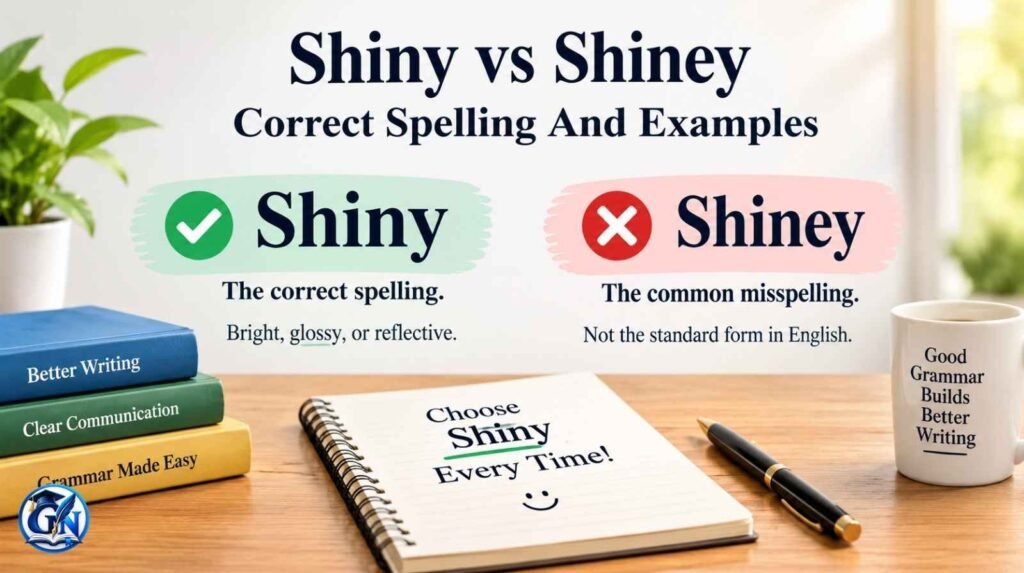
Have you ever wondered whether to write Shiny vs Shiney? These spellings look almost identical, so it is easy to assume that both are correct. However, only one is the standard spelling in English.
Shiny is the correct spelling, while shiney is a common misspelling. The word shiny describes something that reflects light or looks bright, glossy, or polished. You can use it to describe a car, a pair of shoes, a metal surface, or even someone’s hair.
Understanding the difference between shiny and shiney will help you avoid spelling mistakes in school assignments, professional emails, blog posts, and everyday writing. In this guide, you will learn the meaning of shiny, why people misspell it, the spelling rule behind it, and practical examples that make the correct form easy to remember.
Shiny vs Shiney: Which Spelling Is Correct?
The correct spelling is shiny. The spelling shiney is not accepted as the standard adjective meaning bright, glossy, or reflective.
Although shiney may look reasonable because it resembles the base word shine, standard English uses shiny without the final e.
The Correct Spelling: Shiny
Shiny is an adjective that describes something with a bright, smooth, glossy, or reflective appearance.
Examples:
- The new car has a shiny black exterior.
- She wore shiny shoes to the wedding.
- The sunlight reflected off the shiny metal.
- His hair looked shiny after he washed it.
- I bought a shiny silver watch.
In each sentence, shiny describes the appearance of a person or object.
The Incorrect Spelling: Shiney
Shiney is a common spelling mistake when someone intends to use the adjective shiny.
For example:
- Incorrect: The floor looks shiney after cleaning.
- Correct: The floor looks shiny after cleaning.
Another example:
- Incorrect: She bought a shiney new handbag.
- Correct: She bought a shiny new handbag.
The intended meaning is usually clear, but the extra letter e makes the spelling incorrect in standard English.
Quick Comparison Table
| Feature | Shiny | Shiney |
|---|---|---|
| Standard spelling | Correct | Incorrect |
| Part of speech | Adjective | Nonstandard misspelling |
| Meaning | Bright, glossy, or reflective | Intended meaning of shiny |
| Formal writing | Appropriate | Avoid |
| Example | A shiny coin | A shiney coin |
Quick answer: If you are choosing between shiny and shiney, always use shiny when describing something bright or reflective.
What Does Shiny Mean?
The word shiny describes an object or surface that reflects light, appears glossy, or looks polished. It is commonly used in everyday English to describe physical appearances.
According to standard English dictionary usage, shiny can refer to the appearance of materials, objects, hair, and other surfaces. It can also be used figuratively to describe something new or attractive.
Examples of Shiny in Everyday Sentences
Here are several examples that show how to use shiny correctly:
- Shiny shoes: He polished his shiny shoes before the interview.
- Shiny car: Their shiny new car attracted attention on the street.
- Shiny hair: Her hair looked shiny and healthy in the sunlight.
- Shiny surface: The kitchen table has a shiny surface.
- Shiny jewelry: She wore shiny gold earrings to the party.
- Shiny coin: The child found a shiny coin under the sofa.
- Shiny screen: My new laptop has a shiny screen.
These examples demonstrate that shiny works naturally before nouns to describe their appearance.
Can Shiny Describe Something New?
Yes. In informal English, shiny can also describe something new, appealing, or exciting. This use is often figurative rather than literal.
For example:
- The company introduced a shiny new product.
- He was excited about his shiny new bicycle.
- The team presented a shiny new plan for the project.
In these sentences, shiny suggests that something looks attractive, fresh, or impressive. It does not necessarily mean that the object physically reflects light.
Synonyms of Shiny
Depending on the context, you can use several words with meanings similar to shiny.
- Glossy: Having a smooth, reflective surface.
- Polished: Made smooth or bright by rubbing or treatment.
- Gleaming: Shining brightly.
- Glittering: Reflecting light in small, bright flashes.
- Sparkling: Producing bright flashes of light.
- Lustrous: Having a soft, attractive shine.
For example, you could write, “Her polished shoes gleamed under the lights.”
However, these words are not always interchangeable. Choose the synonym that best describes the appearance you want to convey.
Why Do People Confuse Shiny and Shiney?

People often confuse shiny and shiney because the base word shine ends with the letter e. When forming the adjective, writers may assume that the e should remain before adding y.
However, English spelling does not follow that assumption in this word. The standard adjective is shiny.
The Spelling Rule: Shine Becomes Shiny
The correct spelling follows this pattern:
Shine → remove the final e → add y → shiny
The final e in shine is dropped when forming shiny. Keeping it produces the nonstandard spelling shiney.
Consider these examples:
| Base word | Correct form | Incorrect form |
|---|---|---|
| Shine | Shiny | Shiney |
| Ice | Icy | Icey |
| Spice | Spicy | Spicey |
These examples help illustrate why the extra e is unnecessary in shiny.
Why Shiney Looks Reasonable
The mistake is understandable because people often form new words by adding letters to familiar words. Since shine already contains an e, writing shiney may seem logical.
However, familiar-looking spelling is not always correct spelling. The accepted form must be learned and used consistently.
For example:
- Correct: The shiny surface reflected the light.
- Incorrect: The shiney surface reflected the light.
Remembering the spelling pattern is more useful than relying on how a word looks at first glance.
Is Shiney Ever Used?
You may encounter Shiney as a personal name, username, business name, or intentionally stylized label. In such cases, it may be a deliberate proper-name spelling.
That does not make shiney the correct standard adjective. When describing something bright or glossy in ordinary English, use shiny.
Shiny vs Shiney: Real-Life Examples and Usage

Understanding a spelling rule becomes easier when you see how it works in real situations. Whether you are writing a school assignment, describing a product, or creating content for a website, the correct spelling helps your writing look professional.
Example 1: Writing a Product Description
Imagine an online store owner preparing a description for a new wristwatch.
The first draft reads:
“This beautiful watch features a shiney silver finish and a comfortable strap.”
Although readers may understand the description, the spelling mistake can make the product listing appear less carefully edited.
The corrected version is:
“This beautiful watch features a shiny silver finish and a comfortable strap.”
The revised sentence uses the standard adjective and communicates the same information clearly.
Example 2: Writing a School Assignment
A student writes:
“The shiny stars were visible in the dark sky.”
This sentence is correct because shiny describes the bright appearance of the stars.
If the student instead writes, “The shiney stars were visible in the dark sky,” the sentence contains a spelling error. A spell-checking tool may flag it, but understanding the correct spelling helps the student recognize and fix the problem independently.
Example 3: Editing a Blog Post
Consider a blogger writing an article about car care. The draft includes the sentence:
“Regular polishing keeps your car looking shiney and clean.”
After proofreading, the blogger changes it to:
“Regular polishing keeps your car looking shiny and clean.”
The corrected version is suitable for a published article. This example shows why spelling accuracy matters in content creation: even a small mistake can distract readers from the information being presented.
A Practical Case Study: Correcting a Product Listing
Consider a hypothetical online retailer preparing a product page for a stainless-steel water bottle. The initial description says, “This shiney bottle has a modern design and a durable finish.”
Before publishing the listing, the editor reviews the wording and notices that shiney is not the standard spelling. The editor checks the intended meaning, confirms that the sentence describes the bottle’s reflective finish, and changes the word to shiny.
The final description reads, “This shiny stainless-steel bottle combines a modern design with a durable finish.”
The editor then reviews the rest of the page for similar spelling mistakes, checks the product details, and makes sure the description accurately reflects the item being sold.
This example illustrates a useful editing process. First, identify the intended meaning. Second, check the spelling rather than relying on appearance alone. Third, correct the error and reread the sentence in context. Finally, review the surrounding content for clarity and accuracy.
The improvement is straightforward: the corrected description follows standard English spelling and looks more carefully edited. However, this hypothetical example does not establish that changing one word will increase sales, improve rankings, or change customer behavior. Those outcomes would require actual performance data.
Shiny vs Shiney: A Simple Guide to Choosing the Right Word

When deciding between shiny and shiney, the easiest approach is to identify what you want to describe and then use the standard spelling.
Follow These Three Steps
- Check the meaning. If you mean bright, glossy, polished, or reflective, you probably need the adjective shiny.
- Remember the spelling pattern. Start with shine, remove the final e, and add y to form shiny.
- Proofread the sentence. Replace shiney with shiny unless you are referring to a proper name that intentionally uses that spelling.
For example:
- Incorrect: The shiny? No — the shiney ring looked beautiful.
- Correct: The shiny ring looked beautiful.
A cleaner way to avoid hesitation is to remember the complete correct sentence rather than repeatedly comparing the two spellings.
Common Mistakes to Avoid
Watch out for these errors:
- Writing shiney shoes instead of shiny shoes.
- Using shiney in a professional product description.
- Assuming that shiney is an accepted British spelling.
- Keeping the final e simply because it appears in shine.
- Relying entirely on automatic spell-checking without reviewing your writing.
The standard spelling is shiny in both American and British English. There is no regional spelling difference between these two forms.
Spelling Accuracy, Search Quality, and Reliable References
Correct spelling contributes to clear communication, particularly in educational articles, product descriptions, and professional writing. However, it is important to distinguish established spelling guidance from claims about search engine performance.
What Do Current References Tell Us?
Standard dictionaries recognize shiny as an English adjective. The spelling shiney is generally treated as a misspelling when used to convey the same meaning.
These sources serve different purposes: dictionaries help verify spelling and meaning, while Google’s documentation explains broader principles for publishing helpful content.
Is There Specific 2025–2026 Data About Shiny vs Shiney?
There is no verified statistic presented here showing how many people misspell shiny as shiney in 2025 or 2026. Nor is there a reliable, established percentage available here showing how this particular spelling affects website rankings.
It would therefore be misleading to invent search-volume figures, spelling-error percentages, or ranking improvements.
For website owners who want to investigate this topic, useful approaches include:
- Reviewing query impressions and clicks in Google Search Console.
- Comparing search demand for the two spelling variants using a keyword research tool.
- Checking published spelling guidance against reputable dictionaries.
- Monitoring the performance of a revised article over time without assuming that spelling changes alone caused any improvement.
The practical conclusion is simple: use the established spelling because it is correct and clear, not because an unsupported statistic promises better rankings.
FAQs
Q1: Is shiny or shiney correct?
A: Shiny is correct. It is the standard English adjective for something that reflects light or looks glossy, bright, or polished. Shiney is a common misspelling.
Example: “The shiny car looked beautiful in the sunlight.”
Q2: Is shiney a real word?
A: Shiney is not the standard spelling of the adjective meaning bright or reflective. It may appear as a name, username, or deliberately stylized term, but ordinary English writing should use shiny.
Q3: Why is shiny spelled without an e?
A: The word is formed by removing the final e from shine and adding y. The result is shiny, not shiney.
Remember this pattern: shine → shiny.
Q4: What does shiny mean?
A: Shiny means reflecting light or having a bright, glossy, or polished appearance.
Examples include shiny shoes, a shiny coin, shiny hair, and a shiny metal surface.
Q5: Is shiny correct in British English?
A: Yes. Shiny is the standard spelling in British English as well as American English. You do not need to change it based on your audience’s location.
Q6: Can I use shiney in an essay or professional email?
A: You should use shiny instead. In standard writing, shiney is considered a spelling mistake when you intend to describe something glossy or reflective.
Q7: What are some synonyms for shiny?
A: Common synonyms include glossy, gleaming, polished, sparkling, glittering, and lustrous. The best choice depends on the context and the type of appearance you want to describe.
Q8: How can I remember the difference between shiny and shiney?
A: Use the simple spelling pattern: shine loses its final e before y is added.
Think of it as shine → shiny, and remember that shiney contains an unnecessary extra letter.
Conclusion:
When comparing shiny vs shiney, the answer is straightforward: shiny is the correct spelling, while shiney is a common misspelling in standard English.
Use shiny to describe something bright, glossy, polished, or reflective. You can write about shiny shoes, a shiny car, shiny jewelry, or a shiny surface. The same spelling applies in American and British English.
To remember the rule, start with the word shine, remove the final e, and add y. This simple pattern makes it easier to recognize the correct form and avoid the same mistake in future writing.
Whether you are a student, blogger, professional writer, or English learner, accurate spelling makes your message clearer and easier to read.
👉 Explore more useful grammar tips and guides on Gramnora

Explore the world of English grammar with simple explanations, practical examples, and easy-to-follow guides by Zia Tarar, the founder and author of Gramnora. From essential grammar rules and sentence structure to common mistakes and advanced concepts, Gramnora helps learners improve their English, strengthen their writing skills, and communicate with greater clarity and confidence.