
Have you ever written “I except your apology” when you meant “I accept your apology”? You are not alone. Accept vs except is a common source of confusion because the two words look and sound remarkably similar, but their meanings are completely different.
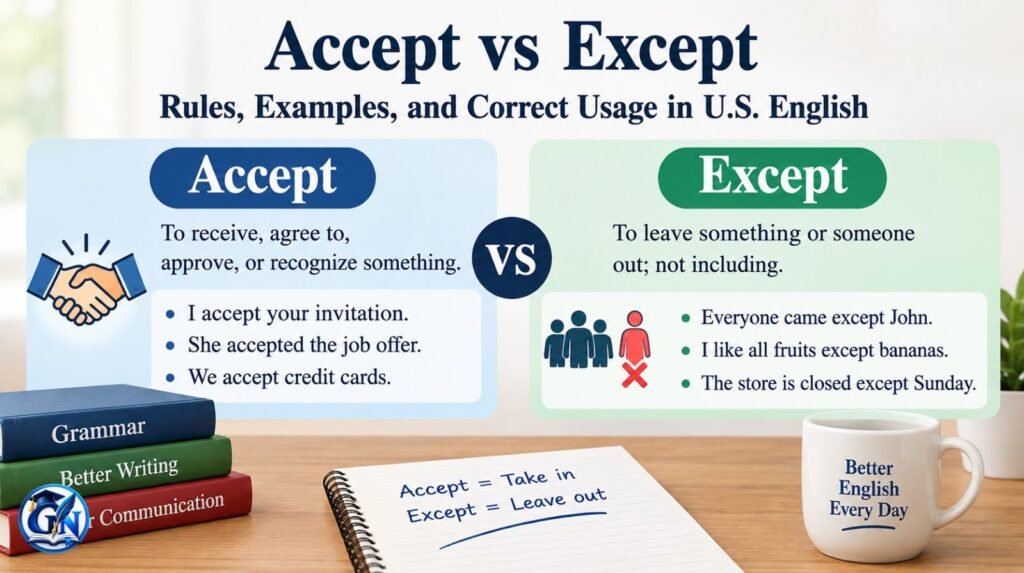
In simple terms, accept means to receive, agree to, approve, or recognize something, while except generally means to leave something or someone out. Cambridge’s American Dictionary gives examples such as accepting a job offer or invitation, while except is used for something that is not included.
The good news is that you do not need to memorize complicated grammar rules. Once you understand what each word means and how it functions in a sentence, choosing the correct word becomes much easier.
Accept vs Except: What Is the Difference?
The easiest way to understand accept vs except is to focus on their basic meanings.
What Does Accept Mean?
Accept is primarily a verb. It means to receive something willingly, agree to something, approve something, or recognize something as true or valid.
For example:
- I accepted the job offer.
- She accepted my invitation.
- We accept credit cards.
- He finally accepted that he was wrong.
- The university accepted her application.
A useful shortcut is:
Accept = receive, agree, or approve
Cambridge’s American Dictionary defines accept as agreeing to take something or considering something satisfactory, reasonable, or true.
What Does Except Mean?
Except usually means “not including,” “excluding,” or “apart from.”
For example:
- Everyone came except John.
- I eat all vegetables except mushrooms.
- The store is open every day except Sunday.
- All the students passed except two.
- I like every color except orange.
A useful shortcut is:
Except = leave out or exclude
Cambridge also identifies except as a preposition or conjunction meaning “not including” or “but.”
The One-Second Test
When you are unsure which word to use, try replacing it mentally:
Can you replace it with “receive” or “agree to”?
If yes → accept
Can you replace it with “excluding” or “not including”?
If yes → except
For example:
I will ___ the invitation.
“I will receive/agree to the invitation.”
✅ I will accept the invitation.
Now:
Everyone came ___ Sarah.
“Everyone came excluding Sarah.”
✅ Everyone came except Sarah.
This simple test works in most everyday situations.
How to Use Accept Correctly
Because accept is a verb, it describes an action. It often appears when someone receives something, agrees to an offer, or recognizes an idea.
Accept an Offer, Invitation, or Proposal
Use accept when someone says yes to something offered.
Examples:
- Maria accepted the job offer.
- They accepted our invitation.
- The company accepted the proposal.
- I decided to accept the scholarship.
- He accepted the terms of the agreement.
The noun form is acceptance:
Her acceptance of the offer surprised everyone.
Cambridge notes that accepting an offer or invitation means saying yes to it.
Accept Something as True
Accept can also mean recognizing something as true, valid, or unavoidable.
Examples:
- She accepted the fact that she had made a mistake.
- We must accept that plans can change.
- He refused to accept the explanation.
- The judge accepted the evidence.
This meaning is especially common in formal and professional writing.
Accept vs Agree
Although accept and agree can sometimes appear in similar contexts, they are not always interchangeable.
Compare:
I accepted the offer.
This means I agreed to take the offer.
I agreed to help him.
This means I said yes to doing something.
Cambridge specifically notes that accept is used for receiving or saying yes to something offered, while agree is used when someone says they will do something.
How to Use Except Correctly
Except is usually used to identify something or someone that is excluded from a larger group or statement.
Except Before a Noun or Pronoun
This is one of the most common patterns.
Examples:
- Everyone except Mike attended the meeting.
- I like all fruits except bananas.
- The office is closed every day except Monday.
- All employees except the manager left early.
- We invited everyone except him.
Here, except introduces the person or thing being left out.
Except for
Except for has a similar meaning and is very common in English.
Examples:
- Except for one small mistake, the report was excellent.
- Everyone attended except for David.
- Except for Saturday, I work every day.
- The house was perfect except for the small kitchen.
Cambridge explains that except and except for can both be used as prepositions to mean “not including” or “excluding.”
Except as a Conjunction
Except can also connect clauses.
For example:
I would go with you, except I have to work.
Here, except is similar to but.
Another example:
I would have called you, except I didn’t have your number.
You may also see:
The twins look almost identical, except that one is taller.
This construction is grammatically different from using except before a noun, but the central idea remains one of difference or exclusion.
Accept vs Except: A Quick Comparison
| Feature | Accept | Except |
|---|---|---|
| Main meaning | Receive, agree, approve | Exclude, leave out |
| Common grammar role | Verb | Preposition/conjunction |
| Simple synonym | Receive / agree | Excluding / but |
| Example | I accept your offer. | Everyone came except Tom. |
| Related word | Acceptance | Exception |
| Main idea | Taking something in | Leaving something out |
Easy Memory Trick
Think of these two words as opposite actions:
ACCEPT → TAKE IN
EXCEPT → LEAVE OUT
For example:
I accept the invitation.
You are saying yes to something.
Everyone came except John.
John is being left out.
This distinction is more useful than trying to remember the spelling alone.
Common Accept vs Except Mistakes
Because the words sound similar, writers sometimes choose the wrong one even when both words are spelled correctly.
“I Except Your Apology” ❌
This is one of the most common mistakes.
Incorrect:
I except your apology.
Correct:
I accept your apology. ✅
You are receiving or acknowledging the apology, so accept is correct.
“Everyone Accept John” ❌
Incorrect:
Everyone accept John attended the meeting.
Correct:
Everyone except John attended the meeting. ✅
John is being excluded from the group, so except is required.
“She Excepted the Offer” ❌
Incorrect:
She excepted the job offer.
Correct:
She accepted the job offer. ✅
The person agreed to take the offer, so the verb must be accepted.
Why Spell Check May Not Catch the Error
This is an important point for writers.
Both accept and except are correctly spelled English words. Therefore, if you use one when you actually mean the other, a basic spell checker may not identify the problem.
For example:
We are happy to except your proposal.
There is no spelling error in except. The problem is that the word does not fit the intended meaning.
Purdue OWL similarly warns that spell-check tools may fail to recognize correctly spelled but incorrectly chosen words, particularly with commonly confused words.
That is why context-based proofreading still matters.
Accept vs Except in Real-Life U.S. English

The difference becomes much easier when you see how these words appear in everyday situations.
Workplace Example
Imagine a manager writing an email:
We are pleased to accept your proposal. However, all departments will participate except the accounting department.
Both words appear naturally in the same sentence.
- accept = agree to receive or approve the proposal
- except = leave the accounting department out
School Example
A teacher might say:
All students must submit the assignment by Friday except those who have an approved extension.
Here, except identifies an excluded group.
A student might then write:
I accept the teacher’s feedback and will revise my essay.
Here, accept describes receiving or agreeing with something.
Everyday Example
Imagine a restaurant:
We accept credit cards, except for certain prepaid cards.
The first word describes what the restaurant takes. The second identifies something excluded.
This is an excellent way to see why accept vs except cannot be treated as interchangeable words.
A Real-Life Case Study: One Letter, Two Very Different Meanings
Consider a job applicant named Daniel who receives an email from a company.
The email says:
“We are pleased to ___ your application.”
Daniel wants to respond professionally, so he writes:
“Thank you. I am happy to except the position.”
At first glance, the sentence may look reasonable because except sounds almost identical to accept in rapid speech. However, the meaning is wrong. Daniel is not excluding the position. He is agreeing to receive or take it.
The correct sentence is:
“Thank you. I am happy to accept the position.”
Now imagine that the company’s email says:
“All applicants will receive an email except those who withdrew their applications.”
Here, except is correct because the people who withdrew are excluded from the statement.
This small distinction can matter in professional communication. A hiring email, customer response, school application, or business proposal may contain one of these words several times. Using the wrong word does not necessarily create a spelling error, but it can change the meaning of the sentence.
The practical lesson is simple: before choosing between accept and except, stop and identify the action. If someone is receiving, agreeing to, or approving something, choose accept. If someone or something is being left out, choose except. This quick meaning-based check is often more reliable than depending entirely on spell-check software.
What Current Sources Tell Us About the Problem
There is an important limitation when discussing statistics about accept vs except: major English-language authorities do not publish a reliable annual 2025–2026 statistic showing exactly how many people confuse these two words.
Therefore, it would be misleading to invent a percentage or claim that a particular number of Americans make this mistake.
However, current educational resources continue to treat accept/except as a commonly confused word pair. Purdue OWL’s current grammar resources specifically include “accept/except” among common spelling and usage problems, while its proofreading guidance recommends checking context rather than relying only on automated spelling tools.
A 2025–2026 educational resource from Scholastic also specifically teaches students the distinction: accept means agreeing to, believing, or receiving something, while except means “but” or “not including.”
Why This Matters in 2025–2026
Modern writing increasingly happens through digital tools, including email, word processors, messaging platforms, and automated writing assistants. Yet a correctly spelled word can still be the wrong word for the sentence.
That means writers should check meaning and context, not spelling alone.
Purdue OWL’s proofreading guidance recommends identifying words that frequently cause trouble and reading carefully for errors that automated tools may overlook.
A Simple Step-by-Step Method to Choose the Right Word
When you hesitate between accept vs except, follow these four steps.
Step 1: Look at the Meaning
Ask:
Am I receiving, agreeing to, or approving something?
If yes, use accept.
She will accept the offer.
Step 2: Check for Exclusion
Ask:
Am I leaving someone or something out?
If yes, use except.
Everyone attended except Mark.
Step 3: Try a Replacement Word
Replace the word with:
- receive
- agree to
- approve
If one works → accept
Or try:
- excluding
- not including
- but
If one works → except
Step 4: Read the Sentence Again
Read the complete sentence slowly.
For example:
I ___ your invitation.
“Receive your invitation” makes sense.
✅ I accept your invitation.
Then:
Everyone ___ Sarah was invited.
“Everyone excluding Sarah” makes sense.
✅ Everyone except Sarah was invited.
Purdue OWL recommends reading writing carefully and even reading aloud as part of effective proofreading because context-based mistakes can be missed during ordinary reading.

Accept vs Except: Examples You Can Remember
Here are some quick examples for everyday U.S. English:
Accept Examples
- I accept your apology.
- She accepted the invitation.
- We accept Visa and Mastercard.
- He accepted the job.
- They accepted our proposal.
- The school accepted her application.
- I accept responsibility for the mistake.
Except Examples
- Everyone was invited except Tom.
- I like every subject except math.
- The store is open every day except Sunday.
- All the rooms were clean except the kitchen.
- Nobody knew the answer except Maria.
- I would help you except I am busy.
- The restaurant serves everything except breakfast.
Sentences Using Both
These examples are especially useful because they show the difference clearly:
I accept all the terms except the final condition.
We accept reservations every day except Monday.
She accepted everyone into the group except two applicants.
I would accept the offer except that the salary is too low.
Notice the pattern: accept describes receiving or agreeing, while except identifies what is excluded.
FAQs
Q1: Is it “accept” or “except”?
A: It depends on the meaning. Use accept when you mean receive, agree to, or approve. Use except when you mean exclude or leave out.
I accept your offer.
Everyone came except John.
Q2: What is an easy way to remember accept vs except?
A: Remember:
Accept = take in.
Except = leave out.
If something is being received or agreed to, use accept. If someone or something is excluded, use except.
Q3: Is “except” a verb?
A: Usually, except functions as a preposition or conjunction in everyday English. It can also function as a verb meaning to exclude, but this use is uncommon and tends to appear in formal or specialized contexts.
Q4: Can I say “except for”?
A: Yes. Except for commonly means “excluding” or “apart from.”
Everyone attended except for James.
Except for one mistake, the essay was excellent.
Cambridge confirms that except and except for can both be used to express exclusion in appropriate constructions.
Q5: Is “accept” a noun or a verb?
A: Accept is primarily a verb.
I accept your invitation.
Its related noun is acceptance.
We received her acceptance of the offer.
Q6: Are accept and except pronounced the same?
A: Not quite. In standard U.S. English, they begin with different vowel sounds, although the difference can be difficult to notice in fast speech. This similarity in sound contributes to the confusion.
Q7: Can spell check tell me whether to use accept or except?
A: Not always. Both words are correctly spelled, so a spell checker may not recognize that you selected the wrong word for the context. Purdue OWL specifically notes that spell-check tools can miss errors involving correctly spelled but incorrectly chosen words.
Q8: Which is correct: “I accept everyone except John”?
A: Both words are correct in that sentence.
I accept everyone except John.
Here, accept means “receive or approve,” while except means “excluding.” The sentence demonstrates the difference particularly well.
Conclusion:
The difference between accept vs except is much easier once you focus on meaning rather than spelling.
Accept is generally a verb meaning to receive, agree to, approve, or recognize something.
Except generally means excluding, not including, or leaving something out.
Remember this simple rule:
Accept = take in.
Except = leave out.
So you accept an invitation, accept an offer, and accept an apology. But you attend every meeting except Monday’s meeting, invite everyone except one person, or eat everything except mushrooms.
When you are unsure, ask yourself whether something is being received or excluded. That quick question can prevent one of the most common word-choice mistakes in English.
👉 Discover more simple and practical grammar guides on Gramnora

Explore the world of English grammar with simple explanations, practical examples, and easy-to-follow guides by Zia Tarar, the founder and author of Gramnora. From essential grammar rules and sentence structure to common mistakes and advanced concepts, Gramnora helps learners improve their English, strengthen their writing skills, and communicate with greater clarity and confidence.