
Have you ever written a sentence and wondered whether to use Than vs Then? You are not alone. These two words look and sound similar, but they serve diferent purposes in American English. Choosing the wrong one can change the meaning of your sentence or make your writing look less polished.
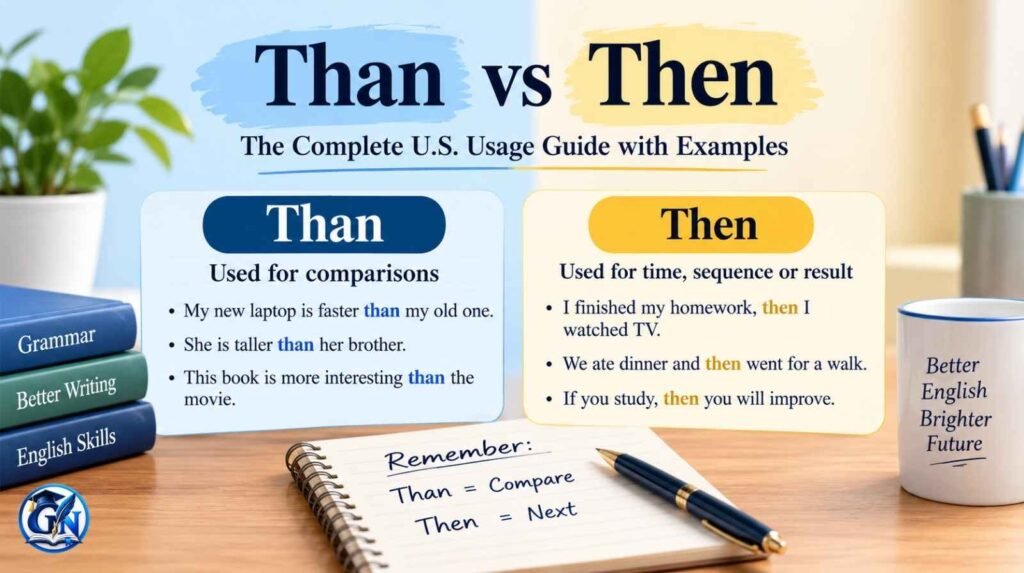
Understanding than vs then is easier than you might think. The key is to remember that than is mainly used for comparisons, while then refers to time, sequence, or a result.
For example:
- Correct: My new laptop is faster than my old one.
- Correct: I finished my homework, then I watched TV.
In the first sentence, than compares two laptops. In the second, then explains what happened next.
This complete guide explains the difference between than and then, provides practical examples, and shares simple memory tricks to help you use both words correctly in everyday American English.
What Is the Difference Between Than and Then?
The easiest way to understand these words is to focus on their meaning rather than their spelling.
What Does Than Mean?
Than is used primarily to compare people, places, objects, quantities, or actions. It commonly follows comparative words such as better, bigger, smaller, faster, and more.
Examples:
- Sarah is taller than her brother.
- This book is more interesting than the movie.
- I would rather walk than drive.
- The second test was easier than the first.
- Our new office is closer to home than the old one was.
In each example, than connects two things being compared.
What Does Then Mean?
Then commonly refers to a time, the next step in a sequence, or the result of a condition.
Examples:
- We ate dinner and then watched a movie.
- I lived in Chicago back then.
- Finish your assignment, and then you can play.
- If you study regularly, then you may improve your grades.
- First, open the application. Then, enter your password.
In these sentences, then tells readers when something happens, what happens next, or what follows from a condition.
The Quickest Way to Remember
Use this simple rule:
- Than = comparison
- Then = time, next, or result
For example, if you are comparing two smartphones, write, “This phone is cheaper than that one.”
If you are describing what you did after buying the phone, write, “I bought the phone and then set it up.”
This basic distinction works in most everyday writing situations.
When to Use Than in American English
Use than whenever you compare two or more things or express a preference between alternatives.
Than After Comparative Adjectives
Comparative adjectives describe how one person or thing differs from another.
Common examples include:
Comparative word
Example
Taller
Jack is taller than Mike.
Faster
My car is faster than yours.
Better
This solution is better than the previous one.
Cheaper
Shopping online is cheaper than buying in that store.
More expensive
This watch is more expensive than mine.
Easier
Grammar becomes easier than it first appears.
The word than introduces the second part of the comparison.
Than With Preferences and Choices
You can also use than when explaining what you prefer or choose.
Examples:
– I prefer tea than coffee.
In standard American English, this sentence is better written as: “I prefer tea to coffee.”
However, than is correct with constructions such as:
- I would rather drink tea than coffee.
- She would rather read than watch television.
- He chose to stay home rather than attend the party.
- I would rather save money than spend it unnecessarily.
Remember that different preference expressions use different grammatical patterns. For example, prefer A to B is standard, while would rather A than B is also correct.
Than in Questions and Everyday Conversations
Comparisons frequently appear in questions and informal conversations.
Examples:
- Is your new job better than your old one?
- Who runs faster than you?
- Do you think this restaurant is more affordable than the other one?
- Is driving safer than riding a motorcycle in these conditions?
When a question compares two people, objects, or activities, than is generally the correct choice.
When to Use Then in American English
Use then to describe when something happens, what happens next, or what follows logically from a situation.
Then to Show Time
Then can refer to a particular time in the past or future.
Examples:
- I was much younger then.
- We lived in Texas then.
- I will call you then.
- The meeting is scheduled for 2 p.m. See you then.
- I did not understand the instructions at the time, but I understand them now.
Here, then identifies a time rather than comparing two things.
Then to Show the Order of Events
Use then to connect steps or actions in a sequence.
Examples:
- Wake up, brush your teeth, and then eat breakfast.
- She finished her report and then sent it to her manager.
- First, preheat the oven. Then, place the baking tray inside.
- We visited the museum and then went to a nearby restaurant.
- He checked his email, then started working on the project.
This use is especially common in instructions, recipes, stories, and daily conversations.
Then to Show a Result or Conclusion
Then can also mean something similar to “in that case” or help introduce a logical consequence.
Examples:
- If you are tired, then you should get some rest.
- If the store is closed, then we will return tomorrow.
- You have finished your work? Then you can leave.
- If the price is too high, then we should consider another option.
In many sentences, the word then is optional without changing the essential meaning.
For example:
“If it rains, we will stay home.”
“If it rains, then we will stay home.”
Both are grammatically acceptable. The second version makes the connection between the condition and its result slightly more explicit.
Than vs Then: Comparison Table and Common Mistakes
A comparison table can help you quickly identify the correct word when editing your writing.
Than vs Then at a Glance
Feature
Than
Then
Main meaning
Comparison
Time, sequence, or result
Common use
After comparative words
Before or after an event in a sequence
Example
She is smarter than me.
She studied, then took the test.
Memory clue
Compare
Next
Common phrase
More than
Back then
Another phrase
Rather than
Until then
Common Mistakes and Their Corrections
Mistake 1
Incorrect: My house is bigger then yours.
Correct: My house is bigger than yours.
Why? The sentence compares the sizes of two houses.
Mistake 2
Incorrect: We went shopping and than ate lunch.
Correct: We went shopping and then ate lunch.
Why? The sentence describes two events in chronological order.
Mistake 3
Incorrect: I would rather sleep then work.
Correct: I would rather sleep than work.
Why? The sentence expresses a preference between two activities.
Mistake 4
Incorrect: If you need help, than call me.
Correct: If you need help, then call me.
Why? Then introduces the action that follows the condition.
A Simple Three-Step Checking Method
Before publishing an email, school assignment, blog post, or business document, follow these steps:
- Identify the meaning. Are you comparing two things, describing time, or explaining what happens next?
- Check the word before the blank. Words such as better, faster, and more often signal that than is needed.
- Read the sentence again. Replace then with “next” or “at that time.” If the meaning makes sense, then may be correct. If the sentence compares two things, choose than.
This method is useful because it focuses on meaning instead of relying only on memorization.
Real-Life Case Study: How One Small Word Changes a Message
Consider an illustrative workplace scenario involving a marketing assistant named Emily. She prepares a weekly performance report for her manager and writes the following sentence:
“Our new campaign performed better then the previous campaign.”
Her manager understands the intended message, but the incorrect word makes the report look less carefully edited. Emily is comparing the performance of two campaigns, so the correct sentence is:
“Our new campaign performed better than the previous campaign.”
Later that day, Emily writes another sentence in an email:
“We reviewed the results and than created a new marketing plan.”
This time, the problem is reversed. Emily is describing a sequence of events: first, the team reviewed the results; next, they created a plan. Therefore, the correct sentence is:
“We reviewed the results and then created a new marketing plan.”
Emily realizes that she cannot choose between these words simply by looking at the surrounding letters. She needs to identify the relationship between the ideas.
To avoid similar mistakes, she creates a short editing checklist for her reports. Whenever she sees than or then, she asks whether the sentence expresses a comparison or a sequence. She also checks phrases containing comparative words such as higher than, more than, and better than.
After adopting this routine, Emily has a practical way to catch these errors before sending her work. The lesson is simple: even when readers can understand your meaning, correct word choice helps make professional communication clearer and more polished.
This scenario illustrates a useful editing technique rather than a documented experiment or a measured improvement in error rates.
Than vs Then in 2025–2026: Usage Facts and Reliable References
Understanding the grammar rule is more useful than memorizing an unsupported statistic about how often people confuse these words.
What Current Grammar References Explain
The distinction between than and then remains a standard English usage rule. Authoritative grammar references explain that than is associated with comparison, while then can express time, sequence, and results.
For example:
- The Modern Language Association published an explanation of the difference between the words on March 5, 2025. Its guidance covers comparative expressions, chronological order, and conditional results.
- Cambridge Dictionary’s grammar resources explain the use of than in comparisons and then in expressions of time and sequence.
- Cambridge’s American Dictionary entry for then provides American English definitions and examples of its use.
These references support the practical rules described in this guide.
Is There a Verified 2025–2026 Confusion Rate?
There is no verified, representative 2025–2026 statistic established in the references cited here that measures how many U.S. writers confuse than and then.
It would therefore be misleading to claim that a particular percentage of Americans make this mistake or that confusion has increased by a specific amount.
Instead, the most reliable approach is to use established grammar guidance and check the context of each sentence. For writers who want to improve their English, understanding the distinction provides a clear, actionable solution without relying on invented statistics.
Recommended Grammar References
- Modern Language Association (MLA):style.mla.org— Explains the grammatical differences with examples.
- Cambridge Dictionary:dictionary.cambridge.org— Covers time, sequence, and result meanings.
- Cambridge Grammar:dictionary.cambridge.org— Explains how than introduces the second part of a comparison.
These sources offer readers a way to verify the rules and explore more advanced examples.
FAQs
Q1: What is the main difference between than and then?
A: Than is primarily used to compare two things, while then refers to a time, the next event, or a result.
Example: “My car is faster than yours.”
Example: “I finished work and then went home.”
Q2: How do I remember whether to use than or then?
A:Remember than = comparison and then = next.
If you are comparing prices, sizes, ages, or abilities, use than. If you are explaining what happened afterward, use then.
Q3: Is it more than or more then?
A: The correct expression is more than when expressing a comparison or quantity.
Examples:
- The box weighs more than 10 pounds.
- She has more books than I do.
- More than 100 people attended the event.
Use then only when you are referring to time, sequence, or a result.
Q4: Should I write better than or better then?
A:Write better than when comparing two things.
Example: “This version is better than the original.”
You can use better then only if the words independently serve their appropriate roles in a sentence, which is uncommon in this particular arrangement. In ordinary comparisons, better than is the correct expression.
Q5: Can then start a sentence?
A: Yes. Then can begin a sentence when it introduces the next step, an outcome, or a point in a sequence.
Examples:
- First, read the instructions. Then, begin the assignment.
- Then, we realized we had taken the wrong road.
- Then, what do you suggest we do?
Starting a sentence with then is acceptable when the connection between ideas is clear.
Q6: Is than a conjunction or a preposition?
A: Than can function as a conjunction or a preposition, depending on its grammatical use.
For example, in “She is taller than I am,” it introduces a clause. In “She is taller than me,” it introduces a comparison with an object pronoun. Both constructions are used in English, although some formal contexts prefer the full clause when appropriate.
The main point is that than expresses a comparison.
Q7: Can I use then and than in the same sentence?
A: Yes. A sentence can use both words correctly when it contains a comparison and a sequence or result.
Example:
“My first presentation was shorter than my second one, but I prepared more carefully then.”
In this example, than compares the presentations, while then refers to the time of the second presentation. The wording is grammatically possible, though “during the second presentation” might be clearer in a formal context.
Q8: Is the difference between than and then the same in American and British English?
A: Yes. The fundamental distinction between than and then is the same in standard American and British English.
Both varieties use than for comparisons and then for time, sequence, and results. Differences in pronunciation or regional speech do not change these core spelling and usage rules.
Conclusion:
Understanding than vs then does not require memorizing complicated grammar terminology. You simply need to recognize what your sentence is trying to express.
Use than to compare two things:
- My new phone is cheaper than my old one.
- Writing every day is more effective than practicing once a month.
Use then to express time, sequence, or a result:
- I finished my homework and then went outside.
- If you practice regularly, then you may become a stronger writer.
Whenever you are unsure, pause and ask yourself: Am I comparing something, or am I describing what happens next?
That small question can help you avoid a common spelling mistake in school assignments, professional emails, blog posts, and everyday conversations.
👉 Explore more useful grammar tips and guides on Gramnora

Explore the world of English grammar with simple explanations, practical examples, and easy-to-follow guides by Zia Tarar, the founder and author of Gramnora. From essential grammar rules and sentence structure to common mistakes and advanced concepts, Gramnora helps learners improve their English, strengthen their writing skills, and communicate with greater clarity and confidence.