
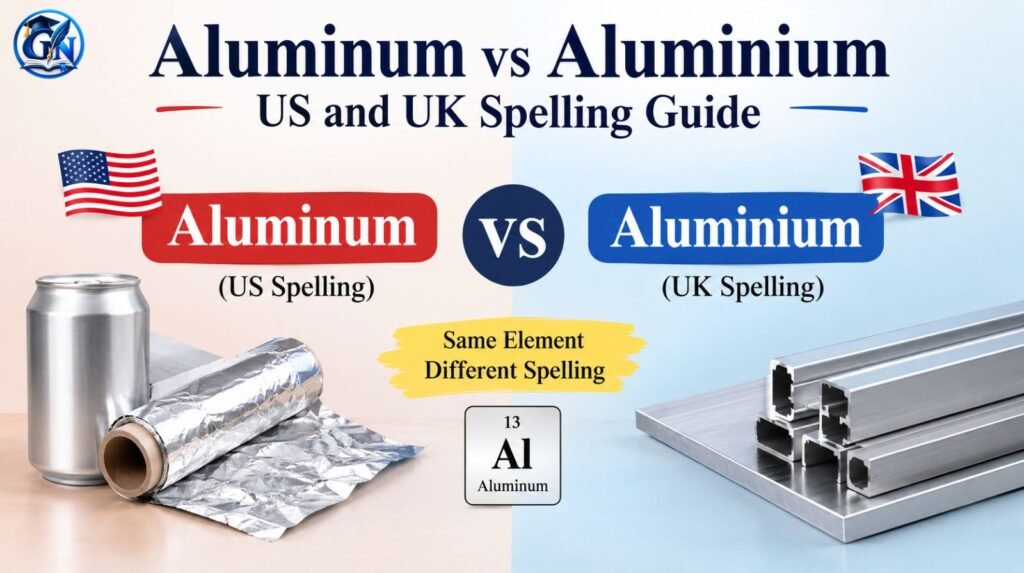
Aluminum vs Aluminium is a common spelling difference between American and British English. If you have seen aluminum on a US website and aluminium in a UK textbook, you may wonder which spelling is actually correct.
The answer is simple: both aluminum and aluminium are correct. The main difference is regional. Aluminum is the standard spelling in American English, while aluminium is preferred in British English and several other varieties of English. Cambridge Dictionary explicitly identifies aluminum as the US spelling and aluminium as the UK spelling.
In this guide, you will learn exactly when to use each spelling, why the two forms exist, how they are pronounced, and which version is best for your writing.
What Is the Difference Between Aluminum and Aluminium?
The difference between aluminum and aluminium is primarily a matter of spelling and regional English usage. Both words refer to the same chemical element, represented by the symbol Al and atomic number 13.
Aluminum: The American English Spelling
Aluminum is the preferred spelling in American English.
For example:
- The car has an aluminum frame.
- I bought an aluminum water bottle.
- The aircraft contains lightweight aluminum parts.
- Please cover the food with aluminum foil.
Cambridge Dictionary lists aluminum as the US spelling and defines it as a light, silver-colored metal used in products such as cooking equipment and aircraft parts.
Aluminium: The British English Spelling
Aluminium is the preferred spelling in British English.
For example:
- The car has an aluminium frame.
- I bought an aluminium water bottle.
- The aircraft contains lightweight aluminium parts.
- Please cover the food with aluminium foil.
Cambridge Dictionary identifies aluminium as the UK spelling of aluminum.
Are Aluminum and Aluminium the Same Thing?
Yes. They have the same meaning and refer to the same chemical element.
| Feature | Aluminum | Aluminium |
|---|---|---|
| Main variety | American English | British English |
| Meaning | Same | Same |
| Chemical symbol | Al | Al |
| Atomic number | 13 | 13 |
| Common phrase | aluminum foil | aluminium foil |
| Example | aluminum can | aluminium can |
So, neither spelling is inherently more “correct.” The better choice depends on the variety of English you are using.
Aluminum vs Aluminium: US and UK Usage
The easiest way to remember the difference is to associate each spelling with its primary English variety.
When to Use Aluminum
Use aluminum when writing in American English.
This is especially appropriate for:
- US audiences
- American schools and universities
- US newspapers and publications
- American websites
- US business communication
- Content following American English style
For example:
The company manufactures aluminum windows for residential buildings.
If your entire article uses American spellings such as color, favorite, and center, aluminum is the natural choice.
When to Use Aluminium
Use aluminium when writing in British English.
This is appropriate for:
- UK audiences
- British publications
- UK educational materials
- British businesses
- Content following British English conventions
For example:
The company manufactures aluminium windows for residential buildings.
If your article already uses British spellings such as colour, favourite, and centre, then aluminium will keep your spelling consistent.
What About Other English-Speaking Countries?
Usage outside the US and UK can vary. For example, aluminium is widely used in British-influenced varieties of English, while aluminum can also appear in countries with stronger North American influence.
The important point is to follow the style of your intended audience rather than switching between the two forms randomly.
Why Are There Two Spellings?
The history of aluminum vs aluminium is surprisingly interesting.
A Brief History of the Word
The element’s name developed through competing forms in the early 19th century. Humphry Davy initially used forms related to alumium and later used aluminum. The form aluminium developed with an ending that matched the names of other elements ending in -ium. Over time, the two forms became associated with different varieties of English.
American English eventually favored aluminum, while British English settled on aluminium.
This is why the difference is not simply a modern spelling mistake. Both forms have a genuine history in English.
Why Does American English Use “-um”?
American English contains many spelling conventions that differ from British English. In this case, aluminum became the established American form.
The result is similar to other US–UK spelling differences, although the pattern is not exactly the same:
- color → colour
- labor → labour
- center → centre
- aluminum → aluminium
The important distinction is that aluminum/aluminium is a regional spelling difference for the name of the same element.
Is One Spelling More Scientific?
Not necessarily.
Scientific sources can use either form depending on their regional or institutional style. The chemical symbol remains Al, regardless of whether the surrounding text says aluminum or aluminium.
For example:
US style: Aluminum has the chemical symbol Al.
UK style: Aluminium has the chemical symbol Al.
Both statements refer to the same element.
Real-Life Example: Choosing the Right Spelling
Imagine that a company based in New York is preparing a product page for a new range of lightweight kitchen products. Its website consistently follows American English. The marketing team writes:
“Our new aluminum cookware is lightweight, durable, and easy to clean.”
That spelling fits the company’s audience and its existing American English style.
Now imagine that the same company launches a UK version of its website. The UK editorial team follows British English throughout the site. The sentence becomes:
“Our new aluminium cookware is lightweight, durable, and easy to clean.”
Nothing about the product has changed. The metal is still the same, and its chemical symbol is still Al. Only the regional spelling convention has changed.
This example shows why consistency matters more than trying to identify one universally “correct” spelling. A US reader will naturally expect aluminum, while a UK reader is more likely to expect aluminium.
The same principle applies to educational articles, product descriptions, technical documents, newspapers, and websites. If your publication follows American English, use aluminum throughout. If it follows British English, use aluminium throughout.
For international websites, you can even maintain separate US and UK versions when the audience and editorial requirements justify it. The goal is not to declare one spelling superior; the goal is to make the language feel natural and consistent for the reader.
Aluminum vs Aluminium in Everyday Examples
Seeing the two spellings side by side makes the difference easier to remember.
Common Phrases
Here are some common examples:
| American English | British English |
|---|---|
| aluminum foil | aluminium foil |
| aluminum can | aluminium can |
| aluminum alloy | aluminium alloy |
| aluminum frame | aluminium frame |
| aluminum sheet | aluminium sheet |
| aluminum bottle | aluminium bottle |
| aluminum aircraft | aluminium aircraft |
| aluminum window | aluminium window |
The meaning does not change when the spelling changes.
Example Sentences
American English:
The manufacturer uses aluminum to reduce the weight of the product.
British English:
The manufacturer uses aluminium to reduce the weight of the product.
American English:
She wrapped the food in aluminum foil.
British English:
She wrapped the food in aluminium foil.
American English:
The bicycle has a lightweight aluminum frame.
British English:
The bicycle has a lightweight aluminium frame.
A Simple Memory Trick
Think of the endings:
US → aluminum → -um
UK → aluminium → -ium
So if you are writing for an American audience, choose aluminum.
If you are writing for a British audience, choose aluminium.
2025–2026 Facts About Aluminum and Aluminium
Although this article focuses on spelling, the material itself remains extremely important in modern industry.
The U.S. Geological Survey describes aluminum as a major industrial material used across the global economy. It notes that aluminum weighs about one-third as much as steel or copper and is valued for properties such as malleability, ductility, and corrosion resistance.
Recent industry data also show the scale of global production. The International Aluminium Institute reported that global primary aluminium production increased year over year in March 2026, with estimated global production of 6.302 million tonnes for the month.
USGS’s 2025 Mineral Commodity Summaries also reported that transportation accounted for 36% of US aluminum consumption, followed by packaging at 23%, building at 14%, and electrical applications at 9% based on its reported 2024 consumption data.
These figures help explain why readers encounter both spellings so frequently: the material is used across transportation, packaging, construction, electrical products, consumer goods, and manufacturing.
The spelling varies by English variety; the material does not.
How to Choose the Correct Spelling
If you are unsure which spelling to use, follow this simple checklist.
Step-by-Step Guide
Step 1: Identify your audience.
Are you writing primarily for readers in the United States or the United Kingdom?
Step 2: Check your existing spelling style.
Look at words such as color/colour, labor/labour, and center/centre.
Step 3: Match the regional convention.
- American English → aluminum
- British English → aluminium
Step 4: Stay consistent.
Do not switch between aluminum and aluminium without a reason.
Step 5: Follow your publication’s style guide.
If a school, company, newspaper, or client has a specific style guide, follow that guide.
Quick Decision Checklist
Ask yourself:
- 🇺🇸 Writing for the US? → Aluminum
- 🇬🇧 Writing for the UK? → Aluminium
- Using American spelling elsewhere? → Aluminum
- Using British spelling elsewhere? → Aluminium
- Unsure which one is universally correct? → Both are correct
This approach keeps your writing clear and professionally consistent.
FAQs
Q1: Is aluminum or aluminium correct?
A: Both are correct. Aluminum is the standard US spelling, while aluminium is the standard UK spelling. They refer to the same chemical element.
Q2: Is aluminum American or British English?
A: Aluminum is American English. British English generally uses aluminium.
Q3: Is aluminium American or British English?
A: Aluminium is British English. American English generally uses aluminum.
Q4: Why does America spell it aluminum?
A: The -um form became established in American English. Historical usage and American dictionaries helped reinforce aluminum as the standard US form.
Q5: Do aluminum and aluminium mean the same thing?
A: Yes. They are two regional spellings for the same chemical element, with the chemical symbol Al and atomic number 13.
Q6: How do you spell aluminum in the UK?
A: In British English, it is normally spelled aluminium.
Q7: How do you spell aluminium in the US?
A: In American English, it is normally spelled aluminum.
Q8: Which spelling should I use in an international article?
A: Choose the spelling that matches your primary target audience and overall English style. If your website primarily targets US readers, use aluminum. If it targets UK readers, use aluminium. Consistency is the key.
Conclusion:
When comparing aluminum vs aluminium, there is no need to wonder which word is the “real” one. Both spellings are correct, but they belong to different regional English conventions.
Use aluminum in American English and aluminium in British English. Both words describe the same lightweight chemical element, represented by Al on the periodic table.
The easiest rule to remember is:
US English = aluminum
UK English = aluminium
If you are writing for a specific audience, choose its preferred spelling and use it consistently throughout your content.
👉 Discover more simple and practical grammar guides on Gramnora

Explore the world of English grammar with simple explanations, practical examples, and easy-to-follow guides by Zia Tarar, the founder and author of Gramnora. From essential grammar rules and sentence structure to common mistakes and advanced concepts, Gramnora helps learners improve their English, strengthen their writing skills, and communicate with greater clarity and confidence.