
If you have ever paused while writing and wondered whether to use affect vs effect, you are not alone. These two words look and sound closely related, and even experienced writers sometimes hesitate over them. The good news is that the basic difference is much easier than it first appears.
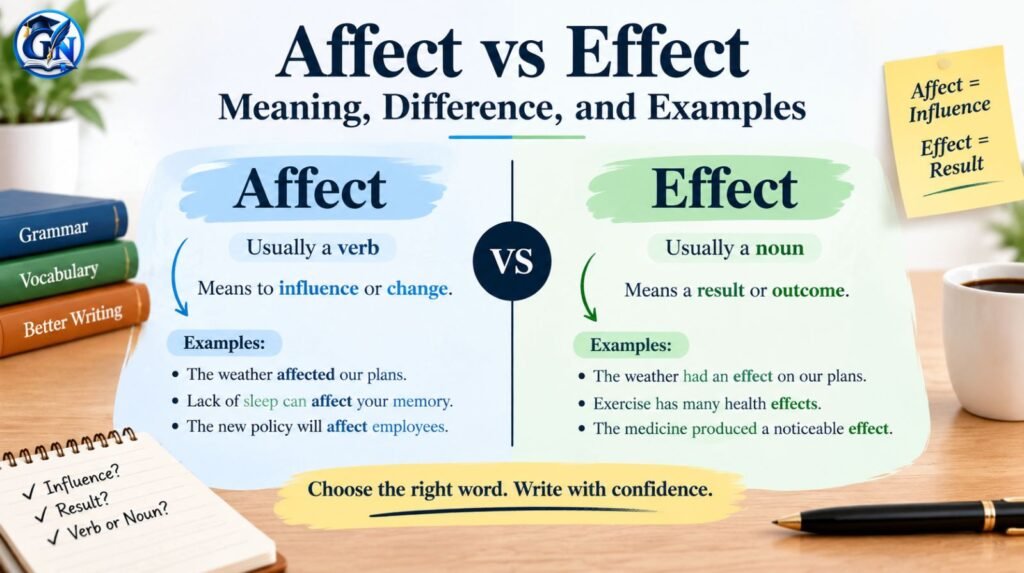
In everyday English, affect is usually a verb meaning “to influence,” while effect is usually a noun meaning “a result.”
For example:
- The weather affected our plans.
- The weather had an effect on our plans.
The first sentence focuses on the influence. The second focuses on the result.
In this guide, you will learn the difference between affect and effect, discover simple examples, understand the less-common exceptions, and learn an easy trick that can help you choose the right word confidently.
Affect vs Effect: What Is the Difference?
The simplest way to understand affect vs effect is to remember this:
Affect = influence or change
Effect = result or outcome
Affect is most commonly used as a verb, while effect is most commonly used as a noun. This distinction is also reflected in university writing guidance and grammar references.
What Does “Affect” Mean?
Affect usually means to influence, change, or have an impact on something or someone.
Because this meaning describes an action, affect is normally a verb.
Examples:
- Lack of sleep can affect your concentration.
- Loud music affected my ability to study.
- The new policy may affect small businesses.
- Stress can affect your mood.
- Cold temperatures affect battery performance.
A useful replacement test is to substitute influence for affect.
The noise affected my concentration.
The noise influenced my concentration.
Because “influenced” works, affected is correct.
What Does “Effect” Mean?
Effect usually means a result, consequence, or outcome produced by something.
Because it names a thing or result, effect is normally a noun.
Examples:
- The new policy had a positive effect.
- Exercise has many health effects.
- The weather had an effect on our plans.
- The medicine produced a noticeable effect.
- Lack of sleep can have a negative effect on concentration.
Try replacing effect with result:
The change had a major effect on sales.
The change had a major result on sales.
The second sentence is awkward, so “result” is not always a perfect grammatical replacement. However, thinking of effect = result/outcome can help you identify the noun you need.
Affect vs Effect: The Easy Rule
The easiest rule is:
Use affect when you mean “influence.” Use effect when you mean “result.”
Affect Is Usually the Action
When something does something to another thing, affect is usually the correct choice.
For example:
- Social media can affect sleep.
- The delay affected our schedule.
- Poor nutrition can affect energy levels.
- Noise affects concentration.
Think:
Something → affects → something
Effect Is Usually the Result
When you are talking about what happened because of something, use effect.
For example:
- Social media can have an effect on sleep.
- The delay had an effect on our schedule.
- Poor nutrition can have an effect on energy levels.
- Noise has an effect on concentration.
Think:
Cause → result = effect
Compare These Sentences
| Affect | Effect |
|---|---|
| The rain affected our plans. | The rain had an effect on our plans. |
| Stress can affect your health. | Stress can have an effect on your health. |
| The news affected her mood. | The news had an effect on her mood. |
| Lack of sleep affects memory. | Lack of sleep has an effect on memory. |
Notice something important: the underlying idea can be almost identical, but the grammar changes.
That is why these words are so easy to confuse.
How to Remember Affect vs Effect
If you regularly mix up these words, you do not need to memorize dozens of complicated rules.
Use the “A = Action” Trick
A simple memory trick is:
Affect = Action
When you see affect, think about an action or influence.
The loud noise affected my concentration.
The noise is doing something it is influencing concentration.
For effect, think:
Effect = End result
The loud noise had an effect on my concentration.
Here, you are naming the result.
Try the Influence-or-Result Test
When you are unsure, ask yourself:
Does the word mean “influence”?
If yes, use affect.
Will this change affect my job?
Yes. “Will this change influence my job?” makes sense.
Now ask:
Does the word mean “result”?
If yes, use effect.
What was the effect of the change?
You are asking about the result.
Watch for “An Effect”
One of the easiest clues is the phrase an effect.
For example:
- It had an effect on sales.
- The medicine caused an effect.
- We noticed an effect immediately.
Because effect is functioning as a noun here, the article “an” can come before it.
You normally would not write:
It had an affect on sales.
For ordinary English, that should be:
It had an effect on sales.
Affect vs Effect Examples in Everyday English
Understanding examples is often more useful than memorizing definitions.
Examples With “Affect”
Here are several natural examples:
- The rain affected our travel plans.
- Lack of sleep can affect your memory.
- The new rule will affect all employees.
- Noise can affect your ability to concentrate.
- The price increase affected customer demand.
In each sentence, affect means influence or change.
Examples With “Effect”
Now compare these:
- The rain had an effect on our travel plans.
- Lack of sleep can have a negative effect on memory.
- The new rule had an effect on employees.
- Noise can have a serious effect on concentration.
- The price increase had an effect on customer demand.
Here, effect refers to the result or impact.
Common Phrases to Memorize
Some phrases appear so frequently that learning them can make your writing much easier:
- affect someone
- affect something
- have an effect on
- the effect of
- side effect
- cause an effect
- positive effect
- negative effect
- long-term effect
- immediate effect
For example:
The new schedule affected productivity.
Or:
The new schedule had a positive effect on productivity.
Both can be correct, depending on the sentence structure.
The Exceptions: When Affect Is a Noun and Effect Is a Verb
The basic rule solves most everyday cases, but English has exceptions. Both words can actually function as either nouns or verbs in specific contexts. Santa Clara University’s writing guidance specifically highlights these less-common uses.
“Effect” as a Verb
Effect can be a verb meaning to bring about, cause, or make something happen.
This use is more formal than the everyday noun effect.
For example:
The new director effected major changes in the organization.
Here, effected does not mean “influenced.” It means the director brought the changes about.
Another example:
The government hopes to effect meaningful reforms.
This means the government hopes to bring about meaningful reforms.
A useful distinction is:
- affect change = influence change
- effect change = bring about or accomplish change
“Affect” as a Noun
Affect can also be a noun, particularly in psychology and related academic contexts.
In this specialized use, affect refers to a person’s observable emotional expression or demeanor.
For example:
The patient displayed a flat affect.
This is different from the everyday verb:
The experience affected him deeply.
For most everyday writing, however, you will rarely need the noun form of affect.
A Real-Life Case Study: Why the Difference Matters
Imagine that a company introduces a four-day workweek and wants to describe what happened to employee productivity.
A manager might write:
“The four-day workweek affected employee productivity.”
This sentence is grammatically correct because affected is the verb. It tells us that the new schedule influenced productivity.
After several months, the company reviews the results and discovers that productivity increased.
The manager could then write:
“The four-day workweek had a positive effect on employee productivity.”
Now effect is a noun because the manager is naming the result of the change.
The two sentences describe the same general situation from different grammatical angles. The first focuses on the influence of the new schedule; the second focuses on the result that followed.
This distinction becomes especially useful in professional writing. Consider a report that says, “The training program effected employee performance.” A reader may interpret “effected” as the formal verb meaning “brought about,” which is a very different claim from simply saying the training affected performance. If the writer only means that training influenced performance, affected is the clearer choice.
This is why choosing between affect and effect is not merely about spelling. The word you select can communicate a different relationship between a cause and its result.
Affect vs Effect: 2025–2026 Usage and Search Data
The continued attention given to affect vs effect shows that this is not an outdated grammar concern.
A 2025 Babbel guide describes affect and effect as among the frequently confused words in English and emphasizes the same core distinction: affect as the usual verb meaning influence and effect as the usual noun meaning result.
More recent third-party keyword data also indicates substantial ongoing search interest. Plainspell reports approximately 368,000 monthly Google searches in the United States for “affect vs effect,” based on keyword data covering the average month from September 2025 through August 2026. The same source reports approximately 28,010 monthly Bing searches for the query and close variants. These figures are third-party keyword estimates rather than official Google Search statistics, so they should be treated as directional rather than exact.
The broader lesson is clear: writers and learners continue to look for practical explanations of these two words. That makes concise examples, clear definitions, and useful memory techniques particularly valuable.
Common Affect vs Effect Mistakes
Knowing the rules is helpful, but seeing the mistakes makes them easier to avoid.
Mistake 1: “The Weather Will Effect Our Plans”
Incorrect:
The weather will effect our plans.
Correct:
The weather will affect our plans.
Why? Here, “affect” means influence.
Mistake 2: “It Had a Big Affect”
Incorrect:
The decision had a big affect on sales.
Correct:
The decision had a big effect on sales.
Why? The word follows “a” and names a result, so effect is the noun you need.
Mistake 3: “What Affect Did It Have?”
Incorrect:
What affect did it have on you?
Correct:
What effect did it have on you?
The common phrase is “what effect did it have?”
Mistake 4: “Side Affect”
Incorrect:
Headache is a common side affect.
Correct:
Headache is a common side effect.
A side effect is an additional result, so effect is the correct noun.
A Quick Step-by-Step Guide to Choosing the Right Word
When you are unsure about affect vs effect, use this three-step process.
Step 1: Identify the Meaning
Ask what you are trying to say.
- Influence/change? → affect
- Result/outcome? → effect
Step 2: Check the Grammar
Ask whether the blank needs a verb or noun.
- Verb → usually affect
- Noun → usually effect
Step 3: Try the Memory Trick
Remember:
Affect = Action
Effect = End result
For example:
Stress can affect your sleep.
Stress is influencing sleep.
Stress can have an effect on your sleep.
You are naming the result or impact.
Affect vs Effect: Quick Comparison Checklist
| Question | Use |
|---|---|
| Do you mean “influence”? | Affect |
| Do you mean “change” as a verb? | Affect |
| Do you mean “result”? | Effect |
| Does it follow “an,” “the,” or “a”? | Usually effect |
| Is it “___ on something”? | Usually effect on |
| Do you mean “bring about” in formal writing? | Effect as a verb |
| Are you discussing observable emotional expression in psychology? | Affect as a noun |
FAQs
Q1: What is the main difference between affect and effect?
A: The main difference is grammatical and semantic. Affect is usually a verb meaning to influence, while effect is usually a noun meaning a result or consequence. For example, “Stress affects sleep” and “Stress has an effect on sleep.”
Q2: Is it “affect” or “effect” on someone?
A: Usually, use affect when the word is the verb:
The experience affected me.
But use effect when it is a noun:
The experience had a strong effect on me.
Q3: Is “side effect” or “side affect” correct?
A: Side effect is correct. It refers to an additional result, especially an unintended or unwanted result of a medicine, treatment, or action.
Q4: Can effect be a verb?
A: Yes. Effect can be a verb meaning to bring about, cause, or accomplish something. For example, “The new policy effected major changes.” This use is less common and generally more formal.
Q5: Can affect be a noun?
A: Yes. Affect can be a noun in specialized psychological contexts, where it refers to observable emotional expression or demeanor. For example, “The patient displayed a flat affect.”
Q6: How can I remember affect vs effect?
A: Use the simple memory trick “Affect = Action” and “Effect = End result.” If you mean influence, choose affect. If you mean result, choose effect.
Q7: Which is correct: “It affected me” or “It effected me”?
A: Usually, “It affected me” is correct when you mean “It influenced me.” The verb effect has a different, more formal meaning: to bring something about.
Q8: Which is correct: “an affect” or “an effect”?
A: In ordinary English, “an effect” is correct when you mean a result.
The decision had an effect on sales.
Affect can appear as a noun in specialized psychological writing, but that is a different meaning.
Conclusion:
The difference between affect vs effect becomes much easier once you focus on their most common meanings.
Affect is usually a verb meaning to influence or change:
The noise affected my concentration.
Effect is usually a noun meaning a result or consequence:
The noise had an effect on my concentration.
Just remember:
Affect = influence/action
Effect = result/outcome
There are exceptions particularly effect as a formal verb and affect as a specialized psychology noun but the basic rule will handle most everyday writing.
When you’re unsure, stop and ask: “Do I mean influence, or do I mean result?” That one question can prevent many common grammar mistakes.
👉 Discover more simple and practical grammar guides on Gramnora

Explore the world of English grammar with simple explanations, practical examples, and easy-to-follow guides by Zia Tarar, the founder and author of Gramnora. From essential grammar rules and sentence structure to common mistakes and advanced concepts, Gramnora helps learners improve their English, strengthen their writing skills, and communicate with greater clarity and confidence.