
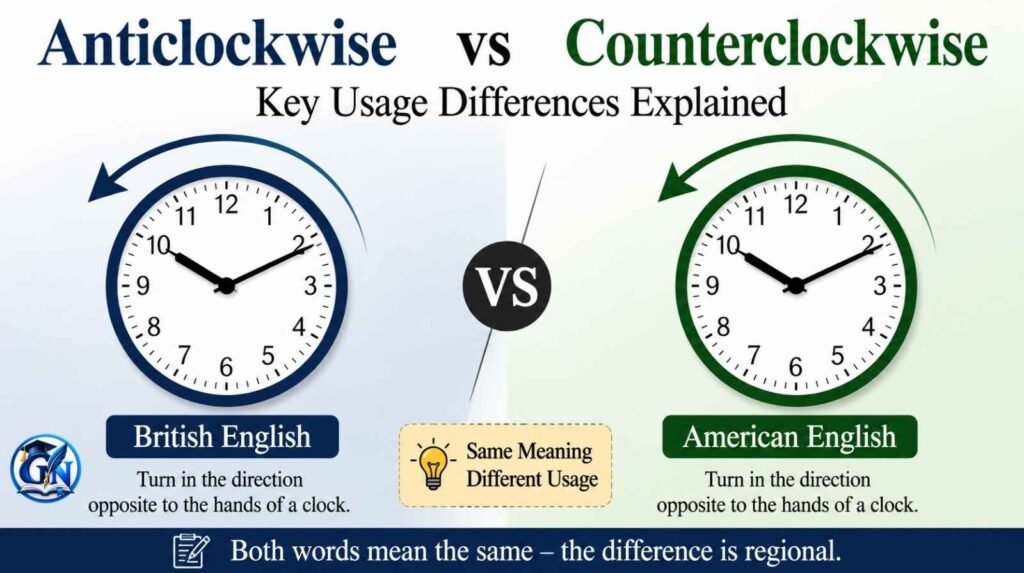
If you have ever wondered whether anticlocwise vs counterclockwise means two different things, you are not alone. Both words describe movement in the direction opposite to the hands of a clock. The main difference is regional usage, not meaning: anticlockwise is chiefly used in British English, while counterclockwise is the standard term in American English.
So, is one correct and the other incorrect? No. Both are correct. The better choice depends mainly on the variety of English you are writing or speaking.
In this guide, you will learn the exact difference between anticlockwise and counterclockwise, when to use each spelling, how they work in sentences, and which version is best for different English-speaking audiences.
Anticlockwise vs Counterclockwise: What Is the Difference?
The simplest answer is that anticlockwise and counterclockwise have the same meaning. They both describe movement in the direction opposite to the movement of a clock’s hands.
Cambridge Dictionary identifies anticlockwise as the UK term and counterclockwise as the US term.
Anticlockwise in British English
Anticlockwise is chiefly associated with British English. It can function as both an adjective and an adverb.
For example:
- Turn the knob anticlockwise.
- The wheel moved anticlockwise.
- Rotate the handle in an anticlockwise direction.
- The dancers moved anticlockwise around the room.
Merriam-Webster also describes anticlockwise as chiefly British and defines it as synonymous with counterclockwise.
Counterclockwise in American English
Counterclockwise is the usual American English equivalent.
For example:
- Turn the knob counterclockwise.
- Rotate the dial counterclockwise.
- The wheel spins counterclockwise.
- Move around the track counterclockwise.
Cambridge labels counterclockwise as US and gives anticlockwise as its UK equivalent.
Is One More Correct Than the Other?
No. Neither word is grammatically more correct.
The practical rule is:
British English → anticlockwise
American English → counterclockwise
Therefore, choosing the version that matches your audience is usually the best approach.
Anticlockwise vs Counterclockwise in British and American English
The biggest difference between these words is regional preference.
British English: Anticlockwise
If your content is primarily intended for readers in the UK, anticlockwise is generally the more natural choice.
You may see it in instructions, textbooks, technical writing, everyday conversation, and descriptions of movement.
Example:
Turn the screw anticlockwise to loosen it.
This sounds natural in British English.
American English: Counterclockwise
For an American audience, counterclockwise is generally the more familiar choice.
Example:
Turn the screw counterclockwise to loosen it.
The meaning remains exactly the same.
What About Other Varieties of English?
English is used across many countries, so regional preferences can vary. Australian, Canadian, New Zealand, and other English varieties may show preferences influenced by British or American usage and by local style.
If you are writing for an international audience, consistency matters more than trying to eliminate every regional variation.
For example, a global instruction manual could use counterclockwise throughout if it follows an American-based style guide. A UK publication may consistently use anticlockwise instead.
Anticlockwise and Counterclockwise Examples
Understanding the words becomes easier when you see them in ordinary sentences.
Everyday Examples
Both versions can describe the same action:
| British English | American English |
|---|---|
| Turn the dial anticlockwise. | Turn the dial counterclockwise. |
| Rotate the knob anticlockwise. | Rotate the knob counterclockwise. |
| The wheel moved anticlockwise. | The wheel moved counterclockwise. |
| Move anticlockwise around the circle. | Move counterclockwise around the circle. |
| Turn the handle anticlockwise. | Turn the handle counterclockwise. |
The important point is that the direction does not change.
Examples With Objects
Consider a bottle cap. If you rotate it in the direction opposite to the hands of a clock, you can describe the action as:
She turned the cap anticlockwise.
For American readers:
She turned the cap counterclockwise.
The action is identical.
Examples in Science and Mathematics
These terms are also common when describing rotation.
For example:
The object rotates anticlockwise around its central axis.
In American English:
The object rotates counterclockwise around its central axis.
Cambridge’s examples show both words being used in scientific and technical contexts, including descriptions of rotation, torque, robotics, and physical systems.
How to Choose Between Anticlockwise and Counterclockwise
Choosing the correct word is mostly a matter of knowing your audience.
Use Anticlockwise for British English
Choose anticlockwise when:
- You are writing primarily for UK readers.
- Your publication follows British English.
- Your organization’s style guide prefers British spelling.
- You want your terminology to match other British English vocabulary.
Example:
Turn the control anticlockwise until the indicator reaches zero.
Use Counterclockwise for American English
Choose counterclockwise when:
- You are writing for a US audience.
- Your publication follows American English.
- Your company’s style guide uses American terminology.
- Your surrounding content consistently follows US English conventions.
Example:
Turn the control counterclockwise until the indicator reaches zero.
Quick Decision Checklist
Use this simple checklist:
- Writing for the UK? → Use anticlockwise.
- Writing for the US? → Use counterclockwise.
- Writing for an international audience? → Choose one based on your style guide and remain consistent.
- Editing someone else’s work? → Preserve the regional variety unless there is a reason to change it.
- Unsure which one to use? → Check the publication’s existing spelling conventions.
A Real-Life Example: Instructions for a Machine
Imagine a company has created a machine with a rotating adjustment dial. The instruction says:
“Turn the dial counterclockwise to reduce the setting.”
An American customer is likely to find this wording completely natural. However, if the same machine is being marketed primarily in Britain, the instructions could instead say:
“Turn the dial anticlockwise to reduce the setting.”
The machine has not changed, and neither has the direction of rotation. Only the regional vocabulary has changed.
This distinction matters in real-world communication because technical instructions need to be immediately understandable. A British engineer reading counterclockwise will generally understand what is meant, just as an American engineer will understand anticlockwise. Nevertheless, using the terminology expected by the target audience can make instructions feel more natural and professionally localized.
This is particularly useful for product manuals, educational materials, websites, software interfaces, engineering documents, and safety instructions. If a company publishes separate US and UK versions of its documentation, it may choose counterclockwise for the US version and anticlockwise for the UK version.
The broader lesson is that correct English is not always about choosing one universal word. English has regional varieties, and good writing respects those differences. When the meaning is identical, matching the audience’s variety often produces clearer and more natural communication.
What Current Dictionary Evidence Shows
There is no meaningful statistical difference in the meaning of the two words: major dictionaries treat them as regional equivalents.
2025–2026 Reference Check
Recent dictionary information provides a useful snapshot:
- Cambridge Dictionary currently labels anticlockwise as UK and counterclockwise as US.
- Merriam-Webster, with its entry updated in February 2026, describes anticlockwise as “chiefly British” and gives counterclockwise as its equivalent.
- Merriam-Webster records 1879 as the first known use of anticlockwise in the meaning given in its dictionary entry.
These references are more useful for this topic than an arbitrary percentage claiming that one word is “more correct.” The important linguistic evidence is that established dictionaries recognize both forms while distinguishing their regional use.
Anticlockwise vs Counterclockwise: Common Mistakes
Although the two words are straightforward, writers sometimes make avoidable mistakes.
Mistake 1: Thinking Anticlockwise Is Incorrect
Some learners assume that anticlockwise is a spelling mistake because counterclockwise is more familiar to them.
That is incorrect.
Anticlockwise is an established English word and is chiefly associated with British English.
Mistake 2: Thinking Counterclockwise Means Something Different
The prefix counter- can sometimes make learners think the word describes a different type of movement.
It does not.
Counterclockwise describes movement opposite to the direction of a clock’s hands.
Mistake 3: Mixing Regional Styles Without a Reason
Using anticlockwise in one paragraph and counterclockwise in the next is not necessarily grammatically wrong. However, unnecessary switching can make a document look inconsistent.
For professional content, choose the variety that fits your audience and use it consistently.
Mistake 4: Assuming “Anti-Clockwise” Is the Only Spelling
You may encounter anti-clockwise, especially in British English resources. Cambridge’s Essential British English Dictionary lists anti-clockwise as a UK form.
However, if your goal is to choose between the two terms in this article’s title, anticlockwise and counterclockwise are the clearest forms to use.
FAQs
Q1: Is anticlockwise the same as counterclockwise?
A: Yes. Anticlockwise and counterclockwise have the same basic meaning: moving in the direction opposite to the hands of a clock. The main distinction is regional usage. Anticlockwise is chiefly British, while counterclockwise is standard American usage.
Q2: Is anticlockwise British or American?
A: Anticlockwise is primarily British English. Cambridge identifies it as the UK equivalent of the US word counterclockwise.
Q3: Is counterclockwise British or American?
A: Counterclockwise is primarily American English. Cambridge labels it as US and gives anticlockwise as the UK equivalent.
Q4: Which is correct: anticlockwise or counterclockwise?
A: Both are correct. Use anticlockwise when following British English conventions and counterclockwise when following American English conventions.
Q5: Should I use anticlockwise in a UK article?
A: Yes. If your article is written specifically for a British audience, anticlockwise is generally the more natural choice.
Q6: Should I use counterclockwise in American English?
A: Yes. Counterclockwise is the standard choice for American English and is the term recognized by Cambridge as the US equivalent of anticlockwise.
Q7: Is anticlockwise one word or two?
A: Anticlockwise is commonly written as one word. You may also encounter the hyphenated British form anti-clockwise in dictionaries and other sources.
Q8: What is the opposite of anticlockwise and counterclockwise?
A: The opposite is clockwise, meaning movement in the same direction as the hands of a clock. Cambridge lists clockwise as the opposite of both terms.
Conclusion
When comparing anticlockwise vs counterclockwise, the key point is simple: they mean the same thing. The difference is primarily regional.
Use anticlockwise for British English and counterclockwise for American English. Neither is inherently more correct, and both can describe the same movement in everyday, scientific, mathematical, and technical contexts.
The best approach is therefore to match your word choice to your audience and stay consistent.
👉 Discover more simple and practical grammar guides on Gramnora

Explore the world of English grammar with simple explanations, practical examples, and easy-to-follow guides by Zia Tarar, the founder and author of Gramnora. From essential grammar rules and sentence structure to common mistakes and advanced concepts, Gramnora helps learners improve their English, strengthen their writing skills, and communicate with greater clarity and confidence.