
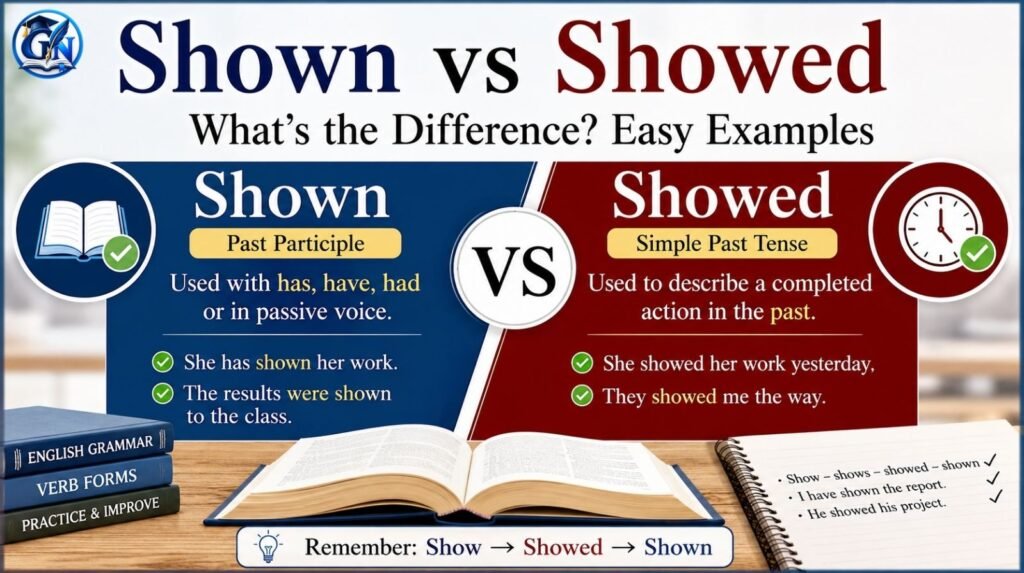
If you are confused about shown vs showed, you are not alone. Both words come from the verb show, but they do not work in exactly the same way. The main difference is simple: showed is the past tense of show, while shown is usually the past participle.
For example:
- She showed me the picture yesterday. ✅
- She has shown me the picture before. ✅
So, when should you use showed, vs shown? This guide explains the difference with simple rules, everyday examples, a comparison table, and common mistakes so you can use both forms confidently.
Target audience: English learners, students, writers, bloggers, teachers, ESL learners, and anyone checking whether “showed” or “shown” is correct.
Tone: Friendly, clear, practical, and engaging.
Showed vs Shown: The Basic Difference
The easiest way to understand shown vs showed is to remember their grammatical roles.
Showed is the simple past tense
Showed is the simple past form of show. You normally use it when an action happened and finished in the past.
Examples:
- I showed him my new phone.
- She showed us her artwork yesterday.
- They showed me the way to the station.
- He showed great courage during the difficult situation.
- The results showed a significant improvement.
Cambridge Dictionary lists showed as the past tense of show.
Shown is usually the past participle
Shown is the past participle of show. It is normally used with an auxiliary verb such as has, have, had, is, was, or were, depending on the sentence structure.
Examples:
- She has shown great improvement.
- They have shown me the results.
- He had shown enough evidence.
- The results have shown a clear pattern.
- The picture was shown to the audience.
Cambridge specifically identifies shown as the past participle of show.
Quick rule to remember
Think of the pattern like this:
show → showed → shown
| Verb form | Word | Example |
|---|---|---|
| Base form | show | I show my work. |
| Simple past | showed | I showed my work. |
| Past participle | shown | I have shown my work. |
This is the key distinction you need to remember.
Shown vs Showed: When Should You Use Each?
Understanding the difference becomes much easier when you look at the sentence structure.
Use “showed” for a completed past action
Use showed when you are simply describing something that happened in the past.
For example:
- Maria showed me her new apartment.
- The teacher showed the students an example.
- He showed us his passport.
- The report showed a decline in sales.
Notice that these sentences do not need has, have, or had before showed.
You can often identify the simple past by looking for a past-time expression:
- yesterday
- last week
- last year
- two days ago
- in 2025
- when I was younger
Example:
Last week, my teacher showed us how to solve the problem.
Use “shown” with perfect tenses
Use shown after has, have, or had when forming perfect tenses.
Examples:
- She has shown remarkable progress.
- We have shown that the method works.
- He had shown interest in the project before.
- The study has shown promising results.
This structure is one of the easiest ways to distinguish shown vs showed.
Use “shown” in passive constructions
Shown can also appear in passive sentences.
Examples:
- The movie was shown at 8 p.m.
- The results were shown on the screen.
- The documents were shown to the manager.
- The painting was shown at the gallery.
Here, shown is not functioning as a simple past verb by itself. It is part of a passive construction.
For example:
The teacher showed the students the answer.
The answer was shown to the students.
Both sentences describe the same general action, but their grammatical structures are different.
Is “Showed” or “Shown” Correct?
Both showed and shown are correct. The right choice depends on the grammar of your sentence.
“Showed” is correct in simple past sentences
Consider:
She showed me her new car.
This is correct because showed is the simple past form of show.
Another example:
The experiment showed an unexpected result.
Again, the action is presented as a completed past event.
“Shown” is correct after helping verbs
Consider:
She has shown me her new car.
This is also correct because has + shown creates the present perfect.
You would not normally write:
She has showed me her new car. ❌
Instead:
She has shown me her new car. ✅
The same principle applies to have and had:
- We have shown the evidence. ✅
- They had shown the evidence earlier. ✅
Can “shown” appear without “has,” “have,” or “had”?
Yes. This is an important detail.
Because shown can be used in passive constructions, it can appear with forms of be:
- The results were shown on the screen.
- The film was shown to the audience.
- The evidence is shown in the report.
Therefore, the rule is not simply “always use shown after has.” A better rule is:
Use “showed” as the simple past form. Use “shown” as the past participle, usually with an auxiliary verb.
Showed vs Shown Examples in Everyday English
Seeing the two forms side by side makes the difference much clearer.
Everyday examples
Simple past — showed:
James showed me his new laptop yesterday.
Present perfect — shown:
James has shown me his new laptop before.
Simple past — showed:
The teacher showed us an interesting video.
Past perfect — shown:
The teacher had shown us the video before the class ended.
Passive — shown:
The video was shown to the entire class.
More examples to remember
- She showed me how to use the software.
- She has shown me how to use the software.
- They showed their support during the event.
- They have shown their support for the project.
- The report showed an increase in revenue.
- The report has shown an increase in revenue.
- The painting was shown at the exhibition.
- He showed us around the museum.
Merriam-Webster likewise identifies showed as the past tense of show and gives examples of its use for actions such as displaying or demonstrating something.
A Simple Case Study: Choosing “Showed” or “Shown”
Imagine that a student is writing an essay about a science project.
Her first sentence says:
“The experiment showed that temperature affected the results.”
This sentence is correct. The writer is describing what the experiment demonstrated, so showed works as the simple past form.
Later, she writes:
“The experiment has showed that temperature affects the results.”
This sentence sounds natural to many learners, but it is grammatically incorrect in standard English. Because has is being used to form the present perfect, the past participle shown is needed:
“The experiment has shown that temperature affects the results.”
Now imagine the student describes what happened during her presentation:
“Yesterday, I showed the results to my teacher.”
Again, showed is correct because yesterday establishes a completed past action.
She then writes:
“The results were shown on a large screen.”
Here, shown is correct because the sentence is passive: the results received the action rather than performing it.
This small example demonstrates why memorizing a single rule such as “shown is more formal” does not work. Showed and shown are not interchangeable versions of the same tense. Their grammatical function determines which one belongs in a sentence.
The most useful editing habit is to look at the words immediately before the verb. If you see has, have, or had, you will generally need shown. If you are simply describing a completed past action, showed is usually the correct choice.
2025–2026 Evidence and Usage Snapshot
Grammar advice should be based on reliable references rather than invented statistics or unsupported claims. For this topic, authoritative dictionaries consistently distinguish the two forms.
What current reference sources show
As of the current 2025–2026 reference period:
There is no reliable public statistic showing exactly how many people search for “shown vs showed” each month, so it would be misleading to invent a search-volume number. For a grammar article, the stronger evidence is the consistent treatment of these forms by established dictionaries.
The practical takeaway
The current reference evidence supports this simple distinction:
Showed = simple past
Shown = past participle
That rule is enough to solve most shown vs showed questions you will encounter in everyday writing.
A Quick Checklist for Choosing the Correct Word
Before publishing or submitting a sentence, use this checklist.
Step 1: Look for the time structure
Ask whether you are describing a straightforward completed past action.
She showed me the letter yesterday. ✅
If yes, showed is likely correct.
Step 2: Check for “has,” “have,” or “had”
If one of these appears before the verb, use the past participle:
She has shown me the letter. ✅
They had shown us the evidence. ✅
Step 3: Check whether the sentence is passive
If something receives the action, shown may be needed:
The evidence was shown to the jury. ✅
Step 4: Compare the sentence patterns
| Situation | Correct form | Example |
|---|---|---|
| Simple past | showed | She showed me the photo. |
| Present perfect | shown | She has shown me the photo. |
| Past perfect | shown | She had shown me the photo. |
| Passive | shown | The photo was shown to us. |
| Present/base form | show | Please show me the photo. |
This four-step check can help you avoid most common mistakes.
Common Mistakes With Showed and Shown
Mistake 1: “I have showed him”
❌ I have showed him the results.
✅ I have shown him the results.
Why? Have requires the past participle in the present perfect, so shown is needed.
Mistake 2: “She shown me yesterday”
❌ She shown me the picture yesterday.
✅ She showed me the picture yesterday.
Why? There is no auxiliary verb supporting the past participle. The sentence is simply describing a completed past action.
Mistake 3: Thinking “shown” is more formal
Some learners believe that shown is simply a more formal version of showed. It is not.
The difference is grammatical, not merely stylistic.
Compare:
He showed me the document yesterday.
with:
He has shown me the document before.
The choice depends on tense and sentence structure.
Mistake 4: Using “showed” after “had”
❌ They had showed us the results.
✅ They had shown us the results.
The pattern is:
had + past participle = had shown
FAQs
Q1: Is “shown” the past tense of show?
A: No. Showed is the simple past tense of show. Shown is the past participle.
Q2: Is “showed” grammatically correct?
A: Yes. Showed is the standard simple past form of show.
Example:
She showed me her new book.
Q3: Is “shown” grammatically correct?
A: Yes. Shown is the standard past participle of show.
Example:
She has shown me her new book.
Q4: Should I say “has showed” or “has shown”?
A: Use has shown.
She has shown great improvement. ✅
“Has showed” is not the standard form in this construction.
Q5: Should I say “I showed him” or “I shown him”?
A: Use I showed him when describing a simple past action.
I showed him the picture yesterday. ✅
Q6: Can “shown” be used in a passive sentence?
A: Yes.
The movie was shown at the theater.
The results were shown on the screen.
Q7: What are the three forms of “show”?
A: The three main forms are:
show → showed → shown
For example:
I show my work every week.
I showed my work yesterday.
I have shown my work before.
Q8: Is “showed” or “shown” more common?
A: Neither is simply “better.” They perform different grammatical jobs. Showed is the simple past form, while shown is the past participle, so the correct choice depends on the sentence structure.
Conclusion:
The difference between shown vs showed is easier than it first appears.
Remember these three forms:
Show → showed → shown
- Show = base form
- Showed = simple past
- Shown = past participle
Use showed for a straightforward past action:
She showed me the picture yesterday.
Use shown with perfect tenses or in passive constructions:
She has shown me the picture.
The picture was shown to the audience.
Once you understand this pattern, choosing between showed and shown becomes much more natural.
If this guide helped you, save it for the next time you are unsure about an English verb form, and explore more practical grammar guides on GramNora to strengthen your everyday English writing.
👉 Discover more simple and practical grammar guides on Gramnora

Explore the world of English grammar with simple explanations, practical examples, and easy-to-follow guides by Zia Tarar, the founder and author of Gramnora. From essential grammar rules and sentence structure to common mistakes and advanced concepts, Gramnora helps learners improve their English, strengthen their writing skills, and communicate with greater clarity and confidence.