
When writing in English, small spelling differences can sometimes create confusion, especially when a word has two accepted forms. Totaling vs Totalling are excellent examples. Both spellings look correct, sound identical, and are commonly used in written English. However, choosing between them depends on the variety of English you are using.
You might see totaling in American business reports, financial statements, and everyday writing, while totalling frequently appears in British publications, academic documents, and professional correspondence. Although the difference is only one letter, using the appropriate spelling can make your writing more consistent and professional.
So, is it totaling or totalling? Are both forms grammatically correct? And when should you use each spelling?
Let’s explore their meanings, spelling rules, practical examples, and common mistakes to help you understand exactly when to use each one.
Totaling vs Totalling: Which Spelling Is Correct?
Both totaling and totalling are correct English spellings. The difference comes from regional spelling conventions rather than grammar or meaning.
- Totaling: The preferred spelling in American English.
- Totalling: The preferred spelling in British English.
Both words are forms of the verb total, meaning to calculate the complete amount, add several numbers together, or reach a particular sum.
For example:
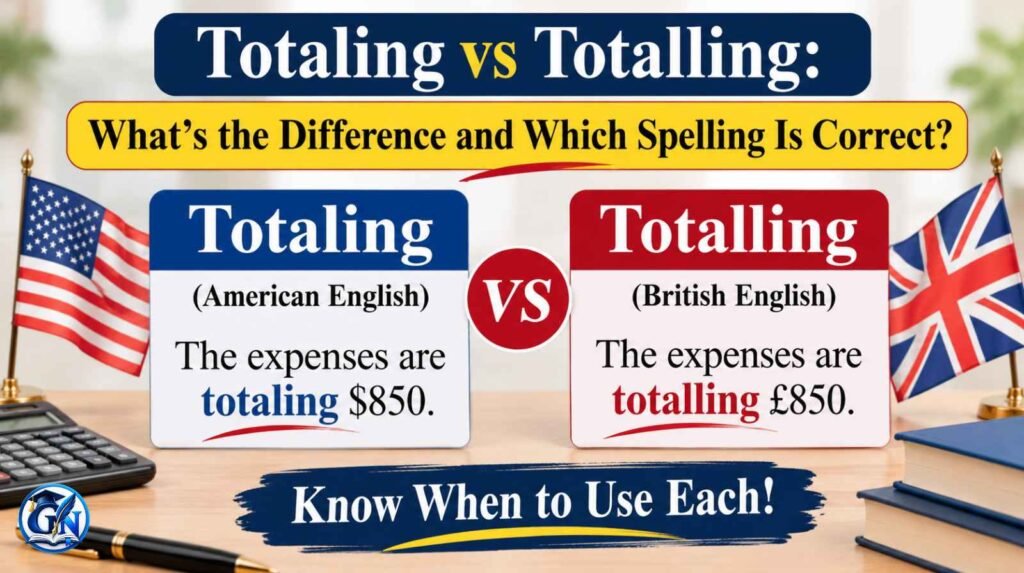
- American English: The expenses are totaling $850.
- British English: The expenses are totalling £850.
Notice that the meaning remains exactly the same. Only the spelling changes.
If you are writing for an American audience, use totaling. If your readers primarily use British English, totalling is generally the better choice.
Neither spelling is incorrect, and neither changes the pronunciation of the word.
What Does Totaling Mean?
Totaling is the present participle of the verb total. It describes the process of adding different amounts together to calculate a final figure.
It can also describe something that reaches a particular quantity, value, or amount.
This spelling is particularly common in American English, where verbs ending in a single consonant preceded by a vowel do not always double that consonant when adding -ing.
For example:
- The restaurant’s daily sales are totaling $2,500.
- We are totaling the expenses before preparing the final report.
- The donations are totaling more than $10,000.
- Her medical bills are totaling approximately $3,000.
In each sentence, totaling describes adding amounts or reaching a combined figure.
Examples of Totaling in Everyday Situations
Here are some practical situations showing how to use totaling naturally.
Calculating Monthly Expenses
Imagine that Daniel wants to calculate his household expenses before the end of the month.
He might say:
“I have been totaling my monthly expenses to understand how much money I spend on groceries, transportation, and electricity.”
Here, totaling describes the process of calculating the combined cost of different expenses.
Preparing a Business Report
Suppose Emily works as an accountant for a small company. Her manager asks her to calculate the company’s monthly sales.
She might write:
“Our sales for November are totaling approximately $18,500, which is higher than last month’s revenue.”
In this example, totaling communicates the combined value of the company’s sales.
Calculating Shopping Costs
Imagine that Michael purchases groceries, clothing, and household supplies.
He might tell his brother:
“The items I purchased yesterday are totaling around $240.”
The word describes the combined cost of everything he purchased.
What Does Totalling Mean?
Totalling has exactly the same meaning as totaling. It is the British English spelling of the present participle of total.
The additional letter L follows the traditional British spelling convention of doubling the final consonant in certain words when adding a suffix.
For example:
- The expenses are totalling £750.
- We are totalling the receipts before submitting them.
- The donations are totalling nearly £5,000.
- The company’s losses are totalling thousands of pounds.
These sentences have the same meanings as their American English equivalents.
The only difference is that British English generally prefers totalling, particularly in the United Kingdom and other regions influenced by British spelling conventions.
Examples of Totalling in Everyday Situations
Let’s look at a few realistic situations where totalling would be appropriate.
Calculating Office Expenses
Imagine that Sophie works in an accounting department in London. Her supervisor asks her to calculate the company’s monthly expenses.
She might send this message:
“We are currently totalling all office expenses to prepare the financial statement for November.”
Here, totalling refers to adding individual expenses to calculate the final amount.
Preparing an Email About Payments
Suppose James needs to inform his colleague about several outstanding payments.
He could write:
Hi Oliver,
I have reviewed the outstanding payments and am currently totalling the amounts for the final report. The payments are expected to total approximately £2,800. I will share the completed figures once everything has been checked.
Best regards,
James
This example demonstrates how totalling can be used naturally in professional British English correspondence.
Calculating Fundraising Contributions
Imagine that a school in Manchester is organising a fundraising event. Several parents and local businesses have contributed money.
The organiser might announce:
“Our fundraising contributions are totalling more than £7,000, and we are grateful to everyone who participated.”
Here, totalling communicates the combined amount of the contributions.
Why Do Totaling and Totalling Have Different Spellings?
The difference between totaling and totalling comes from the spelling conventions used in American and British English.
Although both varieties share the same grammatical rules, they sometimes treat certain consonants differently when adding suffixes such as -ing, -ed, and -er.
In American English, the final consonant is often not doubled in words such as total when adding -ing.
Therefore:
– Total + ing = Totaling
In British English, the final consonant is commonly doubled in this particular word.
Therefore:
– Total + ling? No. Total + ing = Totalling
The result is two accepted spellings with identical meanings.
Here are some other examples of similar American and British spelling differences:
| American English | British English |
|---|---|
| Traveling | Travelling |
| Canceling | Cancelling |
| Labeling | Labelling |
| Modeling | Modelling |
| Fueling | Fuelling |
| Totaling | Totalling |
These differences are especially useful to understand if you regularly write for international audiences.
When Should You Use Totaling?
You should use totaling when writing in American English or communicating with an audience that generally follows American spelling conventions.
It is especially appropriate for American business documents, educational materials, professional emails, and everyday communication.
Here are some situations where totaling is the preferred choice.
In American Business Reports
American companies commonly use totaling in financial reports and accounting documents.
For example:
“The department’s operating expenses are totaling $45,000 this quarter.”
This spelling follows standard American English conventions.
In Professional Emails
If you are communicating with American colleagues or clients, using totaling helps maintain consistent spelling throughout your message.
For example:
Hi Sarah,
I am currently totaling the expenses from all departments to prepare the monthly financial summary. Once the calculations are complete, I will send you the final report for review.
Best regards,
David
In Academic Writing
American students and researchers should generally use totaling when discussing calculations, financial figures, or combined quantities.
For example:
“The total contributions collected during the research project were totaling more than $12,000.”
A more natural alternative would be:
“The contributions collected during the research project were totaling more than $12,000.”
The important point is to follow American spelling conventions consistently.
When Should You Use Totalling?
Use totalling when writing in British English or when following a style guide that prefers British spelling.
This spelling is common in the United Kingdom and is also used in other English-speaking regions that follow British conventions.
Here are some situations where totalling is appropriate.
In British Business Documents
British businesses generally prefer totalling in their financial reports, invoices, and accounting documents.
For example:
“The outstanding invoices are totalling £4,200.”
This spelling is appropriate for a document following British English conventions.
In Workplace Communication
When communicating with British colleagues, using totalling helps maintain consistency.
For example:
Hi Charlotte,
I have reviewed the latest financial records and am totalling the outstanding payments. The updated figures should be ready by tomorrow afternoon. I will send you the completed report once everything has been verified.
Kind regards,
Oliver
In British Academic Writing
Students following British English spelling conventions should use totalling in their assignments and academic reports.
For example:
“The donations received from different organisations were totalling nearly £15,000.”
Using the appropriate regional spelling helps maintain a consistent writing style.
Totaling vs Totalling: Key Differences at a Glance
Although these two spellings are different, their meanings and grammatical functions are identical.
The following table summarises everything you need to know.
| Feature | Totaling | Totalling |
|---|---|---|
| Spelling | One L before -ing | Two Ls before -ing |
| English variety | American English | British English |
| Meaning | Adding amounts together | Adding amounts together |
| Pronunciation | Same | Same |
| Grammar | Present participle | Present participle |
| Correctness | Correct | Correct |
| Typical usage | United States | United Kingdom |
The most important thing to remember is that neither spelling is universally better. Your choice should depend on your intended audience and the spelling convention you are following.
Common Mistakes to Avoid When Using Totaling and Totalling
Although the difference between these words is simple, writers sometimes make mistakes when using them.
Understanding these common errors can help you improve your grammar and avoid confusing your readers.
Assuming That Totalling Is Incorrect
Some writers believe that totaling is the only correct spelling because they are more familiar with American English.
However, totalling is perfectly correct in British English.
For example:
Incorrect assumption: “Totalling is always a spelling mistake.”
Correct understanding: “Totalling is the standard British English spelling.”
Mixing American and British Spellings
Another common mistake is using different regional spelling conventions in the same document.
For example:
“Our team is totaling the expenses and travelling to London tomorrow.”
This sentence mixes American totaling with British travelling.
Although readers can understand it, maintaining one spelling convention is generally better.
A consistent American English version would be:
“Our team is totaling the expenses and traveling to London tomorrow.”
A consistent British English version would be:
“Our team is totalling the expenses and travelling to London tomorrow.”
Confusing Totaling With Total
Total and totaling are related words, but they serve different grammatical purposes.
For example:
- Correct: The total cost is $500.
- Correct: We are totaling the expenses.
- Incorrect: We are total the expenses.
Remember that total can function as a noun, adjective, or verb, while totaling is a verb form used to describe an ongoing action or process.
Using Totalling When You Mean a Different Word
Writers should also understand that totaling and totalling do not mean every situation involving a final amount.
For example, if you want to describe the final amount of several purchases, you might use total, amounting to, or adding up to.
Consider these sentences:
- The purchases total $300.
- The purchases are amounting to $300.
- We are adding up the purchases.
Choosing the right expression makes your writing clearer and more natural.
Totaling vs Totalling in Different Types of Writing
Both spellings can appear in various types of communication. The appropriate choice depends on the English variety used in the document.
Here are some examples.
In Emails
American English:
“Hi Robert, I am totaling the monthly expenses and will send you the figures shortly.”
British English:
“Hi Robert, I am totalling the monthly expenses and will send you the figures shortly.”
In Financial Reports
American English:
“The company’s expenses are totaling $75,000 for the current quarter.”
British English:
“The company’s expenses are totalling £75,000 for the current quarter.”
In Everyday Conversations
American English:
“I am totaling everything we spent during our vacation.”
British English:
“I am totalling everything we spent during our holiday.”
In Educational Writing
American English:
“The students are totaling their scores to calculate their final results.”
British English:
“The students are totalling their scores to calculate their final results.”
These examples show that the meaning never changes, even when the spelling does.
Is Totaling or Totalling More Common?
The answer depends on the region and the audience.
Totaling is the standard American English spelling and is widely used in the United States. Totalling is the standard British English spelling and is commonly used in the United Kingdom.
Neither form is inherently more correct or more professional than the other.
If you are writing an article for an international audience, you can choose either spelling. However, it is important to use your chosen spelling consistently throughout the article.
For example, if your website generally follows American English, use totaling rather than switching to totalling in different sections.
Similarly, if you follow British English, use totalling consistently.
Frequently Asked Questions
1. Is Totaling or Totalling Correct?
Both totaling and totalling are correct English spellings. Totaling is preferred in American English, while totalling is preferred in British English. Both words have the same meaning and refer to adding amounts together or calculating a combined figure.
2. Is Totaling American or British English?
Totaling is the preferred American English spelling. It uses one L before the -ing ending. British English generally uses totalling, with two Ls.
3. Is Totalling American or British English?
Totalling is the standard British English spelling. It follows the British convention of doubling the final L when adding the -ing suffix to total.
4. Does Totaling Have One L or Two?
In American English, totaling has one L before the -ing ending. In British English, totalling has two Ls. Both spellings are correct, depending on the regional convention.
5. Do Totaling and Totalling Mean the Same Thing?
Yes. Totaling and totalling have exactly the same meaning. Both describe adding separate amounts together to calculate a combined figure or final sum. Their only difference is regional spelling.
6. How Do You Use Totalling in a Sentence?
You can use totalling when describing the process of calculating a combined amount. For example: “We are totalling the monthly expenses before submitting the financial report.” This spelling is preferred in British English.
7. Is Totalled or Totaled Correct?
Both totalled and totaled are correct past-tense and past-participle spellings of the verb total. Totaled is preferred in American English, whereas totalled is preferred in British English.
8. Should I Use Totaling or Totalling in Professional Writing?
Choose the spelling that matches your intended audience. Use totaling for American English documents and totalling for British English documents. Both are acceptable in professional writing when used consistently.
Final Thoughts
The difference between totaling vs totalling is simply a matter of regional spelling conventions. Both words are correct, have identical meanings, and are used to describe adding different amounts together or calculating a combined figure.
Remember that totaling is preferred in American English, while totalling is preferred in British English.
If you are writing for an American audience, choose totaling. If your readers follow British English conventions, use totalling.
Most importantly, remain consistent throughout your writing. Once you understand this simple spelling difference, choosing the correct form becomes much easier.
👉 Explore more useful grammar tips and guides on Gramnora

Explore the world of English grammar with simple explanations, practical examples, and easy-to-follow guides by Zia Tarar, the founder and author of Gramnora. From essential grammar rules and sentence structure to common mistakes and advanced concepts, Gramnora helps learners improve their English, strengthen their writing skills, and communicate with greater clarity and confidence.