
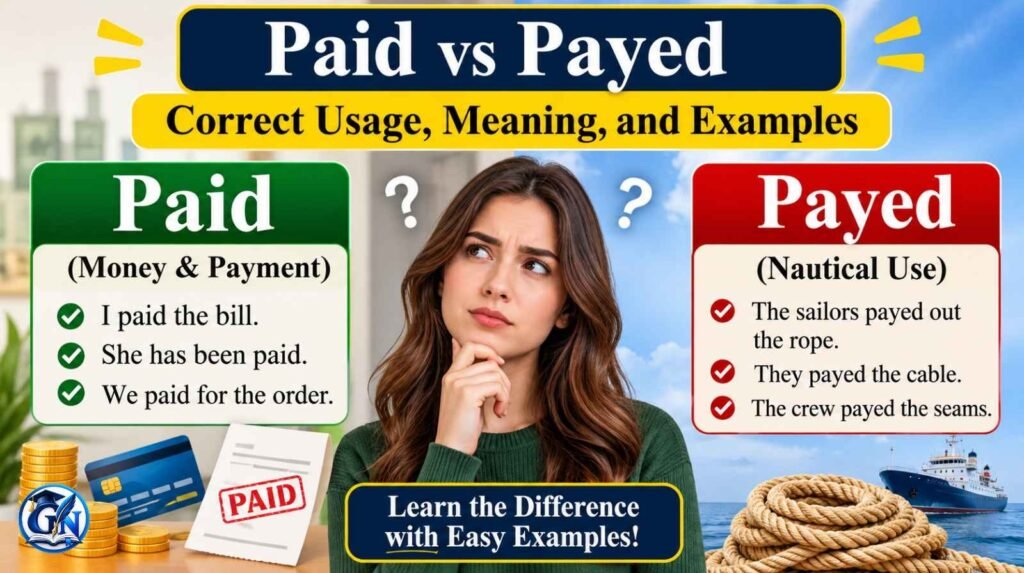
Have you ever stopped while writing a sentence and wondered whether to use Paid vs Payed? You’re not alone. These two words look almost identical, sound the same in most English accents, and are sometimes confused with each other. However, they do not have the same meaning or usage.
The good news is that the difference between paid vs payed is relatively simple once you understand their grammatical roles. In everyday English, paid is the correct past tense and past participle of the verb pay. It is used when talking about giving money, settling bills, receiving salaries, or compensating someone for their work. On the other hand, payed is a much less common word used mainly in specific nautical situations, particularly when referring to letting out a rope or cable.
In this guide, we’ll explore the meanings of both words, explain when to use each spelling, and provide practical examples from everyday conversations, workplace situations, and professional emails. By the end, you’ll know exactly which word belongs in your sentence.
Paid vs Payed: Which Spelling Is Correct?
Paid is the correct spelling in almost all everyday situations involving money or payment. It is the simple past tense and past participle of the verb pay.
For example:
- I paid the electricity bill yesterday.
- Sarah has already paid for her new laptop.
- The company paid its employees on Friday.
Payed, however, is a specialized spelling used mainly in nautical terminology. It can describe the action of letting out or loosening a rope, cable, or chain. It also appears in certain technical expressions, such as payed out and payed away.
For example:
- The sailors payed out the rope carefully.
- The crew payed out the cable during the operation.
Therefore, if you’re discussing money, salaries, shopping, bills, or expenses, paid is almost always the word you need.
What Does Paid Mean?
Paid is the past tense and past participle of the verb pay. It means that money has been given to someone in exchange for a product, service, or completed work. It can also refer to settling a financial obligation or making a payment.
The word paid is commonly used in everyday conversations, professional communication, business transactions, and financial situations.
Here are some common meanings of paid:
Giving Money for Something
When someone gives money in exchange for a product or service, the word paid describes the completed transaction.
Examples:
- I paid $50 for my new shoes.
- Daniel paid for everyone’s lunch.
- We have already paid for the hotel reservation.
Everyday scenario:
Imagine that Emma visits a clothing store to purchase a new jacket. After choosing the jacket, she pays the cashier and receives her receipt.
She might tell her friend:
“I paid $80 for this jacket, but I think it was worth the money.”
In this situation, paid is correct because Emma gave money in exchange for the jacket.
Receiving a Salary or Wages
Paid is also used when someone receives money for their work or services.
Examples:
- My brother is paid every two weeks.
- The employees were paid on the last day of the month.
- Jessica gets paid for working overtime.
Workplace scenario:
Imagine that Michael works as a graphic designer at a marketing company. His monthly salary arrives in his bank account on the first day of every month.
He tells his colleague:
“Our company paid us yesterday, so I can finally take care of my monthly expenses.”
Here, paid correctly describes the money the employees received for their work.
Settling Bills and Financial Obligations
When someone clears an outstanding bill, debt, or financial obligation, paid is the appropriate word.
Examples:
- I paid my internet bill this morning.
- She has paid all her outstanding debts.
- We haven’t paid the rent yet.
Everyday scenario:
Suppose Olivia receives an electricity bill that must be settled before the end of the month. She makes the payment through her banking application.
Later, she messages her brother:
“Don’t worry about the electricity bill. I’ve already paid it.”
The word paid is correct because Olivia has completed the financial transaction.
Paying for Someone’s Services
The word paid can also describe compensating someone for providing a service.
Examples:
- We paid the plumber to repair the kitchen sink.
- The company paid a professional photographer for the event.
- Mark has paid a lawyer to review the contract.
Professional scenario:
Imagine that a business owner hires a web developer named David to create a website for a new company. After the developer completes the project, the owner transfers the agreed amount.
The owner might say:
“We paid David for his work because he completed the website on time.”
This is another situation where paid is the only appropriate spelling.
What Does Payed Mean?
Payed is a real English word, but it has a very limited meaning. It is primarily used in nautical terminology, where it refers to letting out, loosening, or allowing a rope, cable, or chain to move out gradually.
It is associated with the verb pay in its specialized nautical sense rather than the everyday financial meaning.
Although most English speakers rarely encounter this spelling, it can appear in sailing instructions, maritime documents, and technical descriptions.
Here are some examples of how payed is used:
Letting Out a Rope or Cable
In nautical language, payed can describe the action of allowing a rope or cable to move out gradually.
Examples:
- The sailors payed out the rope slowly.
- The crew payed the cable into the water.
- The captain ordered the workers to have the rope payed out carefully.
Nautical scenario:
Imagine that a ship is preparing to lower an anchor. The crew needs to release the anchor chain gradually to ensure that it moves safely into the water.
The captain gives an instruction:
“Make sure the anchor chain is payed out slowly.”
In this situation, payed is appropriate because the sentence describes a nautical operation rather than a financial transaction.
Paying Out a Cable During a Maritime Operation
The word payed can also describe releasing a cable during a technical or maritime operation.
Examples:
- The crew payed out the cable as the vessel moved forward.
- The workers carefully payed out the heavy rope.
- The ship’s crew payed out additional cable to maintain the required distance.
Workplace scenario:
Imagine that a marine engineering team is working on an underwater installation. The team must release a long cable from a vessel while maintaining a controlled speed.
A supervisor might explain:
“The technicians payed out the cable gradually to prevent it from becoming tangled.”
Here, payed is correct because it refers to the specialized action of releasing a cable.
Applying Protective Material to a Ship’s Seams
Another specialized use of pay in maritime terminology involves applying protective material, such as tar or pitch, to the seams of a wooden ship to make them waterproof.
The past tense can be written as payed in this context.
Examples:
- The workers payed the seams of the wooden vessel.
- The ship’s deck seams were payed with protective material.
- The crew carefully payed the joints to prevent water from entering.
Historical scenario:
Imagine that a shipbuilding crew is repairing an old wooden sailing vessel. Before the vessel returns to the water, the workers apply protective material to its seams.
A shipbuilder might explain:
“We payed the seams to help prevent water from leaking into the ship.”
This is a specialized historical and maritime use, not something you would normally encounter in everyday writing.
Paid vs Payed: Key Differences Explained
Although paid and payed look similar, their meanings and applications are quite different.
Understanding their differences will help you avoid spelling mistakes in emails, business documents, school assignments, and everyday communication.
| Feature | Paid | Payed |
|---|---|---|
| Meaning | Given money or settled a debt | Letting out a rope or cable; certain nautical uses |
| Common usage | Everyday English | Specialized nautical English |
| Part of speech | Past tense and past participle of pay | Specialized past tense and past participle |
| Frequency | Very common | Very rare |
| Example | I paid the bill. | The crew payed out the rope. |
The easiest way to remember the distinction is to associate paid with money and payed with nautical activities.
If your sentence involves a salary, shopping, bills, services, or financial transactions, choose paid. If you’re describing a specialized maritime activity involving ropes or cables, payed may be appropriate.
Paid vs Payed in Everyday Sentences
The following examples will help you understand how these words work in different situations.
Examples of Paid in Sentences
- I paid for my groceries before leaving the supermarket.
- She has already paid her university tuition fees.
- The company paid its workers before the holiday.
- James paid the restaurant bill after dinner.
- We haven’t paid the monthly internet charges yet.
- My father paid for my driving lessons.
- The customer paid for the order online.
- Emily was paid for completing the assignment.
- They have paid their mortgage installments on time.
- I paid extra to receive faster delivery.
Examples of Payed in Sentences
- The sailors payed out the rope carefully.
- The crew payed out the anchor chain.
- The workers payed the cable into the water.
- The captain instructed the crew to have the line payed out slowly.
- The technicians payed out the underwater cable.
- The rope was payed out as the boat moved away.
- The crew carefully payed out additional cable.
- The sailors payed out the line to control the vessel.
- The maritime workers payed the ship’s seams with protective material.
- The cable was gradually payed out during the operation.
Notice that the examples of paid involve money or payment, while the examples of payed describe specialized maritime activities.
Paid vs Payed in Emails: Practical Examples
Choosing the correct spelling is particularly important in professional emails. A small spelling mistake can make your communication appear less polished, especially when discussing payments, invoices, salaries, or business transactions.
Here are some realistic email examples showing how to use these words correctly.
Email Example 1: Confirming a Payment
Subject: Payment Confirmation
Hi Daniel,
I wanted to let you know that I have paid the outstanding invoice for the website development project. The payment was successfully processed this morning. Please let me know if you need a copy of the transaction receipt.
Best regards,
Michael
Why is paid correct?
Michael is confirming that he has transferred money to settle an invoice. Therefore, paid is the correct spelling.
Email Example 2: Asking About an Unpaid Salary
Subject: Follow-Up Regarding Monthly Salary
Dear Mr. Anderson,
I hope you are doing well. I wanted to follow up regarding my monthly salary, as I have not yet been paid for the previous month. Could you please check the payment status and let me know when I can expect the amount to be transferred? Thank you for your assistance.
Kind regards,
Sophia Williams
Why is paid correct?
The email discusses receiving a salary for completed work. The correct expression is been paid, not been payed.
Email Example 3: A Nautical Instruction
Subject: Cable Release Procedure
Dear James,
During tomorrow’s marine operation, please ensure that the cable is payed out gradually as the vessel moves forward. The crew should maintain a steady release speed to avoid unnecessary tension or tangling. Please confirm that everyone understands the procedure before the operation begins.
Best regards,
Robert
Why is payed correct?
This email discusses releasing a cable during a maritime operation. Since payed out is a specialized nautical expression, the spelling is appropriate.
Common Expressions and Phrases Using Paid
There are several common English expressions that use paid. Learning these phrases can improve your vocabulary and help you communicate more naturally.
Here are some useful examples:
Paid in Full
This means that the entire amount owed has been paid.
Example: “Your invoice has been paid in full.”
Well-Paid
This describes someone who earns a good salary or receives good compensation for their work.
Example: “She is a well-paid software engineer.”
Paid Leave
This refers to time away from work during which an employee continues receiving their salary.
Example: “Employees are entitled to paid leave during approved vacations.”
Paid Off
This can mean that a debt has been completely repaid.
Example: “I finally paid off my student loan.”
Paid Advertisement
This refers to promotional content for which a business pays to reach an audience.
Example: “The company launched a paid advertisement on social media.”
These expressions are widely used in professional and everyday English, making them useful to remember.
Common Mistakes to Avoid When Using Paid and Payed
Even though the difference is straightforward, many English learners confuse these spellings. Understanding the following mistakes can help you write more accurately.
Mistake 1: Using Payed When Talking About Money
Incorrect: I payed the electricity bill yesterday.
Correct: I paid the electricity bill yesterday.
Explanation: When discussing money or settling a bill, always use paid.
Mistake 2: Writing Payed in Professional Emails
Incorrect: We have payed the invoice.
Correct: We have paid the invoice.
Explanation: The past participle of pay in financial situations is paid. This spelling is expected in professional communication.
Mistake 3: Assuming Payed Is Always Incorrect
Incorrect assumption: The word payed is not a real English word.
Correct understanding: Payed is a valid but specialized word used mainly in nautical contexts.
Explanation: Although paid is the correct choice in most situations, payed has legitimate uses in maritime terminology.
Mistake 4: Confusing Paid With Pay
Incorrect: I have pay the rent.
Correct: I have paid the rent.
Explanation: After the auxiliary verb have, you need the past participle paid.
Remember that pay, paid, and paid are the standard forms of the verb when referring to money.
Simple Tricks to Remember the Difference Between Paid and Payed
If you still find these two spellings confusing, a few simple memory tricks can make them easier to remember.
Connect Paid With Payment
Both paid and payment are associated with money. When your sentence involves giving or receiving money, remember to use paid.
Connect Payed With Ships and Ropes
Think of sailors, ships, cables, and anchor chains. If your sentence describes letting out a rope or cable, payed may be the correct choice.
Remember the Everyday Rule
In approximately every ordinary situation involving money, paid is the correct spelling.
Read Your Sentence Again
Before submitting an email, assignment, or business document, check whether you’re discussing a financial transaction or a specialized nautical activity. This simple check will help you choose the right word.
Frequently Asked Questions
1. Is It Paid or Payed?
Paid is the correct spelling when referring to money, salaries, bills, or financial transactions. Payed is a specialized word used mainly in nautical contexts, such as letting out a rope or cable. In everyday English, paid is almost always the correct choice.
2. Is Payed a Real Word?
Yes, payed is a real English word. However, it has limited usage and is primarily associated with nautical terminology. It can describe letting out a rope or cable or applying protective material to a ship’s seams. It should not replace paid when discussing money.
3. Why Is It Paid and Not Payed?
The verb pay has an irregular past tense and past participle when referring to money. Instead of adding -ed to form payed, English uses paid. For example, “I paid the bill yesterday” is correct.
4. Is It I Have Paid or I Have Payed?
The correct expression is I have paid when referring to money. For example, “I have paid the rent” means that the payment has been completed. I have payed the rent is incorrect in standard English.
5. Is Paid the Past Tense of Pay?
Yes. Paid is the simple past tense and past participle of pay in its ordinary financial meaning. For example, “She pays the bills every month” becomes “She paid the bills yesterday.”
6. Can Payed Be Used in a Sentence?
Yes. Payed can be used in specialized nautical sentences. For example, “The sailors payed out the anchor chain carefully.” Here, it describes releasing the chain rather than making a financial payment.
7. Is It Paid Off or Payed Off?
The correct expression is paid off when referring to completing a debt or financial obligation. For example, “I finally paid off my car loan.” The spelling payed off is incorrect in this context.
8. Is It Paid or Payed for an Order?
Paid is correct when referring to purchasing an order. For example, “I have already paid for my order.” Since the sentence describes a financial transaction, paid is the appropriate spelling.
9. Is It Well-Paid or Well-Payed?
The correct expression is well-paid. It describes someone who receives a good salary or earns a high amount of money for their work. For example, “My sister has a well-paid job in the technology industry.”
10. How Do You Remember Paid vs Payed?
The easiest way to remember the difference is to associate paid with money and payed with nautical activities. If you’re discussing bills, salaries, shopping, or services, use paid. If you’re describing the release of a rope or cable, payed may be appropriate.
Conclusion: Paid vs Payed
Understanding paid vs payed becomes much easier when you know what each word means and where it belongs.
Paid is the standard past tense and past participle of pay when discussing money, salaries, bills, purchases, and financial obligations. It is the spelling you’ll need in almost every everyday conversation, professional email, and piece of general writing.
Payed, on the other hand, is a legitimate but uncommon word used mainly in nautical terminology. It describes actions such as letting out a rope or cable and certain specialized ship-related activities.
The simplest rule is to remember that paid is for money, while payed is mainly for specialized nautical situations.
So, the next time you write about paying a bill, receiving a salary, or purchasing something, choose paid. It’s the correct spelling for standard English, and remembering this simple distinction will help you write with greater confidence.
👉 Explore more useful grammar tips and guides on Gramnora

Explore the world of English grammar with simple explanations, practical examples, and easy-to-follow guides by Zia Tarar, the founder and author of Gramnora. From essential grammar rules and sentence structure to common mistakes and advanced concepts, Gramnora helps learners improve their English, strengthen their writing skills, and communicate with greater clarity and confidence.