
Have you ever wondered whether to write Lose vs Loose? You are not alone. These two English words look and sound similar, but they have different meanings and uses. Choosing the wrong one can change the meaning of your sentence and make your writing less clear.
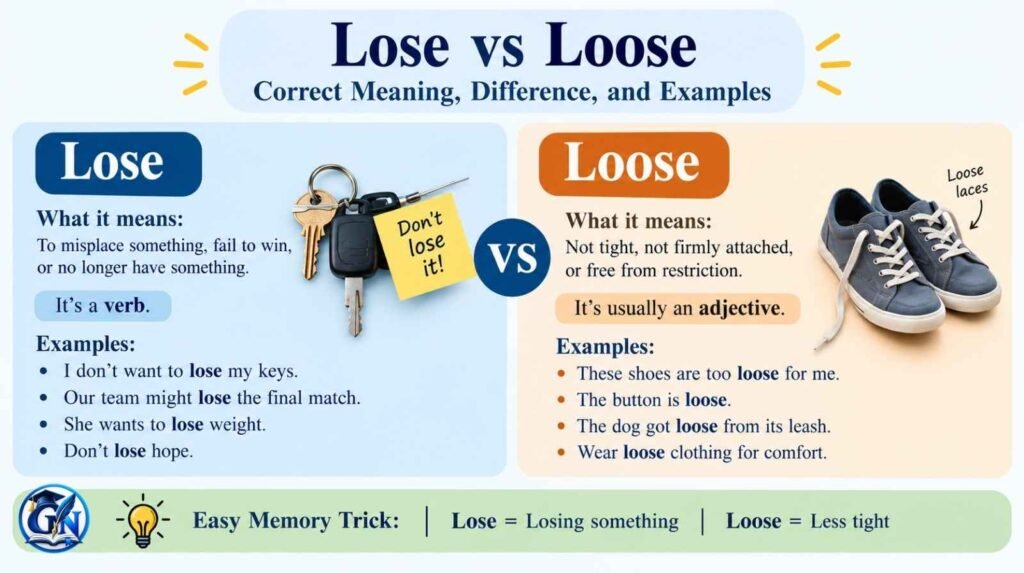
Understanding lose vs loose is easier than you might think. The key is to remember that lose usually means to misplace something, fail to win, or no longer have something, while loose generally means not tight, not firmly attached, or free from restriction.
In this guide, you will learn the correct meaning of each word, explore practical examples, discover common spelling mistakes, and use simple memory tricks to choose the right word confidently.
What Is the Difference Between Lose vs Loose?

The main difference between lose and loose is their meaning and grammatical function. Lose is a verb, while loose is usually an adjective.
- Lose: To misplace something, fail to win, or stop having something.
- Loose: Not tight, not firmly fixed, or free from restraint.
For example, you might lose your keys, but you might have loose keys in a bag that are not attached to a key ring.
Lose Meaning and Usage
The word lose describes an action or a change in a situation. It is commonly used when someone cannot find something, fails to win, or experiences a reduction.
Examples:
- I do not want to lose my phone.
- Our team might lose the final match.
- She hopes to lose a little weight.
- Do not lose hope during difficult times.
- He may lose his job if he ignores the warnings.
In each example, lose expresses something that happens or may happen.
Loose Meaning and Usage
The word loose usually describes the condition of a person or thing. It often means something is not tight, secure, or firmly attached.
Examples:
- These shoes are too loose for me.
- The dog got loose from its leash.
- One button on my shirt is loose.
- Please wear comfortable, loose clothing.
- The screw has become loose over time.
In these sentences, loose describes a condition rather than an action.
Quick Comparison Table
| Feature | Lose | Loose |
|---|---|---|
| Part of speech | Verb | Usually an adjective |
| Main meaning | Misplace, fail to win, or no longer have | Not tight or not firmly attached |
| Pronunciation | Looz | Loos |
| Example | I might lose my wallet. | My wallet is loose in my bag. |
| Common phrase | Lose weight | Loose clothing |
| Opposite | Find, win, or keep, depending on context | Tight or secure |
Easy rule: If you mean misplace something or fail to win, use lose. If you mean something is not tight, use loose.
When Should You Use Lose?
Use lose when you are describing an action or outcome involving something you no longer have, cannot find, fail to win, or decrease.
When You Cannot Find Something
Use lose when an object goes missing or you cannot remember where you put it.
Examples:
- I always worry that I will lose my wallet.
- She does not want to lose her passport while traveling.
- Please keep your documents safe so you do not lose them.
Incorrect: I do not want to loose my keys.
Correct: I do not want to lose my keys.
When You Fail to Win
Use lose when a person or team does not win a competition, game, or contest.
Examples:
- Our school team did not lose a single game this season.
- I hate to lose, but I always learn from my mistakes.
- They might lose the championship if they stop practicing.
Remember that lose is the opposite of win in this context.
When You Experience a Reduction
The word lose is also used when something decreases or disappears.
Examples:
- She wants to lose weight through healthy habits.
- We could lose valuable time if we leave late.
- The company may lose customers because of poor service.
- He began to lose interest in the project.
In these examples, something is reduced or no longer maintained.
Lose in Everyday Expressions
Some common expressions also use lose.
- Lose your temper: Become angry.
- Lose track of time: Stop noticing how much time has passed.
- Lose confidence: Become less confident.
- Lose control: No longer be able to manage a situation.
- Lose your way: Become unable to find the correct route.
Example: I got so involved in reading that I lost track of time.
These expressions are useful in everyday conversation, professional writing, and storytelling.
When Should You Use Loose?
Use loose when you want to describe something that is not tight, not secure, or not restricted. It can also appear in expressions that describe freedom or a lack of strict control.
When Something Is Not Tight
The most common use of loose is to describe clothing, objects, or fittings that are not tight.
Examples:
- My jacket is too loose around the shoulders.
- These trousers feel loose around the waist.
- The lid is loose, so the container might spill.
- The dentist noticed a loose tooth.
Here, loose tells the reader about the condition of something.
When Something Is Not Securely Attached
Use loose when something is not firmly connected or fastened.
Examples:
- The handle on this door is loose.
- A loose wire can create a safety hazard.
- The bicycle has a loose chain.
- One tile became loose after the storm.
Notice the difference:
- I might lose the screw. (I might misplace it.)
- The screw is loose. (It is not firmly tightened.)
Both sentences are correct, but they describe different situations.
When Something Is Free or Unrestricted
Loose can also describe something that is free from restraint or not strictly controlled.
Examples:
- The farmer let the horses run loose in the field.
- The dog broke loose from its leash.
- The manager gave the team a loose structure for the project.
- The rules were relatively loose during the informal activity.
The exact meaning depends on the context, but the central idea often involves a lack of tightness, attachment, or restriction.
Common Expressions With Loose
Here are several useful expressions containing loose.
- Let loose: Allow yourself to relax or behave freely.
- Break loose: Escape from restraint.
- On the loose: Free and not under control.
- Loose ends: Unfinished details that need attention.
- A loose interpretation: An interpretation that is not strict or exact.
Example: Before submitting the report, we need to tie up a few loose ends.
This expression means completing the remaining details, not literally tying something.
Lose vs Loose: Common Mistakes and Correct Examples
Because the words differ by only one letter, it is easy to confuse them while typing quickly, writing emails, or posting on social media. The best way to avoid mistakes is to understand the meaning of the complete sentence.
| Incorrect | Correct | Why? |
|---|---|---|
| I do not want to loose my phone. | I do not want to lose my phone. | Lose means misplace. |
| I need to loose weight. | I need to lose weight. | Lose means reduce weight. |
| My shoes are lose. | My shoes are loose. | Loose means not tight. |
| Do not loose hope. | Do not lose hope. | Lose hope is the correct expression. |
| The screw is lose. | The screw is loose. | Loose describes something insufficiently tightened. |
| I always loose at chess. | I always lose at chess. | Lose means fail to win. |
Why Do People Confuse Lose and Loose?
There are three main reasons:
- Similar spelling: Both words begin with the same letters and have a similar appearance.
- Similar pronunciation: They sound alike, although lose ends with a /z/ sound and loose ends with an /s/ sound.
- Typing habits: People may type the extra letter in loose without checking whether it fits the sentence.
These mistakes are especially common in informal writing. However, using the correct word helps make your emails, articles, school assignments, and professional communication more polished.
A Simple Trick to Remember the Difference
Try this memory trick:
- Lose = Losing something. Think about losing your keys or losing a game.
- Loose = Less tight. Think about loose clothing or a loose screw.
You can also remember that loose has an extra o, just as something loose may have extra room.
For example:
- I do not want to lose my favorite shirt.
- My favorite shirt is too loose.
The first sentence describes an action. The second describes the shirt’s condition.
A Real-Life Example: Using Lose vs Loose Correctly
Imagine that Sarah is preparing for an important job interview. She wants to look professional, so she chooses a suit that she has not worn for several months. Unfortunately, the trousers are now too loose around her waist.
Sarah initially writes a message to her friend: “I need to loose some weight, or my clothes will not fit properly.”
Her friend notices the mistake and explains that she should write, “I need to lose some weight.” The verb lose describes reducing weight, while loose describes the fit of her trousers.
Later that morning, Sarah puts her interview documents in her bag. Before leaving, she checks her belongings because she does not want to lose her résumé or identification card. At the office, she discovers that a button on her jacket is loose. She fixes it before entering the interview room.
After the interview, Sarah tells her friend, “I was nervous, but I did not lose my confidence. I think the interview went well.”
This example shows how both words can naturally appear in the same situation, yet each serves a different purpose. Sarah can lose weight, lose documents, and lose confidence, but her trousers can be loose, and her jacket can have a loose button.
The lesson is simple: focus on the meaning you want to communicate instead of choosing a word based on how it looks. Once you recognize the difference between an action and a condition, the correct spelling becomes much easier to remember.
Data and Statistics: What Do We Know About Lose vs Loose Mistakes?

Writers often want to know how frequently people confuse lose and loose. However, a reliable statistic specifically measuring how often English users make this particular mistake in 2025 or 2026 is not readily established by the authoritative references cited in this article. It would be misleading to invent a percentage or present an unverified estimate as fact.
Instead, several reliable language resources can help readers understand and verify the distinction.
Dictionary Definitions Provide a Reliable Baseline
Established dictionaries, including Merriam-Webster and Cambridge Dictionary, distinguish lose as a verb from loose, which is commonly used as an adjective. Checking the definition and example sentences is a practical way to confirm the correct word.
Context Matters More Than Appearance
A spelling checker may flag an incorrectly spelled word, but both lose and loose are valid English words. Therefore, software may not identify the error when the wrong word is spelled correctly but used in the wrong context.
For example, “I will loose the game” may not be caught by a basic spelling check. Reading the sentence for meaning is essential.
How to Verify Your Writing
For dependable guidance, use these resources:
- Merriam-Webster Dictionary Check definitions, pronunciation, and usage examples.
- Cambridge Dictionary Compare meanings, grammatical roles, and example sentences.
- Google Search Central Learn about creating helpful, people-first online content and prioritizing accuracy.
These sources provide useful reference points for spelling and writing. They do not, by themselves, establish a 2025–2026 error rate for lose versus loose.
The practical takeaway is that understanding word meanings and proofreading sentences remain valuable ways to prevent this common confusion.
FAQs
Q1: What is the main difference between lose and loose?
A: Lose is a verb meaning to misplace something, fail to win, or no longer have something. Loose usually describes something that is not tight, secure, or firmly attached.
Example: “I might lose my keys” and “My keys are loose in my bag.”
Q2: Is it lose weight or loose weight?
A: The correct expression is lose weight.
Use lose because it describes reducing your body weight. Loose weight is incorrect in this context.
Example: She wants to lose weight by following healthy habits.
Q3: Is it lose your mind or loose your mind?
A: The correct expression is lose your mind.
It is an idiom that can mean becoming extremely upset, confused, or overwhelmed.
Example: I thought I would lose my mind when I could not find my passport.
Q4: Is it lose hope or loose hope?
A: The correct expression is lose hope.
It means to stop believing that something good can happen or that a situation can improve.
Example: Even when things become difficult, do not lose hope.
Q5: How do you pronounce lose and loose?
A: Lose rhymes with “news” in many common English pronunciations and ends with a /z/ sound. Loose rhymes with “goose” and ends with an /s/ sound.
Listening for the final sound can help you distinguish the words.
Q6: Is loose ever used as a verb?
A: Yes, although it is much less common than its use as an adjective. As a verb, loose can mean to release, set free, or let something go.
Example: The archer loosed an arrow toward the target.
This is a valid but less common usage. In everyday writing, loose is much more frequently used as an adjective.
Q7: Why do people write loose instead of lose?
A: People often confuse the words because their spelling and pronunciation are similar. Some writers also add an extra letter when typing quickly.
The easiest solution is to remember that lose describes an action, while loose usually describes something that is not tight or secure.
Q8: Which is correct: “I don’t want to lose” or “I don’t want to loose”?
A: “I don’t want to lose” is correct when you mean that you do not want to fail to win or misplace something.
Example: I don’t want to lose the final match.
However, loose can be correct in a different sentence, such as “I don’t want to wear loose clothing.” Always choose the word according to the intended meaning.
Conclusion:
Understanding lose vs loose is a small but valuable step toward better English writing. Although the words look similar, their meanings are different. Lose is a verb used for misplacing something, failing to win, or experiencing a reduction. Loose usually describes something that is not tight, firmly attached, or restricted.
Remember these two examples:
- Lose: I do not want to lose my keys.
- Loose: My shoelaces are loose.
When you are unsure, read the entire sentence and ask yourself whether you are describing an action or a condition. This simple habit can help you avoid spelling mistakes in everyday conversations, academic assignments, emails, and blog posts.
👉 Explore more useful grammar tips and guides on Gramnora

Explore the world of English grammar with simple explanations, practical examples, and easy-to-follow guides by Zia Tarar, the founder and author of Gramnora. From essential grammar rules and sentence structure to common mistakes and advanced concepts, Gramnora helps learners improve their English, strengthen their writing skills, and communicate with greater clarity and confidence.