
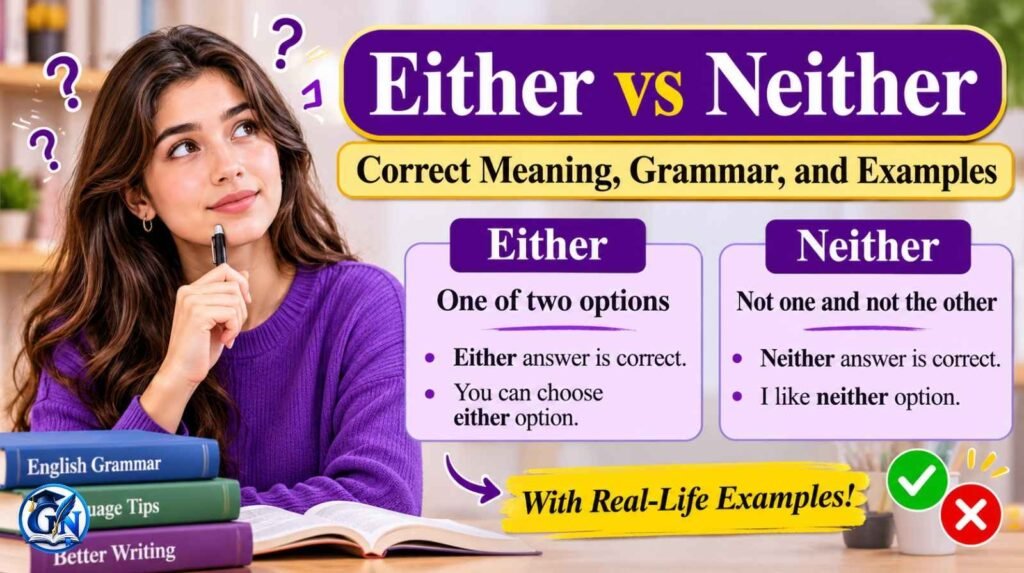
English has many words that look similar or are used in similar situations but express different meanings. Either vs Neither are two common examples. Both words are used when talking about two people, things, or choices, but they communicate different ideas. Understanding the difference between them can help you write more clearly and avoid common grammatical mistakes.
The main difference is simple: either generally refers to one of two options, while neither means not one and not the other. For example, if someone offers you tea or coffee, you can say, “Either option is fine.” However, if you do not want tea or coffee, you can say, “Neither option is suitable for me.”
Although these words may seem straightforward, they can be confusing when used as pronouns, determiners, conjunctions, and adverbs. In this article, we will explore their meanings, grammatical rules, differences, and practical examples to help you use them correctly in everyday conversations and professional writing.
What Does Either Mean?
Either is used when referring to one of two people, things, or possibilities. It indicates that one option or the other is acceptable, possible, or available.
In most situations, either means one or the other of two choices. It does not usually mean both options together.
For example:
- You can choose either dress for the party.
- Either answer is acceptable.
- We can travel by either bus or train.
- Either of my brothers can help you.
In these examples, either presents two possible choices without suggesting that both must be selected.
Either as a Determiner
Either can work as a determiner before a singular countable noun. It indicates that one of two things or people can be selected.
Examples:
- You can sit in either chair.
- Either road will take you to the city center.
- Either candidate could win the competition.
- We can use either method to solve the problem.
Scenario Example: Choosing a Meeting Time
Imagine that a manager named Daniel sends an email to his colleague, Olivia, offering two possible meeting times.
Email Example:
Subject: Meeting Schedule
Hi Olivia,
We can arrange the meeting at either 10:00 a.m. or 2:00 p.m. on Thursday. Please let me know which time works better for you.
Best regards,
Daniel
Here, either introduces two available meeting times, allowing Olivia to choose one.
Either as a Pronoun
Either can also function as a pronoun when the noun is understood from the context. It refers to one of two available options.
Examples:
- Both shirts look beautiful. You can buy either.
- There are two available seats. You may take either.
- I have two pens, and you can borrow either.
- Both solutions are correct, so either will work.
Scenario Example: Selecting a Gift
Emma wants to buy a birthday gift for her friend, but she cannot decide between two books. Her sister gives her some advice:
“Both books are interesting. You can choose either because your friend will enjoy both.”
In this situation, either replaces the phrase “either book” and avoids unnecessary repetition.
Either in the Expression “Either…Or”
One of the most common uses of either is in the paired conjunction either…or. This structure connects two alternatives and shows that one of them will be selected or happen.
Examples:
- You can either call me or send me a message.
- Either Sarah or Emily will attend the event.
- We will either travel tomorrow or stay home.
- You must either apologize or explain your behavior.
Scenario Example: Workplace Instructions
A team leader named Michael sends instructions to his employees about submitting a report.
Email Example:
Subject: Report Submission
Hello Team,
Please submit your completed report either through email or by uploading it to the shared company folder. Make sure you complete the submission before Friday.
Best regards,
Michael
Here, either…or connects two alternative ways of submitting the report.
What Does Neither Mean?
Neither means not one and not the other of two people, things, or possibilities. It expresses a negative idea and indicates that both options are excluded.
In simple words, neither means not either of the two.
For example:
- Neither answer is correct.
- Neither student attended the class.
- I like neither option.
- Neither restaurant is open today.
In these sentences, neither makes it clear that both choices are being rejected or do not meet the situation.
Neither as a Determiner
Neither can be used before a singular countable noun to indicate that not one of two people or things has a particular quality or is involved in an action.
Examples:
- Neither student passed the examination.
- Neither option is suitable for this project.
- Neither road leads to the airport.
- Neither employee was available yesterday.
Scenario Example: School Examination
A teacher named Mrs. Anderson checks the examination results of two students, James and Robert. Unfortunately, both students fail the test.
She says:
“Neither student passed the examination because both scored below the required marks.”
Here, neither student means that James did not pass and Robert did not pass either.
Neither as a Pronoun
Neither can also function as a pronoun when referring to two previously mentioned people or things. It replaces the noun and means not one and not the other.
Examples:
- I offered him two choices, but neither was suitable.
- Both dresses are expensive, so I will buy neither.
- There are two available routes, but neither is safe.
- My friends invited me to two events, but I attended neither.
Scenario Example: Choosing a Restaurant
Suppose David and his friend Alex are looking for a restaurant. They find two options, but neither restaurant offers the food they want.
David says:
“I checked both restaurants, but neither looks suitable. Let’s find another place.”
Here, neither replaces the two restaurant options and indicates that both are unsuitable.
Neither in the Expression “Neither…Nor”
The paired conjunction neither…nor connects two negative alternatives. It indicates that neither of the two people, things, or actions is involved or true.
Examples:
- Neither John nor Peter attended the meeting.
- She likes neither coffee nor tea.
- Neither the manager nor the employees knew about the changes.
- He can neither read nor write in French.
Scenario Example: Professional Communication
A company manager named Sophia sends an email to her department explaining why a project has not started.
Email Example:
Subject: Project Update
Hi Team,
Neither the design team nor the marketing team has received the final project instructions. We will begin the work as soon as the required information becomes available.
Best regards,
Sophia
Here, neither…nor connects two teams and indicates that both have not received the instructions.
Either vs Neither: What Is the Main Difference?
The biggest difference between either and neither is their meaning. Although both words refer to two alternatives, they express opposite ideas.
- Either refers to one of two available options.
- Neither means not one and not the other.
Consider these examples:
| Either | Neither |
|---|---|
| Either answer is correct. | Neither answer is correct. |
| You can choose either dress. | I like neither dress. |
| Either student can participate. | Neither student can participate. |
| Either road will take you there. | Neither road leads there. |
The first column presents a choice or possibility, while the second column rejects both alternatives.
Simple Examples to Understand the Difference
Imagine that someone offers you two drinks: tea and coffee.
Using Either:
“Either tea or coffee is fine with me.”
This means you are happy to have one of the two drinks.
Using Neither:
“Neither tea nor coffee is what I want.”
This means you do not want tea or coffee.
Another example involves two job opportunities.
Using Either:
“I would accept either job.”
This means both opportunities are acceptable, and you would be willing to accept one.
Using Neither:
“I would accept neither job.”
This means you do not want either of the two opportunities.
Grammar Rules for Using Either and Neither
Understanding their meanings is important, but knowing how to use them grammatically is equally necessary. Both words follow specific rules depending on their position in a sentence.
Either and Neither Usually Refer to Two Choices
Traditionally, either and neither refer to two people, objects, or possibilities.
Examples:
- Either of the two answers is acceptable.
- Neither of the two candidates is available.
- You can choose either of these books.
- Neither of these options meets our requirements.
For three or more choices, words such as any, none, or all may be more appropriate, depending on the intended meaning.
Use a Singular Verb with Either and Neither
When either or neither is used directly as the subject of a sentence, it generally takes a singular verb in standard English.
Examples:
- Either option is acceptable.
- Neither answer was correct.
- Either student has permission to participate.
- Neither employee knows about the decision.
A common mistake is using a plural verb because the sentence refers to two people or things.
Incorrect: Neither student are available.
Correct: Neither student is available.
Either of and Neither of
Both expressions can be followed by a plural noun or pronoun.
Examples:
- Either of the students is eligible for the scholarship.
- Neither of the answers is correct.
- Either of them can help you.
- Neither of my parents likes spicy food.
In formal writing, a singular verb is traditionally preferred after either of and neither of. In everyday English, plural agreement is also common, particularly with neither of and plural pronouns.
For professional and academic writing, using a singular verb is a safe choice.
Use Either…Or for Positive Alternatives
Use either…or when presenting two possible choices or alternatives.
Examples:
- You can either study at home or visit the library.
- Either my brother or my sister will pick me up.
- We can either watch a movie or play a game.
Remember: Either…or does not automatically mean that both options will happen. It presents alternatives.
Use Neither…Nor for Negative Alternatives
Use neither…nor when rejecting both options or indicating that neither alternative is true.
Examples:
- Neither my brother nor my sister attended the wedding.
- She wants neither pizza nor burgers.
- Neither the teacher nor the students were ready.
When the subjects joined by neither…nor differ in number, traditional subject-verb agreement generally follows the subject closer to the verb.
For example:
- Neither the students nor the teacher is available.
- Neither the teacher nor the students are available.
For smoother formal writing, you can also rewrite sentences to avoid awkward agreement.
Avoid Double Negatives with Neither
Neither already expresses a negative meaning. Therefore, you should generally avoid adding another negative word such as not in the same clause.
Incorrect: I don’t like neither option.
Correct: I like neither option.
Another correct version:
I don’t like either option.
Both correct sentences communicate that you dislike both choices.
Can Either and Neither Be Used in Everyday Conversations?

Yes! Both words are frequently used in everyday English conversations. They make it easier to discuss preferences, choices, agreements, and disagreements.
Here are some natural examples.
Example 1: Talking About Food
Using Either:
Alex: Would you like pizza or pasta?
Emma: Either is fine. I’m not picky about food.
Using Neither:
Alex: Would you like pizza or pasta?
Emma: Neither, thanks. I’m not hungry right now.
Example 2: Discussing Weekend Plans
Using Either:
Daniel: Should we visit the beach or go shopping?
Sophia: Either sounds good to me.
Using Neither:
Daniel: Should we visit the beach or go shopping?
Sophia: Neither sounds interesting today. I’d rather stay home.
Example 3: Discussing Work
Using Either:
Manager: Can you complete the report today or tomorrow?
Employee: Either day works for me.
Using Neither:
Manager: Can you attend the morning or afternoon meeting?
Employee: Neither time works for me. I have another appointment.
What Does “Me Neither” Mean?
Me neither is a common conversational expression used to agree with a negative statement. It means that the same negative situation or feeling applies to you.
Examples:
Person A: I don’t like cold weather.
Person B: Me neither.
Person A: I haven’t watched that movie.
Person B: Me neither.
Person A: I can’t understand this question.
Person B: Me neither.
In these examples, the second speaker agrees with the first person’s negative statement.
Important: Me neither is natural in informal conversations, but in formal writing, you may prefer expressions such as “Neither do I” or “I don’t either,” depending on the sentence.
What Does “Either Way” Mean?
Either way is an expression used when two possible choices or situations lead to the same result or when the speaker does not have a strong preference between them.
Examples:
- We can travel by car or bus. Either way, we will arrive before noon.
- You can call me today or tomorrow. Either way, I will be available.
- I don’t mind whether we eat at home or outside. Either way is fine.
Scenario Example: Making Travel Arrangements
Olivia asks her friend Daniel whether he prefers travelling by train or bus.
Daniel replies:
“I don’t have a preference. Either way, we should reach the destination by evening.”
Here, either way shows that Daniel is comfortable with both travel options.
Common Mistakes to Avoid When Using Either and Neither
Even experienced English speakers sometimes confuse these words. Understanding a few common mistakes can help you use them more confidently.
Mistake 1: Confusing Their Meanings
Incorrect: Neither option is acceptable if you are happy with both choices.
Correct: Either option is acceptable if you are happy with both choices.
Use either when at least one of the two options is acceptable. Use neither when both options are rejected.
Mistake 2: Using “Neither…Or”
Incorrect: Neither Sarah or Emily attended the meeting.
Correct: Neither Sarah nor Emily attended the meeting.
The correct paired structure is neither…nor, not neither…or.
Mistake 3: Using “Either…Nor”
Incorrect: You can either call me nor send an email.
Correct: You can either call me or send an email.
Remember the correct pairs:
- Either…or
- Neither…nor
Mistake 4: Using Double Negatives
Incorrect: I don’t want neither option.
Correct: I want neither option.
Alternatively:
I don’t want either option.
Both alternatives express the same negative meaning.
Mistake 5: Using the Wrong Verb
Incorrect: Either of these options are suitable.
Correct: Either of these options is suitable.
In standard formal grammar, either of generally takes a singular verb.
Either vs Neither: Quick Comparison Table
| Feature | Either | Neither |
|---|---|---|
| Meaning | One or the other | Not one and not the other |
| Main purpose | Presents alternatives | Rejects both alternatives |
| Paired conjunction | Either…or | Neither…nor |
| Sentence type | Usually affirmative | Negative meaning |
| Example | Either answer is correct. | Neither answer is correct. |
| Verb agreement | Usually singular | Usually singular |
Frequently Asked Questions
1. Is Either Positive or Negative?
Either is generally used in affirmative sentences to refer to one of two possible choices. However, it can also appear in negative sentences, such as “I don’t like either option.” Its meaning depends on the sentence structure and context.
2. Is Neither Always Negative?
Yes, neither carries a negative meaning because it indicates that not one and not the other of two choices is true or acceptable. For example, “Neither answer is correct” means both answers are incorrect.
3. Can I Use Either and Neither in the Same Sentence?
Yes, you can use both words in the same sentence when discussing different ideas. For example: “You can choose either dress, but neither pair of shoes matches it.” Here, either presents two dress options, while neither rejects both pairs of shoes.
4. Should I Use Either Is or Either Are?
In standard English, either used as the subject generally takes a singular verb. Therefore, either is is usually correct. For example: “Either option is suitable.”
5. Is It Correct to Say “Me Neither”?
Yes, me neither is a natural and widely used expression in informal English. It is used to agree with a negative statement. For example:
Person A: “I don’t enjoy horror movies.”
Person B: “Me neither.”
6. What Is the Difference Between Either and Both?
Either refers to one of two options, while both refers to the two options together. For example: “Either student can answer the question.” and “Both students can answer the question.” The first sentence allows one student to answer, while the second includes the two students.
7. What Is the Difference Between Neither and None?
Neither traditionally refers to not one and not the other of two choices. None is generally used when referring to three or more people or things, although it can also refer to a group of two in some contexts. For example:
• Neither of the two books is interesting.
• None of the five books is interesting.
Conclusion
Understanding either vs neither becomes much easier when you remember their basic meanings. Either refers to one of two choices and is commonly used to present alternatives, while neither means not one and not the other.
Use either…or when presenting two possibilities, and use neither…nor when rejecting both alternatives. Also, remember that either and neither generally take singular verbs when used as subjects in standard English.
With regular practice and attention to these simple grammar rules, you can use both words naturally in conversations, emails, academic assignments, and professional writing. The next time someone gives you two choices, you will know exactly when to use either and when to use neither.
👉 Explore more useful grammar tips and guides on Gramnora

Explore the world of English grammar with simple explanations, practical examples, and easy-to-follow guides by Zia Tarar, the founder and author of Gramnora. From essential grammar rules and sentence structure to common mistakes and advanced concepts, Gramnora helps learners improve their English, strengthen their writing skills, and communicate with greater clarity and confidence.