
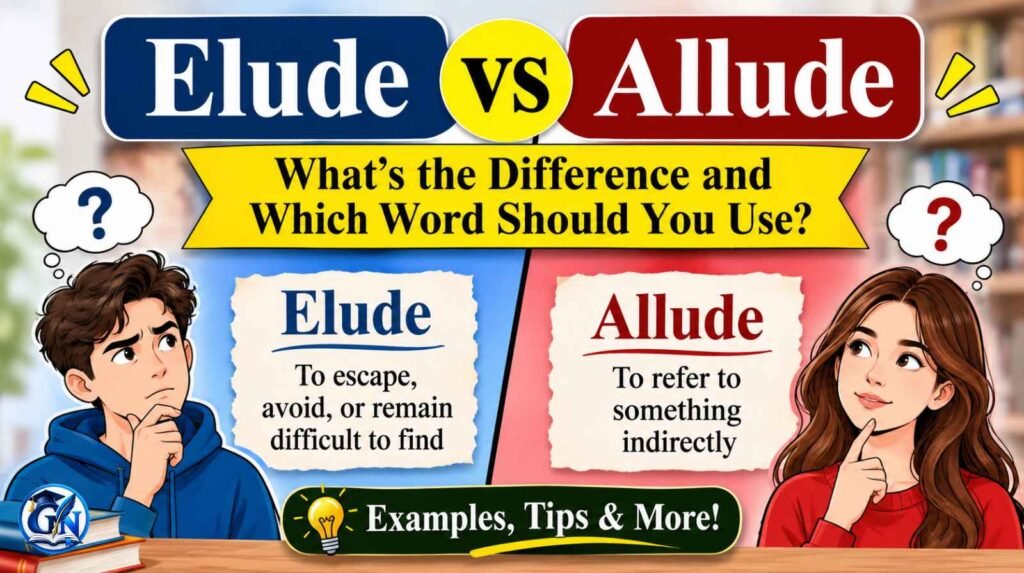
Have you ever confused Elude vs Allude while writing an email, preparing an assignment, or having a conversation? You’re not alone. These two words look and sound quite similar, but they have completely different meanings. Using one instead of the other can change the meaning of your sentence and make your writing confusing.
Understanding the difference between elude vs allude is important if you want to communicate clearly and use English confidently. Although both words are commonly used in written and spoken English, they serve different purposes. Elude means to escape, avoid, or remain difficult to find or understand, while allude means to refer to something indirectly without mentioning it directly.
For example, a criminal might elude the police by escaping capture, whereas a speaker might allude to a previous conversation without explaining it in detail.
In this article, we’ll explore the meanings, differences, correct usage, and practical examples of both words. You’ll also learn how to use them in professional emails, everyday conversations, and different writing situations.
What Is the Difference Between Elude and Allude?
The primary difference between elude and allude is their meaning and purpose. Although they share similar spellings and pronunciation, they are not interchangeable.
- Elude is a verb that means to escape from someone or something, avoid being captured, or remain difficult to understand or achieve.
- Allude is a verb that means to refer to something indirectly without mentioning it clearly or specifically.
Let’s look at a simple example to understand the difference:
Elude: The suspect managed to elude the police for several days.
In this sentence, elude means that the suspect successfully avoided being caught by the police.
Allude: During the meeting, Sarah alluded to the disagreement between the two managers.
Here, alluded means Sarah indirectly referred to the disagreement without discussing it openly.
The easiest way to remember the distinction is that elude is about escaping or avoiding something, while allude is about indirectly referring to something.
What Does Elude Mean?
Elude is a verb that means to escape from someone or something, avoid capture, or successfully stay away from a particular situation. It can also describe something that is difficult to understand, remember, find, or achieve.
The word is commonly used when someone escapes danger, avoids being caught, or cannot accomplish something despite making several attempts.
For example:
- The thief managed to elude the police after the robbery.
- The answer continued to elude me despite hours of research.
- Emma tried to remember his name, but it eluded her.
- The athlete worked hard, but victory continued to elude him.
In each example, elude describes something that escapes, remains out of reach, or is difficult to achieve.
How to Use Elude in Different Situations
The word elude can be used in several contexts. Here are some practical examples to help you understand its usage.
When Someone Escapes Capture
Use elude when a person successfully avoids being caught by someone.
Example:
The criminal managed to elude the security guards and escape through the back entrance.
When Something Is Difficult to Understand
Sometimes, a concept or explanation can be difficult to understand even after several attempts. In this situation, you can use elude.
Example:
Despite reading the instructions three times, the meaning of the final paragraph continued to elude Daniel.
When You Cannot Remember Something
You can also use elude when you are trying to remember something but cannot recall it.
Example:
I knew I had met her before, but her name completely eluded me.
When Something Is Difficult to Achieve
Use elude when a goal, opportunity, or achievement remains out of reach.
Example:
After several unsuccessful attempts, the championship title continued to elude the team.
Elude in a Professional Email
Here is an example of how you can use elude in a professional email.
Subject: Difficulty Identifying the Technical Issue
Dear Michael,
I’ve reviewed the system reports several times, but the exact cause of the technical issue continues to elude me. I’ve checked the recent updates and examined the error logs, but I haven’t identified the underlying problem yet. I’ll continue investigating and share an update as soon as I have more information.
Best regards,
James Wilson
In this email, elude communicates that the cause of the technical problem remains difficult to identify.
What Does Allude Mean?
Allude is a verb that means to mention, refer to, or suggest something indirectly without explaining it openly or specifically.
When you allude to something, you give a hint or make a reference that allows another person to understand what you’re talking about without directly stating it.
The word is especially common in professional communication, literature, discussions, and everyday conversations.
For example:
- During the interview, the candidate alluded to her previous management experience.
- Mark alluded to an upcoming project but didn’t share any details.
- The author alluded to historical events throughout the novel.
- Jessica alluded to the disagreement without mentioning anyone’s name.
In these examples, allude indicates an indirect reference rather than a direct explanation.
How to Use Allude in Different Situations
The word allude is useful in situations where you want to refer to something without discussing it directly.
Here are some common situations.
When You Refer to Something Indirectly
Use allude when you want to mention an event, subject, or situation without explaining it completely.
Example:
During the conversation, Robert alluded to the company’s financial difficulties but avoided discussing the details.
When You Give Someone a Hint
You can use allude when you indirectly suggest something instead of saying it clearly.
Example:
My sister alluded to a surprise for my birthday, but she refused to tell me what it was.
When You Refer to a Previous Conversation
Use allude when mentioning something that was discussed earlier without repeating the entire conversation.
Example:
During the meeting, our manager alluded to the concerns we had raised last week.
When Discussing Literature or Historical Events
Writers often allude to famous people, historical events, or other literary works without directly explaining the reference.
Example:
The poet alluded to Greek mythology in several parts of the poem.
Allude in a Professional Email
Here is a realistic example of using allude in a professional email.
Subject: Follow-Up on Yesterday’s Meeting
Dear Olivia,
Thank you for attending yesterday’s meeting. During our discussion, you alluded to some concerns regarding the upcoming project deadline. I’d appreciate it if you could share a little more information about those concerns so we can address them before the next planning session. Looking forward to hearing from you.
Best regards,
Daniel Carter
In this example, alluded to means Olivia indirectly mentioned her concerns without explaining them fully.
Elude vs Allude: Key Differences Explained
Although elude and allude look similar, their meanings, uses, and sentence structures are different.
Here is a comparison to help you understand both words more clearly.
| Feature | Elude | Allude |
|---|---|---|
| Part of speech | Verb | Verb |
| Meaning | To escape or avoid | To refer indirectly |
| Main purpose | Describes avoidance or something out of reach | Describes an indirect reference |
| Common usage | Escape, memory, understanding, achievement | Conversations, hints, discussions, literature |
| Example | The suspect eluded the police. | She alluded to the problem. |
| Common structure | Elude someone or something | Allude to something |
The most important grammatical difference is that allude is commonly followed by the preposition “to,” whereas elude generally takes a direct object.
For example:
- Correct: He managed to elude the guards.
- Correct: He alluded to the incident.
- Incorrect: He alluded the incident.
- Incorrect: He eluded to the incident.
Remembering these sentence structures can help you avoid common grammatical mistakes.
Elude vs Allude Example Sentences
One of the easiest ways to understand the difference between these words is to see them in everyday sentences.
Here are some additional examples.
Examples of Elude in Sentences
- The suspect attempted to elude the officers by changing vehicles.
- The solution continued to elude the researchers despite their efforts.
- Her childhood memories began to elude her as she grew older.
- The mountain climbers struggled to reach a peak that had eluded previous explorers.
- The meaning of the complicated sentence eluded several students.
- Despite practicing every day, the perfect performance continued to elude him.
- The escaped dog managed to elude its owners for several hours.
- The answer had been right in front of me, but it somehow eluded my attention.
Examples of Allude in Sentences
- The teacher alluded to the upcoming examination during class.
- He alluded to his past experiences without sharing specific details.
- The politician alluded to several changes in the government’s policy.
- Maria alluded to the surprise party during our conversation.
- The author alluded to Shakespeare’s famous works in her novel.
- My colleague alluded to a possible promotion during lunch.
- The speaker alluded to the company’s recent challenges.
- During the interview, the applicant alluded to her leadership skills.
These examples demonstrate that elude describes escaping or remaining out of reach, while allude describes making an indirect reference.
Common Mistakes People Make When Using Elude and Allude
Because these words have similar spellings and pronunciation, people sometimes use them incorrectly. Understanding the following mistakes can help you improve your writing.
Using Allude When You Mean Escape
Incorrect: The robber managed to allude the police.
Correct: The robber managed to elude the police.
Why? The sentence describes someone avoiding capture. Therefore, elude is the correct word.
Using Elude When You Mean Refer Indirectly
Incorrect: Sarah eluded to the problem during the meeting.
Correct: Sarah alluded to the problem during the meeting.
Why? Sarah indirectly mentioned the problem rather than escaping or avoiding it.
Forgetting the Preposition After Allude
Incorrect: The manager alluded the recent changes.
Correct: The manager alluded to the recent changes.
Why? The verb allude is normally followed by the preposition to when introducing the subject being referenced.
Assuming Both Words Have the Same Meaning
Incorrect: The author eluded to a historical event in the novel.
Correct: The author alluded to a historical event in the novel.
Why? The sentence describes an indirect reference, not an attempt to escape something.
Easy Tricks to Remember the Difference Between Elude and Allude
If you frequently confuse these words, a few simple memory tricks can make the distinction easier.
Remember E in Elude for Escape
Think of the letter E in elude as standing for escape. Whenever someone escapes capture or something remains out of reach, remember elude.
Example: The prisoner managed to elude the guards.
Remember A in Allude for Alluding to Something
Think of allude as making an indirect reference to a subject.
Example: The speaker alluded to an important announcement.
Pay Attention to the Word “To”
The phrase allude to is a common grammatical pattern.
Example: She alluded to the mistake.
On the other hand, you would normally say:
Example: She eluded the question.
Here, eluded means she avoided or evaded the question.
These simple tricks can help you select the correct word when writing or speaking English.
Are Elude and Allude Interchangeable?
No, elude and allude are not interchangeable because they have different meanings.
Although both words are verbs and have similar spellings, they communicate entirely different ideas.
Consider these two sentences:
- The criminal managed to elude the investigators.
- The criminal alluded to the investigation during questioning.
In the first sentence, the criminal avoided being caught by investigators. In the second sentence, the criminal indirectly referred to the investigation.
Replacing one word with the other would change the meaning of the sentence and could create confusion for readers.
Therefore, always consider what you want to communicate before choosing between these two words.
Which Word Should You Use: Elude or Allude?
Choosing between elude and allude becomes much easier when you understand the message you want to express.
Use elude when you are describing:
- Someone escaping capture or avoiding another person.
- Something that is difficult to understand.
- A name, memory, or detail that you cannot remember.
- A goal or achievement that remains out of reach.
- Someone avoiding a question or responsibility.
Use allude when you are describing:
- An indirect reference to a particular subject.
- A hint about an event or situation.
- A reference to a previous conversation.
- An indirect mention of someone or something.
- A literary or historical reference.
For example, if you want to explain that someone avoided answering a question, use elude. However, if you want to explain that someone indirectly mentioned a particular subject, use allude.
The key is to remember that elude means to escape or avoid, while allude means to refer indirectly.
Frequently Asked Questions
1. Is Elude or Allude Correct?
Both elude and allude are correct English words, but they have different meanings. Elude means to escape, avoid, or remain difficult to achieve or understand, while allude means to refer to something indirectly without mentioning it directly.
2. What Is the Main Difference Between Elude and Allude?
The main difference is their meaning. Elude refers to escaping or avoiding something, whereas allude means making an indirect reference to a person, event, subject, or situation.
3. How Do You Use Elude in a Sentence?
Elude is used when someone escapes, avoids capture, or when something remains difficult to understand or achieve. For example, “The suspect managed to elude the police during the chase.”
4. How Do You Use Allude in a Sentence?
Allude is used when referring to something indirectly without explaining it openly. For example, “During the meeting, the manager alluded to some upcoming changes.”
5. Is It Allude To or Allude With?
The correct expression is generally allude to when referring indirectly to a particular subject. For example, “She alluded to the recent disagreement during the discussion.”
6. Can Elude Mean Avoid?
Yes. Elude can mean to avoid someone or something, especially when escaping capture, attention, or responsibility. For example, “The suspect managed to elude the security officers.”
7. What Is Another Word for Allude?
Some alternatives to allude include refer to, hint at, suggest, imply, and mention indirectly. The best alternative depends on the context and intended meaning.
8. What Is Another Word for Elude?
Some alternatives to elude include escape, evade, avoid, dodge, and slip away. However, the most appropriate synonym depends on how the word is used in a sentence.
Final Thoughts
Understanding elude vs allude doesn’t have to be difficult. Although these words look and sound similar, their meanings are quite different. Elude means to escape, avoid, or remain difficult to understand or achieve, while allude means to refer to something indirectly.
Remember the simple distinction: someone can elude the police, but they can allude to a particular incident without explaining it directly.
By learning their meanings, grammatical structures, and practical examples, you can avoid common mistakes and communicate more confidently. Whether you’re writing professional emails, completing academic assignments, or having everyday conversations, choosing the correct word will make your English clearer and more effective.
👉 Explore more useful grammar tips and guides on Gramnora

Explore the world of English grammar with simple explanations, practical examples, and easy-to-follow guides by Zia Tarar, the founder and author of Gramnora. From essential grammar rules and sentence structure to common mistakes and advanced concepts, Gramnora helps learners improve their English, strengthen their writing skills, and communicate with greater clarity and confidence.