
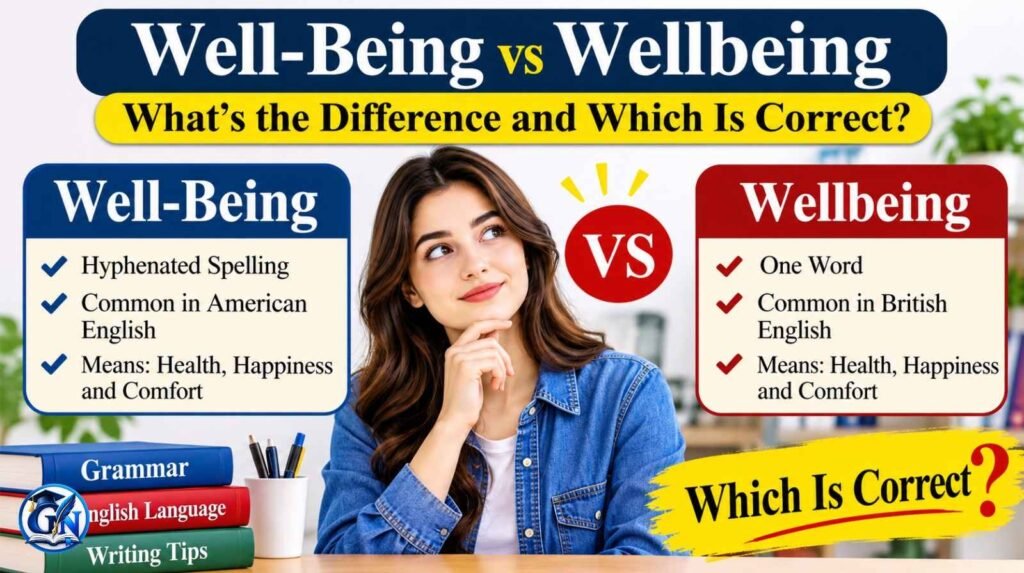
When writing about health, happiness, and quality of life, you may come across two spellings: Well-Being vs Wellbeing. Both look correct, and both appear in books, articles, workplace documents, and everyday conversations. However, this raises an important question: Is it well-being or wellbeing? Which spelling should you use?
The good news is that both well-being and wellbeing are accepted forms in modern English. They share the same meaning and describe a person’s overall state of health, happiness, comfort, and satisfaction with life. The main difference is their spelling preference and the style guide followed by a particular publication or organization.
Although the hyphenated spelling, well-being, is traditionally more common in American English and many formal writing contexts, wellbeing is also widely used, particularly in British English and modern publications.
In this article, we’ll explore the difference between well-being and wellbeing, explain when to use each spelling, and provide practical examples to help you choose the right form for emails, professional writing, academic work, and everyday communication.
Well-Being vs Wellbeing: Which Is Correct?
Both well-being and wellbeing are correct English spellings. Neither is inherently wrong, and both communicate the same idea.
The choice generally depends on regional preferences, editorial style, and personal or organizational consistency.
Here is a quick comparison:
| Well-Being | Wellbeing |
|---|---|
| Hyphenated spelling | Closed compound spelling |
| Traditionally common in American English | Common in British English |
| Frequently used in formal writing | Widely used in modern publications |
| Accepted in dictionaries | Accepted in dictionaries |
| Refers to health, happiness, and comfort | Has exactly the same meaning |
Examples:
- Regular exercise is essential for maintaining your well-being.
- The company introduced new policies to support employee wellbeing.
Both sentences are grammatically correct. The only difference is the spelling.
If you’re writing an academic paper, professional report, or website article, the most important thing is to follow your chosen style guide and use the same spelling consistently.
What Does Well-Being Mean?
Well-being is a noun that describes a person’s overall condition of health, happiness, comfort, and satisfaction with life. It includes physical, mental, emotional, and social aspects of living.
It is not limited to simply being free from illness. A person can be physically healthy but still experience stress, loneliness, or emotional difficulties. True well-being involves maintaining a healthy balance in different areas of life.
For example, someone who exercises regularly, eats nutritious food, maintains positive relationships, and manages stress may enjoy a good level of well-being.
Example sentences:
- Regular exercise can improve your physical and mental well-being.
- Parents should pay attention to their children’s emotional well-being.
- The organization introduced several programs to support employee well-being.
- Spending time with family contributes to overall well-being.
- Getting enough sleep is important for your general well-being.
In all these examples, well-being refers to a person’s overall health, happiness, and quality of life.
What Does Wellbeing Mean?
Wellbeing is another accepted spelling of the same noun. It describes a person’s physical health, mental condition, emotional stability, happiness, and general quality of life.
The spelling does not change the meaning, pronunciation, or grammatical function of the word.
Many writers prefer wellbeing because it looks simpler without the hyphen. It is also frequently used in British publications, educational materials, workplace policies, and discussions about health.
Example sentences:
- The school introduced a new program to improve students’ wellbeing.
- A healthy lifestyle plays an important role in maintaining personal wellbeing.
- The manager believes employee wellbeing should be a workplace priority.
- Spending time outdoors can have a positive effect on mental wellbeing.
- Financial stability can contribute to a person’s overall wellbeing.
As you can see, wellbeing works in exactly the same way as well-being.
What Is the Main Difference Between Well-Being and Wellbeing?
The main difference is the hyphen, not the meaning.
Both forms are nouns and describe a person’s overall state of health, happiness, and satisfaction. They can be used in the same grammatical situations without changing the meaning of a sentence.
However, their popularity can vary depending on the country, publication, and writing style.
Difference in Spelling
The most obvious difference is how the two words are written.
- Well-being: Written with a hyphen between well and being.
- Wellbeing: Written as one complete word without a hyphen.
For example:
- Exercise is beneficial for your overall well-being.
- Exercise is beneficial for your overall wellbeing.
Both sentences are correct.
Difference in Regional Usage
Regional preferences can influence which spelling writers choose.
Well-being is a traditional spelling frequently found in American English publications and formal writing.
Wellbeing is particularly familiar in British English, where closed compound spellings are common in many modern publications.
However, neither spelling belongs exclusively to one English variety. Both appear in different regions.
Difference in Formal Writing
Both spellings are suitable for formal writing, including business reports, academic papers, educational materials, and workplace communications.
For example:
- The organization is committed to improving employee well-being.
- The organization is committed to improving employee wellbeing.
Both sentences are professional and grammatically correct.
The key is to follow the spelling convention required by your institution or publication.
When Should You Use Well-Being?
Use well-being when your preferred dictionary, style guide, or publication follows the traditional hyphenated spelling.
It is an excellent choice for formal documents, academic writing, health-related articles, and professional communication.
Here are some situations where you can use it.
In Professional Emails
When discussing employee health, workplace happiness, or personal support, well-being is a suitable choice.
Example email:
Subject: Employee Well-Being Initiative
Dear Olivia,
I hope you’re doing well. Our company is planning to introduce a new initiative focused on improving employee well-being. The program will include flexible working arrangements, mental health resources, and opportunities for professional development. We believe these changes will help create a healthier and more supportive working environment. Please share your thoughts and suggestions.
Best regards,
Daniel
In this email, well-being refers to employees’ overall physical, emotional, and mental health.
In Academic Writing
Well-being is frequently used in research papers, educational studies, and academic discussions about health and quality of life.
Example:
Research suggests that regular physical activity can positively influence students’ mental health and overall well-being.
In Health and Wellness Articles
When writing about healthy lifestyles, nutrition, exercise, or mental health, the hyphenated spelling is appropriate.
Example:
Maintaining a balanced diet, exercising regularly, and getting enough sleep can improve your overall well-being.
When Should You Use Wellbeing?
Use wellbeing when your preferred writing convention accepts or favors the closed spelling. It is especially familiar in British English publications and modern workplace or educational writing.
Here are some practical situations.
In Workplace Communication
Wellbeing is commonly used when discussing employee support, workplace satisfaction, and organizational policies.
Example email:
Subject: Improving Employee Wellbeing
Dear James,
I wanted to let you know that we’re introducing a few new workplace initiatives to improve employee wellbeing. These initiatives will include flexible working hours, wellness activities, and additional mental health support. Our goal is to create a positive environment where everyone feels valued, supported, and motivated.
Kind regards,
Sophia
Here, wellbeing describes the overall health and happiness of employees.
In Educational Content
Schools and universities often discuss student wellbeing when explaining the importance of mental health, academic development, and a supportive learning environment.
Example:
The university provides counseling services and student support programs to promote the wellbeing of its learners.
In Everyday Conversations
You can also use wellbeing in casual conversations when discussing someone’s health or happiness.
Example conversation:
Emma: How have you been feeling since you started your new job?
Michael: Much better! The working environment is less stressful, and my overall wellbeing has improved.
This example shows how naturally the word fits into everyday communication.
Well-Being vs Wellbeing: Examples in Different Situations
Understanding a spelling difference becomes easier when you see both forms used in realistic situations.
Here are some additional examples.
In a Business Report
- The company introduced new policies to protect employee well-being.
- The company introduced new policies to protect employee wellbeing.
Both sentences are correct and suitable for professional reports.
In a School Announcement
- The school is organizing activities to support students’ mental well-being.
- The school is organizing activities to support students’ mental wellbeing.
Both versions communicate the same message.
In a Personal Message
- I hope your health and well-being continue to improve.
- I hope your health and wellbeing continue to improve.
Either spelling works naturally in a personal message.
In a Health Article
- Meditation can have a positive impact on emotional well-being.
- Meditation can have a positive impact on emotional wellbeing.
Both are acceptable.
In a Workplace Policy
- Our organization prioritizes the health and well-being of every employee.
- Our organization prioritizes the health and wellbeing of every employee.
Again, both spellings are correct.
Is Well-Being or Wellbeing More Formal?
Both spellings are considered appropriate in formal English.
However, well-being has a long-established presence in formal and academic writing, making it a familiar choice for many readers.
Wellbeing is also accepted in professional documents, research publications, educational resources, and workplace communication.
You should not assume that one spelling is automatically more professional than the other.
For example:
- The research examines the relationship between sleep quality and psychological well-being.
- The research examines the relationship between sleep quality and psychological wellbeing.
Both sentences are suitable for academic writing.
If your university, employer, or publication has a preferred style guide, follow that convention.
Is Wellbeing One Word or Two?
Wellbeing is one word, while well-being is written as a hyphenated compound.
Although the two spellings look different, they function as a single noun.
The word describes a person’s general health, happiness, and quality of life.
Examples:
- Mental wellbeing is important for a healthy lifestyle.
- Mental well-being is important for a healthy lifestyle.
Neither spelling should be confused with the phrase being well, which has a different grammatical structure.
For example:
- Your well-being matters to us.
- I hope you are being well.
The first sentence uses a noun, while the second uses a verb phrase.
Common Mistakes to Avoid When Using Well-Being and Wellbeing
Although both spellings are correct, writers sometimes make mistakes when using them.
Here are a few things to remember.
Mixing Both Spellings in the Same Article
Using well-being in one paragraph and wellbeing in another is not necessarily grammatically incorrect. However, switching between the two without a clear reason can make your writing look inconsistent.
Better approach: Choose one spelling and use it throughout your article.
Treating Them as Different Words
Some writers assume that well-being refers to physical health while wellbeing refers to mental health.
This is incorrect.
Both spellings have exactly the same meaning.
Confusing Wellbeing With Being Well
These expressions are related but grammatically different.
- Wellbeing: A noun referring to overall health and happiness.
- Being well: A phrase describing someone’s condition or state.
For example:
- Regular exercise improves your wellbeing.
- She is being well looked after by her family.
The second sentence uses a passive construction rather than the noun wellbeing.
Ignoring Your Chosen Style Guide
Different organizations and publications may prefer different spellings.
If you’re writing for a particular audience, check its editorial guidelines before deciding which version to use.
Which Spelling Should You Choose?
If you’re still unsure whether to write well-being or wellbeing, the simplest solution is to consider your audience and writing requirements.
Here is a practical guide:
| Writing Situation | Suggested Spelling |
|---|---|
| American English writing | Well-being |
| British English writing | Wellbeing |
| Academic writing | Follow the required style guide |
| Professional emails | Either spelling |
| Blog articles | Either spelling |
| Workplace policies | Follow company guidelines |
| Everyday conversations | Either spelling |
Remember that these are general preferences, not strict grammatical rules.
My recommendation: If you are writing a general English article and don’t have a specific style guide to follow, well-being is a reliable choice because of its long-established use. However, wellbeing is equally correct.
Frequently Asked Questions
1. Is It Well-Being or Wellbeing?
Both well-being and wellbeing are correct English spellings. They have the same meaning and refer to a person’s overall health, happiness, and quality of life. The difference is simply that well-being contains a hyphen, while wellbeing is written as one word.
2. Is Wellbeing One Word or Two?
Wellbeing is one word because it is written without a space or hyphen. Well-being is the hyphenated alternative. Both forms are accepted and function as nouns in English.
3. Is Well-Being More Correct Than Wellbeing?
No. Neither spelling is more grammatically correct than the other. Both are accepted forms in modern English. Your choice should depend on regional preferences, dictionary recommendations, or the style guide you follow.
4. Is Wellbeing American or British English?
Wellbeing is particularly common in British English, although it is also used in other varieties of English. The hyphenated spelling, well-being, has traditionally been more common in American English. However, both spellings are understood internationally.
5. Should I Use Well-Being in Formal Writing?
Yes. Well-being is perfectly suitable for formal writing, including academic papers, business reports, professional emails, and health-related articles. Wellbeing is also acceptable in these contexts, provided it follows the preferred style of your publication or organization.
6. What Is the Plural of Well-Being?
Well-being is generally used as an uncountable noun, so it does not normally have a plural form. Writers usually use expressions such as different aspects of well-being or levels of well-being when discussing multiple people or situations.
7. Does Wellbeing Have the Same Meaning as Well-Being?
Yes. Wellbeing and well-being have exactly the same meaning. Both describe a person’s general physical, mental, emotional, and social health, as well as their happiness and satisfaction with life.
8. Which Spelling Should I Use in a Professional Email?
You can use either well-being or wellbeing in a professional email. Both are grammatically correct and appropriate. However, you should follow your company’s preferred writing style and use the same spelling consistently throughout your communication.
Conclusion
The difference between well-being and wellbeing is simply their spelling. Well-being uses a hyphen, whereas wellbeing is written as one word. Both are accepted English nouns and describe a person’s overall physical health, mental condition, emotional happiness, and quality of life.
Although regional and editorial preferences may influence which spelling people choose, neither form is incorrect. Well-being is traditionally common in American English and formal writing, while wellbeing is widely used in British English and modern publications.
Ultimately, the best approach is to choose one spelling, follow your preferred writing style, and remain consistent throughout your content.
👉 Explore more useful grammar tips and guides on Gramnora

Explore the world of English grammar with simple explanations, practical examples, and easy-to-follow guides by Zia Tarar, the founder and author of Gramnora. From essential grammar rules and sentence structure to common mistakes and advanced concepts, Gramnora helps learners improve their English, strengthen their writing skills, and communicate with greater clarity and confidence.