
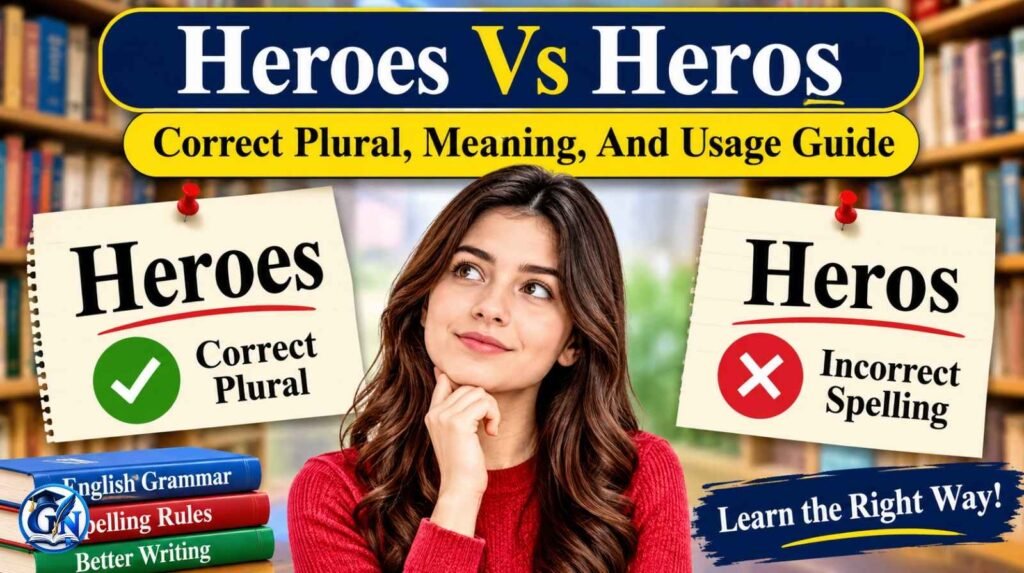
English spelling can sometimes be confusing, especially when a word changes from singular to plural. One common example is Heroes Vs Heros. Both spellings may look reasonable at first glance, but only one is correct in standard English.
The correct plural form of hero is Heroes Vs Heros. Although many English nouns simply add an -s to become plural, words ending in certain combinations of letters follow different spelling rules. This is why people sometimes mistakenly write heros when referring to more than one hero.
Whether you are writing a school assignment, preparing a professional email, creating a social media post, or talking about people you admire, knowing the correct spelling helps you communicate clearly.
In this guide, you will learn the difference between heroes and heros, understand their meanings, explore spelling rules, and discover practical examples that show how to use the correct word in everyday English.
Heroes Vs Heros: Which Spelling Is Correct?

The correct spelling is heroes. It is the standard plural form of the singular noun hero, which describes someone admired for their courage, achievements, bravery, or outstanding actions.
On the other hand, heros is an incorrect spelling when you want to refer to more than one hero in standard English.
For example:
- Correct: The firefighters were heroes during the emergency.
- Incorrect: The firefighters were heros during the emergency.
The confusion happens because many English nouns form their plurals by adding -s. However, nouns ending in consonant + o sometimes take -es instead.
For example:
- Hero → Heroes
- Potato → Potatoes
- Tomato → Tomatoes
- Echo → Echoes
Therefore, whenever you want to describe two or more heroes, remember to write heroes.
What Does Heroes Mean?
Heroes is the plural form of hero. It refers to two or more people who demonstrate bravery, courage, kindness, determination, or exceptional qualities through their actions.
A hero does not necessarily need to save someone’s life or perform a dramatic act. Sometimes, ordinary people become heroes by helping others, standing up for what is right, or making meaningful contributions to their communities.
Here are some common situations in which the word heroes is used:
People who demonstrate bravery
People who risk their safety to protect others are often described as heroes.
Example: The rescue workers became heroes after saving several people from the burning building.
People who inspire others
Someone who motivates others through their achievements or positive actions can also be called a hero.
Example: My parents are my heroes because they have always encouraged me to follow my dreams.
Historical figures
People who made important contributions to society or fought for freedom are often remembered as heroes.
Example: The national heroes of the country are remembered for their sacrifices.
Fictional characters
The word heroes can also describe brave or admirable characters in movies, books, television shows, and video games.
Example: The heroes in the movie worked together to protect their city.
What Does Heros Mean?
Heros is generally considered a misspelling of heroes when referring to multiple people admired for their courage or achievements.
Although people sometimes write heros because they assume that adding -s is enough to make the word plural, this spelling is not accepted in standard English for the ordinary plural of hero.
For example:
- Incorrect: The heros saved the village.
- Correct: The heroes saved the village.
However, it is worth understanding that Heros may occasionally appear as a proper name, brand name, or specialized term. Such uses do not make it the correct standard plural of hero.
In everyday writing, academic assignments, professional communication, and formal documents, always use heroes.
Why Is Heroes the Correct Plural of Hero?
The reason heroes is correct comes from English pluralization rules.
Most English nouns form their plural by adding -s or -es. However, nouns ending in certain letters follow particular spelling patterns.
For many nouns ending in a consonant followed by o, the plural is formed by adding -es.
For example:
| Singular | Plural |
|---|---|
| Hero | Heroes |
| Potato | Potatoes |
| Tomato | Tomatoes |
| Echo | Echoes |
| Torpedo | Torpedoes |
The word hero follows this pattern.
When you add -es, the word changes from hero to heroes. This is the established spelling in standard English dictionaries and everyday writing.
However, not every noun ending in o follows this rule. Some words simply take -s.
Examples include:
- Photo → Photos
- Piano → Pianos
- Radio → Radios
- Video → Videos
This means you cannot assume that every word ending in o will form its plural in exactly the same way. It is important to learn the accepted plural form of each word.
Heroes Vs Heros: Examples in Everyday Sentences
Understanding a spelling rule becomes easier when you see how the word works in real situations.
Here are several practical examples.
Talking About Family Members
You might describe your parents, grandparents, or other family members as heroes because of their sacrifices and support.
Example:
“My parents are my heroes because they have worked hard to give me a better future.”
Discussing Emergency Workers
Firefighters, doctors, nurses, and rescue workers are often described as heroes because they help people during difficult situations.
Example:
“The doctors and nurses became heroes during the difficult period because they continued helping patients.”
Writing About Historical Figures
When discussing important people from history, heroes is the correct plural form.
Example:
“Our history teacher asked us to write an essay about the heroes who fought for our country’s independence.”
Talking About Sports
Athletes can become heroes when their performances inspire fans and help their teams achieve important victories.
Example:
“The players became heroes after winning the championship for their country.”
Discussing Movies and Books
The word heroes is also frequently used when discussing fictional characters.
Example:
“The heroes of this adventure story showed courage, friendship, and determination throughout their journey.”
Heroes in Professional Emails
Using correct spelling is important in professional communication. Whether you are writing to a colleague, teacher, manager, or client, choosing the correct plural form makes your message look more polished.
Consider the following email example.
Scenario: Thanking Emergency Workers
Dear Mr. Daniel,
I would like to express my appreciation for the firefighters and rescue workers who helped our community during the recent emergency. Their courage, dedication, and willingness to help others make them true heroes. We are grateful for everything they have done to keep people safe. Thank you for recognizing their efforts and supporting these incredible individuals.
Best regards,
Michael
In this email, heroes is used correctly because the message refers to several people who demonstrated courage and dedication.
Writing heros instead would be a spelling mistake.
Common Mistakes When Using Heroes and Heros

Even though the difference is simple, writers sometimes make mistakes when using these words.
Here are some common errors to avoid.
Adding Only -s to Hero
Incorrect: The heros received awards for their bravery.
Correct: The heroes received awards for their bravery.
Confusing Singular and Plural Forms
Incorrect: The heroes is ready to help.
Correct: The heroes are ready to help.
Remember that heroes is plural, so it generally takes plural verbs.
Using Heroes When Referring to One Person
Incorrect: My heroes is my father.
Correct: My hero is my father.
Use hero for one person and heroes for two or more people.
Forgetting the Correct Spelling in Formal Writing
Incorrect: We should appreciate our everyday heros.
Correct: We should appreciate our everyday heroes.
Always check the spelling before submitting important assignments, reports, or professional documents.
Hero Vs Heroes: Understanding Singular and Plural Forms
Another important part of understanding heroes vs heros is knowing when to use the singular and plural forms.
The word hero refers to one person, while heroes refers to more than one person.
Here is a simple comparison:
| Word | Meaning | Example |
|---|---|---|
| Hero | One brave or admirable person | My brother is my hero. |
| Heroes | Two or more brave or admirable people | My brothers are my heroes. |
Consider these additional examples:
- Hero: The young firefighter became a hero after rescuing the child.
- Heroes: The firefighters became heroes after rescuing several families.
- Hero: She considers her mother a hero.
- Heroes: She considers her parents her heroes.
Using the correct form makes your sentences grammatically accurate and easier to understand.
How to Remember the Correct Spelling of Heroes
If you frequently confuse heroes and heros, a few simple tricks can help you remember the correct spelling.
Remember the -oes Ending
Think of the word potatoes. Just as potato becomes potatoes, hero becomes heroes.
Connect Hero With More Than One Person
Whenever you talk about multiple heroes, remember that the word needs an additional e before the final s.
Practice With Simple Sentences
Writing a few sentences regularly can help you remember the correct spelling.
For example:
- My father is my hero.
- My parents are my heroes.
- The rescue workers are heroes.
- These historical figures are national heroes.
Check Your Writing
If you are unsure whether you have written heroes correctly, use a reliable dictionary or spelling checker.
With regular practice, you will naturally become more comfortable using the correct form.
Heroes Vs Heros: Which One Should You Use in Academic Writing?

In academic writing, spelling and grammar play an important role in presenting information clearly and professionally.
If you are writing an essay, research paper, school assignment, or examination answer, heroes is the correct plural form of hero.
For example:
“Historical heroes have played an important role in shaping the values, traditions, and identities of different societies.”
This sentence uses the correct plural form and communicates the intended meaning clearly.
Avoid using heros in academic writing because it is not the standard plural spelling.
The same rule applies to professional reports, articles, presentations, and formal correspondence.
Frequently Asked Questions
1. Is It Heroes or Heros?
Heroes is the correct plural spelling of hero. It refers to two or more people who demonstrate bravery, courage, or admirable qualities. Heros is an incorrect spelling when used as the ordinary plural of hero.
2. What Is the Plural of Hero?
The plural of hero is heroes. The word changes its ending from -o to -oes when forming the plural. For example, one hero becomes two heroes.
3. Why Is Heroes Spelled With an E?
Heroes is spelled with an additional e because hero follows a common English pluralization pattern in which certain nouns ending in consonant + o take -es. This produces the correct spelling heroes.
4. Is Heros Ever Correct?
Heros is not the standard plural form of hero. However, it may appear as a proper name, brand name, or specialized term in certain contexts. When referring to multiple brave or admirable people, always use heroes.
5. Is Heroes Singular or Plural?
Heroes is a plural noun. It refers to more than one person. The singular form is hero. For example, “My father is my hero” is singular, while “My parents are my heroes” is plural.
6. What Is the Difference Between Hero and Heroes?
Hero refers to one brave, admired, or outstanding person, whereas heroes refers to two or more such people. For example, “The firefighter is a hero” and “The firefighters are heroes.”
7. How Do You Use Heroes in a Sentence?
You can use heroes when talking about multiple people who inspire others through their courage, achievements, or positive actions. For example, “The doctors and nurses were heroes during the emergency.”
8. Why Do People Write Heros Instead of Heroes?
People often write heros because they assume that adding -s is enough to make hero plural. However, hero follows a spelling pattern that requires -es, making heroes the correct form.
Conclusion
When comparing heroes vs heros, the correct choice is always heroes when referring to more than one hero in standard English.
Although heros may look like a reasonable plural spelling, it is not the accepted form of the noun hero. Remember that hero refers to one person, while heroes refers to two or more people.
Whether you are writing an academic assignment, sending a professional email, discussing historical figures, or creating everyday content, using heroes will keep your writing accurate and professional.
The easiest way to remember this rule is simple: Hero becomes Heroes, not Heros. Keep this spelling in mind, and you will avoid a common English mistake.
👉 Explore more useful grammar tips and guides on Gramnora

Explore the world of English grammar with simple explanations, practical examples, and easy-to-follow guides by Zia Tarar, the founder and author of Gramnora. From essential grammar rules and sentence structure to common mistakes and advanced concepts, Gramnora helps learners improve their English, strengthen their writing skills, and communicate with greater clarity and confidence.