
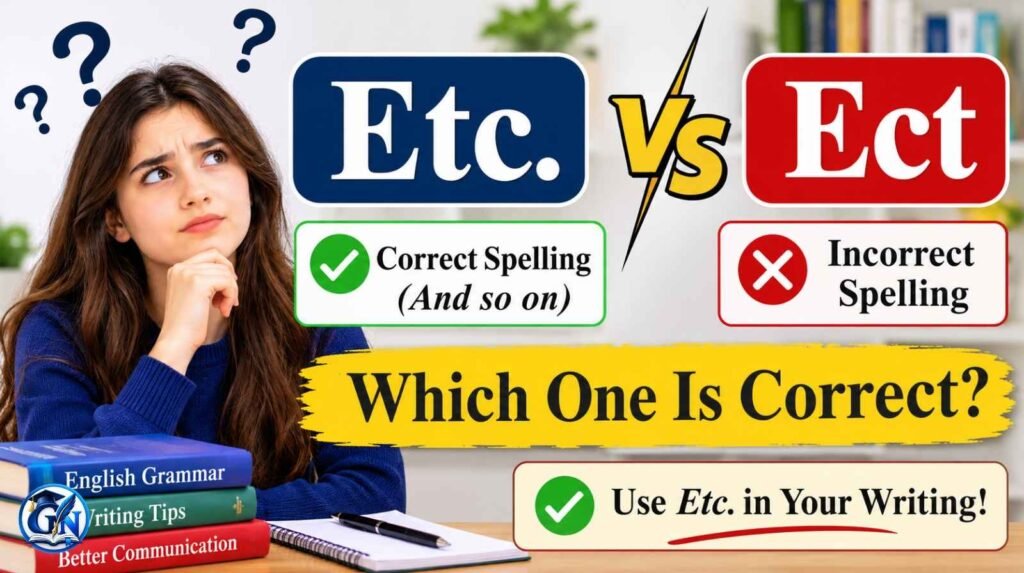
Have you ever written a sentence using “etc.” and wondered whether you were spelling it correctly? You are not alone. Many English learners and even experienced writers sometimes confuse etc vs ect because the two forms contain almost the same letters. However, only one is the standard spelling in English.
The confusion often appears in emails, school assignments, professional documents, social media posts, and everyday writing. Although etc. is widely used to indicate that a list continues with other similar items, ect is a common spelling mistake that should generally be avoided.
Understanding the difference between these two forms can help you write more clearly and confidently. In this guide, we will explore the correct spelling, meanings, pronunciation, grammar rules, and practical examples of etc vs ect so you know exactly which one to use.
Etc vs Ect: Which One Is Correct?
The correct spelling is etc., not ect. The abbreviation etc. comes from the Latin expression et cetera, meaning “and other things” or “and so on.” Writers use it at the end of a list when they want to indicate that additional similar items exist but do not need to be mentioned individually.
On the other hand, ect is an incorrect spelling when someone intends to write et cetera. It does not serve as the standard English abbreviation for continuing a list.
Consider these examples:
- Correct: Please bring notebooks, pens, pencils, markers, etc.
- Incorrect: Please bring notebooks, pens, pencils, markers, ect.
In the first sentence, etc. correctly indicates that other similar stationery items may also be needed. The second sentence contains a spelling mistake.
Therefore, whenever you want to express the idea of “and so on,” use etc.
What Does Etc Mean?
Etc. is an abbreviation of the Latin phrase et cetera. The phrase literally means “and the rest” or “and other things.”
In everyday English, people use it to avoid writing every item in a list when the remaining examples are understood or are not particularly important.
For example:
- Sarah enjoys reading novels, magazines, newspapers, comics, etc.
- You should bring your travel documents, passport, tickets, etc.
- The supermarket sells vegetables, fruits, dairy products, snacks, etc.
In these examples, etc. tells readers that the list contains additional related items.
When Should You Use Etc?
You can use etc. when you are listing several examples of the same general category and want to indicate that more examples exist.
Here are some common situations:
In Everyday Writing
You might use etc. when discussing ordinary objects, activities, or things.
Example:
“Please clean your bedroom, organize your wardrobe, arrange your books, etc., before your guests arrive.”
In Emails
It is also common in informal and semi-formal emails when the remaining examples are obvious.
Example:
Hi Daniel,
Could you please arrange the office supplies for next week’s meetings? We need notebooks, pens, markers, sticky notes, etc. Please make sure everything is ready by Monday morning.
Best regards,
Emily
Here, etc. indicates that other similar office supplies may also be required.
In Academic Writing
Students sometimes use etc. when listing examples in notes or less formal academic writing. However, in formal academic papers, it is often better to provide specific examples or use a clearer expression.
Example:
“Common renewable energy sources include solar power, wind energy, hydropower, etc.”
For a more precise academic sentence, you could write:
“Common renewable energy sources include solar power, wind energy, and hydropower, among others.”
What Does Ect Mean?
Ect is generally a misspelling of etc. when someone intends to express “and so on” or “and other things.”
People often make this mistake because they remember the sound of the abbreviation but not its correct letter order.
For example:
- Incorrect: I bought apples, bananas, oranges, ect.
- Correct: I bought apples, bananas, oranges, etc.
The problem is not the meaning of the sentence. The problem is the spelling of the abbreviation.
Why Do People Confuse Etc and Ect?
There are several reasons why writers mix up these two forms.
Similar Letter Combinations
Both forms contain the letters E, C, and T. Because they look and sound similar, people sometimes place the letters in the wrong order.
Unfamiliarity With the Original Latin Phrase
Many English speakers use etc. without knowing that it comes from et cetera. Understanding its origin makes the correct spelling easier to remember.
Typing Too Quickly
When writing messages, emails, or social media posts, people may type ect accidentally without noticing the mistake.
Incorrect Spelling Habits
If someone repeatedly sees or uses ect online, they may mistakenly believe it is an acceptable alternative.
Remember that ect is not an accepted alternative spelling of etc.
Etc vs Ect: Key Differences
Although etc. and ect look similar, their usage is different.
| Feature | Etc. | Ect |
|---|---|---|
| Correct spelling | Yes | No |
| Origin | Latin | No standard abbreviation meaning “and so on” |
| Meaning | And other things | Usually a spelling mistake |
| Usage | Lists and examples | Should be avoided |
| Standard English | Accepted | Incorrect in this context |
The most important distinction is simple: etc. is correct, while ect is incorrect when referring to et cetera.
How to Use Etc Correctly in a Sentence
Knowing the correct spelling is important, but understanding its grammatical placement is equally useful.
Here are some practical rules to follow.
Use Etc at the End of a List
The abbreviation usually appears after the final example in a list.
Example:
“We need chairs, tables, desks, lamps, etc.”
Here, etc. indicates that other similar furniture or equipment may also be included.
Do Not Use Etc With And
Because etc. already means “and other things,” using and immediately before it is generally unnecessary.
Incorrect: “She bought dresses, shoes, bags, and etc.”
Correct: “She bought dresses, shoes, bags, etc.”
Remember: Avoid writing “and etc.” because it repeats the meaning of the abbreviation.
Avoid Using Etc When the List Is Already Complete
If you have mentioned every relevant item, there is no reason to add etc.
Example:
Incorrect: “There are three primary colors: red, blue, yellow, etc.”
Better: “There are three primary colors: red, blue, and yellow.”
When the list is complete, finish the sentence without adding an unnecessary abbreviation.
Use a Period After Etc.
The standard abbreviation is written with a period: etc.
Example:
“We purchased paper, folders, notebooks, etc.”
The period is part of the abbreviation. If etc. appears at the end of a sentence, you do not need to add another period.
Avoid Using Etc When It Makes Your Meaning Unclear
Your readers should understand what additional items belong to the list.
For example:
Unclear: “The company needs several things, etc.”
Better: “The company needs computers, office furniture, printers, etc.”
The second sentence provides enough context to make the meaning clear.
Etc vs Ect: Real-Life Scenario Examples
Let’s explore some everyday situations to understand how etc. works in practical communication.
Scenario 1: Writing a School Assignment
Imagine a student named Olivia preparing a school assignment about healthy eating.
Incorrect:
“Healthy foods include vegetables, fruits, whole grains, ect.”
Correct:
“Healthy foods include vegetables, fruits, whole grains, etc.”
In this situation, etc. indicates that other healthy food options exist beyond the examples listed.
Scenario 2: Sending a Professional Email
Suppose James is emailing his colleague about the materials needed for an upcoming presentation.
Hi Michael,
Please prepare the presentation materials before Thursday. We will need charts, printed reports, project summaries, reference documents, etc. Let me know if you need anything else.
Best regards,
James
Using etc. here helps James avoid mentioning every possible document individually.
Scenario 3: Shopping for Groceries
Imagine Emma preparing a shopping list for her family.
Incorrect:
“Buy milk, bread, eggs, butter, ect.”
Correct:
“Buy milk, bread, eggs, butter, etc.”
The correct abbreviation suggests that other grocery items may also be needed.
Scenario 4: Writing a Social Media Post
Suppose Sophia wants to share her weekend activities online.
Incorrect:
“My weekend was full of fun activities: shopping, traveling, meeting friends, ect.”
Correct:
“My weekend was full of fun activities: shopping, traveling, meeting friends, etc.”
The correct form makes the sentence grammatically appropriate.
Scenario 5: Giving Instructions at Work
Imagine a manager named Robert explaining what employees should bring to a training session.
Correct:
“Please bring your laptop, notebook, pen, charger, etc., to the training session.”
In this example, etc. indicates that employees may need other related materials.
Is Etc Formal or Informal?
Etc. is acceptable in both formal and informal English, but whether you should use it depends on the context.
In casual conversations, emails, personal notes, and everyday writing, it is perfectly normal.
For example:
“I need to buy groceries, snacks, drinks, etc.”
However, in formal academic writing, legal documents, business reports, or professional instructions, using etc. can sometimes make a sentence less precise.
Consider these alternatives:
- And so on: Suitable for general writing.
- Among others: Useful when mentioning people, things, or examples.
- Including: Helpful when introducing specific examples.
- And other similar items: Useful when clarity is important.
For instance:
Instead of writing:
“The office requires computers, printers, desks, etc.”
You could write:
“The office requires computers, printers, desks, and other essential equipment.”
The second version is more descriptive and may be more suitable for a formal report.
Easy Tricks to Remember Etc vs Ect
If you frequently confuse these spellings, a few simple tricks can help you remember the correct form.
Remember the Original Phrase
Think of the Latin expression et cetera. Its first letters give you the correct abbreviation: etc.
Remember the Meaning
Whenever you want to say “and other things,” remember etc.
Check the Letter Order
The correct order is E-T-C, not E-C-T.
Read Your Sentence Again
Before submitting an assignment or sending an important email, check whether you have accidentally typed ect instead of etc.
These small habits can help you avoid a common spelling mistake.
Common Mistakes to Avoid When Using Etc
Even though etc. is a short abbreviation, writers sometimes misuse it.
Here are some common mistakes to watch out for:
- Writing ect instead of etc.: Always use the correct letter order.
- Writing and etc.: Avoid repeating the meaning of the abbreviation.
- Using etc. without examples: Give readers enough information to understand the category.
- Using etc. in a complete list: Do not suggest that more items exist when the list is already finished.
- Overusing etc.: Repeated use can make your writing less specific and less professional.
Paying attention to these details will make your English writing clearer and more polished.
Frequently Asked Questions
1. Is It Etc or Ect?
Etc. is the correct spelling. It is an abbreviation of the Latin phrase et cetera, meaning “and other things” or “and so on.” Ect is an incorrect spelling when used with this intended meaning.
2. What Does Etc Stand For?
Etc. stands for et cetera, a Latin expression meaning “and the rest” or “and other things.” It is commonly used at the end of a list to indicate additional similar items.
3. Is Ect Ever Correct?
Ect can appear as a sequence of letters in other specialized contexts, but it is not the correct abbreviation for et cetera. If you mean “and so on,” always write etc.
4. Should I Write Etc or Etc.?
The standard written abbreviation is etc., including the period. The period indicates that the word has been shortened.
5. Can I Use Etc in a Professional Email?
Yes. You can use etc. in professional emails when the additional examples are obvious. However, for important instructions or formal communication, providing specific details is often better.
6. Is It Grammatically Correct to Say And Etc?
No. Writing “and etc.” is generally considered redundant because etc. already carries the meaning of “and other things.”
Instead, write: “Please bring your books, notebooks, pens, etc.”
7. What Is the Difference Between Etc and Et Cetera?
Et cetera is the complete Latin expression, while etc. is its shortened form. Both communicate the same general meaning, but etc. is more convenient in everyday writing.
8. Can Etc Be Used in Academic Writing?
Yes, but it should be used carefully. Academic writing generally benefits from specific examples and clear explanations. Expressions such as “among others” or “and other related examples” may sometimes be more suitable.
Conclusion
When comparing etc vs ect, the correct choice is always etc. when you want to express “and so on” or “and other things.” It comes from the Latin phrase et cetera and is commonly used in everyday writing, emails, assignments, and professional communication.
Although ect is a common typing and spelling mistake, it should not replace the standard abbreviation.
The easiest way to remember the difference is to think of the original phrase: et cetera = etc.
So, the next time you write a list of examples, remember to use etc. instead of ect. This small spelling detail can make your writing more accurate, clear, and professional.
👉 Explore more useful grammar tips and guides on Gramnora

Explore the world of English grammar with simple explanations, practical examples, and easy-to-follow guides by Zia Tarar, the founder and author of Gramnora. From essential grammar rules and sentence structure to common mistakes and advanced concepts, Gramnora helps learners improve their English, strengthen their writing skills, and communicate with greater clarity and confidence.