
Have you ever wondered whether to write Breached vs Breeched? These two words look almost identical and sound the same, making them easy to confuse. However, their meanings are quite different, and choosing the wrong spelling can change the meaning of your sentence.
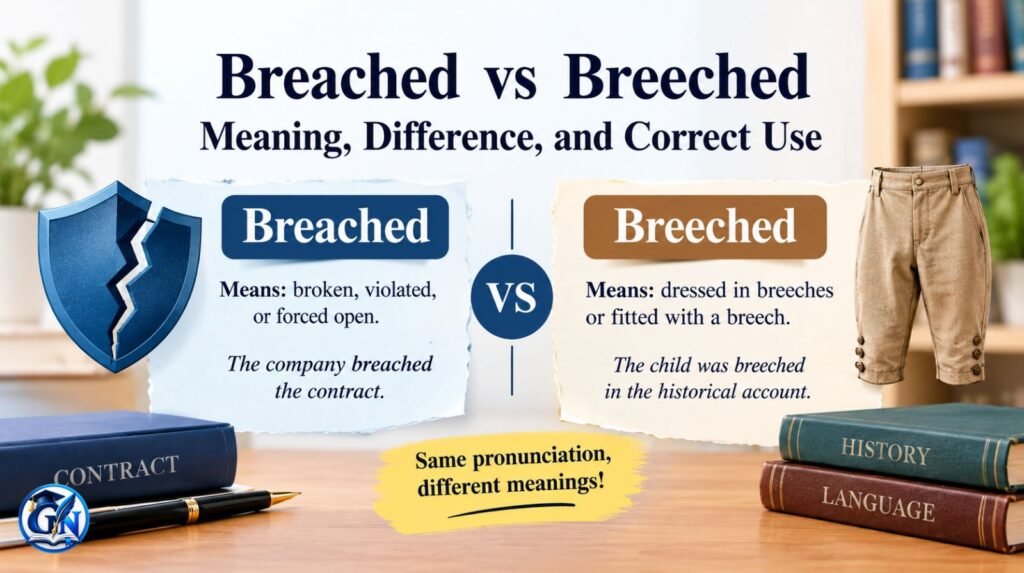
The good news is that understanding the difference between breached vs breeched is simple once you learn their root words. Breached means broken, violated, or forced open, while breeched is a much less common word associated with clothing or fitting something with a breech.
In this guide, you will learn the meaning of each word, discover the correct spelling for different situations, explore practical examples, and find an easy way to remember the difference.
What Is the Difference Between Breached and Breeched?

The main difference between breached and breeched is their meaning and grammatical origin. Although they sound alike, they come from two different words: breach and breech.
- Breached: The past tense and past participle of breach, meaning broke, violated, or forced open.
- Breeched: The past tense and past participle of breech, a rare verb associated with clothing someone in breeches or fitting something with a breech.
For example, a company can breach a contract, and a security system can be breached. In contrast, breeched may appear in historical writing about clothing or in specialized technical contexts.
Breached vs Breeched: Quick Comparison
| Feature | Breached | Breeched |
|---|---|---|
| Root word | Breach | Breech |
| Main meaning | Broken, violated, or forced open | Dressed in breeches or fitted with a breech |
| Common usage | Contracts, security, rules, barriers | Historical clothing and specialized technical contexts |
| Example | The company breached the agreement. | The historical account described how the child was breeched. |
| Frequency in modern writing | Common | Rare |
The easiest way to choose is to consider what you want to communicate. If something was broken or violated, breached is the correct word. If you genuinely mean the rare verb breech, use breeched.
Why Are These Words Confused?
Breached and breeched are homophones, meaning they have the same pronunciation but different spellings and meanings. Because you cannot hear the difference, you must rely on context.
For example:
- Correct: The hackers breached the company’s security.
- Incorrect for this meaning: The hackers breeched the company’s security.
The second sentence uses the wrong word because cybersecurity involves breaking through or violating security, not the specialized meaning of breech.
What Does Breached Mean?
Breached is the past tense and past participle of the verb breach. It means to break, violate, penetrate, or create an opening in something that should remain protected, intact, or respected.
The word is common in legal documents, business communication, cybersecurity, news reporting, and everyday English.
For example, a person may breach a promise, an organization may breach a contract, or a flood may breach a protective barrier.
Examples of Breached in Sentences
Here are some practical examples showing how to use breached correctly:
- The company breached its agreement with the supplier.
- Hackers breached the website’s security system.
- The employee breached confidentiality by sharing private information.
- Heavy flooding breached the riverbank.
- The athlete breached the competition’s rules.
- The soldiers breached the enemy’s defensive wall.
Each sentence describes a violation, a break, or a forced opening.
Breached in Legal and Business Writing
In legal and business contexts, breached often refers to failing to meet an obligation or violating an agreement.
For example:
- The landlord breached the terms of the lease.
- The supplier breached the contract by failing to deliver the goods.
- The employee allegedly breached the company’s confidentiality policy.
Notice that breached does not automatically mean someone committed a crime. Whether an action is unlawful, legally actionable, or subject to a penalty depends on the circumstances and applicable law.
Breached in Cybersecurity
The word is also widely used when discussing digital security and privacy.
For example:
- The attackers breached the company’s network.
- The investigation revealed that customer information had been exposed.
- The organization strengthened its security after the system was breached.
A related expression is data breach, which refers to a security incident involving unauthorized access to or disclosure of protected information.
Remember that breached is appropriate whenever the intended meaning involves breaking through a barrier, violating a rule, or compromising security.
What Does Breeched Mean?
Breeched is the past tense and past participle of the much less common verb breech. Its meaning is connected to breeches, a historical term for a type of trousers, or to fitting something with a breech.
The noun breech also refers to the rear part of a firearm or certain other mechanisms. In medicine, breech describes a baby’s position in the uterus when the buttocks or feet are positioned to come first during birth.
However, these meanings require an important distinction: the medical term is normally breech, not breeched, when describing a baby’s position.
Breeched in Historical Clothing
In historical writing, breeched can describe the act of dressing someone in breeches, traditionally a type of garment worn by men and boys.
For example:
- The historical account described the age at which the boy was breeched.
- The museum’s notes discussed the clothing traditions of the period.
This usage is uncommon in everyday modern English, so readers may encounter it more often in historical or specialized material.
Breech in Medical Terminology
The word breech is frequently used in discussions of pregnancy and childbirth.
For example:
- The baby was in a breech position.
- The ultrasound showed a breech presentation.
- The medical team discussed the options for a breech birth.
In these examples, breech describes the baby’s position. Writing that a baby was breeched to mean that the baby was in this position is generally not the standard modern medical phrasing.
Breech in Technical Writing
The word breech also refers to the rear portion of a firearm where ammunition is loaded.
For example:
- The technician inspected the breech mechanism.
- The manual explained how the breech was designed.
In specialized contexts, breeched may be used when the verb’s particular meaning requires it. Nevertheless, it should not replace breached when the intended meaning is to violate or break through something.

Breached vs Breeched: Common Mistakes and Correct Examples
Understanding the difference becomes easier when you compare incorrect and correct sentences. Since both spellings are recognized words, a spell-checker may not identify the error if you use one in place of the other.
| Incorrect sentence | Correct sentence | Reason |
|---|---|---|
| The company breeched the contract. | The company breached the contract. | A contract can be violated. |
| Hackers breeched the network. | Hackers breached the network. | The hackers broke through security. |
| The wall was breeched during the attack. | The wall was breached during the attack. | The wall was broken through. |
| The employee breeched confidentiality. | The employee breached confidentiality. | Confidentiality was violated. |
| The baby was in a breached position. | The baby was in a breech position. | Breech is the standard medical term. |
How to Choose the Correct Word
Follow these simple steps whenever you are unsure which spelling to use.
- Identify the meaning. Are you describing a violation, a broken agreement, or a forced opening?
- Choose breach if something was broken or violated. Its past tense is breached.
- Choose breech for its specific physical or historical meanings. The past form breeched is appropriate only when that verb is intended.
- Read the sentence again. Make sure the chosen word communicates the meaning you intend.
For example, if you write, “The company its privacy policy,” the correct answer is breached because the sentence describes a violation.
If you write, “The baby was in a position,” the correct word is breech because the sentence concerns a medical position.
A Real-Life Example: Using Breached vs Breeched Correctly
Imagine that a small online store discovers that unauthorized users have accessed its customer database. The owner must explain the incident to customers, review the security report, and prepare a statement for the business website.
At first, the owner writes, “Our customer database was breeched last night.” The sentence may look correct because breeched is a recognized spelling. However, it communicates the wrong word for the intended meaning.
The correct statement is: “Our customer database was breached last night.”
Why? Because the incident involves unauthorized access to a protected system. The verb breach describes breaking through a security barrier, so its past participle, breached, is appropriate.
The owner might also write, “The incident involved a potential data breach, and we are investigating whether customer information was accessed.” This wording is more precise because it distinguishes the security incident from the still-unconfirmed details of the investigation.
Now imagine that the same owner is reading a historical article about traditional clothing. The article states that a child was breeched at a particular age. In that context, the word relates to historical clothing customs rather than a security violation.
This example demonstrates why context matters more than appearance. Both words exist, but they perform different jobs. Choosing the correct word makes your writing clearer, more professional, and less likely to mislead readers.
What Do Usage Guidance and Current Data Tell Us?
When choosing between similar spellings, the most useful evidence comes from established dictionary definitions and reliable writing guidance. Current statistics about internet use or search behavior do not, by themselves, establish which spelling is correct.
Dictionary Evidence
Dictionary.com distinguishes breach from breech by defining breach in terms of breaking or violating something and breech through meanings associated with the rear or lower part of something, including specialized uses. Its explanation also highlights how easily these homophones can be confused.
This supports a straightforward rule: use the spelling that matches the meaning of your sentence.
What About 2025–2026 Statistics?
There is no verified, authoritative 2025–2026 statistic available in the sources reviewed here that reliably measures how often English writers confuse breached and breeched. Giving a precise percentage or claiming that one spelling error has increased by a particular amount would therefore be misleading.
Instead, the practical evidence is linguistic:
- Breached is the ordinary past-tense form used for violations and forced openings.
- Breeched is a real but uncommon form associated with specialized meanings of breech.
- Both spellings may pass automated spell-checking because both are valid words.
For website owners and editors, Google’s guidance on helpful, reliable, people-first content emphasizes giving readers accurate, useful information rather than writing primarily to manipulate search rankings.
FAQs
Q1: Is breached or breeched the correct spelling?
A: Both are valid words, but they have different meanings. Breached is correct when something has been broken, violated, or forced open. Breeched is a rare form associated with dressing someone in breeches or fitting something with a breech.
Q2: What does breached mean?
A: Breached is the past tense and past participle of breach. It means violated, broken, penetrated, or forced open.
Example: “The company breached the agreement.”
Q3: Is breeched a real word?
A: Yes. Breeched is a real word, although it is much less common than breached. It is used in specialized or historical contexts related to the verb breech.
Q4: Is it breached or breeched in a contract?
A: The correct expression is breached a contract or breach of contract. A contract can be broken or violated, which is the meaning of breach.
Example: “The supplier breached the contract.”
Q5: Is it breached or breeched in cybersecurity?
A: Use breached when describing unauthorized access to a network, account, or protected system.
Example: “Attackers breached the company’s network.”
The related noun is breach, as in “a security breach.”
Q6: Is a baby breached or breech?
A: The standard medical expression is breech. A baby in a breech position is positioned with the buttocks or feet toward the birth canal rather than the head.
Example: “The doctor identified a breech presentation.”
Q7: Why do people confuse breached and breeched?
A: The words are pronounced the same way and differ by only one vowel in their spelling. Because pronunciation cannot distinguish them, writers need to understand their meanings and grammatical uses.
Q8: How can I remember the difference between breached and breeched?
A: Remember this simple rule:
- Breached = broken or violated.
- Breeched = related to breech, including specialized clothing or technical meanings.
If you are writing about a broken agreement, a violated rule, or a compromised security system, breached is almost certainly the word you need.
Conclusion:
The difference between breached vs breeched becomes clear once you understand their root words. Breached is the past tense of breach and means broken, violated, or forced open. Breeched comes from breech and has much narrower uses, particularly in historical clothing and specialized technical contexts.
For everyday writing, legal discussions, business communication, and cybersecurity, breached is the correct spelling whenever you mean that something was broken or violated. Use breeched only when its specific meaning fits the sentence.
Before publishing your next article, email, or report, check the meaning rather than relying on pronunciation alone. A small spelling difference can make a big difference in clarity.
👉 Explore more useful grammar tips and guides on Gramnora

Explore the world of English grammar with simple explanations, practical examples, and easy-to-follow guides by Zia Tarar, the founder and author of Gramnora. From essential grammar rules and sentence structure to common mistakes and advanced concepts, Gramnora helps learners improve their English, strengthen their writing skills, and communicate with greater clarity and confidence.