
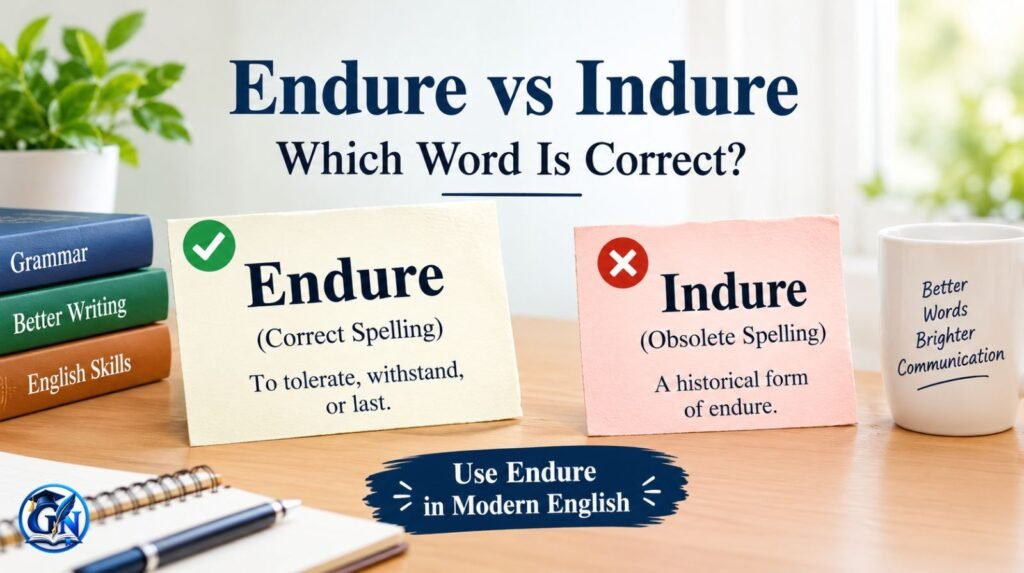
Have you ever wondered whether to write Endure vs Indure when describing a difficult experience? These words look and sound similar, so choosing the correct spelling can be confusing. However, the answer is simple: endure is the standard spelling in modern English, while indure is an obsolete historical form.
Whether you are writing a school assignment, professional email, blog post, or social media caption, knowing the correct spelling helps you communicate clearly. In this guide, you will learn the meaning of endure, discover why people confuse it with indure, explore practical examples, and find easy ways to remember the correct spelling.
What Is the Difference Between Endure and Indure?
The main difference between endure and indure is their status in modern English. Endure is the accepted spelling used in everyday and professional writing. Indure is an obsolete spelling that may appear in historical texts.
What Does Endure Mean?
Endure is a verb that means to experience or tolerate something difficult or unpleasant without giving up. It can also mean to continue to exist or last for a long time.
For example:
- She had to endure months of uncertainty.
- The hikers endured freezing temperatures during their journey.
- Their friendship endured for more than thirty years.
- Great works of literature often endure across generations.
In the first two examples, endure describes experiencing something difficult. In the last two, it means continuing to exist over time.
What Does Indure Mean?
Indure is an obsolete historical spelling associated with endure. It is not the standard form to use in contemporary English writing.
For example:
- Incorrect in modern writing: She had to indure the pain.
- Correct: She had to endure the pain.
Although the older form may appear in historical documents, modern writers should generally choose endure.
Endure vs Indure: Quick Comparison
| Feature | Endure | Indure |
|---|---|---|
| Modern spelling | Correct | Obsolete |
| Word type | Verb | Historical verb form |
| Meaning | To tolerate, withstand, or last | Historical form of endure |
| Everyday writing | Recommended | Avoid |
| Academic writing | Standard choice | Use only when historically relevant |
| Example | They endured the hardship. | May appear in an old text |
Remember that endure and indure are not equivalent modern spelling alternatives like color and colour. For contemporary English, endure is the appropriate choice.
What Does Endure Mean in Different Contexts?
The word endure has two main meanings. Understanding both will help you use it naturally in conversations, essays, and professional writing.
Endure Means to Tolerate or Withstand
Use endure when someone experiences a difficult, painful, or unpleasant situation and continues through it.
Examples:
- The athlete endured intense training before the competition.
- She endured several challenging months at work.
- The passengers endured a long delay at the airport.
- He endured criticism while working toward his goals.
In these sentences, endure describes dealing with hardship, discomfort, or an unpleasant experience.
Tip: Words such as pain, hardship, pressure, criticism, and difficulty often work naturally with endure.
Endure Means to Last or Continue
Endure can also describe something that remains important, exists, or continues over a long period.
Examples:
- Their love endured despite the distance.
- The ancient building has endured for centuries.
- Her influence continues to endure in modern literature.
- The team’s success endured for several seasons.
Here, endure does not necessarily suggest suffering. Instead, it emphasizes persistence and longevity.
Endure in Everyday and Professional Writing
Endure is useful in several situations, including academic writing, workplace communication, storytelling, and everyday conversation.
For example:
- Academic: The theory has endured despite years of debate.
- Professional: The company endured significant financial pressure.
- Personal: She endured a difficult period and eventually recovered.
- Historical: The monument has endured for hundreds of years.
Choosing the right context makes your writing more precise and meaningful.
Why Do People Confuse Endure and Indure?

The confusion between endure and indure mainly comes from pronunciation, familiarity with other English words, and the historical development of spelling.
The First Syllable Can Be Misleading
In spoken English, the opening sound of endure may resemble the sound of in. This can lead people to spell the word as indure when writing from memory.
For example, someone might hear a sentence such as:
“She learned to endure difficult circumstances.”
Without knowing the spelling, that person might incorrectly write, “She learned to indure difficult circumstances.”
However, pronunciation alone is not a reliable guide to English spelling. The standard written form remains endure.
The Influence of Other English Words
English includes many words beginning with in-, such as:
- Include
- Inform
- Inspire
- Insist
- Inspect
Because these words are familiar, indure may initially look reasonable. Nevertheless, the spelling of one word does not determine the spelling of another.
For instance:
- Correct: He endured the pressure.
- Incorrect: He indured the pressure.
The Historical Origin of Endure
The history of endure helps explain why the alternative spelling may appear in older writing. Oxford traces the word through Middle English and Old French to the Latin indurare, meaning “to harden.”
Oxford Learner’s Dictionaries
English spelling has changed over the centuries, and historical forms do not always match modern conventions. Although indure has historical relevance, endure became the established spelling used in contemporary English.
Therefore, if you encounter indure in an old document, consider the historical context before judging it. If you are writing a new sentence today, choose endure.
Endure vs Indure: Real-Life Examples and Common Mistakes
The easiest way to understand the difference between endure and indure is to see how the words work in real situations.
| Incorrect or outdated usage | Correct modern usage |
|---|---|
| She had to indure the pain. | She had to endure the pain. |
| They indured many difficulties. | They endured many difficulties. |
| He cannot indure the noise. | He cannot endure the noise. |
| Their friendship will indure. | Their friendship will endure. |
| The team indured a difficult season. | The team endured a difficult season. |
A Real-Life Example: Writing a Professional Email
Imagine a student named Daniel who is preparing an application for a competitive university program. He wants to describe how he handled a demanding academic year in his personal statement.
His first draft reads:
“I had to indure several challenges while balancing my studies and family responsibilities.”
Although the message is understandable, the spelling is incorrect for modern standard English. Daniel checks the word and revises his sentence:
“I had to endure several challenges while balancing my studies and family responsibilities.”
The revised sentence communicates the same experience using the accepted spelling.
Later, Daniel writes another sentence:
“The experience taught me that patience and determination can endure even during difficult circumstances.”
Here, he uses endure to express persistence over time. He has learned that the word can describe both experiencing hardship and continuing to exist.
This example illustrates an important lesson: spelling accuracy matters even when readers can understand the intended meaning. In academic applications, professional emails, and published articles, using standard spelling helps make your writing clearer and more polished.
The same principle applies to bloggers, students, job applicants, and business professionals. Before submitting important writing, check unfamiliar words rather than relying entirely on how they sound.
Common Mistakes to Avoid
Mistake 1: Writing indure in modern sentences
Incorrect: We must indure the difficult conditions.
Correct: We must endure the difficult conditions.
Mistake 2: Assuming indure is British English
Endure is the standard spelling in both American and British English. Indure is not a regular regional alternative.
Mistake 3: Thinking endure only refers to suffering
Endure can also mean to last or continue to exist.
Example: The tradition has endured for generations.
Mistake 4: Confusing endure with ensure
These words have different meanings:
- Endure: To tolerate, withstand, or last.
- Ensure: To make certain that something happens.
Example: “We must endure the challenge and ensure that the project is completed.”
Using the correct word depends on the meaning you want to express.
How to Remember the Correct Spelling of Endure
A simple memory technique can help you avoid the endure vs indure spelling mistake in the future.
Remember the E in Endure
The standard spelling begins with E-N, not I-N.
Think of the word family:
- Endure
- Endured
- Enduring
- Endurance
These related words reinforce the spelling pattern.
For example:
“Her endurance helped her endure the difficult journey.”
This sentence uses both endurance, a noun, and endure, a verb.
Follow This Simple Checklist
Before using the word in an essay, email, or article, ask yourself:
- Am I describing someone tolerating a difficult experience?
- Am I describing something that continues to exist?
- Have I spelled the word with en- at the beginning?
- Am I quoting a historical document that genuinely uses an older spelling?
If you are writing in modern English and the intended meaning is to tolerate, withstand, or last, use endure.
Learn the Related Words
Understanding related vocabulary will make your writing more accurate.
| Word | Part of speech | Meaning | Example |
|---|---|---|---|
| Endure | Verb | To tolerate or last | They endured the storm. |
| Endurance | Noun | The ability to withstand difficulty | Running requires endurance. |
| Enduring | Verb form or adjective | Continuing or lasting | They share an enduring friendship. |
| Endured | Past-tense verb | Tolerated or lasted through | She endured many challenges. |
Learning these forms together makes it easier to remember the correct spelling and use each word in the right grammatical context.
FAQs
Q1: Is endure or indure correct?
A: Endure is the correct spelling for modern English. Indure is an obsolete historical form and should generally be avoided in contemporary writing.
Q2: Is indure a real word?
A: Indure has appeared as a historical spelling of endure. However, it is not the standard spelling used in modern English. If you are writing a new sentence, use endure.
Q3: What does endure mean?
A: Endure means to tolerate or withstand something difficult or unpleasant. It can also mean to continue to exist over time.
Examples:
- She endured the pain.
- Their friendship endured for decades.
Q4: Why do people spell endure as indure?
A: The first syllable of endure can sound similar to “in” in natural speech. Consequently, people sometimes choose the wrong first vowel when writing the word from memory.
Q5: Is endure the same in American and British English?
A: Yes. Endure is the standard spelling in both American and British English. Pronunciation can vary, but the spelling does not change to indure.
Q6: What is the past tense of endure?
A: The past tense and past participle of endure are both endured.
Examples:
- She endured a difficult journey.
- They have endured many challenges.
Q7: What are some synonyms for endure?
A: Depending on the context, synonyms include tolerate, withstand, bear, survive, and last.
For example, “She endured the pressure” could be rewritten as “She withstood the pressure.”
However, these words are not interchangeable in every sentence. Choose a synonym that preserves your intended meaning.
Q8: How can I remember endure vs indure?
A: Remember that the standard word starts with en-. Connect endure with related forms such as endured, enduring, and endurance. This simple habit can help you avoid the spelling mistake.
Conclusion:
When comparing endure vs indure, the choice is straightforward: endure is the correct standard spelling in modern English. It means to tolerate a difficult experience, withstand hardship, or continue to exist over time. Indure is an obsolete historical form that may appear in older texts but is not appropriate for ordinary modern writing.
To improve your spelling, remember the word family: endure, endured, enduring, and endurance. Pay attention to the intended meaning, and avoid relying entirely on pronunciation when spelling unfamiliar words.
👉 Explore more useful grammar tips and guides on Gramnora

Explore the world of English grammar with simple explanations, practical examples, and easy-to-follow guides by Zia Tarar, the founder and author of Gramnora. From essential grammar rules and sentence structure to common mistakes and advanced concepts, Gramnora helps learners improve their English, strengthen their writing skills, and communicate with greater clarity and confidence.