
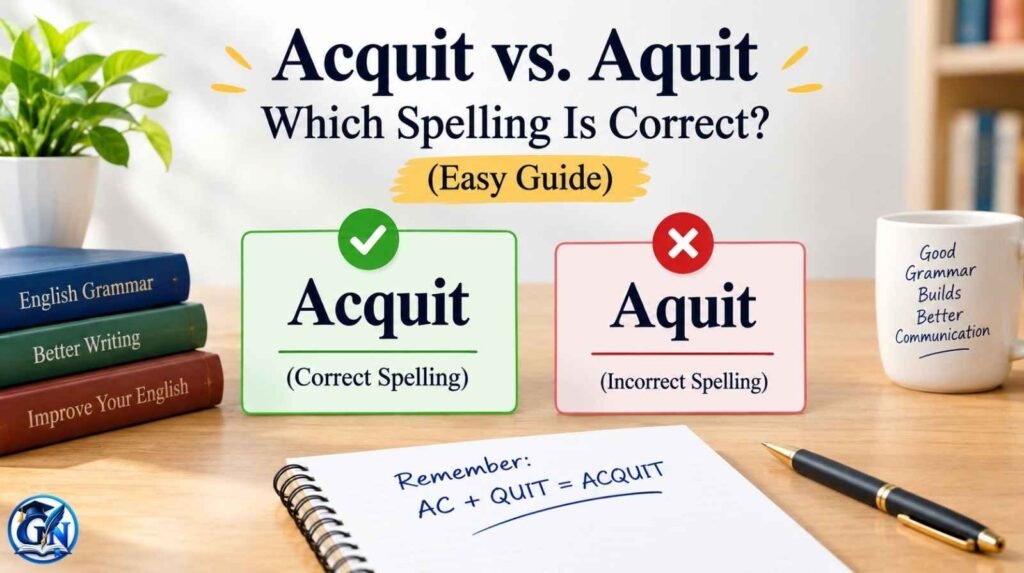
Have you ever wondered whether “Acquit vs. Aquit” is the correct spelling? If so, you are not alone. This is an easy spelling mistake to make because the word acquit contains a double c, even though we pronounce it with a sound similar to “quit.”
The correct spelling is acquit. Aquit is a misspelling and should not be used in standard English.
In this guide, you will learn the meaning of acquit, why aquit is incorrect, how to pronounce and use the word, and several simple examples that will help you remember the correct spelling.
Acquit vs. Aquit: Which Spelling Is Correct?
Acquit is the standard and correct English spelling.
Aquit is not the standard spelling of this word. If you are writing about a court deciding that someone is not guilty, you should write acquit, not aquit.
According to the Cambridge Dictionary, acquit is a verb meaning to officially decide in a court of law that someone is not guilty of a particular crime.
Quick comparison
| Word | Correct? | Meaning |
|---|---|---|
| Acquit | ✅ Yes | To declare someone not guilty |
| Aquit | ❌ No | Misspelling of acquit |
For example:
The jury decided to acquit the defendant.
Not:
The jury decided to aquit the defendant. ❌
The extra c is essential.
What Does “Acquit” Mean?
The most common meaning of acquit is related to law.
When a court acquits someone, it officially decides that the person is not guilty of the crime they were accused of committing. Cambridge gives examples such as someone being “acquitted of all the charges.”
For example:
- The jury acquitted him of the charges.
- She was acquitted of murder.
- The defendant was acquitted because the evidence was insufficient.
Notice the common structure:
acquit + someone + of + crime/charge
Acquit can also mean “perform or behave well”
There is another, less common meaning of acquit.
The expression “acquit oneself” means to perform or behave in a particular way, especially successfully in a difficult situation. Cambridge provides examples of people who “acquitted themselves well.”
For example:
She acquitted herself well during the interview.
This means she performed well or handled the situation successfully.
Why Is “Aquit” Incorrect?
One of the easiest ways to make a spelling mistake with acquit is to leave out one of the c’s.
The word is spelled:
A + C + Q + U + I + T
So:
ACQUIT ✅
Not:
AQUIT ❌
The spelling can feel unusual because acquit is pronounced approximately uh-KWIT, not as if every letter were pronounced separately.
Acquit vs. aquit pronunciation
Acquit: /əˈkwɪt/
The c and q work together in the spelling to produce the /kw/ sound.
This is one reason English learners may accidentally write aquit after hearing the word spoken.
A useful strategy is to remember the spelling visually:
AC + QUIT = ACQUIT
Think of acquit as beginning with AC followed by QUIT.
Acquit vs. Aquit Examples
Here are some natural sentences using the correct spelling:
- The court decided to acquit the defendant.
- The jury acquitted her of all charges.
- He was acquitted of the crime.
- The evidence was not strong enough to prevent an acquittal.
- The lawyer hoped the jury would acquit his client.
- She acquitted herself well during the difficult examination.
Incorrect examples with “aquit”
These sentences contain the common spelling mistake:
- ❌ The jury decided to aquit him.
- ❌ She was aquit of the charges.
- ❌ The judge ordered the court to aquit the defendant.
Correct them to:
- ✅ The jury decided to acquit him.
- ✅ She was acquitted of the charges.
- ✅ The judge ordered the court to acquit the defendant.
A Simple Memory Trick for “Acquit”
Remember: “AC + QUIT”
One of the easiest ways to remember the spelling is to break the word into two parts:
AC + QUIT = ACQUIT
The word QUIT is already familiar to most English learners. Simply remember to put AC before it.
ACQUIT = AC + QUIT
This also helps prevent the common mistake of writing aquit.
Remember the related word “acquittal”
Another useful spelling clue is the noun acquittal.
Acquit → Acquittal → Acquitted
All three forms keep the important cc spelling.
Cambridge defines acquittal as the decision of a court that someone is not guilty.
So you can create a spelling family:
| Word | Example |
|---|---|
| Acquit | The jury may acquit him. |
| Acquitted | He was acquitted. |
| Acquittal | The trial ended in an acquittal. |
This makes the spelling much easier to remember.
Acquit, Acquitted, and Acquittal: What’s the Difference?
“Acquit” is the verb
Use acquit when talking about the action of declaring someone not guilty.
The jury may acquit the defendant.
“Acquitted” is the past form
Use acquitted when the action has already happened.
The defendant was acquitted yesterday.
The spelling changes slightly because acquit doubles the final t before adding -ed:
acquit → acquitted
Cambridge lists acquitted as the past tense and past participle of acquit.
“Acquittal” is the noun
Acquittal refers to the official decision or result.
The defendant celebrated his acquittal.
In simple terms:
Acquit = action
Acquitted = past action/result
Acquittal = decision/result
Real-Life Example: How “Acquit” Works in Context
Imagine a defendant is accused of stealing money from a business. The case goes to court, and both the prosecution and defense present evidence.
During the trial, the prosecution argues that the defendant committed the crime. However, the defense presents evidence showing that the defendant was somewhere else when the theft happened. Several witnesses also support the defendant’s account.
After considering the evidence, the jury decides that the prosecution has not established the defendant’s guilt. The court therefore acquits the defendant.
You could report the result like this:
The jury acquitted the defendant because the evidence did not establish his guilt beyond the required standard.
If you were describing the completed event, you would say:
The defendant was acquitted of the charges.
And if you were referring to the official outcome itself, you could say:
The defendant’s acquittal ended the criminal case.
This example shows why choosing the correct form matters. Acquit describes the action, acquitted describes the completed action, and acquittal describes the resulting legal decision. Most importantly, all three forms retain the cc spelling.
Acquit vs. Aquit: Quick Comparison Checklist
Before publishing or submitting your writing, use this quick checklist:
- ✅ Use acquit when you mean “declare not guilty.”
- ❌ Do not use aquit as the standard spelling.
- ✅ Remember AC + QUIT = ACQUIT.
- ✅ Use acquitted for the past tense.
- ✅ Use acquittal for the noun.
- ✅ Use acquit someone of something for the common legal construction.
- ✅ Check the spelling carefully because the missing c changes the word into a misspelling.
2025–2026 SEO & Usage Data: Why Clear Spelling Content Still Matters
There is no reliable public 2025–2026 dataset showing an exact worldwide search volume specifically for “acquit vs aquit.” It would therefore be misleading to invent a number.
However, Google’s current guidance gives an important reason for creating useful spelling and language content. Google says its systems prioritize helpful, reliable, people-first content, and it specifically recommends content that is original, comprehensive, easy to understand, and genuinely useful to readers.
Google also states that its AI search experiences use the same foundational SEO principles: create unique, valuable content that satisfies visitors rather than trying to optimize for search engines alone.
A particularly relevant 2026 figure comes from Google itself: in June 2026, Google reported that AI Overviews had more than 2.5 billion monthly active users, while AI Mode had surpassed 1 billion monthly users.
For a spelling article like this, the practical takeaway is simple: give the reader the answer immediately, explain the reason clearly, provide examples, and use authoritative dictionary sources. That approach is more useful than simply repeating the keyword.
FAQs
Q1: Is “aquit” a correct spelling?
A: No. Aquit is not the standard spelling. The correct spelling is acquit.
Q2: What is the correct spelling: acquit or aquit?
A: The correct spelling is acquit, with two c’s.
Acquit ✅
Aquit ❌
Q3: What does “acquit” mean?
A: Acquit means to officially decide in a court of law that someone is not guilty of a particular crime.
Q4: How do you pronounce “acquit”?
A: Acquit is pronounced approximately uh-KWIT /əˈkwɪt/. The pronunciation can make the spelling easy to forget, so remembering AC + QUIT is useful.
Q5: What is the past tense of “acquit”?
A: The past tense and past participle are acquitted.
The defendant was acquitted.
Cambridge lists acquitted as the past tense and past participle of acquit.
Q6: What is the noun form of “acquit”?
A: The noun is acquittal.
The trial ended in an acquittal.
An acquittal is the court’s decision that someone is not guilty.
Q7: What is the correct phrase: “acquit of” or “acquit from”?
A: The standard legal construction is acquit someone of something.
For example:
The jury acquitted him of the charges.
Cambridge specifically lists acquit someone of something as the standard collocation.
Conclusion:
So, acquit is the correct spelling, while aquit is a misspelling.
If you are talking about a court declaring someone not guilty, use acquit. If you’re describing the completed action, use acquitted, and if you’re referring to the official decision, use acquittal.
The easiest spelling trick is:
AC + QUIT = ACQUIT
Once you remember that simple pattern, it becomes much harder to accidentally leave out the second c.
👉 Discover more simple and practical grammar guides on Gramnora

Explore the world of English grammar with simple explanations, practical examples, and easy-to-follow guides by Zia Tarar, the founder and author of Gramnora. From essential grammar rules and sentence structure to common mistakes and advanced concepts, Gramnora helps learners improve their English, strengthen their writing skills, and communicate with greater clarity and confidence.